

Vice Mayor Sandra Maurer, Councilmember Phill Carter and Councilmember Stephen Zollman were present in chambers for the July 7 Sebastopol City Council meeting. Councilmember Neysa Hinton attended via Zoom, and Mayor Jill McLewis was absent.
At last night’s city council meeting, Public Works Director Oriana Hart gave a detailed presentation on the status of mold remediation at the Sebastopol Library.
She gave a brief history of the problem, described what steps the city had taken to date, and what needs to be done next.
As the Sebastopol Times reported in an earlier story, the library was closed on June 4 after library staff discovered some mold and warping on the wallpaper in the staff room and teen room. The city owns the building, and, according to its contract with Sonoma County Library, the exterior walls of the building are the city's responsibility.
Hart explained that Public Works employees opened some holes in the walls in an attempt to assess the extent of the mold damage, but when the city’s environmental consultant arrived, “They advised that we stop making the holes in the walls, because we might possibly spread any potential mold into the two areas [where the mold was found]….We tested the air in the two areas—the staff room and the teenage reading room—where wall material had been removed, and we found elevated mold in those two areas. They tested the common room as well, and the other staff areas, and there were no elevated mold readings in any of those areas…We did not find any elevated mold within the main areas of the library. It was just in these two enclaves where the excavation happened into the wall.”
The environmental specialist from ServPro took samples of the mold and sent them to an outside lab, which determined it was black mold, one of the more dangerous strains of mold.
The city asked ServPro to begin emergency remediation.
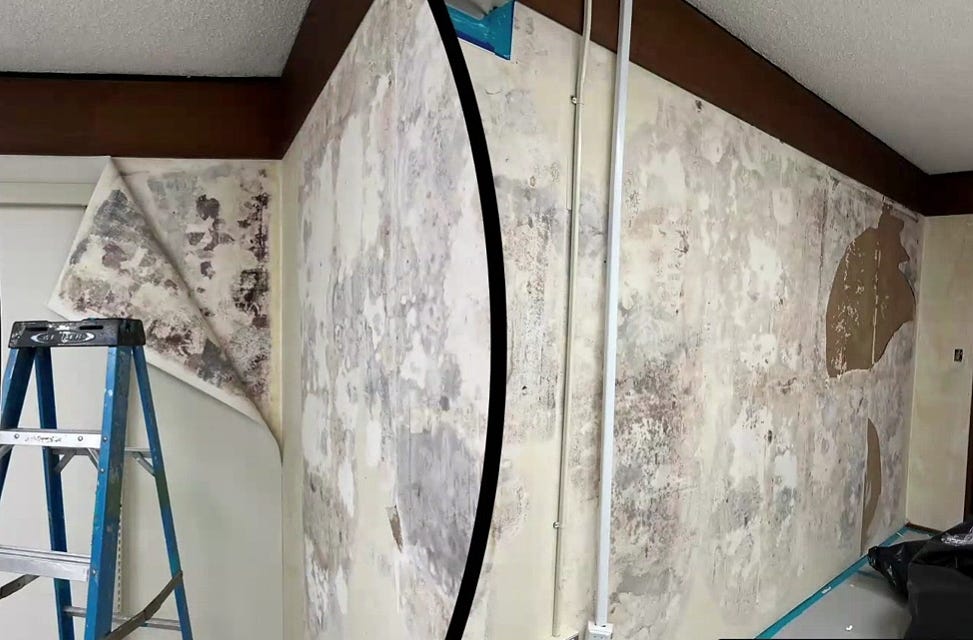
According to Hart, “They removed wallpaper within those areas, and they found that the mold is pretty substantial underneath the wallpaper.” (See the photo at the top of this article.)
“They removed all of the sheetrock. They removed the batting that was underneath and remediated the area and cleaned the framing. What they found in the teen reading room is that after they had removed all of the sheetrock, there’s some structural damage to that west wall of the building.”
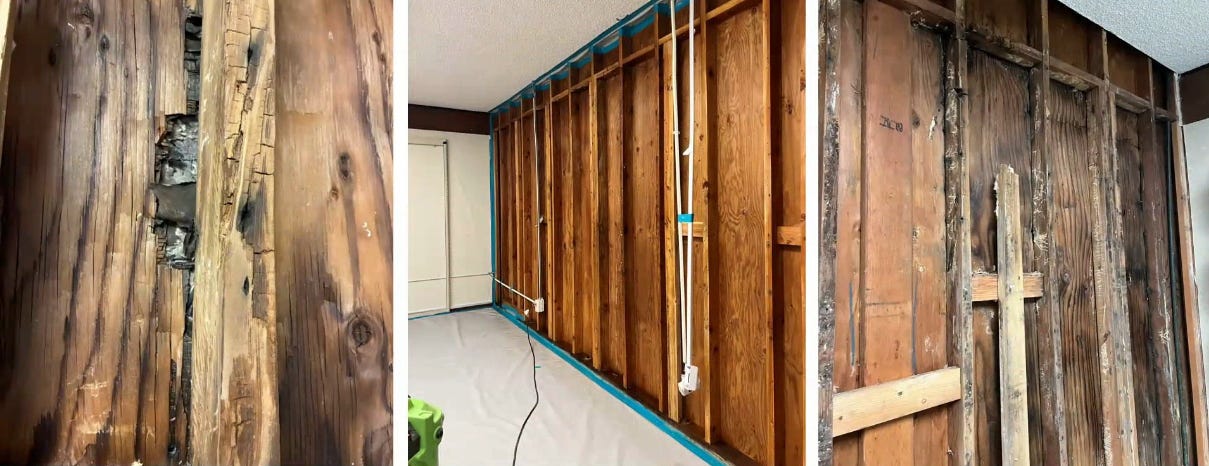
“Again, this is just in one little wall,” Hart emphasized. “We don’t know what else is going on. This is just in the areas that they’ve exposed. While they were doing that, they did some moisture testing in the other areas in the library, both the areas they’d exposed and…on other areas where there’s peeling wallpaper…The initial assessment is that there’s likely additional mold around the exterior of the building.”
The ask before the council last night was simple: 1) to ratify the emergency Phase I environmental testing, containment, remediation, and investigation work completed by ServPro at $47,687.55; and 2) to authorize the City Manager to engage a qualified contractor for Phase II (not to exceed $175,000) to remove the wallpaper and sheetrock, remediate the wall cavities, assess the cause of the moisture and the extent of the damage that may still lay hidden in other walls of the library.
The good news is the Sonoma County Library has volunteered to pick up the cost of 50% of Phase I. At the meeting. Sonoma County Library Director Erika Thibault also said, “I’m also willing to take the Phase II cost to the library commission and ask them to just share in that responsibility as well.”
Phase III, in the chart below, represents the cost of repairing and rebuilding those sections of the library. It was not included in the request before the council.
“At this point, we’re really just guessing what a full repair would look like,” Hart said. “I’ve gotten some just preliminary costs on what we think it might be to reconstruct, assuming the level of damage that we saw in the teen room, but we’re going to have contractors come in once we have the walls exposed and do a better bid for the project.”
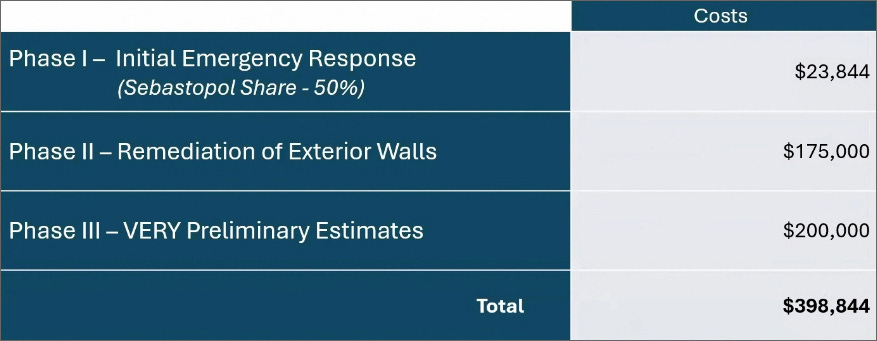
The city has a Building Reserve Fund of $594,939, which can be used to pay for the library repairs.

Councilmember Zollman, who is head of the Building the Commons Committee, which is looking to create a new civic hub that would have space for a larger library, questioned whether this was a good use of city funds. He asked why the council would spend “half a million dollars for a building that the library administration has already said in its report 10 years ago is not the right size for us…We need to really have a strong think about whether we’re going to approve $500,000 for a building we’re going to hope to get fixed with mold and dry rot to—to what?—be in a substandard place? It doesn’t even make mathematical sense to me.”
Councilmember Hinton asked what the building was currently worth. Councilmember Carter, another member of the Building the Commons Committee, said the parcel was worth $3.6 million, while the building itself (before the recent mold discovery) was worth $2 million.
Councilmember Zollman also had concerns about City Hall, which is right next door and built at the same time as the library. Hart tried to set his mind at ease on that count.
“What we’re finding in the library is that they had wallpaper against the sheetrock and that was holding in moisture, and we don’t know what’s causing the moisture to be there—so that’s one of the things we’re going to look at when we pull all of it off—but because that wallpaper was not letting the sheet rock breathe, that is the primary reason we’re assuming that the mold is there. We’re not seeing that at City Hall, which has sheetrock” — with no wallpaper — “so I don’t believe that we have the same issues there.”
Hinton asked who put the wallpaper up in the library—the city or the library? The answer: the library installed it during one of their renovations.
During public comment, several people spoke to the centrality of the Sebastopol Library to the civic life of the town and the difficulty of using public transit to get to libraries in other towns. Some requested that the Sonoma County Library open a temporary location in Sebastopol.
Sonoma County Library Director Thibault pushed back on that, noting that recent efforts to temporarily move libraries during renovations have cost between $400,000 (Healdsburg) and $1 million (Petaluma).
“So, from my perspective, $200,000 to do the repairs and the remediation is significantly more cost-effective,” Thibault said. “We also will be able to provide a higher level of service at the library than we can in a temporary space, and given that the length of time that the library will be closed, to me it just makes good sense to repair the existing building while we work on a long-term plan for a future larger library.”
Maurer wondered if the library conference room could be used for book pick-up and classes, while the library itself is closed and being worked on. Thibault agreed that that would be ideal, but said, “We need to assess if there’s any mold in the meeting room space as well.”
Both Hinton and Maurer spoke to the necessity of maintaining the current library building as a city asset, whether or not the library ultimately stayed there or not. And in the end, the rest of the council agreed, voting 4 to 1 (McLewis absent) in favor of funding their share of Phase I and Phase 2 repairs from the city’s Building Reserve Fund.
So if you're looking at spending 1/2 a million dollars to repair and reopen the library, which is judged to be too small, Why not look to the old Rite Aid building. If that could be renovated and the cost is also 1/2 a million but it is a bigger space, then why not just move the Library over there.
It would be much more comforting know there was a third party testing after the remediation that has nothing to do with ServePro. I hope they are not allowing the same company to test and remediate. https://yesweinspect.com/
There is SO much to remediation in a building like that, with an unknown cause…and always getting a third party to assess remediation is essential for integrity of removal and safety. Ugh, this is such a bummer.