

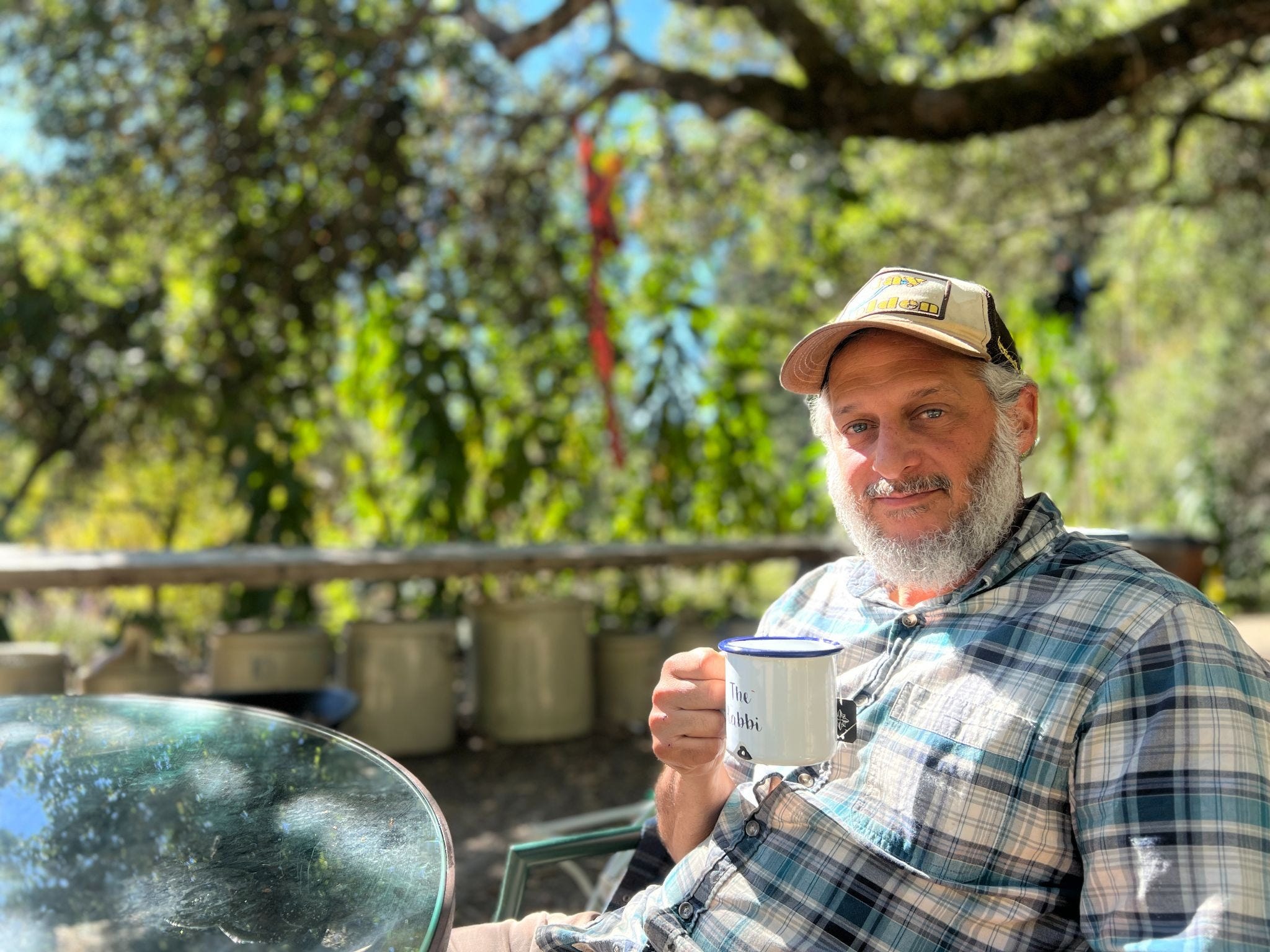
Perched high in the woods on Occidental’s Bohemian Lane, Rabbi Zelig Golden’s home is a leafy refuge. As his King Charles Spaniel bounds out to say hello — his name is Ori, which means “My Light” in Hebrew — the rabbi refers to the purchase of his property nine years ago as “a prayer answered.”
Golden lives on seven acres with his wife Rachel Ruach Golden (a third-generation West County resident), his three children and, of course, Ori. Fitting for his location, Golden has an earth-based approach to Judaism that he has been refining for decades. After co-founding and leading Wilderness Torah for nearly 20 years, the Spokane native established the local Makom Shalom synagogue over a year ago to bring together a wide spectrum of Jewish believers.
The rabbi attended Berkeley Law School in the early 2000s and graduated with a JD in environmental law. Working for the Center for Food Safety, his law career culminated with a U.S. Supreme Court victory against agrochemical giant Monsanto, a win that secured protection for organic farmers and seeds. But Golden became burned out on practicing law.
“I was pretty depressed,” he said.
The rabbi ended up doing a vision quest with Mike Bodkin — what would be the first of many with a man who would become his mentor. He returned to his original love: the great outdoors, which led to the creation of Wilderness Torah. The West County rabbi established land-focused rituals and nature-based rites of passage to ground Judaism in the environmental realm.
“We’re a forest synagogue,” he said.
Golden’s approach might feel novel, yet he said it grows out of the religion’s origins. “The Hebrew people are a rain-praying people,” he said. “This is earth-based Judaism.” Jewish tradition has always followed the earth’s cycles, he contends. West County, with a rain schedule similar to that of Israel’s, is the perfect location to lead a synagogue with this type of approach.
According to Golden, Yom Kippur is not the most important holiday as is traditionally thought. Instead, it’s the seventh day of Sukkot, Hoshanah Rabbah, a joyful day of dance and blessing for water and rain.
“How do we root down again and move past our previous traumas?” Golden asked. “This is healing the tradition and returning to the original instructions.”
“As far as I know, no one [else] is praying for 25 hours around a sacred fire,” Golden said, referring to the celebration on the seventh day of Sukkot.
He noted that the celebration is an opportunity to weave in indigenous learnings from the Miwok, the first stewards of the ancient estuary. “Most of us are new here,” he said.
Golden applies everything he learned from co-founding and leading Wilderness Torah to the establishment of Makom Shalom.
The rabbi saw an unmet need for a rooted Jewish community in West County, and after numerous meetings, he launched Makom Shalom with a board composed of its original enthusiasts: Joe Green, Lauren Ohlsen, Zeb Zankel and Simcha Schwartz.
The congregation meets in three main locations: the forest at Salmon Creek School (and auditorium on rainy winter days), the home of Board President Joe Green on Bohemian Lane and at St. Stephen’s Episcopal Church in Sebastopol.
While Golden was ordained as a Neo-Hasidic rabbi in 2018, his earth-based Judaism is open to followers across the spectrum, including non-Jews. “We want to merge the traditional with the non-traditional.”
In the year since its establishment, the synagogue has organized men’s, women’s and queer community groups as well as a prayer lab and study group. In the future, they’d like to expand their youth offerings to ensure that children are afforded meaningful rites of passage, especially for those who don’t resonate with the traditional B’mitzvah synagogue process. Makom Shalom is finding an audience, with 85 paid members and groups as large as 150 showing up for holiday services.
Yet there are also challenges. Some are the standard fare that come with running any kind of startup: how fast to grow, spreading awareness, sustaining programs. There is also the issue of space. “We can’t sustain a synagogue within a private community,” said Golden of the Bohemian Lane location, which has necessitated a roving approach.
Other challenges are unique to running a Jewish organization, and they are issues that the larger community is also dealing with. Anti-semitism is growing, and the Israel-Palestine conflict remains a heated issue.
“Some people have stepped away because they feel we are not anti-Zionist enough,” Golden said. “Others feel we are not Zionist as they’d like us to be.”
The synagogue’s official stance on the whole Gaza issue is not to take one, opting for a heart-based approach instead of a political one that can allow people to see and feel each other’s similarities and differences.
Yet the rabbi acknowledges that Gaza is the most challenging and most important issue facing Jews today. “We’re split and divided among so many lines right now,” he said. “Yet the anti-semitism you see on Main Street is real.”
So while he advocates a heart-based approach, he also makes it clear the synagogue is not simply “a bunch of hippies in the woods.” They take threats seriously and had armed security for the High Holiday celebrations.
On a happier note, Rabbi Golden has found his calling, weaving the two main threads of his life—nature and Judaism—into an organization that serves and heals his community. There may be no better home than the wilds of West County and the community of Sebastopol for the 52-year-old to carry out his work.
“It’s the interface of the wild and the settled,” he said.
I am so sorry for the ugly weekly displays of antisemitism in Sebastopol. Those marching for a death cult show us the worst of humanity. It's hateful, ignorant and embarrassing. May this period soon pass 🙏