

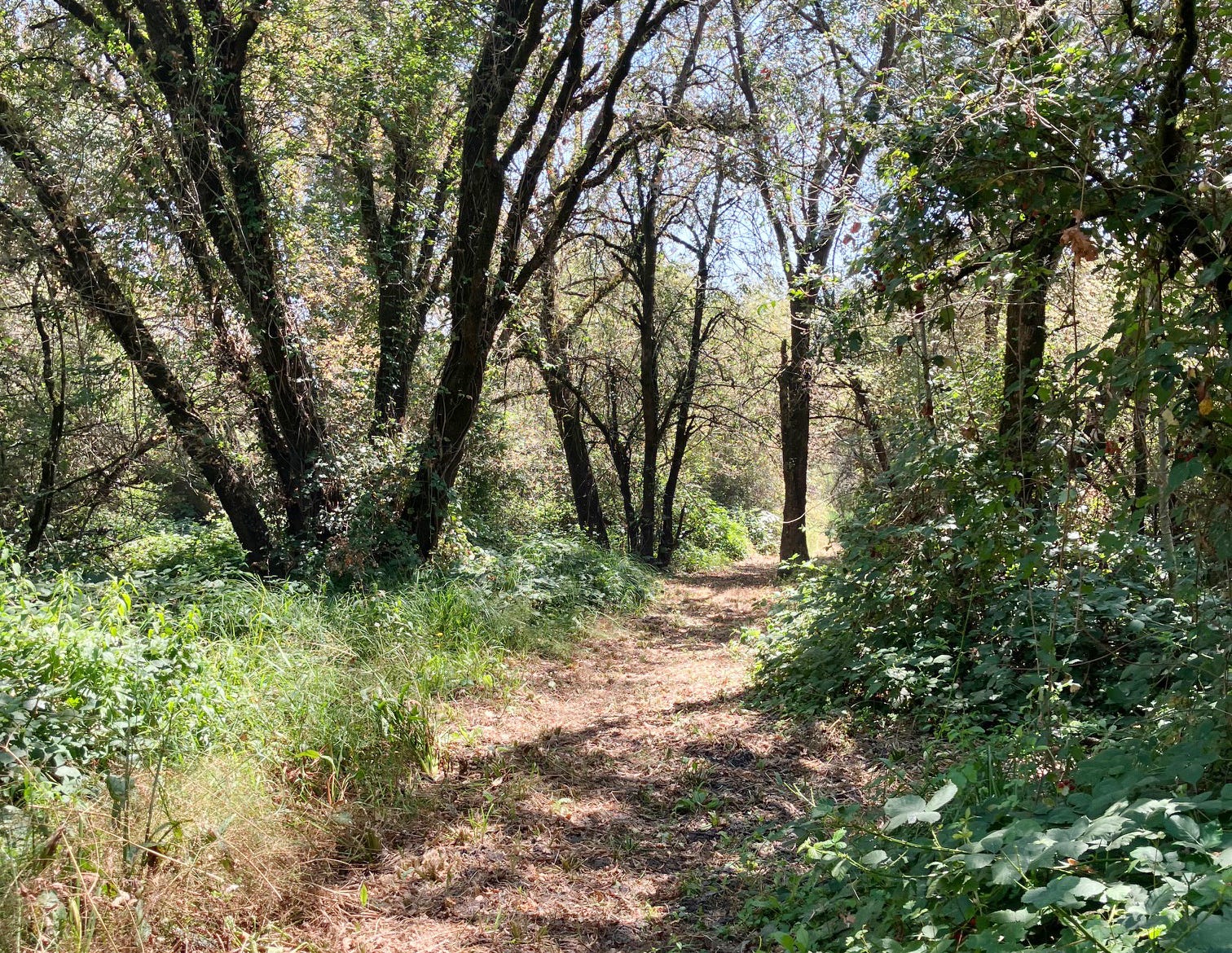
The seasonal AmeriCorps Trail along the Laguna de Santa Rosa at the eastern edge of the city of Sebastopol is not a very long trail. In fact, if you laid all the pages of planning documents, grant applications, conservation easements, environmental reports and work orders for this trail end-to-end, they might be longer than the trail itself.
Originally part of the city of Sebastopol’s Laguna Master Plan from 1992, the first trail work wasn’t begun until 2003, when a contingent of over 100 AmeriCorps workers and volunteers completed a one-day service project to clear blackberry brambles and to blaze a rough route along the edge of the wetlands. The work was difficult—with muddy terrain, a steep creek channel and restricted access. A full path was never completed that summer.
In fact, the full length of the half-mile trail has never officially been opened to the public until just a few weeks ago after a City of Sebastopol public works crew mowed and weed-whacked the trail’s route between the Sebastopol Community Cultural Center to the meadow just north of the Highway 12 bridge.
The formal entrance to the Americorps Trail is located at the southern end of the Community Center Parking lot. The trail parallels Morris Street, offering multiple access points.
What took so long?
The story of the AmeriCorps Trail is either one of a dogged vision and decades of volunteer efforts, or it is a saga of multi-layers of government permits, bureaucratic delays and years of mounting expenditures. In the end, the full story of how a short trail took such a long time to complete probably contains elements of “all of the above.”
After the AmeriCorps youth volunteer workday in 2003, the trail was reclaimed by invasive Tibetan blackberry vines and other plants. AmeriCorps made another visit in 2007, which was described this way in a recent report: “The unpaved, seasonally used dirt trail was modestly improved by AmeriCorps service members in 2007.” In 2011, the Laguna de Santa Rosa Foundation won a restoration grant, which funded several more workdays that cleared portions of the trail.
But then, it languished.
A 2015 Laguna Wetlands Preserve Restoration and Management Plan described the state of the trail this way: “The AmeriCorps Trail’s main formal entrance is in the Youth Park, on the south side of the baseball fields. Often this entrance, and the sign denoting it, are obscured by fast-growing Himalayan blackberry. The trail itself is frequently flooded in winter. Two other unmarked entry paths lead from Morris Street to the trail; these are frequently used by illegal campers and are not well known to the general public. Another entry is immediately south of the wastewater lift station. Park signage is present on the back of this property, but is not readily noticeable to passersby on Morris Street. South of this area, the trail is not maintained, and dead ends at Zimpher Creek. Homeless campers and others looking for a hidden place to gather are currently the main users of this section.”
In 2018, the city of Sebastopol applied for a $126,943 matching grant from the County’s Ag+Open Space District to rebuild the trail. According to an Ag + Open Space document from the time, the city cobbled together matching funds from several sources, including at $1,439 City in-kind project management; $87,079 City CIP Budget; $28,000 Laguna Foundation WPP grant; and $10,425 City in-kind operations and management. The total budget for the project was $253,887.
Consultants for the city designed a permanent trail with portions of infill, sections of boardwalk and a pedestrian bridge over the outlet of Zimpher Creek. But the county Open Space District later required an environmental impact study and prohibited the infill and boardwalk. The California Department of Fish and Game also raised concerns that blocked future trail work for several more years.
While the trail disappeared beneath a jungle of vegetation, the grant project itself stalled in a thicket of bureaucratic documentation. It took six years to get all the easements and covenants—and then the amendments to them—correctly submitted to the county.
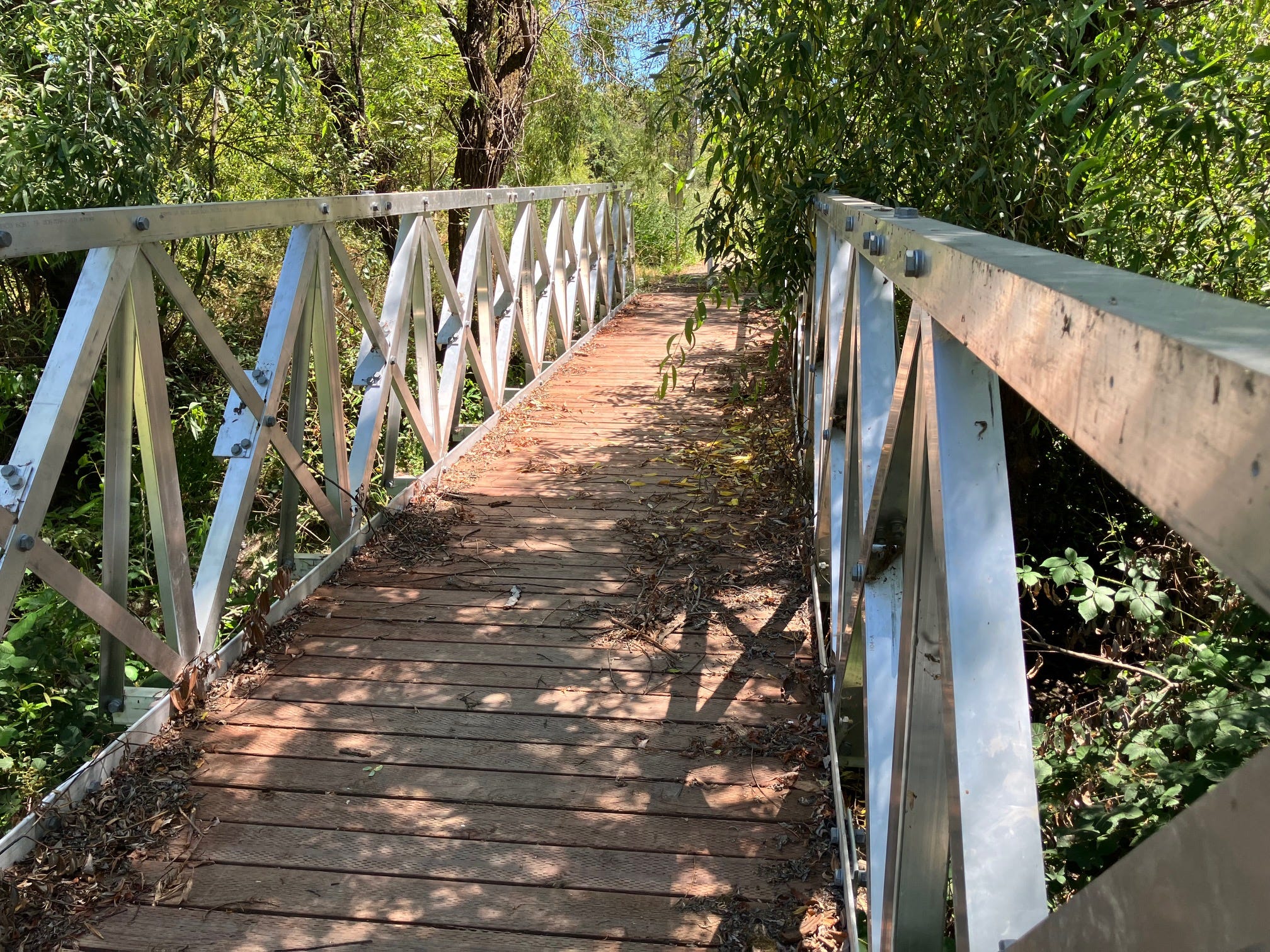
Council awarded the construction contract for the 48-foot-long pedestrian bridge to Pat Nelson Construction in June 2023, but it wasn’t completed until 2025 at a cost of $214,877. The bridge work was delayed twice by added environmental requirements from the state Regional Water Quality Control Board and by the U.S. Fish and Wildlife Service. Until a few weeks ago, it was a bridge to nowhere, ending in a patch of overgrown blackberry vines.
Planning and work on the trail has taken so long that it predates the longest tenure of any current city councilmember. Councilmember Neysa Hinton, who was first elected in 2016, has repeatedly voiced frustrations over how long it has taken to complete the trail.
“It’s hard to believe how long this has taken,” Hinton told the Sebastopol Times this week. “But I’m glad the AmeriCorps Trail is open, and I can’t wait to walk it.”
Despite the delays, she said the many years of work and volunteerism have shown how the Sebastopol community “values our walkable community and parks.”
Councilmember Phill Carter has also made opening the trail one of his goals. This spring, several volunteer workdays were scheduled then cancelled due to wet conditions. Carter said another volunteer workday is planned for September.
“We had hoped to hold a trail opening in conjunction with the Climate Action Committee this spring,” said Oriana Hart, Sebastopol’s Public Works director. “We had late rains and an early cool summer that has kept the area too wet for our equipment.”
Hart said that the City public works crews “finally had some success with vegetation management” during the final weeks of July.
“Longer term, I would love to continue the discussion about installing a raised boardwalk,” she said. “That would allow year-round access while protecting the wetlands, but it will require additional funding.”
Over the past five years, the Laguna de Santa Rosa Foundation has organized work crews to control invasive plant species throughout the Laguna. However, those funds from the county’s Sonoma Water agency and Watershed Partners Program expired this year.
“We don’t have an active involvement with the [AmeriCorps] trail,” said Brent Reed, Stewardship Director at the Foundation. “But we’re always asking the City how we might help. We’d like to see the ongoing maintenance needs minimized, and we’re good at organizing volunteers. But you always need more money for these kinds of efforts.”
Open at last, at least for now
After more than three decades of planning, permitting and repeated clearing, the full length of the trail is finally open to the public. The total cost for the project hovers at about $800,000, and it remains a “work in progress.”
The trail is not a paved or flat path. It is a rough and difficult walk with very muddy spots and uneven terrain. Only lots more footsteps will improve this latest access to the unique habitat of the Laguna and the eastern edge of a city that prides itself on being “trailblazing” (though this word is usually meant in the political sense).
Every year, the city of Sebastopol sets up a seasonal footbridge connecting hikers to the east side of the Laguna Trail system. Now that bridge is finally connected to the newly opened AmeriCorps Trail.
The AmeriCorps Trail also connects, at its southern end, to the meadow that hosts artist Ned Kahn’s 28-foot-tall shimmering tower called “Sebastopol Spire,” which was dedicated in September 2024.
Like the AmeriCorps Trail, Kahn’s sculpture was another saga of government-induced delay. Eight years in the process, the public art project that eventually became the Sebastopol Spire was originally planned as a series of kinetic “banners” along the Highway 12 bridge, with metal scales that captured the movement of the wind. Caltrans nixed that design, fearing the flags would prove so entrancing as to cause traffic safety issues.
Redesigned as a spire covered in metal scales that move with the wind, Sebastopol Spire was sited far enough away from the road that Caltrans had no say over its design. Its location also made it relatively inaccessible. That problem, at least, has now been solved by completion of the AmeriCorps trail.
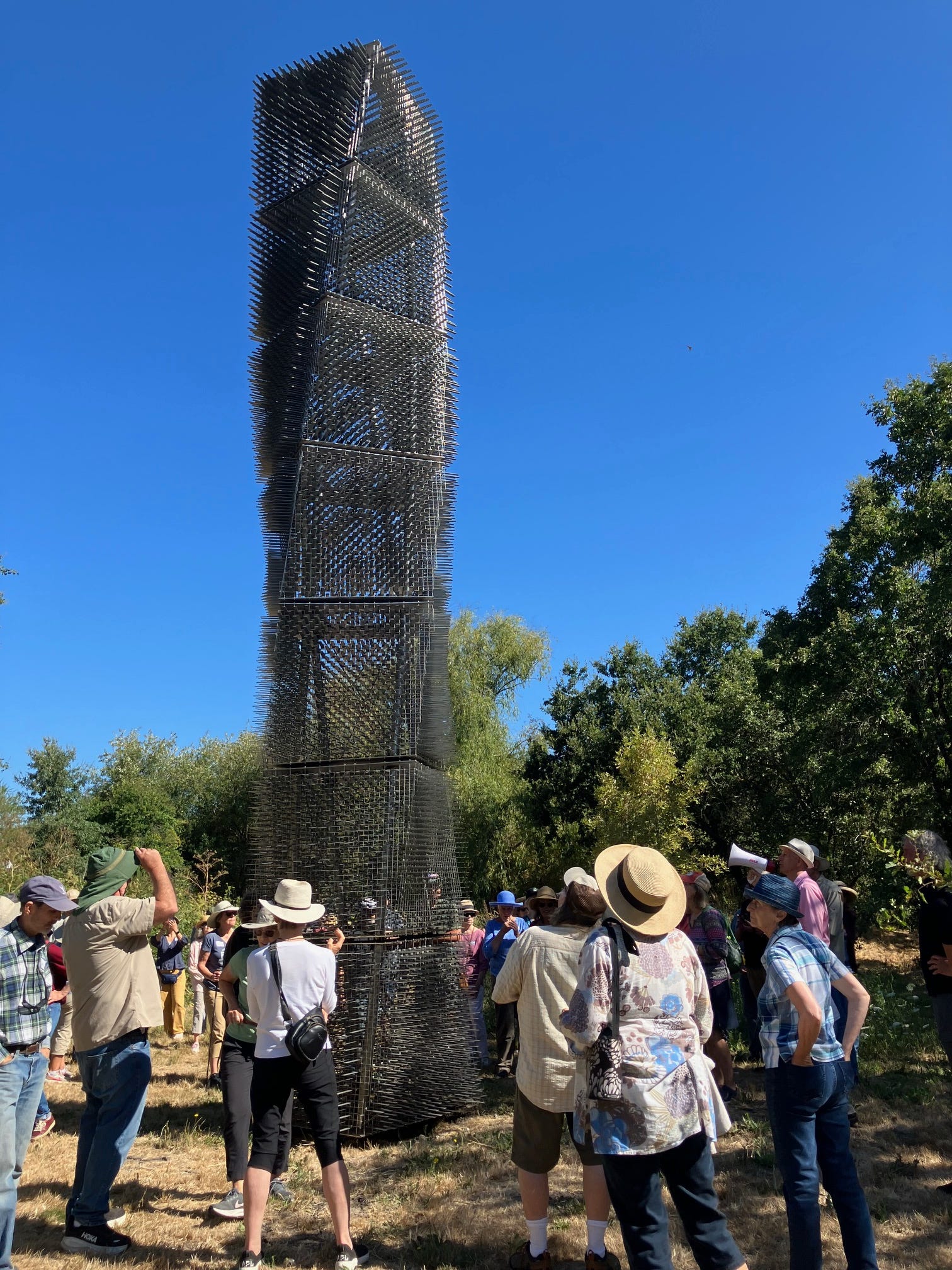
On July 25, Sebastopol Walks sponsored a walk that joined the AmeriCorps Trail where Zimpher Creek pours into the Laguna. Walk leader Peter Schurch started the walk in the Town Plaza and led about 40 hikers along the submerged course of Zimpher Creek, through the Barlow commercial district. At the Laguna, Schurch introduced the group to artist Ned Kahn, who shared the story of the “Sebastopol Spire” on the AmeriCorps Trail.
The AmeriCorps Trail is currently open to the public during daylight hours. Following the September volunteer workday, a ribbon-cutting or modest ceremony may still be in the offing.
Once the rains return this fall, the city’s shortest trail may again be facing another long closure.

Good article