


Mayor Jill McLewis, Vice Mayor Sandra Maurer, Councilmember Phill Carter, Councilmember Neysa Hinton, and Councilmember Stephen Zollman were present in chambers for the June 16 Sebastopol City Council meeting.
At Tuesday night’s meeting, the Sebastopol City Council approved a $16.5 million budget with an $850,583 deficit for the next fiscal year, which starts July 1. It was a narrow 3 to 2 vote—with Maurer, Carter, and Hinton in favor, and Zollman and McLewis opposed.
A little background
The city council had its first discussion on the proposed budget at the end of the June 2 council meeting. Over the next two weeks and at Tuesday’s meeting, more cuts and additions were made. In fact, on Tuesday night, there were so many cuts (about $259,000) and additions (about $150,000) that Mayor Jill McLewis suggested continuing the budget to the next meeting so the council could see a more accurate final draft and perhaps include further cuts, necessitated by recent events. That was not to be.
The day after the council meeting, Administrative Services Director Ana Kwong sent the Sebastopol Times a corrected final balance:
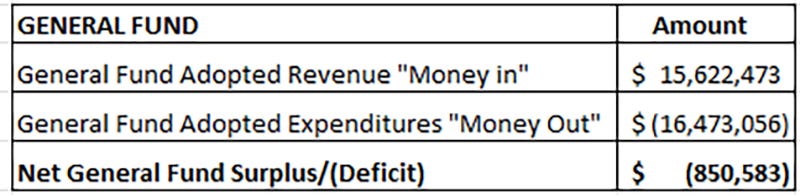
The General Fund reserve stands at 25.8%.
Here’s a quick visual guide from the 2026-2027 Sebastopol Budget to where the city of Sebastopol’s money comes from and where it goes. (We altered this image slightly, shortening the dollar bill representing revenue to emphasize that revenues were not equal to expenditures.)

According to the budget report, revenues declined very slightly from last year—just .04%—while expenditures increased by 6%. This increase was driven principally by increased police salaries and expenditures (up almost 20% over the last two years); animal control services; mandated city benefit increases (such as health, CALPERS, CIRA General Liability, and CIRA Workman Compensation), and capital-related transfers.
More worrisome is the five-year financial forecast, which continues to show a structural imbalance in the General Fund, which, unless something is done, will grow increasingly dire over the next ten years. Consultant Bob Leland gave a sobering account of this at the June 2 Sebastopol City Council meeting. You can see his analysis here, starting on p. 8.
Kwong is still working on incorporating all the final changes from Tuesday’s meeting, but this draft budget gives you a rough idea of where the money is going. The changes made at Tuesday’s council meeting are included below this chart.
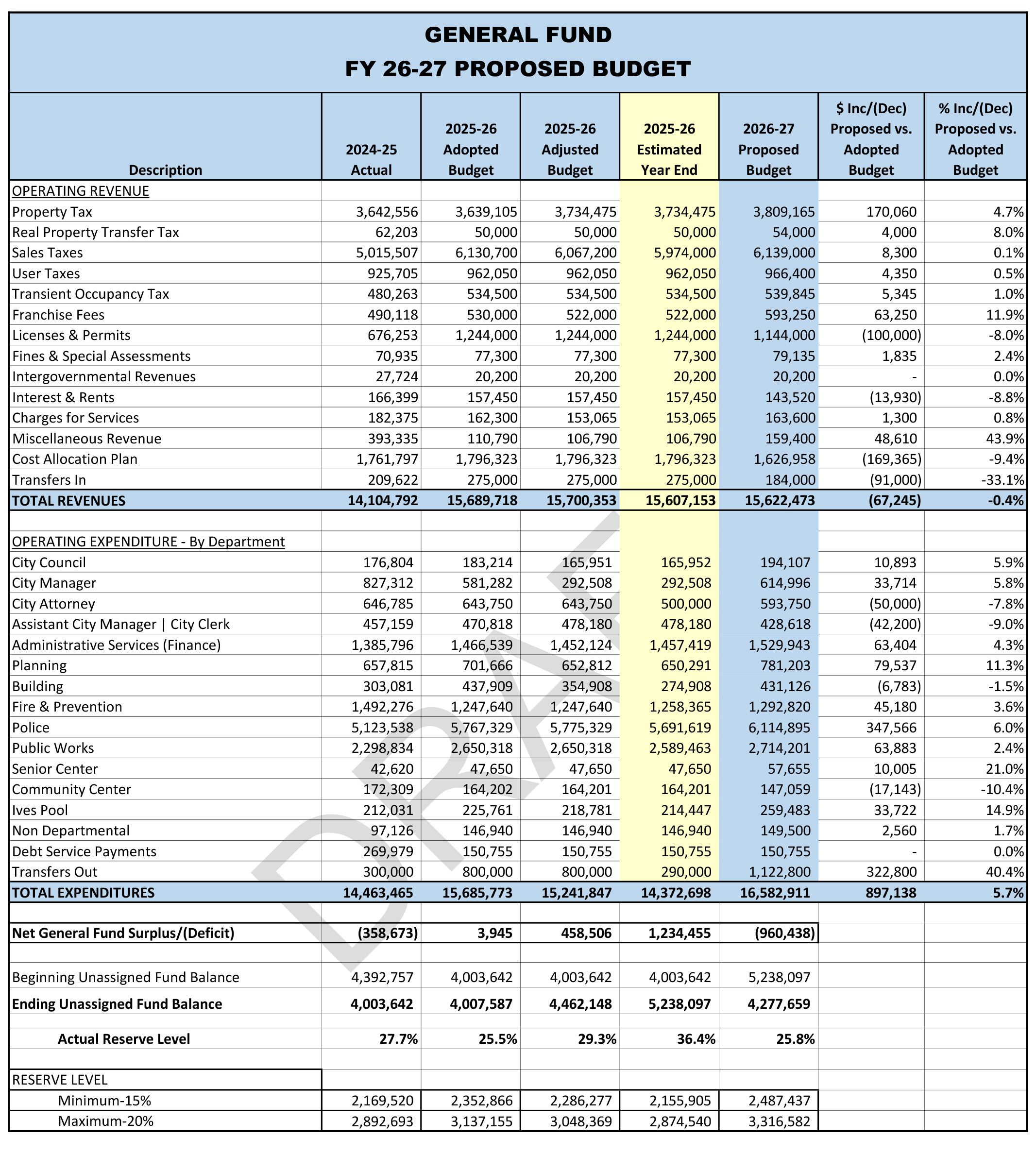
Kwong sent along a summary of the changes to this chart that the city council made on Tuesday:
Reductions / Savings
Main Street subscription reduction: $500
City Manager (suspended training & travel & subscription): $2,500
Training: $600
Travel: $1,500
California City Mgmt Foundation: $400
Assistant City Manager / City Clerk adjustments: $125,855
Salary & benefits savings: Achieved through staffing adjustments, including suspending the Assistant City Manager recruitment and filling the City Clerk position at an entry-level, resulting in reduced staffing cost: $120,000
Recruitment cost reduction: $5,000
Professional dues (IIMC, ICMA, CalPELRA): $855
Administrative Services (GFOA award fee removal): $1,000
Planning (staffing approach savings): hiring an entry-level Associate Planner and a part-time contract Planning Director on an interim basis until a permanent director is appointed: $130,000.
Subtotal – Total Savings: $259,855
Additions / Increased Costs
Rate study and/or time tracking module: $75,000
Additional contracted services for EIFD work programmed in Planning Dept: $75,000
Net Budget Impact (excluding EIFD contract amount): $259,855 (savings) – $150,000 (costs) = $109,855 net savings
Two wild cards: the Water & Sewer scandal and a surprise suggestion for solving the city’s structural deficit
Complicating this year’s budget scenario were two unusual wild cards, including critical reports on Sebastopol Water & Sewer Funds and an unusual letter from a Sebastopol citizen about how to solve the city’s structural deficit.
The water and sewer dilemma
Two reports on Sebastopol’s handling of its Water and Sewer Funds—one by the Sonoma County Grand Jury and another by the city’s own Enterprise Funds Oversight Committee (EFOC)—found that the city owes its Water and Sewer funds more than $5 million due to illegitimate transfers to the General Fund. (The city of Sebastopol has denied that those transfers were illegitimate.)
At Tuesday’s council meeting, EFOC member Kate Haug argued that the city should commit to the recommendations in the committee’s report before finalizing the budget because 1) it’s legally the right thing to do and 2) many of the recommendations in the Grand Jury and EFOC reports will have significant impacts on the budget. These include, among other things, forgiving the General Fund’s $1.1 million loan to the city’s Sewer Department; the freezing of water and sewer rates until a new cost allocation plan based on time tracking by city employees can be done; and the reimbursement to Water and Sewer of $350,000 in alleged attorney overcharges.
A citizen’s suggestion
Another interesting development was the arrival of a detailed letter by Sebastopol resident and frequent public commenter Lee Mathias, titled “Roadmap to Expense Reductions: Repairing the Structural Deficit.” It’s really worth reading, and you can find his letter here.
Councilmember Stephen Zollman, who voted against the adoption of the current budget, was particularly swayed by the letter. “I give a lot of credit to our regular public commenter, who obviously has put a lot of time and thought into how we can close the gap,” he said, calling the letter “brilliant.”
“My question [is] ‘Why was it not used as a playbook?’” Zollman said. “We could have carried over the budget [to the next meeting] and taken time to examine the full savings of what Mary [Gourley] proposed, along with whatever else she could have come up with our unions.”
Zollman mentioned several times during the meeting that he was not comfortable with voting yes on a budget with such a large deficit.
“I’m not going to be okay with passing a budget with a $900,000 deficit, knowing that we’re not going to get insurance to pay for the library [a reference to the recent mold issue] and other basic things that just keep exploding around the city—water and sewer pipes—and employee expenses going through the roof. If we don’t slash a significant amount, my vote’s going to be no tonight for sure. If we continue [the meeting to next month] and get more definitive numbers from staff about what they can realistically reduce, then maybe it could happen at that time. But right now, I’m not going to just be passing a budget [with] a $900,000 deficit.”
“I feel protective of the next council, whether I’m on it or not,” Zollman said. “I do not want them coming in operating under a declared state of fiscal emergency, which, by the way, we all are sitting under.”
The argument for the current budget
Why did Councilmember Phill Carter and Vice Mayor Sandra Maurer, who are on the council’s Budget Committee, vote to approve a budget with such a large deficit? The answer is complicated.
One answer is that they are gradualists.
“I believe in a glide philosophy of economics, where transitions must not be abrupt, but smooth,” Carter said. “I feel like the less traumatic you can be to your economy, the better. Even though you need to make improvements and you need to get better, sometimes that pain is too much all at once. So in order to get there, there should be a glide approach.”
In an exchange of letters between Maurer and EFOC’s Haug, Maurer expressed a similar sentiment: “I believe these recommendations can be addressed over time,” she wrote, referring to the changes requested by the Enterprise Funds Oversight Committee. “I could not delay the budget to undo the CAP (cost allocation plan) this year as it would have been too disruptive.”
Maurer’s list of steps the city was taking exemplified this approach:
These are steps that are being taken in the direction the [EFOC] Committee has advised:
Staff is looking into time tracking.
We are having a master sewer plan done, and we completed a water master plan.
The budget committee will be addressing credit card charges. [The city currently picks up the credit card charge for rate payers that pay with credit cards.]
An ongoing council goal is grant funding.
The request to refund the attorney’s fees may need to be brought back as an agenda item.
The Grand Jury report will be publicly addressed either July 21 or August 4.
A Council majority said they will forgive the million dollar sewer loan. This will be addressed July 21.
A Council majority said they will freeze water rate increases for one year. This will be addressed July 7.
Council set aside $75K for either time tracking or a new rate study.
Then there was the claim made by Administrative Services Director Kwong and Vice Mayor Maurer at the June 2 council meeting that if you looked at the 2025-26 and the 2026-27 budgets together, the city was actually much closer to a balanced budget than it seemed.
This claim was met with derision by Councilmember Zollman and Mayor McLewis. “I would really like to hear who came up with this nifty idea of combining years,” Zollman said. “Like when I was on the budget committee—and all the budget things that I’ve been through—no one combined years.” (Actually, some cities do operate on a two-year (biennial) cycle, but Sebastopol isn’t one of them.)
The explanation Maurer and Kwong gave at the June 2 meeting wasn’t particularly clear, but it also wasn’t wrong. In a city with a one-year budget cycle like Sebastopol, when you don’t spend the money allocated for a particular item, say road repair, in one year, it doesn’t just roll over into the road repair budget for next year. Instead, it goes into the city’s reserve. That’s what happened with the roughly $510,000 slated for road repair from Measure U that didn’t get used this year.
Because Zollman and McLewis didn’t seem to grasp this.
At this week’s meeting, they reacted with horror to Carter and Maurer’s suggestion that road repair was at the root of the large budget deficit this year. [Update: See economist’s blow-by-blow description of the interaction in the comments below.]
“Those are fightin’ words,” said Mayor McLewis, who made her support for Measure U contingent on 40% of the revenue going to road repair. “I just feel very strongly that people deserve to have roads that don’t look like cow paths.”
While it is true that unless the city makes more cuts or raises revenue, it will have to pay for its $850,583 deficit out of the city’s reserves, what Maurer was trying to say was that $510,000 of those reserves—and of that deficit—is really just the road money budgeted for this 2025-26 that didn’t get used.
The view from outside
For some council watchers, the gradualist approach is not enough. Lee Matthias, author of the “Roadmap to Expense Reductions: Repairing the Structural Deficit” referenced above, did not want to sit for an interview, but he did send a longish email about his thoughts.
My only interest and intention are to try to let the data speak. My goal is to get the council to understand the data and make decisions based on the data and not on their gut feelings.
Stephen Zollman did reverse himself when he looked at the budget data over the last two weeks. This week after meeting with Bob Leland and reviewing my suggestions for expenses that might be cut, he expressed serious concerns about the deficit. Jill McLewis has been consistently opposed to this budget but can’t get support from at least one other colleague beside Stephen for change.
Perhaps the budget roadmap inspired staff to cut significant expense, but council members added new expenditures. The city is on a slippery slope. Significant projected deficits, complete denial by three council members and thus not enough votes to take action to fix the structural deficit.
I’ll continue to use data to push the city to address the financial issues, sooner rather than later. The city needs to adopt a realistic forecast of revenues and expenses. Future revenues need to be adjusted for a realistic contribution from Water/Wastewater rate payers. Right now, the city is collecting between $750,000 and $900,000 per year more than should be allowed under Proposition 218. This will result in an approximately $2 million deficit which will have to be addressed by raising taxes, cutting expenses or perhaps financing long term improvements like street repairs.
Really great reporting. A real “back in the day “ moment.
What a terrific article- and wow! Lee Mathias letter is fantastic too! He discusses soo many aspects of the budget in such detail. What a knowledgeable person!! Zollman sounds great too - the whole “glide” nonsense put forth by others as justification for passing an irresponsible budget is distressing in its almost childish and simplistic approach to complex issues.
I pray the City pays attention to Mr Mathias’ outstanding suggestions and that the Council start working harder at solving the fiscal nightmare looming. Their “kick the can down the road” (what “gliding”really means) approach bodes ill for our future.