
By Dan Gurney
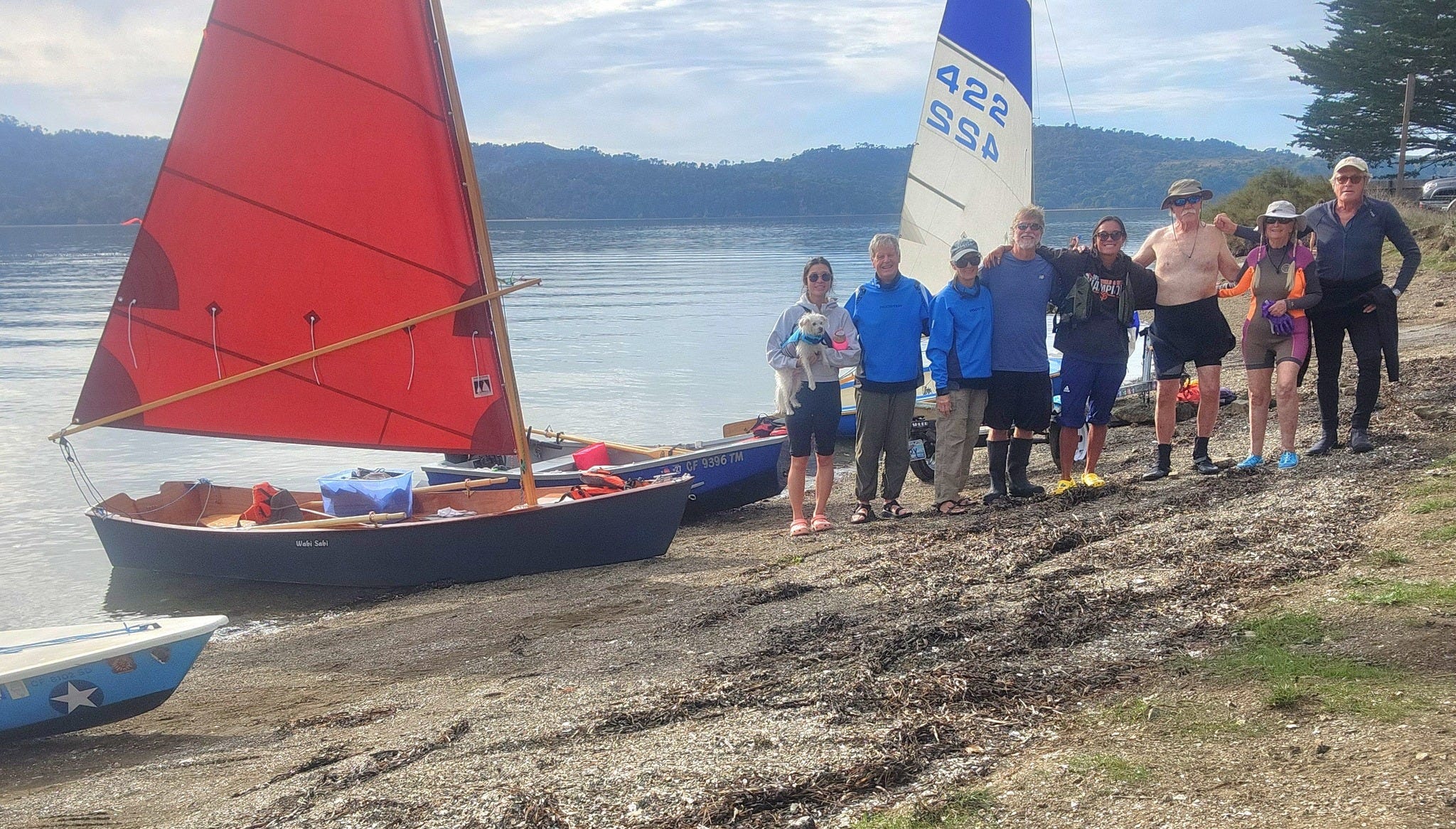
I’ve got a 13-foot traditional flat-bottom sailing skiff, that is black outside and varnished wood inside. She’s got a handsome loose-footed tanbark sprit sail fitted to spars of spruce and bamboo.
She is as pretty as her home waters, Tomales Bay. Strangers approach and offer compliments. “Beautiful boat,” they might say.
Coming closer, though, their smiles fade. Voices drop. She’s a tad scruffy.
Questions replace compliments. “You build it?”
I answer, “I helped build her. A friend built her, mostly. I painted her—gave her a practical workboat finish.”
I say that so they don’t need to. She may be scruffy, but I love my skiff. I can fix her. She’s elder-friendly, repairable, tattered, versatile, valued, and showing wear already.
Building a skiff was not my idea.
One of my sailing friends got the idea. My friends and I sail weekdays on Tomales Bay. We’re retired Sonoma County seniors: in order, oldest to youngest, Jerry, Dennis, me, Doug, and Daniel. Sailing is our social glue. We’ve sailed on Tomales Bay for decades.
In the spring I announced to them that I had decided to quit sailing my Banshee. My friends know that, according to me, the Banshee is the best singlehanded racing sailboat. And they know that medications have wasted my muscles and sapped my stamina so much that, despite working with a personal trainer, it’s not such a great idea for me to sail my Banshee on Tomales Bay.
My sailing friends had their own great ideas.
Doug said, “Don’t quit Tomales, Dan! Come motorboat with me.”
“Thanks, Doug,” I replied, “but I’m a sailor. I’m not ready for motorboats.”
Daniel suggested that I keep my beloved Banshee and use a small electric outboard motor. “Sail only when the wind is calm.”
“You need a sailboat designed for senior sailors,” Doug offered. “A rowing skiff with a small sail, maybe. Hard to find, though.”
Jerry knew a boat design that might work: a Jimmy Skiff II, easy to sail, row or motor, and available only as kits. Assembly requires skill, energy, time, tools, and a workshop—none of which I have.
Jerry, a retired woodworker, had everything I lacked: talent, skill, energy, experience, and tools, together with a spacious workshop. He’d even been thinking about getting himself a single-handed sailboat to use when it’s too calm to windsurf.
I wondered if Jerry might assemble a Jimmy Skiff kit in exchange for the Banshee that I no longer could sail.
Soon we met over tacos to talk. Jerry’s wife, Deb, cautioned me, “Jerry makes mistakes, but he always figures out how to fix them.”
“Uh-oh,” I thought. “I’m persnickety. We’ll drive each other nuts!”
Then I realized: “Life’s to live. Could this be a triple win? Jerry builds me a boat, I have a new home for my Banshee, and I can shed some of my persnicketiness.”
I ordered a Jimmy Skiff kit that evening.
A few weeks later, DHL dropped three huge cardboard boxes at my door. We hauled them to Jerry’s workshop. Weeks of work lay ahead.
That’s when Dennis forwarded us a Craigslist ad for a brand new, beautifully finished Jimmy Skiff for sale by its Rohnert Park builder. He was asking for about the same amount of money that I just forked over for the wood parts now awaiting assembly and spread out across the floor in Jerry’s workshop!
Someone bought that finished boat right away. I reminded myself that I didn’t want a boat that someone else built. I wanted to build a boat that I can work on and fix. I wanted to learn woodworking skills from Jerry and to build friendships along the way.
We got started. Jerry showed me how to use his router, orbital sander, drill press, and traditional hand tools. He taught me how to join the edges of wood panels by laying down watertight “fillets” (pronounced FILL-its) made of epoxy thickened with wood flour.
“You fillet like a pro, Dan,” Jerry said.
We swapped stories, jokes, tears, laughs, and goof-ups. We talked more than we worked.
Jerry got lots done. On hot days, I tired quickly and went home early. I was away with grandkids one week in August. My perfectionism often bothered both of us. Jerry was incredibly patient with me. Doug checked in on us from time to time to make sure we were getting along. We did. Jerry’s aloha spirit rubbed off on me.
The skiff named herself: Friendship. We were building Friendship. I learned to accept mistakes and do-overs, repairs and fixes. Jerry’s patience calmed me. In late August, my unfinished skiff came home to my garage for final assembly and paint. The same day, my Banshee moved to her new home at Jerry’s.
Seven weeks later in mid-October, Friendship was ready to launch. We had planned a launch party on my birthday, but fierce northwesterlies canceled those plans.
We launched the very next day. None of my friends were able to come.
It was raining lightly. There was no wind, no company.
“We really shouldn’t go out alone. What if your boat leaks?” my wife Sarah asked.
“It won’t leak,” I tried to hide my annoyance.
“How can you be so sure?”
“Because Jerry and I didn’t build a leaky boat! Let’s go!”
We motored across the bay. In 20 minutes, we arrived at Duck Cove, which we had all to ourselves. We enjoyed, as best we could, a drizzly picnic.
After lunch I decided to unscrew both the inspection ports to prove that Friendship didn’t leak. The first tank was dry, just like I thought. But when I unscrewed the second inspection port, I saw gallons of saltwater inside.
My dismay was immeasurable. I could hardly breathe. “The starboard floatation tank is full of water!” I whispered. “She leaks. Badly!” I would have significant repairs to make.
Sarah asked, “Should we call the Coast Guard?” (We had a radio.)
I took a breath to collect myself. I remembered the bilge pump. “No. We got here. We can get back.”
The wind was calm. Deciding to save the electric motor in case we needed it, we hoisted the sail and set off. Sarah paddled, I pumped. Slowly we crossed the bay without needing a rescue.
When we got home, I couldn’t find words to tell Jerry about the leak.
So I phoned Doug who has built seven wooden boats. He listened carefully. “Calm down, Dan. We’ll fix the leak. Daggerboard trunk, probably. I’ll come over tomorrow morning with my toolbox. See you at 8 am.”
I needed to vent some more. So I called Daniel who built his SCAMP, a wooden sailboat.
Daniel sounded like Doug: “You can fix it. If you need help, call me.”
Still, I fretted into the wee hours. Sarah echoed Doug and Daniel, “It’s going to be okay. Your friends will help.”
At 8 am sharp, Doug arrived with power tools. He cut big holes in my brand new boat. He looked inside with his bright utility flashlight. “Thought so.” Doug said. “The daggerboard cassette. Needs fillets.”
“Needs fillets?” I thought. “I know fillets. Jerry taught me.”
I could finally fully exhale.
Repairs took me almost a month to complete. In his emails, Dennis encouraged us again and again: “It’s not rocket surgery.”
Finally, I could tell Jerry, “Friendship’s fixed. No leaks.”
Most of us made it to celebrate Friendship on Veteran’s Day.
My troubles did not end there. Three days later, on my next outing to Tomales, I left home without properly tying down my sailing rig. I lost it somewhere between Sebastopol and Tomales Bay. I drove the whole route (via the towns of Bloomfield and Tomales) thinking that I would find it: a big, black canvas bag ten feet long and shaped like a sausage. But no. Someone had already picked it up.
I gave up and joined my friends at Tomales Bay. To salvage the day, we launched our boats and crossed the bay to Indian Beach where we shared stories of trailering’s trials and tribulations.
The next day, Jerry came by my house with tools to help me work on Friendship. We talked about how great his Banshee is. He suggested I post signs along the roads offering a reward for my sail’s return. So I did. Nobody has answered.
“Learned my lesson.” I told Jerry, “I’ll tie down the next sail rig.”
Friendship will see me through the rest of my days on Tomales Bay. I’ll give her regular attention, make repairs, accept her imperfections and navigate the troubles she’ll bring.
I’ll take care of Friendship and Friendship will take care of me—with a little help from our friends.
Dan; wonderful story and parable. Thanks.
“Friendship” could have a subtitle: bravery, knowing your overall health challenges you faced during this long episode.
Sarah might call it obstinance
, I suppose.
Thanks again, Rollie
An inspirational story, Dan. I admire your courage and determination.
Your Neighbor on Vine,
Chris