

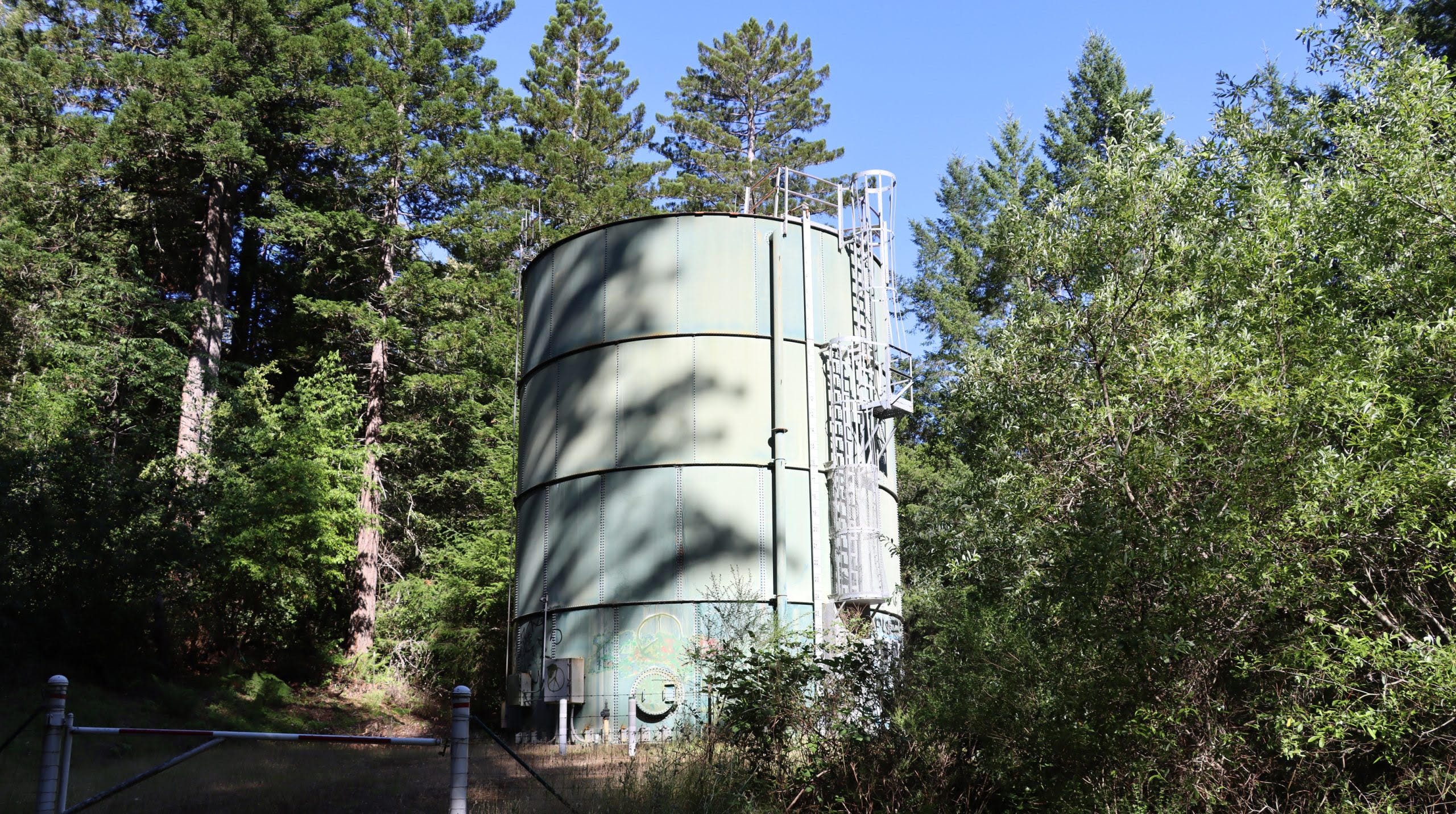
In this week’s Saturday Towns column, columnist Tom Austin delves deep into the work being done to preserve a vital part of Camp Meeker’s water system.
Camp Meeker has been quiet and peaceful for the most part as we enjoy the summer, with dogs (and sometimes humans) getting off the leash being the major day-to-day stress.
The Park and Rec Board continues working away in the background, smoothing out water issues and working with the Ag and Open Space District on a grant that will fund some of the wildfire defense and trail maintenance work, along with repairing the damage done by the small mudslide up by Baumert Reservoir. More on those stories as they develop.
In this issue, I will give you an update on our water tanks. More accurately, I will summarize the update provided by the Brelje and Race engineering firm after they were tasked by the Park and Rec Board with doing a full inspection of the three tanks and recommending appropriate courses of action.
The final Brelje and Race report is available online.
The report is quite detailed, and I recommend downloading it and giving it a full read. For those too busy to do so, allow me to summarize.
I apologize if this gets a bit dry and engineering-nerdy. I love that stuff, but those with actual personalities might not. I dive deep because getting our tanks right for the long term is a significant investment, and an informed electorate makes better decisions. The cost of any tank work would be shared by CMRPD (Camp Meeker Rec and Park District) and OCSD (Occidental County Sanitation District) in a ratio of approximately 68% CMRPD and 32% OCSD.
There are three primary tanks that store water and provide water pressure for Camp Meeker after it is pulled from the Russian River aquifer via a well in Monte Rio. They are known as the Morelli, Tower, and Baumert tanks. The first two are named after the streets they sit on top of, and the third is named after Baumert Reservoir up the hill.
The Morelli tank has a capacity of 100,000 gallons; the other two tanks each hold 129,000. Each are around 30 feet in diameter and have heights ranging from 26 to 33 feet. There is a ladder allowing workers to climb to the top of each tank, and another ladder inside to get to the bottom of the tank. These ladders are locked. The outside ladders are equipped with cages which provide some degree of fall protection for climbers. The Tower and Baumert tanks were installed in 1999 and are bolted steel. The Morelli tank was installed in 1996 and is welded steel.
Here are the results of the inspection by Brelje and Race:
Morelli: Brelje and Race found this tank to be in good condition structurally but found issues of concern. In particular, the coating on the inside tank generally lasts about 30 years, and Morelli tank celebrated that birthday this year. The recommendation is to replace the tank coating within the next two years, and – while we are under the proverbial hood – to also add fall protection components to the interior ladder. These components were not required in 1996 but would be required to meet current safety standards. Other recommendations include an upgrade to the current overflow pipe, adding a concrete drainage box at ground level. Finally, a railing on the top of the tank (safety) and fence and locked gate (security) are recommended. The combined cost of all of this is estimated at $289,940 – which seems likely to be payable over time, although I am not up on the pertinent details.
Tower and Baumert: Both tanks were found to be structurally sound. In contrast to the welded steel Morelli tank, Tower and Baumert tanks are bolted steel. Linings on bolted steel tanks generally last 25-40 years, and both of these tanks are 27 years old. Replacement of linings is not recommended for bolted steel tanks because of the significant costs of coating operations, the potential for damage to gaskets and hardware during recoating, and the limited lifespan of gaskets and hardware. The current estimated cost of a full tank replacement is estimated at $240,000 to $250,000 per tank.
As the most severe corrosion was observed on the roof of the tank, two alternatives were explored:
Replacement of the roof deck and deck supports was estimated at just under half the cost of full tank replacement, or about $125,000 per tank, and
Replacement of roof, supports, and the top ring of the shell would cost around 80% of full tank replacement, or around $200,000.
Because the full tank replacement option would also include replacement of the tank foundation to meet current seismic requirements and because of the high cost of the partial replacement solutions, full tank replacement was recommended.
Additional (tactical) recommendations were made: adding a rust-retardant coating to the roof of the tank to extend the life of the roof and “buy time” for full tank replacement (probably in 8-10 years), and short-term action (costing around $7,000 to repair leaks present in the Baumert tank. Finally, adding secure fending and up to date fall protection components to the exterior ladder of each tank was recommended.
Well geez, that was a lot. Thank you for hanging in to a fairly dry presentation. The hope is we will make good decisions, so we don’t get left…high and dry.
Sorry. Pun very much intended.