


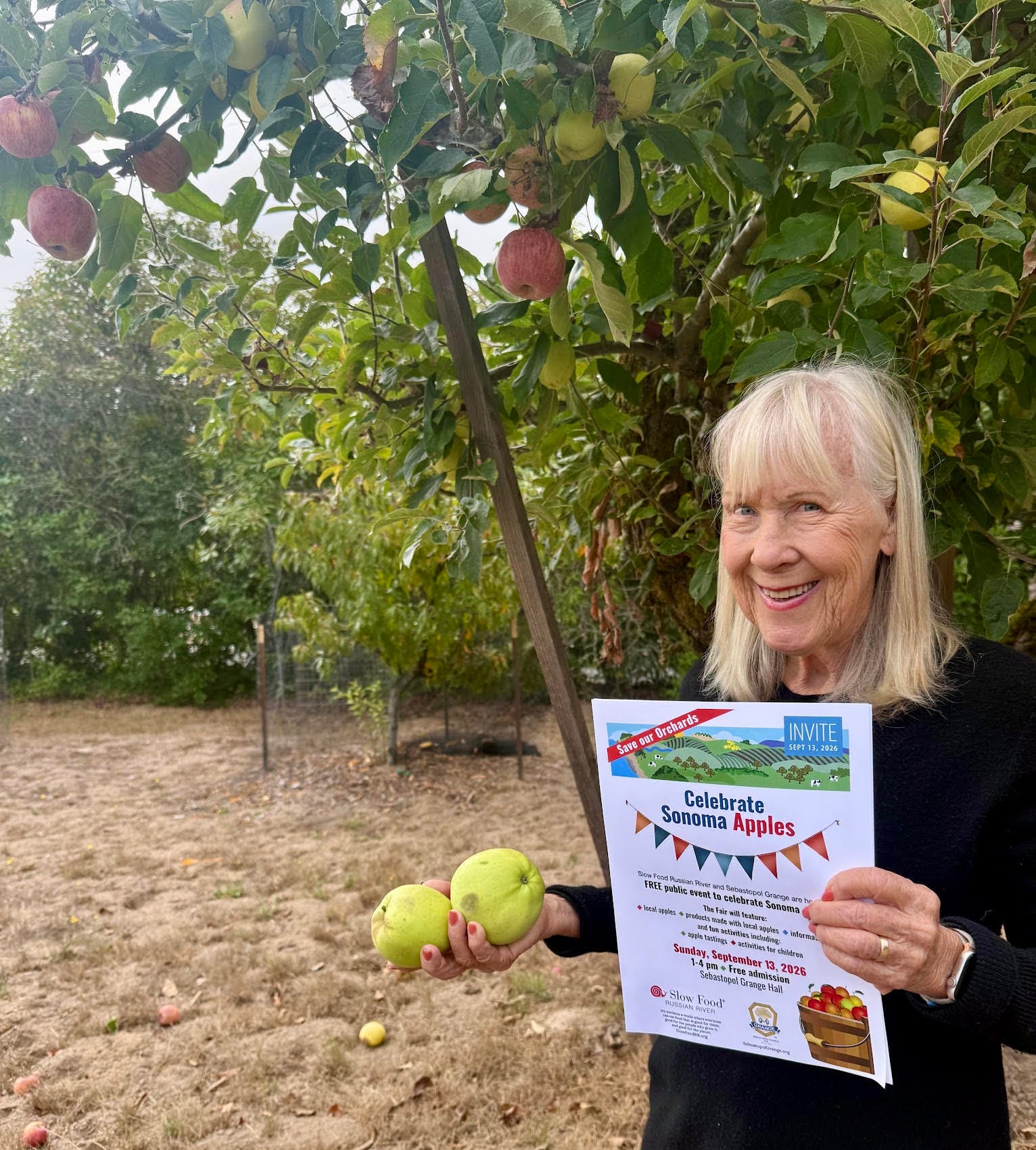
The Gravenstein Apple Fair may be over, but apple season continues in yards and orchards around Sebastopol, and the hearts of many in town are holding true to the fruit that has defined Sebastopol for so long. Though fewer in number, apples are still here, and that’s reason enough to celebrate.
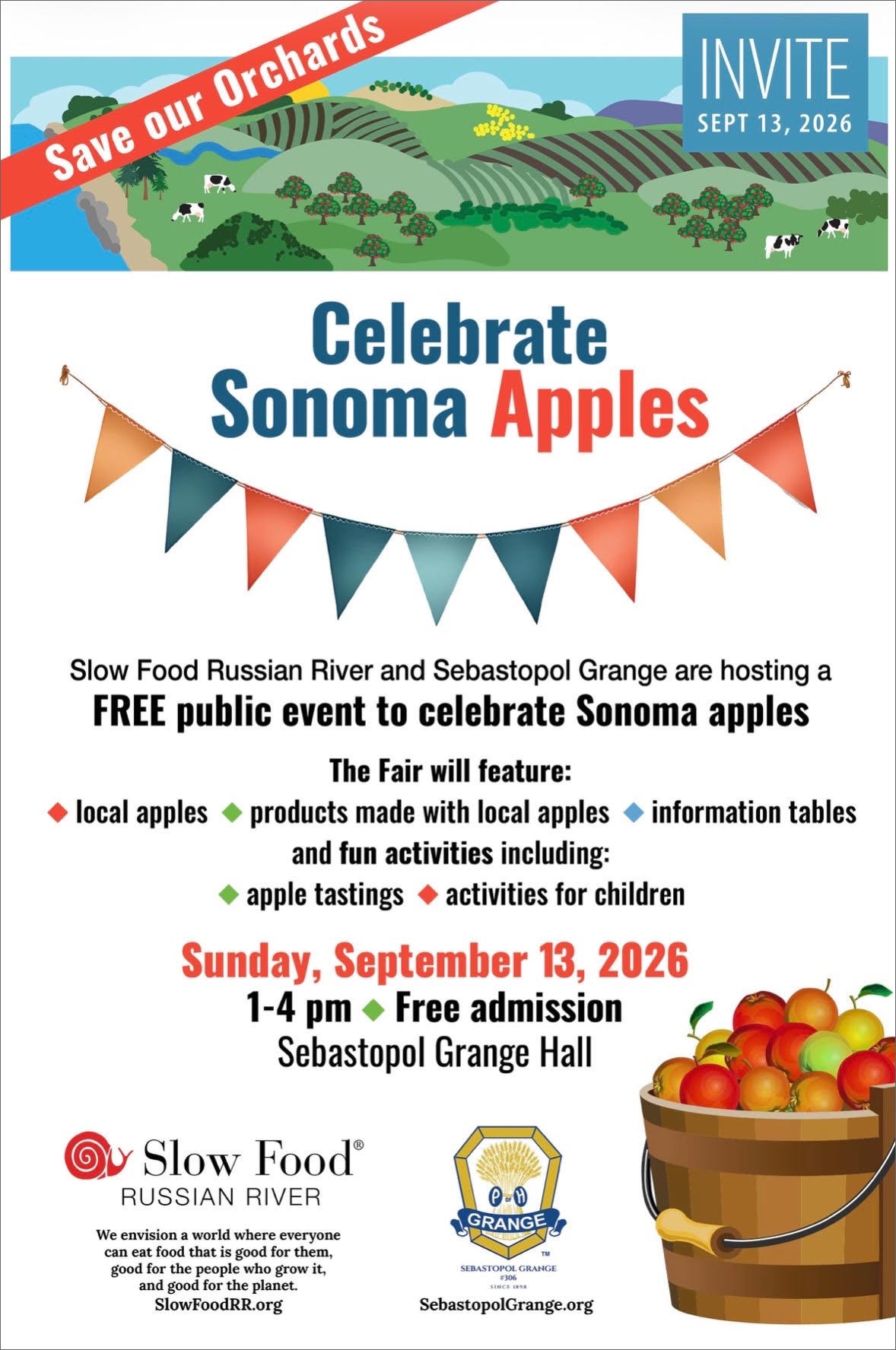
Slow Food Russian River and the Sebastopol Grange invite you to a new event honoring Sebastopol's favorite fruit, “Celebrate Sonoma Apples,” on Sunday, Sept. 13, from 1 pm to 4 pm at the Sebastopol Grange Hall on Highway 12, just east of town.
This all-things-apple event will feature delicious treats to tantalize your taste buds with a wide variety of samples and cooking demonstrations — both sweet and savory. Taste different heirloom apples, take some home, and try out new recipes. Gather ideas on what all you can do with apples. There will be caramel apples, pie and ice cream, ciders and spirits.
Hands-on activities include beloved rural traditions, such as making fresh cider with a manual hand-crank apple press and satisfying apple chips with that classic kitchen tool, a peeler-corer-slicer.
There will also be experts on hand to answer any questions you have about how to keep the apple trees in your yard or on your property healthy and productive, offering advice about common problems like scab, codling moths or this year’s plague, fire blight. The Sonoma County Bee Association is also bringing its popular interactive display, and children will be entertained with face painting and games.
Though the focus is apples, there will be some treasured local musical guests, including Clementine Darling and Diego Jameau, recognized famously as “The Whistler.” The Apple Tree Morris Dancers will also share their celebratory dancing to festive folk songs.
A promise to an old friend
The event is being organized by Slow Food Russian River’s Carole Flaherty, a “Jill of all trades,” who gardens, sews, weaves, paints and more. Most recently, she has become a prominent voice for apple research and representation.
Earlier this year, Flaherty brought local apple farmers together for a conversation and to ask what support they needed. The farmers all said the same thing: they want people to buy more local apples.
That meeting was where the idea for “Celebrate Sonoma Apples” first surfaced. The goal: bring people together for an event built around our local apple varieties.
Part of the funding for this year’s event comes from grant money that Slow Food Russian River received for outreach and education from Sebastopol West 100.
Flaherty hopes “Celebrate Sonoma Apples” will become an annual event. She sees it as a way to both support local apple growers and fulfill a promise she made to an old friend.
In her last days, Paula Downing, the former longtime manager of the Sebastopol Farmer’s Market, told Flaherty that her big regret in life was not doing more to save the local apple orchards. Downing passed the torch to Flaherty, who’s taking the job seriously.
Flaherty remembers, “She [Downing] was one of those people, when she came up to you and said, ‘Will you do something?’ You didn’t hear it as ‘Will you,’ you heard it as ‘you will do this.’”
A history and industry worth preserving
According to Farm Trails, a Sebastopol-based organization that promotes local farming and educates the public about the importance of supporting local agriculture, there is not a 100% consensus on the exact origins of Sebastopol’s signature apple, the Gravenstein.
According to its website, “One story is that Russian fur trappers planted the first Gravensteins in 1812. Another version is that Spaniards planted Gravensteins in a part of California they referred to as New Spain. The most likely explanation is that this mighty apple was imported from the East Coast by a nurseryman who brought apple trees and other plants across the country in a covered wagon.”
Flaherty is partial to the Russian origin story.
Along with hops and prune trees, Gravensteins and other apple varieties were planted in West County in large numbers in the 1800s. The apple industry reached its peak during WWII.
According to an article on the California Ag Network by local apple grower Steve Dutton, “At the beginning of World War II in 1940, Sebastopol had its high point of 13,875 acres of apples with 9,750 acres planted in Gravenstein. By 1950, the apple acreage was in decline with 10,874 planted acres, 7,465 of which were Gravensteins. In 1980, the acreage fell to 7,747 with Gravensteins accounting for 3,234 acres. Fast forward to 2015 and there were only 2,229 acres left of Sonoma County apples with 704 acres in Gravensteins.”
By 2024, according to that year’s Sonoma County Crop Report, the number of acres planted to Gravensteins had dropped to 614.
Thanks to the work of Occidental’s Paula Shatkin and others, Slow Food USA acknowledged the Gravenstein apple as an endangered heritage fruit in 2005, adding it to the “Ark of Taste,” a catalog of endangered heritage foods in America.
Slow Food Russian River applied to the international Slow Food Foundation for Biodiversity over 20 years ago, “to make the Sebastopol Gravenstein the first Presidia [‘fortress’] in California, and one of only six Presidia projects in the US,” reports Shatkin.
Since 2003, Slow Food Russian River and a dedicated “Apple Core” team have put out great effort for the Gravensteins. They support a free community press every apple season at Luther Burbank’s Experimental Farm in Sebastopol, where they also host weekly school tours. This impressive collaborative effort requires countless volunteers and a few regular organizers. (They’re looking for volunteers—see their sidebar at the end of this article.)
This is a pivotal time for the future of apples in West County, as apple processor Manzana moves up to Washington state and other farms try to fill the gap. At Celebrate Sonoma Apples, you can talk to Gold Ridge Organic Farms’ Brooke Hazen about the new 20,000-square-foot apple processing facility he just bought in Santa Rosa. (And don’t miss Gold Ridge’s fifth annual Heirloom Apple Festival on Saturday, Sept. 19, 10 am - 3 pm at 3387 Canfield Road.)
This Sunday’s inaugural “Celebrate Sonoma Apples” is all hands on deck. Countless local advocates, farmers, apple-y businesses, community volunteers, agricultural groups and more will be there. Come out, celebrate, bring your families and friends. Enjoy the first event of its kind and hop aboard for what’s next.
Celebrate Sonoma Apples happens this weekend, on Sunday, Sept. 13, from 1 pm to 4 pm at the Sebastopol Grange Hall, 6000 Sebastopol Ave. (Hwy. 12), just east of town.
Volunteers needed at Sebastopol Community Apple Press
Slow Food operates a community apple press at the Luther Burbank Experiment Farm at 7777 Bodega Avenue. On weekends, members of the public can bring their apples and, for free, make delicious apple juice to drink fresh or to make hard cider. Slow Food also operates the press for primary schools on Wednesdays and Thursdays.
Each day, 5 or 6 volunteers are needed to set up the press, supervise its safe operation, and clean it up at the end of the day. Volunteer shifts are four hours, starting at either 8:30 or noon. No experience is needed. An experienced leader will be there to show you the ropes. Slow Food cannot maintain this service without help from the community. If you can help, go to https://slowfoodrr.org/volunteer-at-the-apple-press/ and sign up.
The apple press is open from August through October.
You can cash in your volunteer hours for other things you need via the Time Bank
David Gill, the administrative coordinator of the Sebastopol Area Time Bank, adds that since Slow Food Russian River is a nonprofit collaborator with Sebastopol Area Time Bank, volunteers for the apple press, who are in or join the Time Bank, can claim Time Bank hours for their apple press work. Then they can use those hours to get other services they need from other Time Bank members. See our article on the Time Bank here.