

To hear the rest of the world talk about Sonoma County, this region has everything anybody could ever need or want, including its natural beauty, world-class wines and diverse agriculture, livable cities and widespread affluence. But when we listen to ourselves talk about this place that we call “home,” we keep hearing about a severe shortage of housing and its unaffordable costs.
That kind of talk has been going on for decades without much change of tone or outcome. That is, until the nonprofit organization Generation Housing and its executive director Jen Klose arrived on the scene. Since 2018, they’ve been leading ongoing forums and other talks with local elected officials and community leaders about how to make more housing more affordable to more people who want to call Sonoma County home.
As it turns out, all this purposeful talk—and state legislation to back it up—is making a difference in how much housing is getting built. Over the last five years, more than a dozen new state laws have forced local governments to ease their most restrictive zoning and design laws to speed up project approvals and construction. State laws have evolved so quickly that many small cities like Sebastopol find themselves running to catch up.
“It’s one thing for us to change the conversation and messaging, but we have to keep backing it up with action and results,” Klose recently told the Sebastopol Times during a series of one-on-one conversations about her favorite topic.
The wake-up call
Following decades of slow-paced housing construction and after the 2017 Tubbs Fire that destroyed over 5,000 homes, Sonoma County leaders woke up to an overwhelming housing emergency. They adopted new slogans of “Sonoma Strong” and “Build Back Better.”
“The problems didn’t get any better at first,” remembered Klose, who was president of the unified Santa Rosa school board at the time. “Next, we had more wildfires, a flood and a pandemic.”
But the region’s leadership stuck together and launched a series of “resiliency plans.” They chased after federal FEMA funds, brought major local banks and credit unions together with homebuilders and saw the birth of the new nonprofit, Generation Housing.
Urged on by other community leaders, Klose put together a 30-page plan of action that quickly became the new nonprofit organization, Generation Housing, which today includes a staff of six people and a $1.3 million annual budget.
Klose, who is in her mid-50s, brought her background as an attorney and her experience on the Santa Rosa School Board to the project. She also credits her interest in community-building to the many dinner and evening conversations she experienced growing up with her journalist parents, Press Democrat reporter Bob Klose and columnist Susan Swartz.
Generation Housing is led by a 12-member board of directors, led by current chair Lauren Taylor, who worked at Burbank Housing, the county’s legacy affordable housing organization, and is now the director of St. Vincent de Paul Sonoma County. In that position, Taylor is now overseeing the development of Gravenstein Commons, a permanent supportive housing development in Sebastopol.
“From the beginning, we [Generation Housing] always saw ourselves as advocates, not builders,” said Klose. “Our work was to win more political and public will to attack these problems. No one was denying we had a housing problem and an affordability problem, but no one was moving fast enough in the right direction.”
Since 2018, Generation Housing has issued annual “State of Housing” reports full of baseline data, demographics, regional economic trends, and a series of proposed local housing policy changes. Generation Housing has held numerous public meetings and seminars in Sonoma and Napa counties to raise support for its recommended policy changes.
These include supporting state and federal housing subsidy bonds and programs; ending exclusionary zoning laws; streamlining housing project applications; supporting new housing types, such as ADUs (accessory dwelling units); and decreasing parking requirements and endorsing more transit-focused housing.
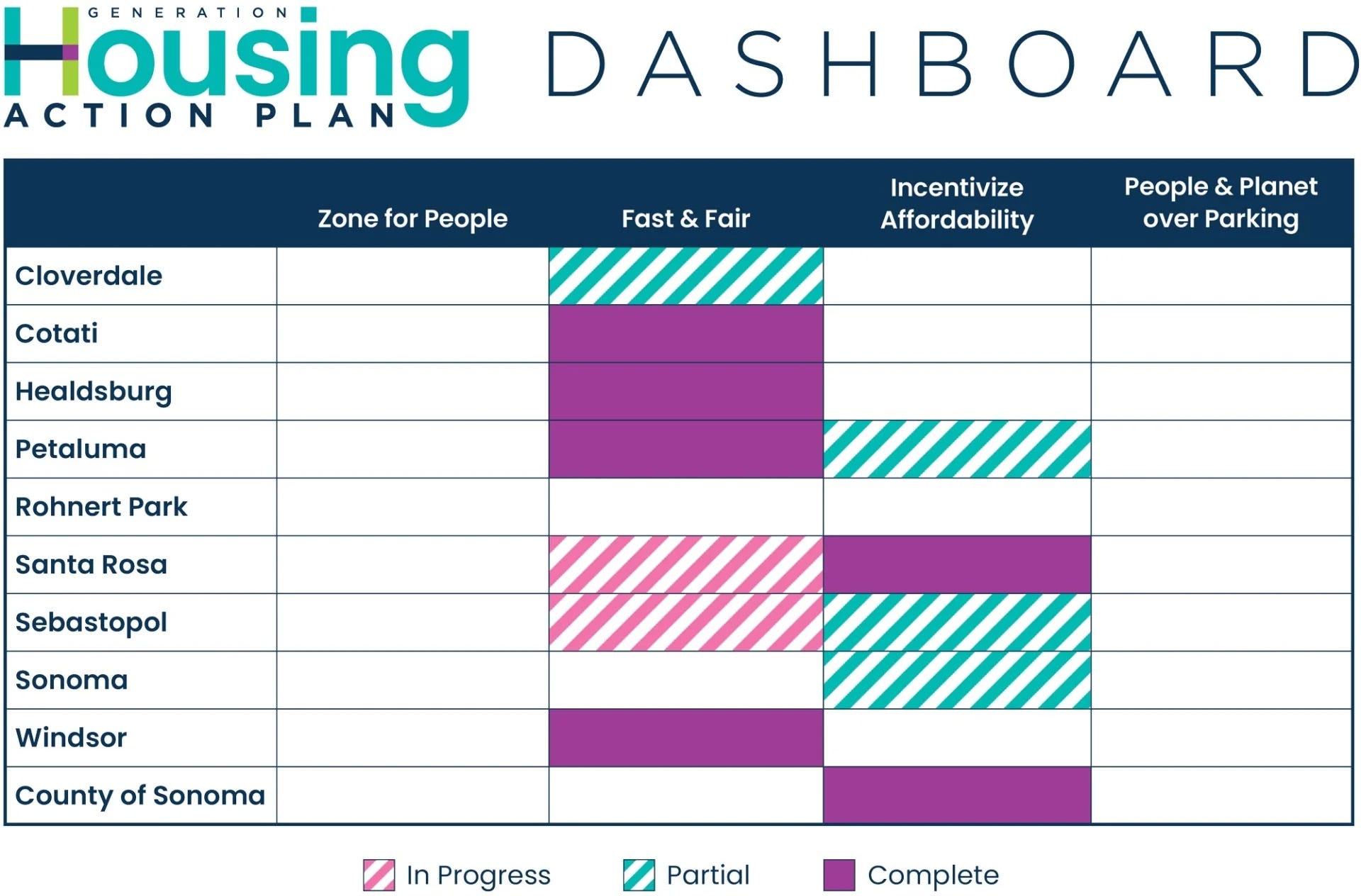
Generation Housing also publishes a “dashboard” on the status and progress of its many housing initiatives, a kind of report card for each of Sonoma County’s nine incorporated cities and unincorporated Sonoma County. According to the website, the dashboard assesses each city’s efforts across four areas:
End exclusionary zoning. Create more diverse and more affordable housing by allowing up to 4-plex housing in single-family zones and expand zoning for Missing Middle small apartment complexes.
Streamline housing development by integrating Design Review Boards into Planning Commissions. This accelerates housing projects while still ensuring transparency and accountability in decision-making.
Incentivize Affordability. Support near-term construction of Affordable and affordable-by-design workforce housing by right sizing fees and adopting fees based on square footage.
People & Planet over Parking. Let developers and their tenants make climate-smart decisions on parking needs by eliminating costly and heavy-handed parking mandates.
Generation Housing takes credit for attracting $170 million to Sonoma County for affordable and climate-smart housing. Since 2018, Gen Housing has endorsed 5,566 new housing units, including almost half considered 100% affordable as set in law for lower-wage workforce members.
How many new houses does Sonoma County need?
In 2021, Generation Housing laid down a challenge to local elected officials to facilitate the building of 58,000 housing units by 2030. That 58,000 number far exceeds the state’s 2026 RHNA targets, which total 14,482 for Sonoma County and all its cities.
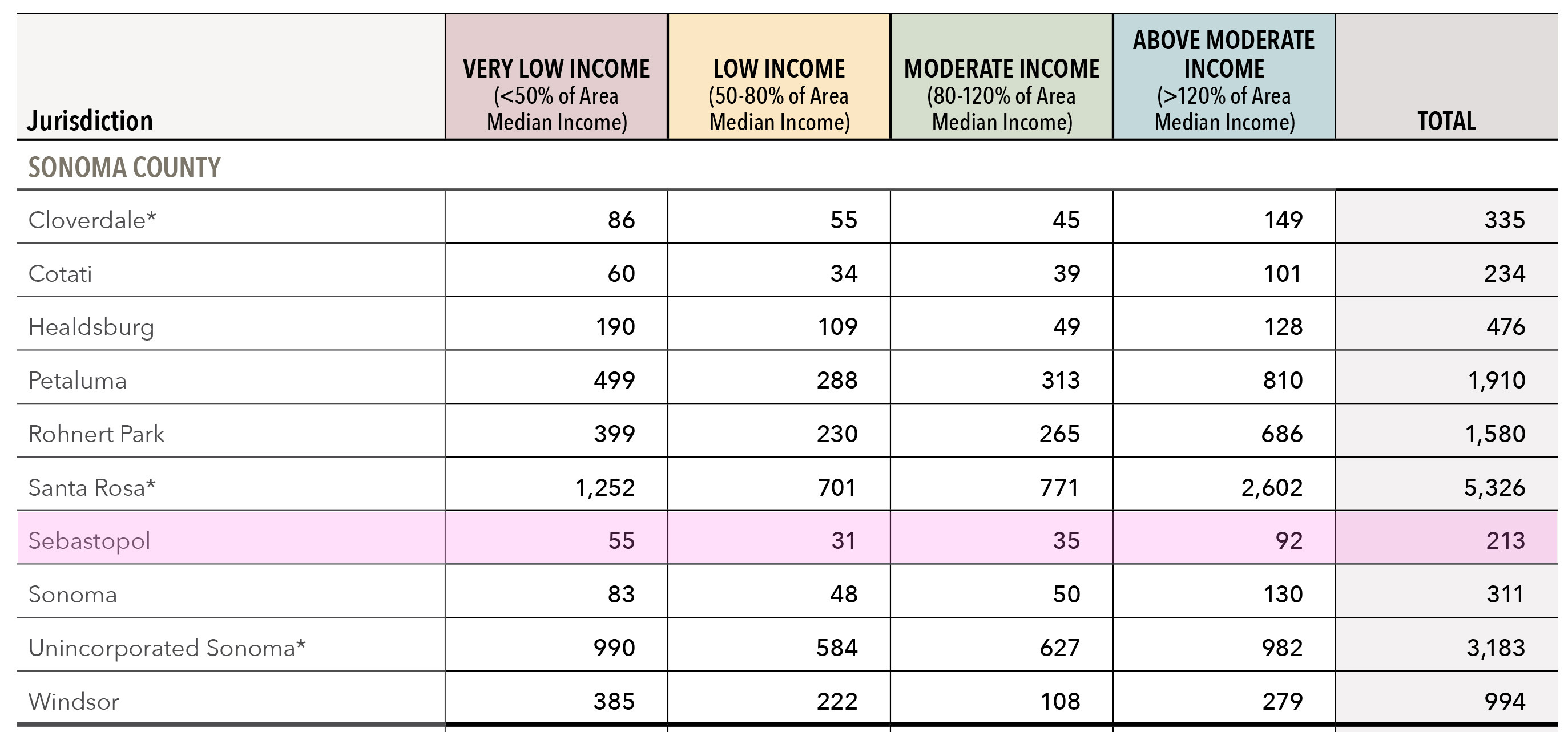
Generation Housing’s higher number folds in past housing deficits and estimates of how many homes are needed to bring down the cost of building new homes and create a sustainable rental vacancy rate. Their 2025 State of Housing in Sonoma County lists their new goal at 50,000 houses—thanks in part to the almost 7,000 houses built countywide since 2021.
The group is supposed to release its new 2026 State of Housing in Sonoma County report before the end of the year, and, according to a talk Klose gave at a recent ReVillage event in Graton, they’ve dropped their goal for the number of houses built by 2030 significantly, down to 30,000 new homes.
“I’m not optimistic that we can build the 30,000 new housing units we think we still need before 2030,” Klose admitted. “But I will also tell you that I think it is possible.”
Her “glass-half-full” answer is based on local history where Sonoma County saw an average of 6,000 homes built annually during the mid-1980s to early 1990s before a slow-growth—and for Sebastopol, a no-growth—period for the last 25 years.
In other words, it’s been done before. “If we do everything we can to reduce barriers and increase (housing) opportunities by streamlining zoning laws and shortening permit timelines, we could make it happen,” she said.
Klose has a pragmatic view of those goals, however. “If we pick up the pace, then, sure, it would be pretty amazing. We just can’t let too much perfection be the enemy of progress.”
The housing seminar in Graton was hosted by the nonprofit Re-Village, which is leading the effort to redevelop the downtown of that small West County village. Klose was joined by other housing advocates who shared ideas about land use innovations, co-housing models and a “hyperlocal” view of Graton and the surrounding West County watershed and rural housing patterns.
At the Graton forum, Klose shared several examples of local housing success stories in places as far-flung as Portland, Oregon; Austin, Texas and Minneapolis. She gave her audience a single challenge: “Will you stand up and say ‘yes’ for more new neighbors?”
Afterward, Klose told the Sebastopol Times that she thought it was possible to meet the new housing goals without changing Sonoma County’s Urban Growth Boundaries.
“There is plenty of opportunity for in-fill and transit-oriented projects,” she said. “We can’t go back to the years before the Tubbs Fire where we weren’t building any sustainable amount of new housing.”
How’s Sebastopol doing?
Some cities are permitting more housing projects than others, but all are increasing their efforts and have made some reforms to their zoning and permit application requirements. The cities of Sebastopol and Cloverdale have the lowest overall scores in meeting Generation Housing’s “Guiding Principles,” while the cities of Cotati, Petaluma and Santa Rosa have the highest scores.
The question of how Sebastopol is doing isn’t an academic one for Klose, who now lives near downtown Sebastopol with her partner and two dogs, just a short walk from the home her parents shared on High Street for 25 years.
Trying to be diplomatic, Klose said Sebastopol’s government leaders could be doing more to welcome or allow housing projects in the city.
“They (city leaders) just haven’t done many of the reforms that other cities have done. They’re not unique, but other communities have done better,” she said. “Look, Sebastopol does not have a growth problem; it’s actually shrunk over the last decade. Its traffic problem is a lot of people who can’t afford to live here but drive [through town] to go to work every day. More available and affordable housing here could help solve that.”
Asked to comment on the recent housing project to build 39 housing units on a three-acre site on Valentine Avenue, Klose said a lot of the city officials’ comments and public testimony demonstrated why many potential housing developers have avoided Sebastopol in the past.
“The comments were not very welcoming,” she said. Some individual city council members’ public complaints about their own previous actions to support state-authorized housing density bonuses were especially “counterproductive” to ongoing housing conversations and future housing project applications, Klose added.
Klose, for example, is a huge supporter of AB1033—the ADU condominimization law that made the 39-unit Valentine housing development possible. Sebastopol opted in to that law in January of this year. Now there are calls for it to opt out.
“Inaction will sink us deeper into a deficit,” one of Klose’s Generation Housing open letters to the community states. “Bold action is necessary to prevent homebuilding from slowing again to recession-era rates. But we can fix this; we’ve done it before.”
“Local elected officials everywhere have tremendous powers to make policy changes,” Klose said. “That’s the good news. They can change costly impact fees, restrictive zoning and parking laws, and they can support co-housing and other innovations.”
At the same time, she said, “Unless the public demands it (policy changes), we’ll just see more of the same status quo.”
Housing advocates and neighbors who might call themselves YIMBYs—Yes, in my backyard—need to show up at public hearings, said Klose. “Studies show that public officials respond more to ‘no’ votes than ‘yes’ votes. We need to outnumber the ‘no’ votes,” she said. YIMBYs are the opposite of NIMBYs — Not in my backyard—an expression she feels characterized many of the neighbors’ complaints about the recently approved Valentine Avenue project.
Beyond the housing crisis
While Generation Housing and other housing advocates rally support for new policies and new housing construction, Klose realizes there are bigger, more universal problems with the housing market—like increased mortgage rates, the ever-spiralling cost of building materials and the uncertain future of federal housing programs that underwrite most affordable housing efforts.
“It’s not only in Sonoma County, but family and personal income levels are not keeping up with rising housing costs,” said Klose.
“Lots of people call this a housing crisis, but I try to avoid that characterization. It’s too loaded with emotions even though we definitely have a housing scarcity and an affordability problem.”
An example of this would be the “missing middle” problem, where families with median or better incomes still can’t afford the costs of Sonoma County’s expensive homes or rising mortgage rates.
Klose’s list of other groups that are struggling includes first-time homebuyers, young renters, low-income workforce housing needs, and elderly homeowners on fixed incomes with large mortgages still to pay.
“With all these various needs and problems focused around affordability and scarcity, we are all ending up, as communities, paying for the housing that we don’t have,” she said. “Employers can’t find enough local workers, local tax revenues go missing, schools suffer declining enrollment, and overall outcomes of “healthy communities” go lacking.”
Klose understands that macro-economic problems like inflation and rising mortgage rates are beyond her control, but she remains convinced that Generation Housing can have a positive effect on local policies in Sebastopol and elsewhere that make a real difference.
“Yes, it’s incredibly complicated, and ultimately a lot of this is at the mercy of the cost of money and materials, but time is also a big expense. Delays and lack of action are huge, huge expenses — and we can change that,” she said. “Each (housing) project we face is very specific and unique to its location. No matter if interest rates change or not, we still have choices to build and make things easier or better for ourselves.”
So glad to hear this.
Frustrating to listen to the “non-profit” experts preach solutions to costly housing in Sonoma County. Data tells a different story. First, compared to building a 2,000 square foot “standard finish” house (land excluded) in St George Utah, Sebastopol is literally twice as costly - $414K/ St George and $868K/ Sebastopol. “Incentivize Affordability” – right sizing fees and adopting fees based on square footage sounds great on the surface, but fees are only 8% of building costs in Sebastopol. Labor makes up the biggest difference – 80%+. There is no discussion about steps to reduce the cost of labor.
Sebastopol has a robust pipeline of already approved new homes. There are currently 135 approved homes in Sebastopol that are not built. Most have been “approved” for a least 4 years, but developers have been reluctant to pull the trigger. If we are serious about new housing, why are city officials or non-profits not working with developers to understand and resolve issues and get them under construction. Seems more practical than just talking.
Sebastopol should be used as an example of a community that has been successfully improving the low-income housing situation for many years. Currently ½ of the residences in the city are rentals. 1/3 of them are deed restricted low income. Currently Sebastopol offers 427 restricted units. Given only 1.88 square miles and about 3,000 residences the city is doing more (for its size) for affordable housing than any other city in the county.
Lastly, “transit focused housing” comes up frequently as a solution. In this article and as the planning commission looks at reducing parking requirements for new development downtown. Sebastopol has no effective transit. There is one bus an hour to Santa Rosa. According to the 2023 census, 7 people used it per day.
While larger cities and the county with lots of available land should be prioritizing new development, with 1.88 square miles of fully developed land that is already straining the existing aging infrastructure, Sebastopol should not get distracted by these well-meaning idealists. Sebastopol needs to focus on balancing the city budget.
For 20 years the city has subsidized government with money from water rate payers. Every tax increase came with a promise it was needed to repair aging infrastructure. For whatever reason the city budget continues to be in deficit, there is still not sufficient money to repair streets. The neglected library is closed for water leaks and mold. The city recently announced it has to borrow $5MM to replace the 70-year-old water well, with interest costs effectively doubling the actual cost of the replacement. These are real problems that will eventually, if not addressed, bring the city down.