

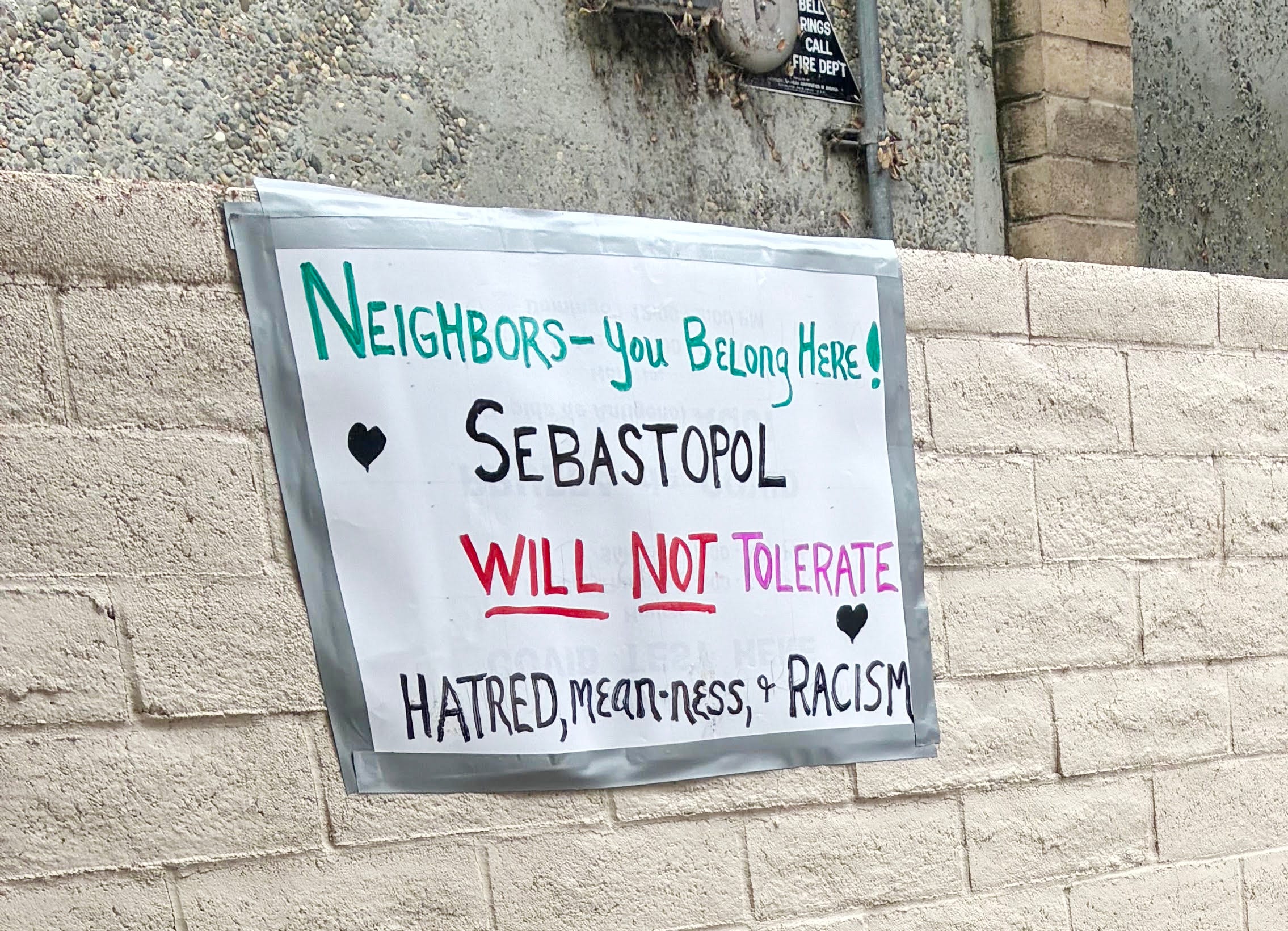
At the end of the Sept. 1 Sebastopol City Council Meeting, the council took on the troublesome question of what to do about the continued racial harassment behind Safeway. (See our earlier articles on this issue here and here.) Last month, the council asked City Attorney Alex Mog to research what options the city had to deal with this problem.
He began by explaining what the city couldn’t do, which was “mandating physical improvements at the site, whether it be a fence or cameras,” because it’s private property belonging to Safeway.
The list of things the city could do was quite short:
City representatives could continue meeting with Safeway and Analy in an attempt to solve this and other problems with juveniles at the store.
It could create a graffiti ordinance that would require businesses to remove graffiti within a given period of time or face a fine or pay the cost of having the city remove the graffiti.
It could take part in some kind of restorative justice program.
Restorative Justice first evolved as a way to keep juveniles out of the criminal justice system. Mog described it this way: “Restorative justice is a process outside the traditional criminal justice system … where parties meet to discuss the incident, the harm, why it was caused, the reasons it occurred, and try to reach resolution or a path forward where everyone feels heard, and there are solutions.”
Mog described two pathways involving restorative justice: In the first, the local police cite or arrest a juvenile, hand them over to the county’s juvenile justice system, which offers different diversion programs, including a restorative justice process. The problem with this, according to Councilmember Zollman, is that it would create a permanent record, including fingerprints.
A city can also contract with a restorative justice practitioner and set up its own program as a first step before involving the County.
“Rather than being sent to the juvenile justice system, that person is referred to the [city’s] restorative justice program, which reports back to the police department,” Mog said. “And if the process is successful, you know that's sort of the end of the line. If the process is unsuccessful for whatever reason, the police department may then decide to move forward with referring that citation to the [County’s] probation department and juvenile justice system.”
Mog noted that Sebastopol used to participate in a County grant-funded program like this, but that the funding had ended, and Sebastopol was no longer involved. That program used the services of a local organization, Restorative Resources, which Councilmember Zollman said would be interested in providing this service for the city in the future.
On the graffiti front, during council questioning, it was revealed that the city already had two volunteers—Ted and Steve—who clean up graffiti. In addition, Police Chief Sean McDonagh said Safeway management was “very receptive to having an extended patrol of their own facility … where they’d walk around the entire premises in the morning and just sort of see what the status of things were.” He also said they’d agreed to remove graffiti within 24 hours.
In terms of the city meeting with the various parties involved, City Manager Mary Gourley said they’d had three meetings this spring, involving her, the police chief, Safeway, and Analy. Gourley met separately with the neighbors on Pitt Avenue, but when she attempted to arrange a meeting with everyone, including the neighbors, she hadn’t heard back from Analy or Safeway.
Councilmember Carter and Zollman both mentioned recent issues with racism at the elementary and middle school level and expressed a desire to include them in the mix.
The Pitt Avenue neighbors, who first brought the racial problem behind Safeway to the attention of the city, were present in the council chambers, but only one of them spoke during public comment, giving an update on the situation.
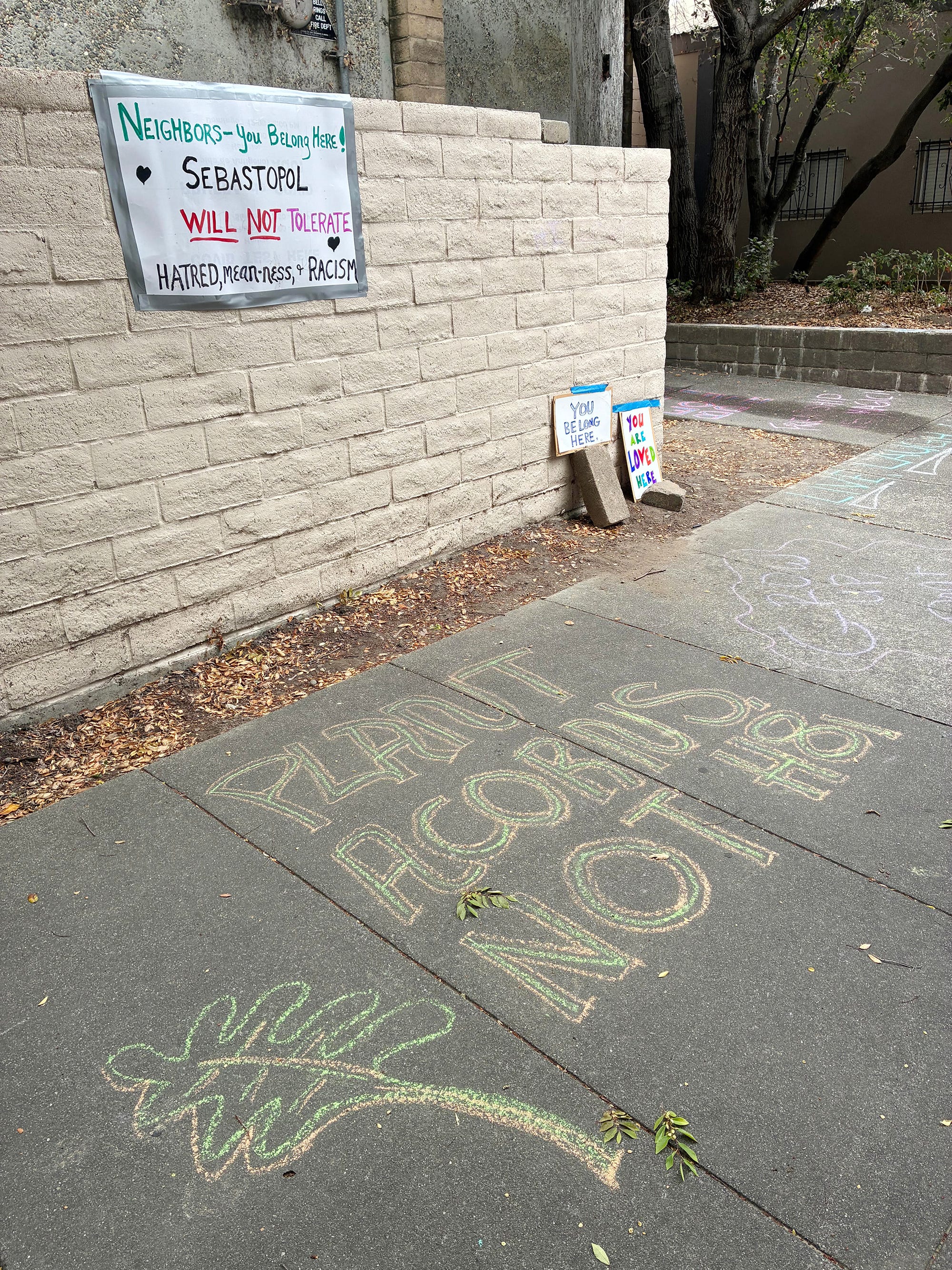
I’m one of the residents on Pitt Avenue who reported the racist graffiti to the police. And I wanted to start by saying thank you to everyone in the community that’s reached out and shown a lot of support for us. We’ve had a group of moms that hang out, a lot of chalk and artwork that have been there to help make these kids [the problematic Analy students] uncomfortable, but that being said, I mean, just today, 15 of them were here, and two of them being those boys that were involved in that incident. [the monkey sounds]. I feel like Safeway should have some kind of restriction from allowing them on the property, a restraining order from the back of the property … I just hope that everybody can kind of come together with a plan. I do think Safeway should be held more accountable for this, and I do think this does need to be addressed in the schools. It’s obviously a problem."
Twenty-two speakers during public comment expressed their dismay at the situation and their support for the neighbors involved, and many asked the city to take responsibility for coordinating a response.
“I’m asking the city to take leadership and convene regular meetings with Safeway, Analy, Parkside, Brookhaven, the charter school, and the other Waldorf schools, to discuss what steps the school and businesses are taking and can take to create a safe place for our students,” Margaret Howe said. “Our kids need our leadership to help them navigate this world where racism and discrimination continue to be baked into our country’s policies.”
Several speakers, including Linda Block and Christy Boblitt, spoke about the psychic pain of racial harassment. Boblitt also asked for the city to step up.
“There’s not a very coherent plan or communication between all the different agencies and leaders who are helping to protect the safety of our community,” she said. “We need to have the police chief aware of what happened at Brookhaven, and we need to have other community council members aware of what’s happening in other different areas and what’s happening to the families who live here, and centering those voices. This community has to become more comfortable with having uncomfortable conversations about race on a regular basis, and having people who are trained to have those conversations talking to our schools, talking to our community leaders and our businesses, so that we can actually continue an active conversation about how we can actually work against racism and not just sit in our privilege here in this community.”
Dena Bliss asked why the city couldn’t put up a camera on city property on Pitt if Safeway refused to do so.
Michelle Kelly suggested anti-racism training for city staff and the council.
Oliver Dick struck a different note: He suggested the residents on the street install Ring cameras themselves to film what’s happening across the street. He also noted a strange irony: Sebastopol residents are generally averse to using surveillance cameras to catch criminals, but seem eager to use them in this case.
“I’ve dealt with bullies in the past myself,” he said. “You ignore them, and you quietly clean up, and you quietly entrap them, and you move on. The more you make a huge, very expensive hullabaloo about this, I would argue, more and more kids will join in.”
Several speakers took issue with this proposal, arguing that racial harassment is more than simple bullying. Bronwen Shears, who is biracial and grew up in Sebastopol, also took issue with the Chief of Police mentioning in an article in this paper that there’s a careful line to tread here involving freedom of speech. “Framing this in terms of free speech,” she said, “can fuel young people’s thoughts that this is somewhat accepted. I know that was not your intention, but the way that it was phrased and the fact “free speech” was used … This was hate speech, and that idea that this was not a hate crime, I think that is absolutely incorrect.”
In council comment, Vice Mayor Maurer, glancing over the five pages of notes she’d taken during public comment, read off a comprehensive list of the public’s suggestions. She also offered to use part of her city council travel and education fund for anti-bias education for the council and called on other councilmembers to do the same.
Councilmember Zollman made a motion to have the staff bring back a proposal to create a city council ad hoc committee to deal with these issues, and Gourley restated the motion as follows: “to direct staff to return the agenda item to the October 6 City Council meeting for creation of an ad hoc committee in response to recommendations from tonight. The ad hoc committee will have staff time, a recommendation for staffing, scope of duties and hours, as well as a recommendation for training for racial bias for City Council and management. (Just as a side note, I will check in with CIRA [the city’s risk pool] to see if they have this program already.)”
All four council members—Vice Mayor Maurer and councilmembers Hinton, Carter and Zollman voted to approve this motion. (Mayor McLewis had left earlier in the evening because she had to have surgery the next day.)
One of the Pitt Avenue neighbors in attendance, who didn’t want her name used, said “I think it’s a step in the right direction, but there’s still a lot more that needs to be done.”
Pitt Avenue neighbor Althea Kai, who, with her daughter Dezi Rae Kai, first brought this issue to light, said, “It was very nice to hear from members of the community, and we appreciated all who showed up. We felt less alone.”
Dezi agreed: “It was nice to feel the support and the outrage from the community. I hope this is the start to finding solutions, and we can keep the momentum going.”
She noted that “There is a follow-up city council meeting on October 6th, and we hope people will attend that meeting as well.”
Speaking of City Council, there’s another council meeting tonight at 6 pm at the Sebastopol Youth Annex, 425 Morris St., Sebastopol. Topics include fee waivers for the Peacetown Summer Concert series ($5,000) and Many Moons Festival ($750); the Citywide Paving Improvement Plan, including which streets will get fixed over the next year; library reconstruction work in the amount of $74,250; and the Sebastopol Commons committee’s final report and their request for additional staff and attorney time ($40,000-$50,000) for a fiscal analysis of the City purchase of the O’Reilly buildings ($20 million). See the agenda and documentation here.