

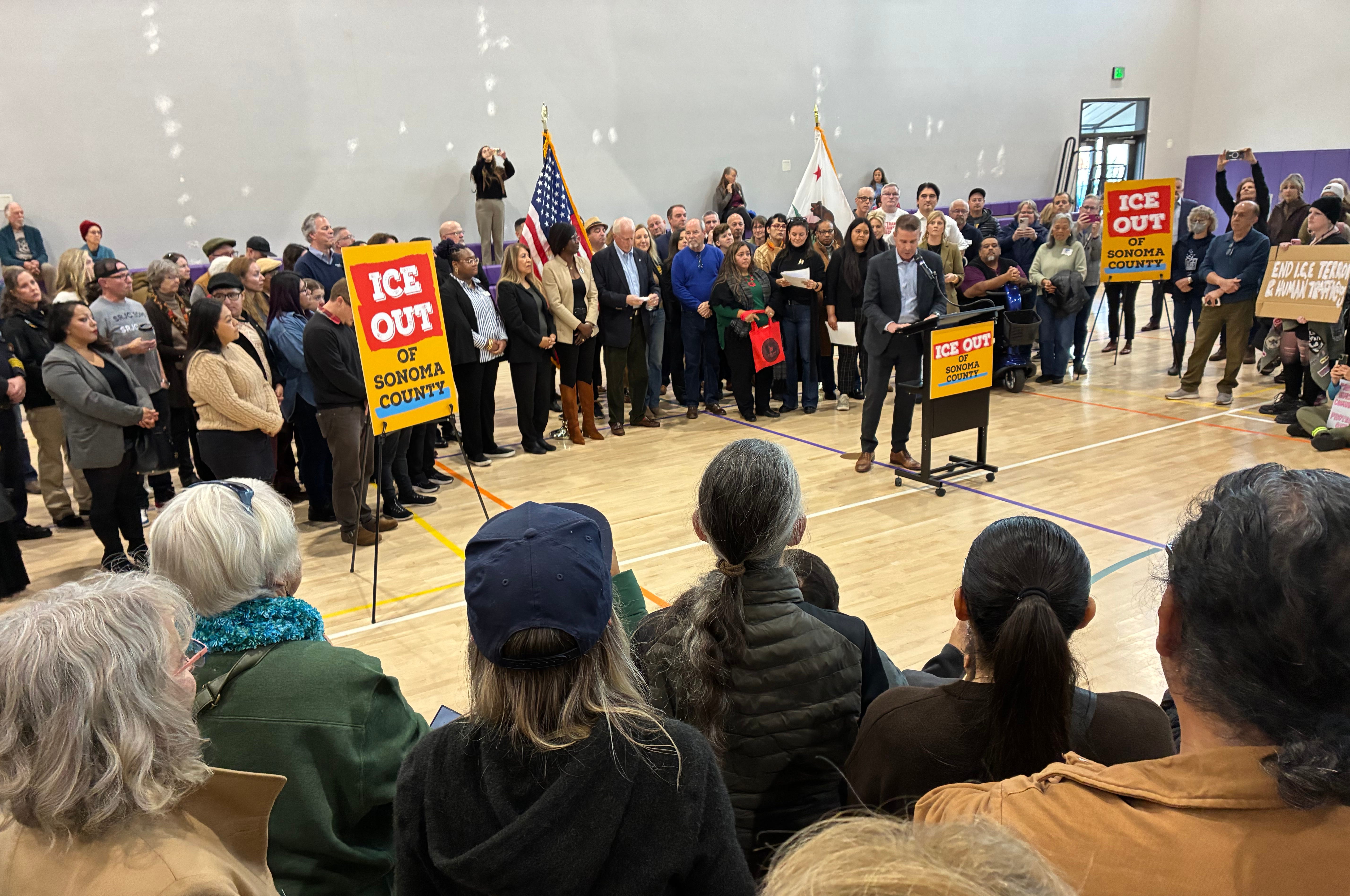
Billed as a press conference, the gathering at the Boys and Girls Club in Roseland on Sunday afternoon was more of a community rally against ICE (Immigration and Customs Enforcement), with hundreds of anti-ICE activists, concerned citizens and a phalanx of nonprofit leaders and local politicians, including Congressman Mike Thompson, soon-to-be Congressman Mike McGuire, soon-to-be State Senator Damon Connolly, and State Assemblyman Chris Rogers.
Sebastopol Mayor Jill McLewis was also in attendance, as was Councilmember Stephen Zollman, though they didn’t speak at the event.
State Senator Mike McGuire (technically he’s still a state senator until Dec. 7; his congressional term starts on Jan. 3) called ICE “Trump’s Secret Police.” He introduced a woman named Maria Salinas, whose cousin, Rafael Vasquez, was one of the people detained on Friday. Vasquez was dragged from his car in Santa Rosa, while his two-year-old screamed in the back seat.
Speaking through a translator, Salinas said, “We are calling on everybody here—on all the elected officials—to do everything we can to make sure that ICE is not coming to our community. This is a beautiful community that we have here, and we don’t want this to be happening, and we don’t want families to be separated.”
“As immigrants, we get up every day to be able to work hard to take care of our families, and we are asking you all to support us. We are strong, and we are going to continue to organize. Can we do it? Sí se puede,” she said, echoing the famous United Farm Workers slogan.
Next up was Eric Leland, a legal observer with the North Bay Rapid Response Network, who first gave a factual breakdown of what happened last Friday, Nov. 23.
“Very early Friday morning, ICE agents raided Sonoma County,” he said. “North Bay Rapid Response Network mobilized over 60 responders. Our network knows of at least 15 people taken. We know of eight people in Santa Rosa, five in Petaluma, and two in Sebastopol. Many were pulled from their vehicles on their way to work. In one case, a child was left behind [in a car]. One person was arrested on the way to a medical appointment, while another was arrested leaving a medical appointment. Two days earlier, at least 11 people were taken in Marin County. The network has received over 800 calls to the hotline since Friday morning.”
And then he told a story about his experience on Friday.
“I wanted to tell you about one thing I saw. We responded to a report of an ICE abduction on Highway 101. We were too late, unfortunately, to observe the abduction. We found their car abandoned after they were taken by ICE, and on the front seat, next to a fresh coffee and a lunch that will never be eaten, there was a piece of paper. On that paper, in handwriting, was their name. Think about what that means. In the moments this person had, with masked, armed agents at the window, they wrote down their own name and left it where someone could find it, so that they would not be disappeared, so that someone would know who to look for. This is what these ICE operations do to a community—to our community. A neighbor of ours on an ordinary morning believed he could be disappeared, and that their best protection was a scrap of paper and the hope that someone would come. Well, you know what? Someone did come. That is what Rapid Response is — neighbors trained and organized, who answer the phone and show up.”
Attorney Monica Julian, the executive director of VIDAS (Vital Immigrant Defense Advocacy and Services) gave a legal perspective on last week’s detentions.
“As an attorney, I cannot provide specific details about any particular case. I can share that as of today, all the people who are detained are accounted for, and all are afforded the opportunity to seek legal remedies available to them to be released. I can also declare that, to the best of our knowledge, not a single warrant was presented to any of the individuals who were arrested.”
Supervisor Rebecca Hermosilla clarified the legal nature of last week’s arrests: “We were first told they were doing targeted enforcement, but it turns out they weren’t. And Monica just confirmed today that they aren’t. They are lawless, and they are creating fear and uncertainty that extend far beyond the people they are detaining.”
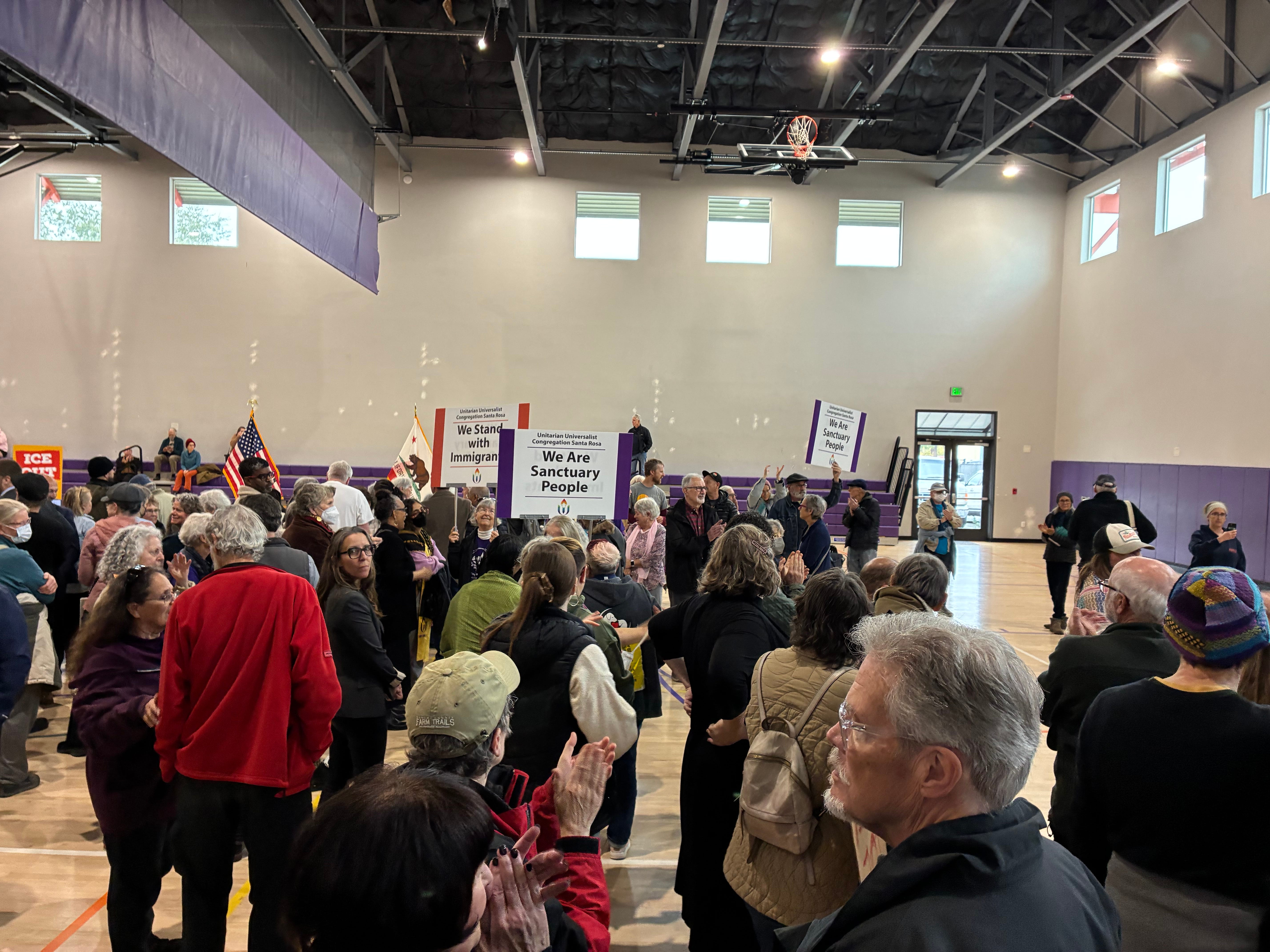
All of the activists—and many voices from the crowd—asked the politicians what they were doing to help, not just with words, but with actions.
What the county is doing
Hermosilla, who is the chair of the Board of Supervisors, said, “I’m working closely every day with our CEO [David Guhin] to ensure all of our resources are made available as quickly and efficiently as possible, and that the safety nets that we’ve been working on for the last two years are deployed quickly.”
She noted that earlier this month, the board approved $1.5 million to VIDAS and others. “This allows county departments to work together and monitor developments in real time and communicate with the community and partners and identify additional needs and resources that are needed in the community.”
“This week, the board allocated another $1.5 million to address the broader impacts of federal actions on our county,” she said. “The County activated its Emergency Response Plan. We established a virtual operations center to coordinate our response and make sure it is as robust as possible.”
She also said she had given direction to staff to review the county’s existing Emergency Financial Assistance Program to determine how the County can help households that have been directly impacted by immigration enforcement—for example, by the detention of the family’s main breadwinner.
The Board of Supervisors will vote on the Emergency Declaration on Dec. 8.
What the legislators are doing
Several legislators gave their own takes on what was happening at the federal and state levels.
Congressman Mike Thompson said, “I can proudly tell you that I voted against the creation of ICE, and I did that because I believe that this is what was in store for us if it were to be created. And sadly, I was right. I’ve never voted to expand their powers. I’ve never voted to expand their funding. I have voted to reduce their powers. I have voted to reduce their funding, and, until the last day I’m in Congress, I will continue to fight with you to ensure that happens … ICE should never be allowed to wear masks or not be required to wear body cameras and most certainly not be able to drag you out of your house or your car or off the street without a signed judicial warrant.”
“If anyone needs anything from my office, please call,” he continued. “If you have family members, loved ones, neighbors who have been detained, please let me know. We can intercede. We can help get those names, get those locations. So please continue to do that and continue to speak out. Continue to stand up. Let’s create some good trouble.”
Incoming State Senator Damon Connolly said he was proud to be a part of a Democratic Legislature that has created “more than 20 bills to rein in ICE and hold their offenses accountable.” He mentioned three bills signed into law in September.
AB1807 prohibits state-owned property from being used for immigration enforcement purposes.
No Kings Act (Senate Bill 747) allows individuals in California to file civil lawsuits against federal officers—including ICE and U.S. Border Patrol agents—who violate their constitutional rights.
AB 1633 imposes a 25% annual tax on the gross income of private detention facility operators starting July 1, 2028, and directs those revenues to the ‘Due Process for All’ Fund for immigration-related services.
Connolly also mentioned another bill, AB 1896, known as the GTFO Act, which would have prohibited ICE officers hired during Donald Trump’s term of office from becoming peace officers or public employees in California. Though approved by the legislature, this bill was vetoed by the governor as a “step too far.”
When Assemblymember Chris Rogers spoke, however, he doubled down on the idea.
“Here in California, we have put a statute that your willingness to be an ICE agent, your willingness to terrorize our communities, is in and of itself a character flaw that has disqualified you from ever holding a position of power in California,” he said. “I have a two-year-old, and after hearing the stories—not just the terror of an individual being dragged from their car, but thinking how my child would have felt sitting alone in the middle of traffic with no one around—the level of inhumanity that you have to possess to be willing to do that tells us why you should never be in law enforcement, never hold a position of power.”
“My message to all of those ICE agents is really simple: you may think that when this administration changes, you can slink back into the shadows,” he said, “but I assure you, your employment with ICE is a stink that California will never let you scrub off. Accountability is coming.”
What law enforcement is doing
Santa Rosa Police Chief John Cregan, introduced by Mike McGuire as “one of the good ones,” spoke on behalf of his department and other police departments in Sonoma County in saying, “This is very emotional for me to hear what’s going on. This is very educational for me as a chief to be able to hear the pain in our community and be able to bring back to our law enforcement leaders. What I’m here today to say is one simple thing: local law enforcement officers are never going to be involved in immigration enforcement.”
While he spoke, the crowd shouted about Flock cameras, and at least one person loudly asked why local law enforcement wasn’t taking up arms against ICE to protect local community members.
One local law enforcement agency that was notably absent from the proceedings on Sunday was the Sonoma County Sheriff’s Department, which has long been accused by activists of collaborating with ICE.
Although the Sheriff’s Department has not involved itself in immigration enforcement efforts, it has cooperated with ICE by letting them know when certain undocumented immigrants were being released from jail.
On Monday, Nov. 24, Sheriff Eddie Engram announced changes to this policy, announcing a zero-voluntary-contact approach. We are publishing the notice in full:
In response to increased federal immigration enforcement activity in Sonoma County over the past week, Sheriff Eddie Engram announced changes to the Sonoma County Sheriff’s Office’s policies regarding cooperation with U.S. Immigration and Customs Enforcement (ICE).
Effective immediately, the Sheriff’s Office will adopt a zero-voluntary-contact approach to civil immigration enforcement, further limiting cooperation with ICE beyond what is required by law.
“Our responsibility as a Sheriff’s Office is to protect and serve everyone in Sonoma County, regardless of their immigration status. For law enforcement to be effective, people need to trust that they can call us when they need help, report a crime, or cooperate as a witness without fear that their interaction with our deputies will lead to immigration enforcement. Sonoma County is home to people from many backgrounds, cultures and immigration statuses. The Sheriff’s Office is committed to serving all members of our community and prioritizing public safety without regard to immigration status,” said Sheriff Engram.
Under the new direction, the Sheriff’s Office will no longer provide those voluntary notifications.
The policy changes include:
Release notifications: The Sheriff’s Office will no longer voluntarily notify U.S. Immigration and Customs Enforcement (ICE) of inmate release dates or times, including in cases where notification is permitted under California’s SB 54.
Detainers and transfers: The Sheriff’s Office will continue its existing practice of not honoring civil immigration detainers, extending custody, or voluntarily transferring individuals to ICE for civil immigration enforcement purposes.
Administrative warrants: The agency’s existing policy remains unchanged. ICE administrative warrants, including Forms I-200 and I-205, do not authorize detention or access to restricted areas.
ICE interviews: Staff will no longer arrange or facilitate inmate interviews for civil immigration enforcement purposes.
Judicial warrants: The Sheriff’s Office will only comply with valid judicial process and other legal requirements.
Documentation: All requests from ICE will continue to be documented.
These changes do not affect the Sheriff’s Office’s obligation to comply with valid judicial process or communications required by law.
While California law permits certain forms of cooperation with federal immigration authorities, it does not require the Sheriff’s Office to engage in all forms of permitted cooperation. Sheriff Engram has determined that the agency’s involvement in civil immigration enforcement will be limited to what is legally required.
The Sonoma County Sheriff’s Office remains committed to transparency, public safety, and serving all members of Sonoma County.
California’s SB 54 limits how local law enforcement, schools and hospitals interact with ICE. In the case of law enforcement, it forbids them from asking about immigration status, forbids arresting people for immigration violations, and limits data sharing with ICE.
SB54 does have some exceptions to these rules, however. It allows law enforcement to voluntarily contact ICE if an individual has been 1) convicted at any time of a serious felony, a violent felony, or a felony punishable by imprisonment in state prison; 2) charged and arrested for a serious, violent, or state-prison felony and a judge has found probable cause to hold them to answer for the charge; 3) the person is a current registrant on California’s sex offender or arson registries.
Unfortunately, SB54 also gives law enforcement leeway to contact ICE for lesser crimes as well. You can see the full list here.
SB54 does not require law enforcement to contact ICE in these cases, it simply allows them to voluntarily do so.
To be clear, the Sonoma County Sheriff has just announced that it will no longer voluntarily contact ICE in any of these cases. This no-contact policy has been a longtime goal of immigration activists in Sonoma County, though it may prove less popular with the general public. A 2025 poll from the Pew Research Center found that 97% of respondents supported deporting violent criminals.
Onward…
The event finished with more stirring speeches. Ana Lugo, who came to the United States when she was 12, asked everyone to link arms.
She said, “Community, these leaders behind me are standing with you. We are linking arms so you can safely walk our babies to school, so you can safely go to work to make an honest living, so you can visit your neighborhood market and shop in peace. So you can walk outside your door and take a full breath, knowing we are here with you, creating human barriers with our bodies, our property, our policies, and our institutions. To each and every person who, like me, is rightfully afraid, in this moment we cannot hide. We cannot go inward. I stand here with you, saying we are worth being visible, and we will never ever hide again.”