

With the new school year underway, and with students returning to a phone-free environment for the first time at the three high schools in the West Sonoma County Union High School District, it is usually a time for renewed optimism on campus. However, the first school board meeting of the year on Wednesday night proved a rough start to the school year, which was just five days old. It was also a reminder of the difficult cuts that were necessary last year to reduce the District’s structural deficit, cuts that always leave parents, students and staff on edge.
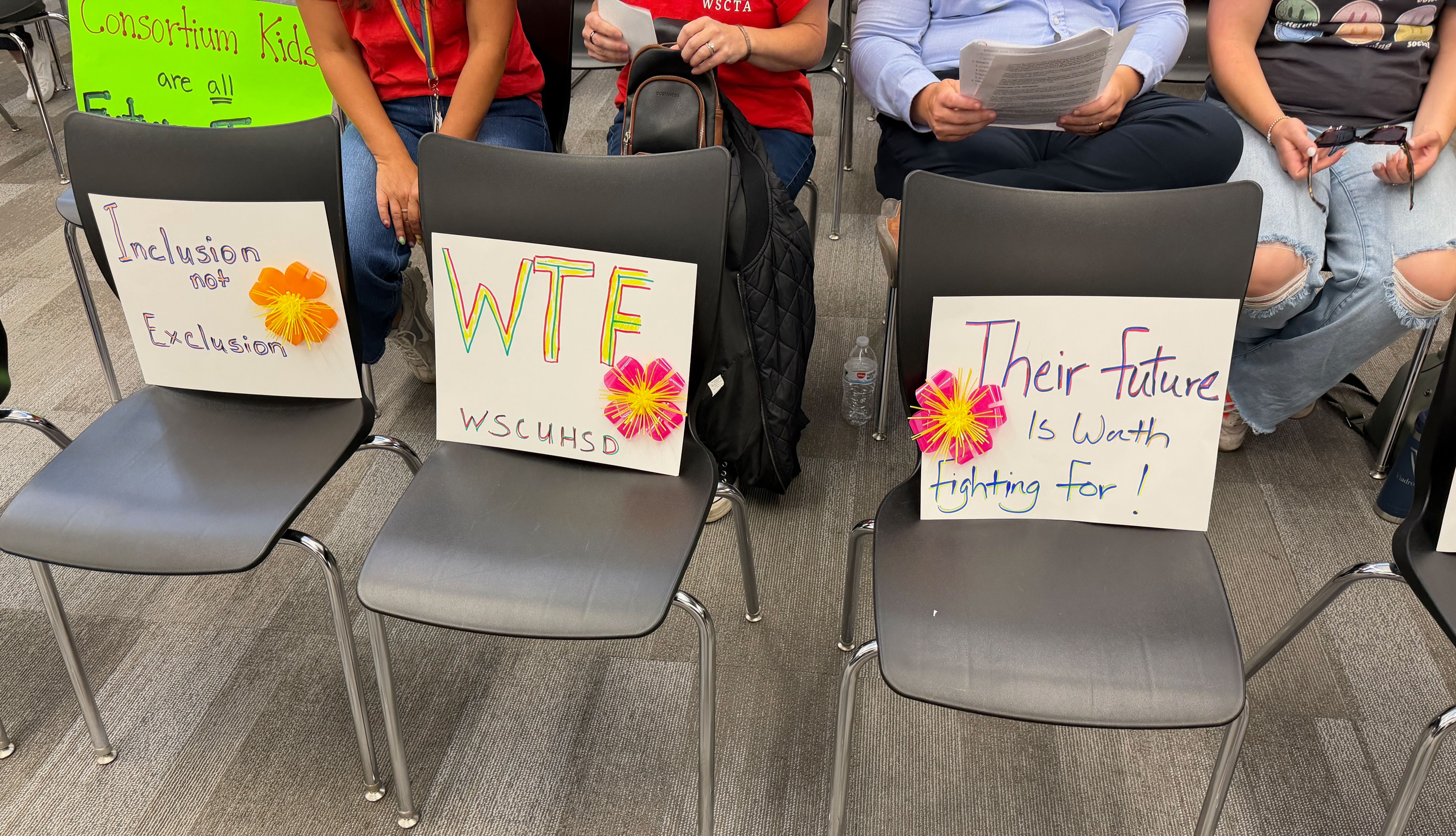
The Analy library was packed well before the meeting started with parents, some students, faculty and staff, some carrying homemade protest signs. Most but not all in the audience were there to oppose the third item on the agenda — a resolution for the District to exit the West County Consortium that provides special education services to nine West County school districts.
Only four of the five trustees were present, and it wasn’t until much later in the meeting that Board President Jeanne Fernandes announced that Trustee Rio Kuteira had resigned from the board earlier that afternoon. (Kuteira is relocating out of the area.) The board will have to appoint someone from Area 4 (Graton/Forestville area) to serve out the remainder of his term.
The District asked the board to approve its early exit at the end of this school year from a Memorandum of Understanding (MOU), under which it served as the administrative lead for the West County Consortium. The District has been the local education agency (LEA) for the Consortium for over 20 years, receiving special education funding and hiring employees who provide the services.
The twist, if you will, is that the Consortium by design serves elementary districts such as Twin Hills and Sebastopol Union, not the students at the District’s high schools. (A few Consortium employees such as a nurse and occupational therapist serve Analy students, but the high school has its own special education teachers for its special ed students.) A decision by the District to exit the Consortium would require a transition to another LEA (likely another school) to take over the administrative role.
The main argument (separate from the more emotional arguments) was whether the District could exit the MOU ahead of its contract, which runs through the 2027-2028 school year. The legal argument was whether California ED code allowed them to exit early. The moral argument was whether they should leave special education programs in limbo, without having a plan agreed to by the Consortium members that fully prepares for their exit.
As the meeting began, Superintendent Chris Meredith asked to remove the Consortium Resolution from the agenda, and the board agreed. Those who turned out to oppose it seemed to sigh collectively in disappointment. Board President Jeanne Fernandes said that those in the audience could speak to the issue in public comment, and 25 speakers did so for over an hour.
The other issue that brought people out to this meeting was the administration’s decision to eliminate the fall stipends that pay teachers who lead a variety of extracurricular programs — drama, band, intramural sports, speech and debate. These stipends, in the amount of roughly $4,900 each, support programs that students and their parents value as much if not more than the standard academic fare.
The future of the West County Consortium
The West County Consortium was organized to allow West County elementary school districts to share resources across many districts and serve special needs students. The most important resources are the 39 staff members, which includes speech and language pathologists, behavior assistants, nurses, psychologists and others who are District employees.
Concerned parents showed up at the meeting to express the importance of special education for their children. Melissa Stagg, the mother of 3-year-old and a 12-year-old, said that she had seen the Consortium go through good times and bad times but “the last two years have been a golden age.” She credited Consortium Program Director, Sarah Zils, for “repairing relationships with parents.” Stagg chastised the board for using the word “advantageous” in the resolution, which said that the program was “determined to no longer be financially or programmatically advantageous for the District.” She said that there should be no consideration whether providing these services was advantageous to the District; they were required by law and essential for the children who are served.
Jed Loveday-Brown, a father of a 13-year-old “who thrived within the West County Special Education Consortium since kindergarten,” wrote to the Board:
Beyond the administrative logistics, maintaining our stewardship of this consortium is simply the right thing to do. WSCUHSD is the single regional body unifying all West County TK–8 feeder districts. Because every student in these programs ultimately transitions into our high school district, we have a civic and moral responsibility to lead. Walking away from administrative oversight sends the wrong message to our community—that supporting our most vulnerable students is a burden to be passed off, rather than a core duty we proudly uphold.
A parent of a six-year-old, Jill McDonald pleaded that the District get parents involved in the discussion about the Consortium’s future. “Please,” she said, “bring me into the discussion.”
Consortium employees spoke up. They argued that the ED code prohibited the District from leaving the Consortium on short notice. They asked for more time for the Consortium to come up with a plan for moving forward. They wanted the District to honor its MOU, which runs through the 2027-2028 school year. Susan Beyrano, a speech therapist, said she was “very disappointed” that the District would consider exiting the Consortium early. She held a poster that said: “Transition with Integrity in 2028.” Mariko Wesley-Fagundes, an education specialist, asked the board to consider “continuity and consistency” and to give the Consortium more time.
Amanda Reece prepared a concise and clear statement outlining the issues for the opposition.
My name is Amanda Reece, and I am a West County resident, Analy graduate (Class of 2000 — “Go tigers!”), Speech Language Pathologist entering my 14th school year with the district, and proud parent of a 6th grader in our Consortium Middle School class and 8th grader at Brook Haven, both bound for Analy in the near future.
The district’s current MOU with the consortium is to remain the LEA through the 27/28 school year. The proposed expedited timeline does not honor the district commitment nor does it meet ed code requirements. Ed Code requires a 2-year timeline to transfer special education programs out from under an LEA. The proposed expedited timeline on the resolution of one year prevents adequate planning time to address all the complex issues entailed in this transfer to support the best possible outcomes for students.
I find the wording of the resolution very troubling. Particularly the phrase “no-longer financially advantageous,” like the value of a student should be measured in what income they bring to the district. And while you are deciding later this evening to dedicate financial resources to recruiting new students from out of district to “build community,” you seem so willing to abandon this vulnerable community right in front of you. These students are all future Tigers. These parents, all West County voters. Why are some students to be courted to our “destination district,” while the ones who already live here are being pushed out on a timeline that shows little care for what comes next for them.
Consortium programs are growing as is our staff. Our dedicated staff deserve a well-planned transition as well. The Consortium council and our special education director are dedicated to retaining staff in this transition as they understand that there is a direct correlation to quality staff and student success. The continuity of programming is extremely important for these vulnerable students. A 2-year transition plan will give adequate time for both staff and parents to be part of the planning process, which is also required by ed code.
Twin Hills Board President Jeff Harding said that he decided not to comment, given that the Board had taken the resolution off the agenda for the evening. He said he would follow up by sending the board “a list of questions that should have been answered” before the resolution came before the school board.
WSCTA union president, Lily Smedshammer, said in her report to the board that legal counsel for CTA had issued a “Cease and Desist” letter to the District on its proposed exit from the Consortium, saying it “doesn’t satisfy statutory requirements.” Superintendent Meredith said the District and its lawyer would review the letter but their own lawyers had said that the Ed Code that was cited did not apply to consortia.
Smedshammer also addressed the loss of stipends, saying that in its history, even when the District was under qualified status, “it had never touched the stipends.” She said a $4,900 stipend each for four or five programs was such a small amount.
Stipends for extracurricular leaders
Several of the teachers most affected by the loss of stipends addressed the board. Nancy Williams, in her 27th year at Analy, runs intramural sports programs during the lunch period at Analy. She had trouble getting her emails answered over the summer, asking about stipends, and then she suddenly learned that stipends had disappeared altogether.
“Kids need things to do,” she said.
She pointed out that teachers do a lot of volunteer work already and mentioned that she worked with kids during the summer on volleyball “because I love the kids and I love volleyball.”
Music teacher Casey Jones said he was asked to choose one stipend or the other, choosing marching band in the fall or spring band. Jones, who has spoken proudly of the music program and the arts at previous board meetings, was visibly shaken by this loss to his music program and what it means for students.
Lily Borgeson, director of the theatre program, was also upset at the loss of her stipend for the fall, which would normally cancel the fall play. She decided, given the preparations already underway and the expectations of her students, that she would go ahead with it anyway on a volunteer basis. “I will not do it again next year,” she said, fuming. (“Radium Girls” opens the first week of November.)
Speaking about the importance of the arts to students, one parent said: “Casey Jones is helping me raise my kids,” she said, smiling. She was talking about the life skills and coaching he provides. Another parent said that “Every kid deserves a place to feel they are good at something,” and drama was that place for her daughter. She was disappointed to see Analy make cuts in the arts, including choir, band and drama. Katie Snyder, a grandparent, asked if cuts could be made elsewhere that don’t affect these programs.
One student spoke about the importance of Speech and Debate Club; the loss of the stipend meant that they wouldn’t have a coach. It’s hard enough to recruit a coach, she said, even with a stipend. Without a coach, the team could not travel and participate in contests. She said that being in Speech and Debate after school gave her a community to belong to and helped her earn a $500 college scholarship.
Zac Shuford, the president of the Analy Band Wagon, spoke about the loss of a stipend on the music program:
The hard work that Mr. Jones puts into these events and programs, and the immense benefit to his students warrants his compensation for his time and expertise. It is truly tragic that we are having discussions about whether to do the Apple Blossom parade or have the marching band play at the Warriors game, or have the jazz band play at the Sebastopol tree lighting, or have the honors band attend anything at all. It seems ridiculous that we are having this discussion over $4,994, a pittance in comparison to millions of dollars the district will spend in the coming fiscal year.
Shuford also looked at the school’s budget and questioned whether the district was spending all of its Prop 28 funding for arts education:
I found that California had approved $263,368 worth of expenditures to grow the arts programs for the West Sonoma County Union High School district, and that this year’s proposed spending of prop 28 money is $200,000. If we are cutting music and arts programs, and also spending less of State funding specifically designated for arts programs, I would ask the board to clarify where they are spending Prop. 28 funds.
Neither the administration nor the board addressed the loss of stipends during the meeting. In a follow up call, Board President Fernandes said that the board will work with the Superintendent on the District’s role in the Consortium and the loss of stipends for extracurricular programs. Sebastopol Times wrote the Superintendent and the Chief Business Officer to ask them to account for Prop. 28 spending.
Raise for administrators approved in June
At the June 24th board meeting in the summer, the board approved a raise for the Superintendent and other administrators for the District.
HR Director Dan Blake said that “Currently, of the 15 school districts in Sonoma County with more than 1,000 students, only three superintendents have served for five or more years.” Superintendent Chris Meredith was entering into the last year of his contract. For reasons of stability in the District and recognition that its schools are in a better place than they were before Meredith arrived, the Board sought to extend a new 4-year contract to the superintendent. This contract would raise his annual salary from around $247,000 to $270,000 annually, and he would receive a 2.6% annual increase each year. The board also approved raises for the Chief Business Officer Andrew Soliz ($225K). The Human Resources Director, two principals and eight other administrators including the Director of West County Consortium were given raises (a 3% raise and two-step increase on their salary schedule). The board’s argument is that it’s a competitive market for administrators — if you don’t pay them, you won’t keep them.
WSCTA president Lily Smedshammer said she was “shocked” by the pay raise for the superintendent. She said that a survey of union members showed “only 12.1% of our respondents were in favor of extending Superintendent Meredith’s contract with a multi-year agreement.” Trustee Fernandes later challenged Smedshammer that only half of the members had filled out the survey, and the questions were designed to elicit negative feedback.
Smedshammer said she was opposed to the multi-year extension, and the Board should use the one year remaining on Superintendent Meredith’s contract to see if he will “demonstrate the professional growth, relationship building, and connections with staff and school sites that many educators have been hoping to see over the past three years.” She said that “it was out of line to pay a superintendent more than twice your highest paid classroom teacher.”
Trustee Lewis Buchner spoke directly to the union president. “I don’t understand the animus,” he said. “I feel like the board’s job is the big picture of what’s in the best interest of the students. There has been a lot of criticism from certain members of the faculty regarding Chris.
“Mostly what I can hear are three things.
People don’t like his tone, which is very hard to quantify.
They don’t think that he treats women fairly, but we have five very, very high rank administrators in the district that are women.
He doesn’t spend enough time at school events, which can be addressed but is not the highest priority.
“The high priority is establishing a really amazing team, which he has, and keeping us fiscally solvent, which he has. And it seems that there’s spoken unspoken effort that says that the board’s not doing a good job of managing the superintendent and that he really should be fired. Can you imagine the chaos that would cause?
“The big problem facing the district right now is enrollment. Right now we have 1,550 students, and in three years, it looks like we’re going to have 1,300. It’s a 250-student decrease at $15,000 each. It is $3.6 or $3.7 million. That’s what’s going to lose jobs. That’s the big problem. We really need to be working together.”
Other items
Construction on the CTE Building at Analy finished and is now in use by teachers and students. There will be a grand opening for the community on Sept. 29.
Dawn Drew, Administrative Assistant at Laguna High School, is the new president of the local chapter of the California School Employees Association (CSEA).
Superintendent Chris Meredith said that he didn’t see cell phones on campus as he walked around during the first few days. He said: “We found out that we have to increase the volume of bells because there’s more human-to-human interaction in the hallways.”
The Analy Alumni Association will have a ceremony on Sept. 11, 2026, around the installation of the Vietnam Memorial Plaque that recognizes six Analy graduates who lost their lives in the war.
Brandon Lau, a senior, is the new Analy Student Representative to the school board.
Don't underestimate the challenges that administrators face and the difficulty of their jobs as leaders and problem-solvers, especially under the constraints of the public school system. Look at Santa Rosa City Schools if you want to see what happens when you have leadership that makes poor decisions or fails to make hard decisions.
Thank you for covering this thoroughly. Our daughter started at the Consortium from the age of 3, in fact it was the day after her 3rd birthday that she went to preschool, so she could receive the early intervention she needed, as a non speaking, non ambulatory child with CP. The Consortium allowed our daughter to receive an education that met her needs in so many ways. She walked with her teacher across the lawn at Twin Hills for her 8th grade promotion (Thanks Ms. Wesley-Fagundes!)
She is now a senior at Analy, in the ESN class, which is no longer a member of the consortium, but had been for many years prior to withdrawing about 4 years back. The value of having a disabled child going to a local school with the supports they need, with the incredible and amazing, highly trained and dedicated teachers and staff that the Consortium retains, is immeasurable. At a time when so many of the safeguards and rights for people with disabilities are being dismantled at the federal level, and in many states, we have an opportunity to do right by ALL of our students. Thank you to all of the community members that came to that meeting, supported, spoke, and stood up for our kids. Kids like mine. As disabled disability rights activist Judy Huemann said, “True leadership means advocating for those who do not have a voice.”
I see leaders within our community, but so far this year, I don’t see them sitting at that long table in the front of the room.