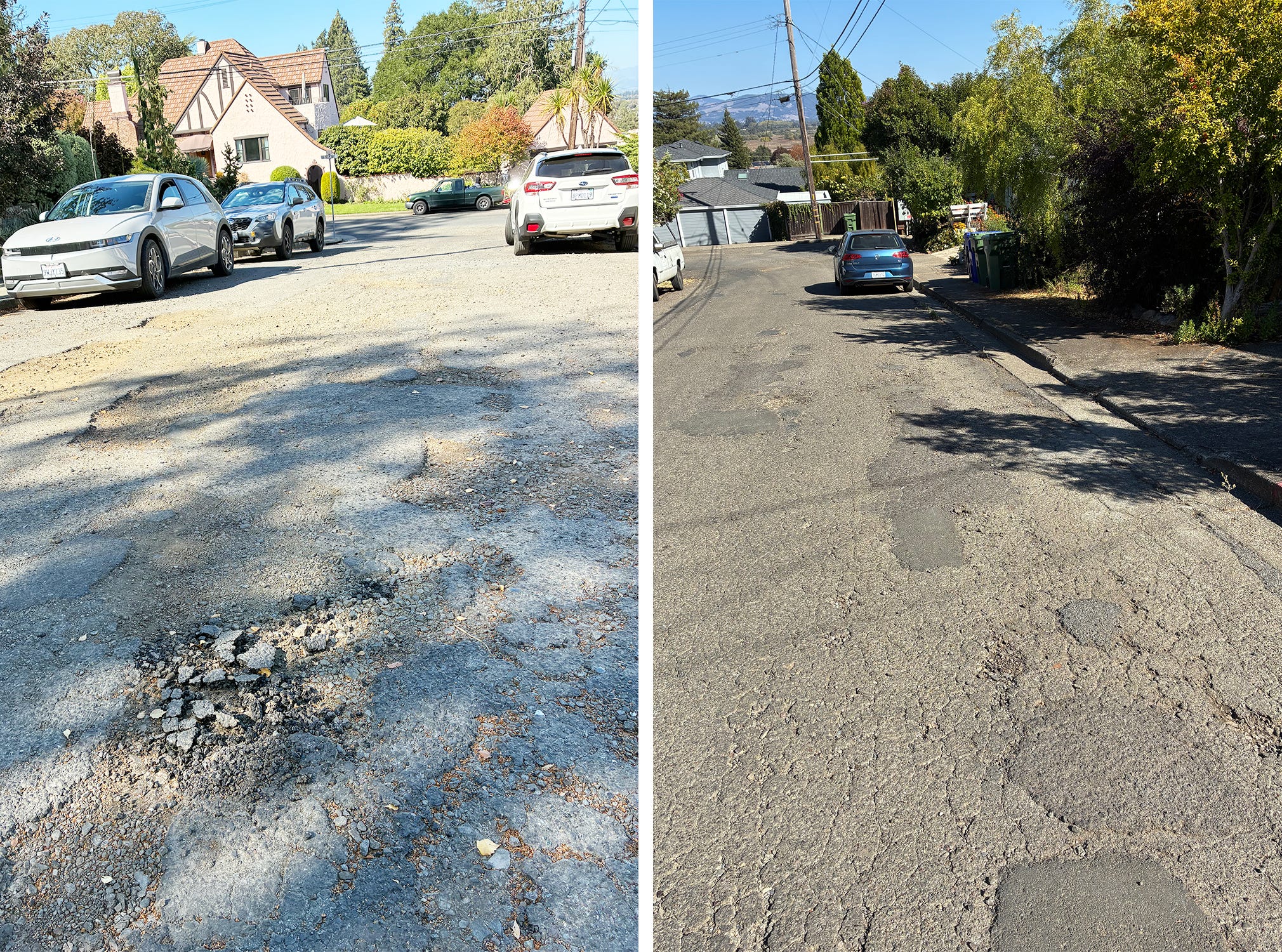
At last week’s city council meeting, Public Works Director Oriana Hart laid out her plans to repair Sebastopol’s streets. It’s a daunting task. The City's current Pavement Management Plan estimates it would take $20.8 million to fix all the streets in town. As the staff report drily points out, “The City's planned pavement funding is substantially less than this amount, requiring the City to prioritize which streets are addressed and when.”
This year, 2026-27, the City has budgeted over $1 million in paving work to be done before next July: $612,800 for the citywide pavement repairs and repaving, funded through Measure U, plus another $450,000 from Gas Tax, SB1 Funds, and Go Sonoma Funds.
Hart gave an interesting presentation on the state of the city’s streets and her paving strategy for the next three years. To start, she gave a brief refresher on the “Pavement Condition Index,” a 0 to 100 rating system for grading road quality.
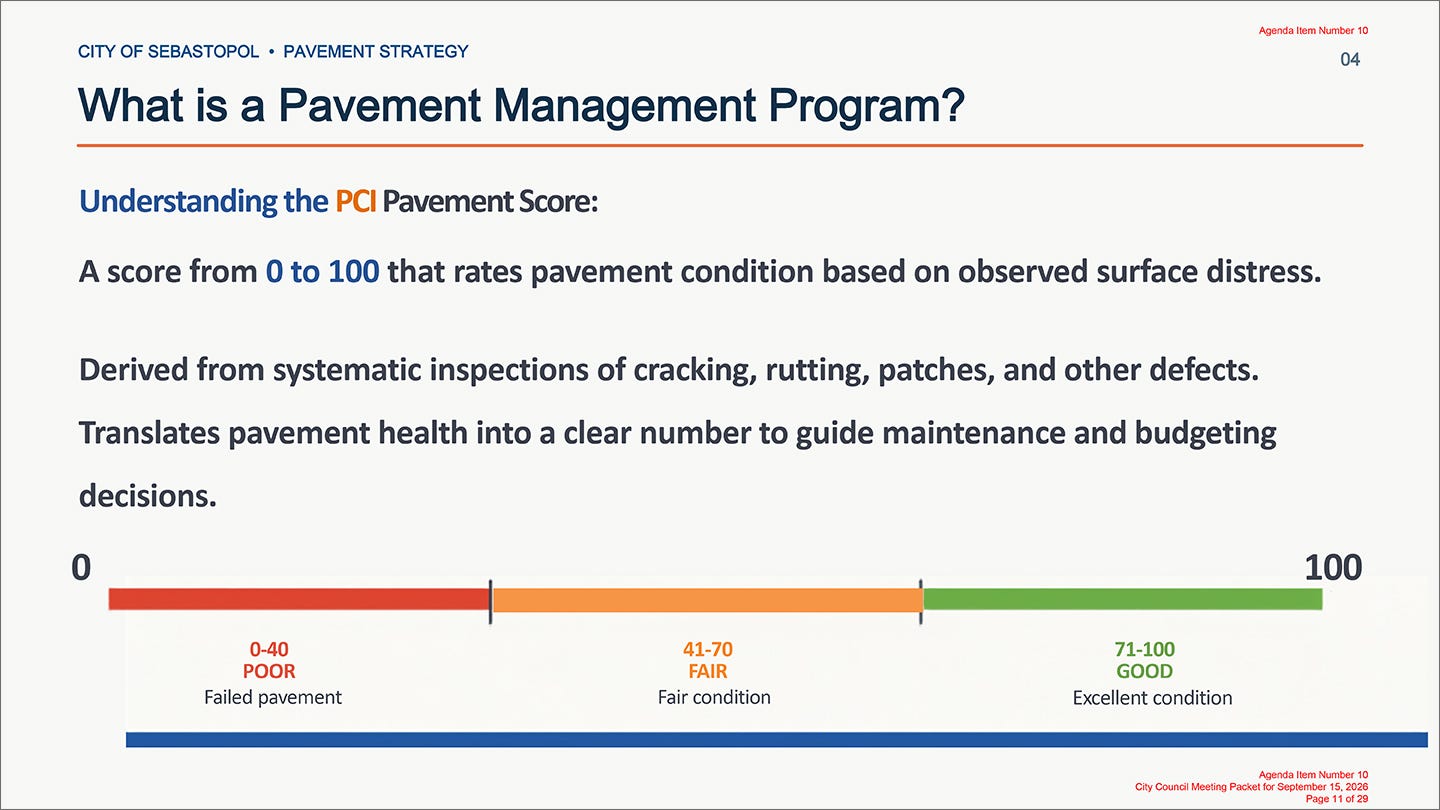
According to the staff report on this item:
Approximately 41 percent of the network is in Good condition;
Approximately 19 percent is in Fair condition;
Approximately 22 percent is in Poor condition; and
Approximately 19 percent is in Very Poor condition.
Hart then discussed how she chose which streets to prioritize. It’s important to maintain heavily used roads, of course, but then, she said, “We also need to figure out how to prioritize our very, very bad roads, neighborhood streets, and roads that would never ever reach the recommendation of a traditional pavement management plan to be repaired. So what I did is I took the pavement condition index at zero to 100, and then I went through all of our other planning documents: the active transportation plan, our safe routes to schools. I looked at which roads are on major travel thoroughfares, which ones are near schools, hospitals, how many parcels they serve, and whether or not we have priority infrastructure projects [i.e. sewer or water repairs] under the roads.”
She combined all those factors into this spreadsheet:
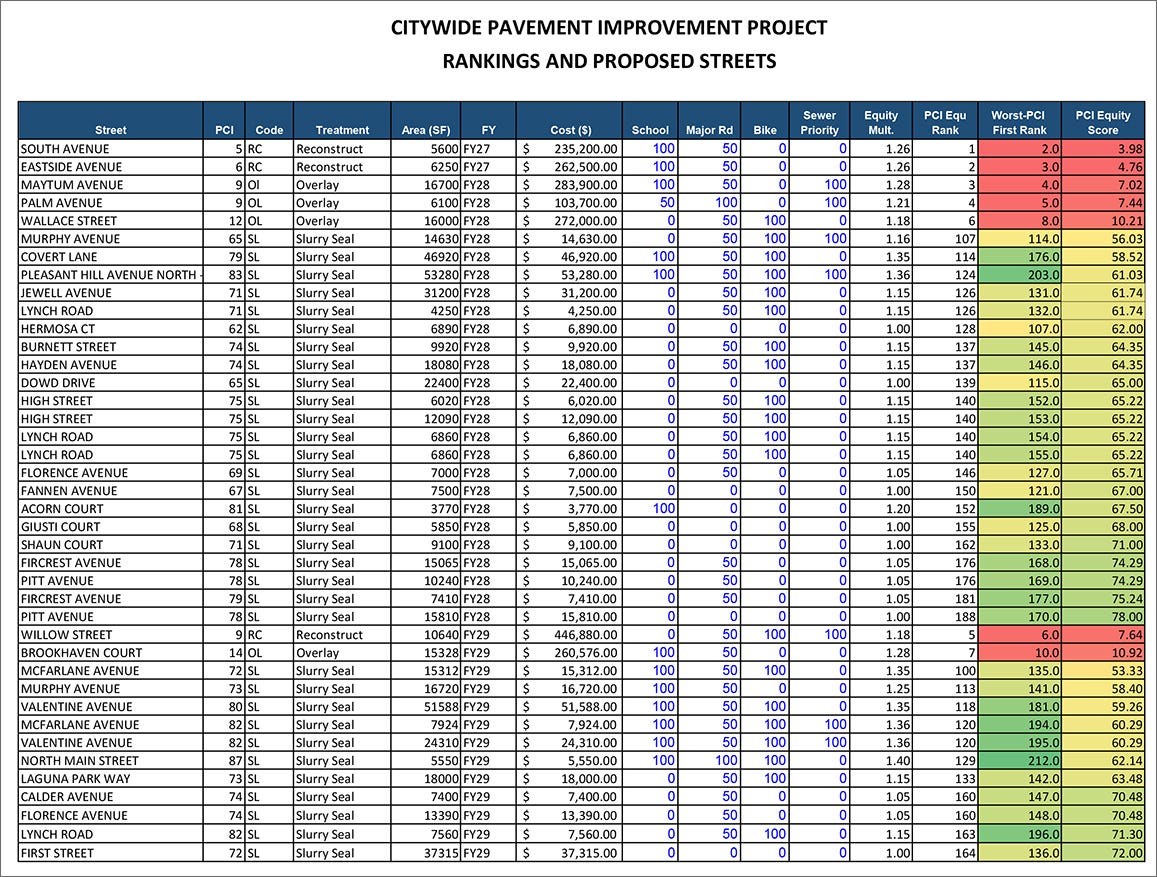
And the lucky winners for this year are Eastside Avenue and South Avenue.
“My recommendation for this current fiscal year is that we do reconstruction on Eastside and South. Those are two of our worst streets after Strout, and they’re near major thoroughfares. They’re on school routes, and we have some sewer infrastructure projects in there that have already been identified.”
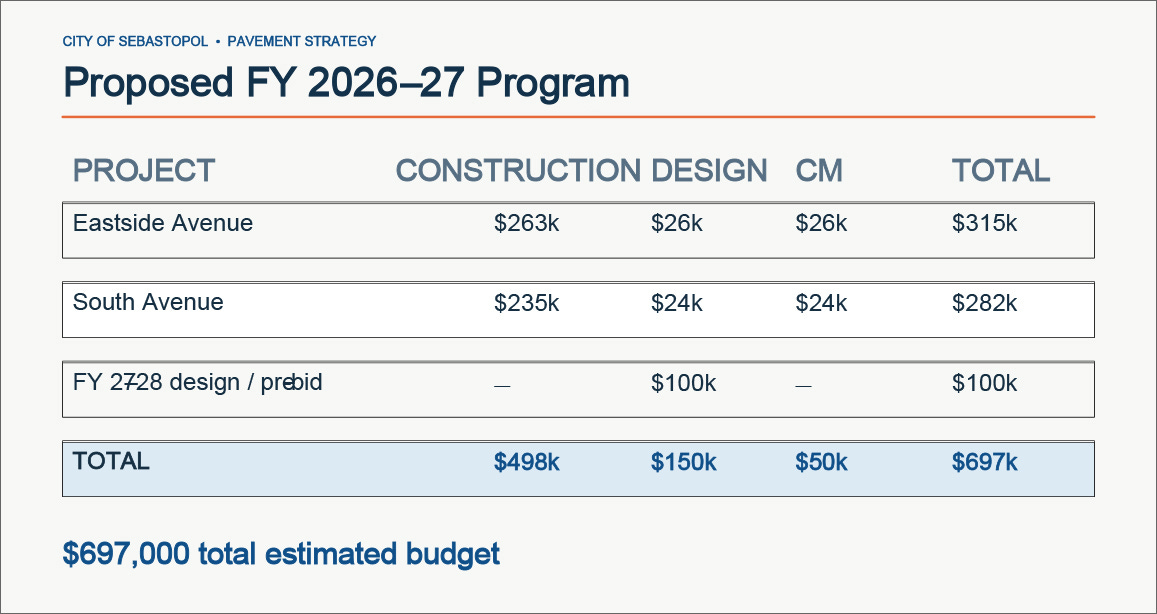
Hart said she was also looking ahead—paying for the design phase of next year’s repairs with this year’s dollars.
“I also have a design pre-build amount that I’d like to use some of this year’s capital money to do. So when we had this discussion in the spring, and the council recommended that we move forward with Strout—and we did, but we had to put out an RFP for design, and then we had to make that contract happen. We’re in design— it’s near completion — but we’ve substantially lost the pavement window for reconstruction. By the time we put out to bid right now, it will be the middle of winter.”
What this means is that the reconstruction of Strout Street that was OK’d this spring probably won’t get done until next spring or, depending on the weather, next summer.
In case you’re wondering why a short, block-long street like Strout would require a formal design process—as opposed to a quick replacement by a competent road construction crew—I asked Hart to explain.
“Even though Strout is only a block long, there is more to it than simply repaving the street,” she said. “We need to evaluate the existing pavement and underlying conditions, drainage, grades, utilities, and the appropriate reconstruction approach. There is also a formal contracting process for public works projects. Under the State’s bidding requirements, projects over $220,000 require formal bidding and plans and specifications. The design gives contractors a clear scope to bid and gives the City a basis for making sure the project is constructed correctly. So the design process is really about making sure we are addressing the underlying issues and spending the City’s money wisely, rather than simply putting down new pavement.”
To make sure that future street repairs don’t get held up over the winter, Hart has a plan.
“To prevent that from happening next year, if we can get approval for both the recommended streets for 26/27 and 27/28, I can put those streets into design and have them pretty much ready to issue a notice once we have budget approval July 1st of next year.”
Here’s what next year’s pavement plan looks like:
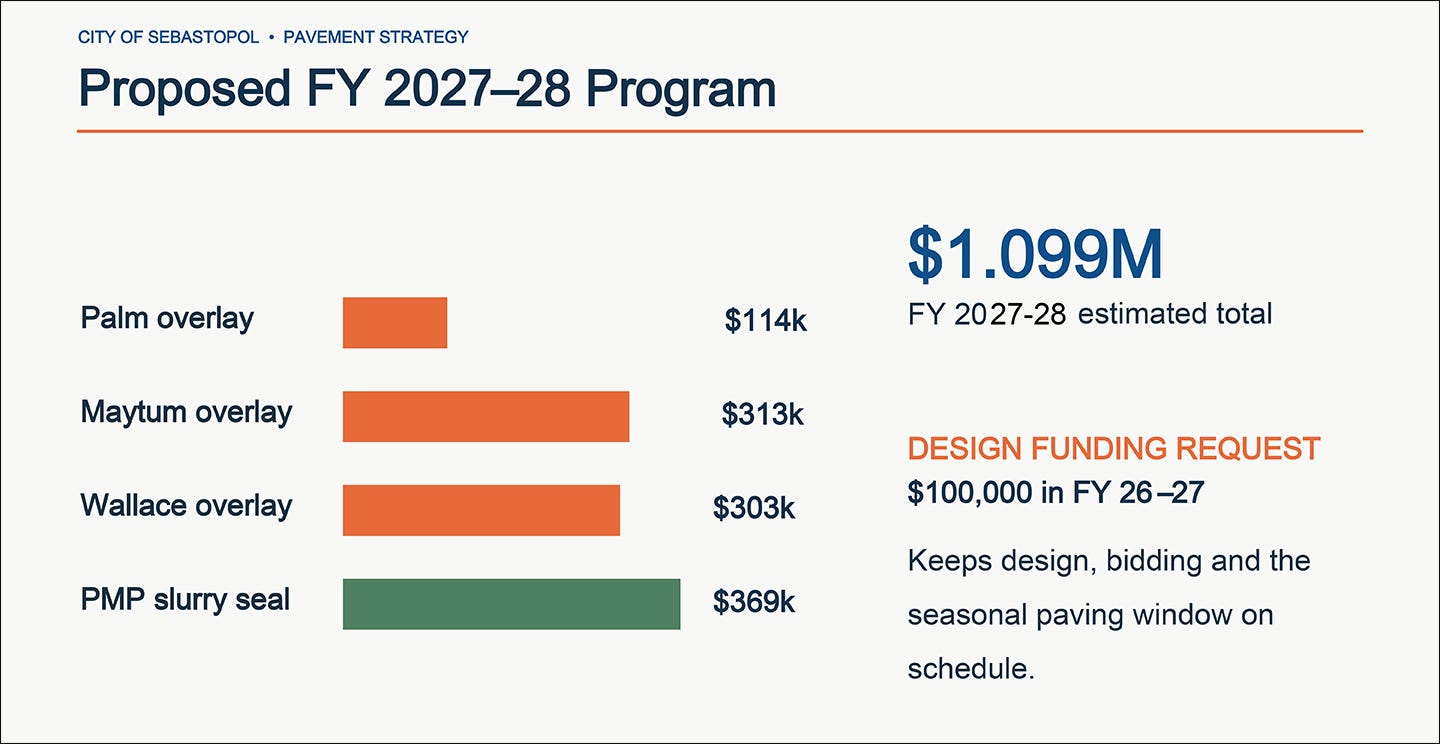
What’s the difference between a slurry seal and an overlay? According to Sonoma County Public Infrastructure, an overlay (which is what’s scheduled for Palm, Maytum, and Wallace in the slide above) is a layer of Hot Mix Asphalt (HMA) applied over existing pavement, often after milling or grinding the old surface. Used for roads needing major resurfacing, it can extend pavement life by 15+ years.
A PMP slurry seal is a mixture of water, asphalt emulsion, fine aggregate, and additives spread over the surface about a quarter inch thick to seal and protect pavement that’s in relatively good shape. Hart said that the streets scheduled to get a slurry seal in 2027-28 include Hermosa Court, Dowd Drive, Fannen Avenue, Giusti Court, Shaun Court, Murphy Avenue, Florence Avenue, Lynch Road, Jewell Avenue, Pitt Avenue, Burnett Street, Hayden Avenue, High Street, Fircrest Avenue, Acorn Court, Covert Lane, and Pleasant Hill Avenue North.
Here’s a map of all the projects in the Citywide Pavement Improvement Plan for 2026 to 2029. The solid lines indicate more serious repairs, while the dotted lines are surface repairs.
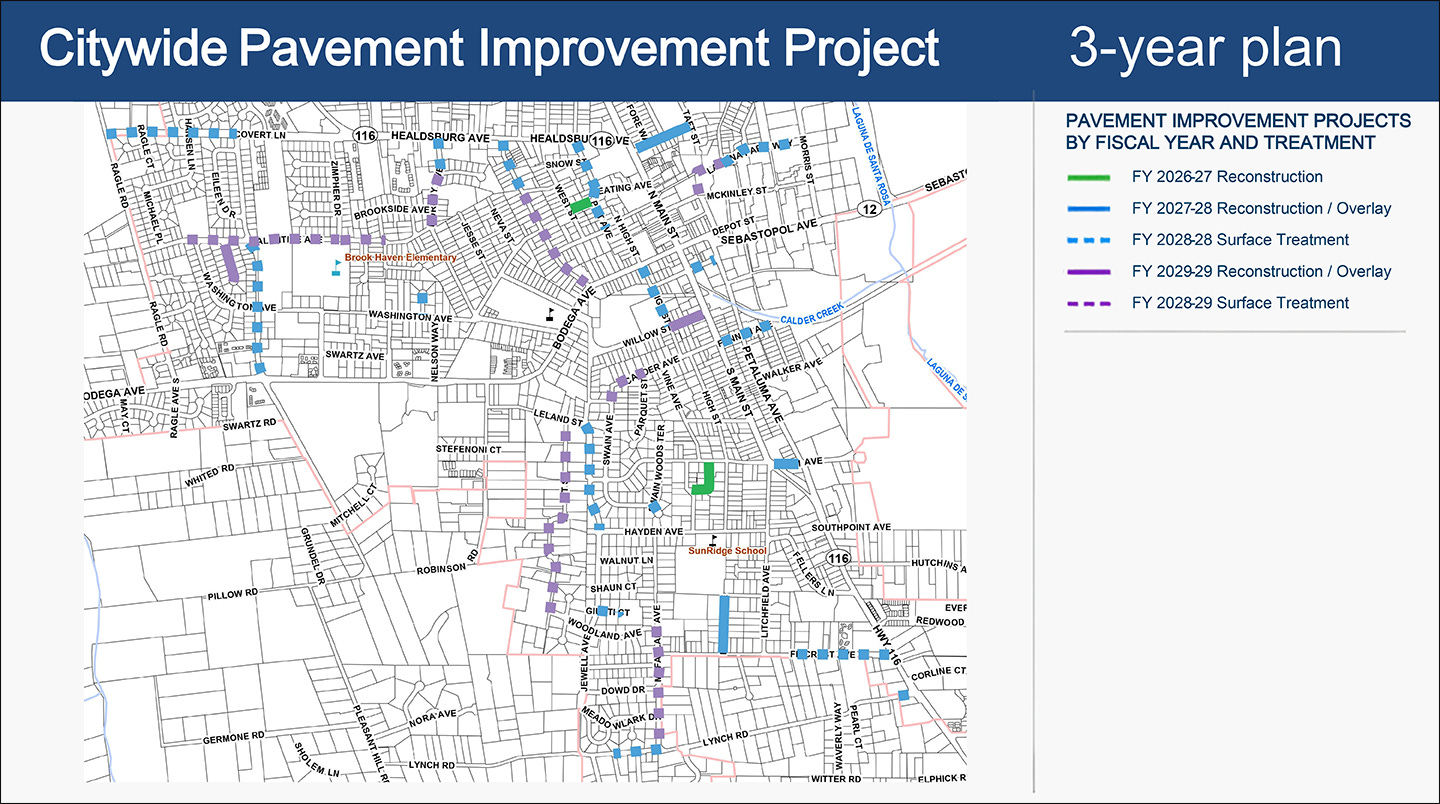
Hart cautioned that the 2028-29 projects will likely change because the city plans to re-do its Pavement Plan next year, thanks to a grant from the Metropolitan Transportation Commission (MTC).
“The city gets a biannual grant from MTC to evaluate all of the streets and see how they’re doing,” she said. “They will work with cities and will look at how I put this together and add their input. So they’ll look at our bad streets and the surface streets and make some recommendations themselves. We can reevaluate anything in the future, but this will get us through this fiscal year and into next fiscal year.”
In public comment, Lee Mathias noted that it had taken 18 months to get to this point, given that the council approved this Pavement Management Program on April 15, 2025.
This was not a critique of Hart, who just joined the city as its director of Public Works in March of this year. In fact, both Mathias and public commenter Kate Haug commended Hart’s work.
“I think we should all count our lucky stars that Director Hart is working for the city and on behalf of the citizens, because I feel that under her leadership that we will actually start to see capital improvements happening because she has the skills and the ability to structure and to plan ahead so that we can actually accomplish things,” Haug said.
Council was equally effusive in its praise of Hart’s work, and they approved “reconstruction of Eastside Avenue and South Avenue for this year and the design and project preparation for overlay projects on Palm Avenue, Maytum Avenue and Wallace Street in 27/28, as well as the slurry seal program” described above.
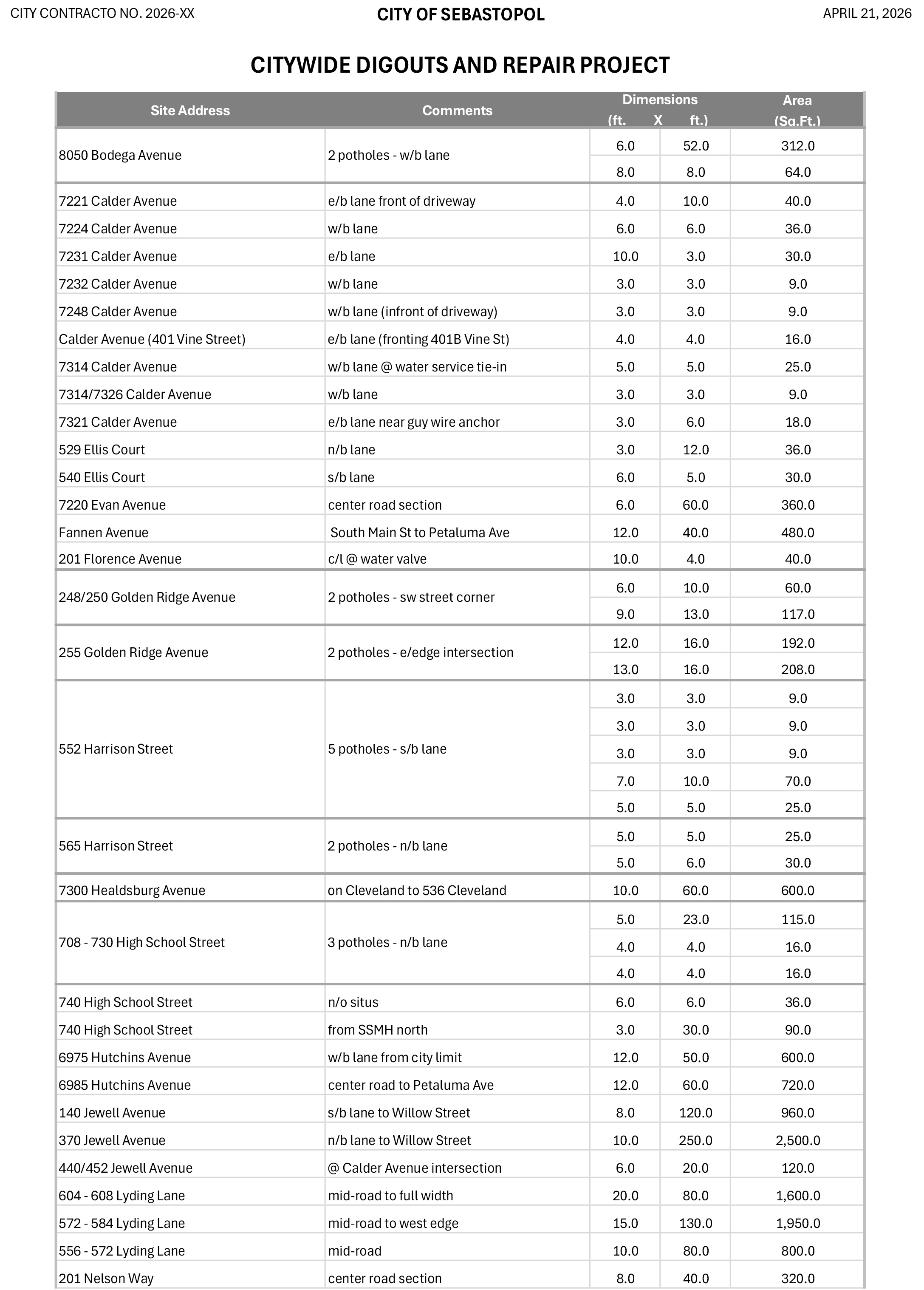
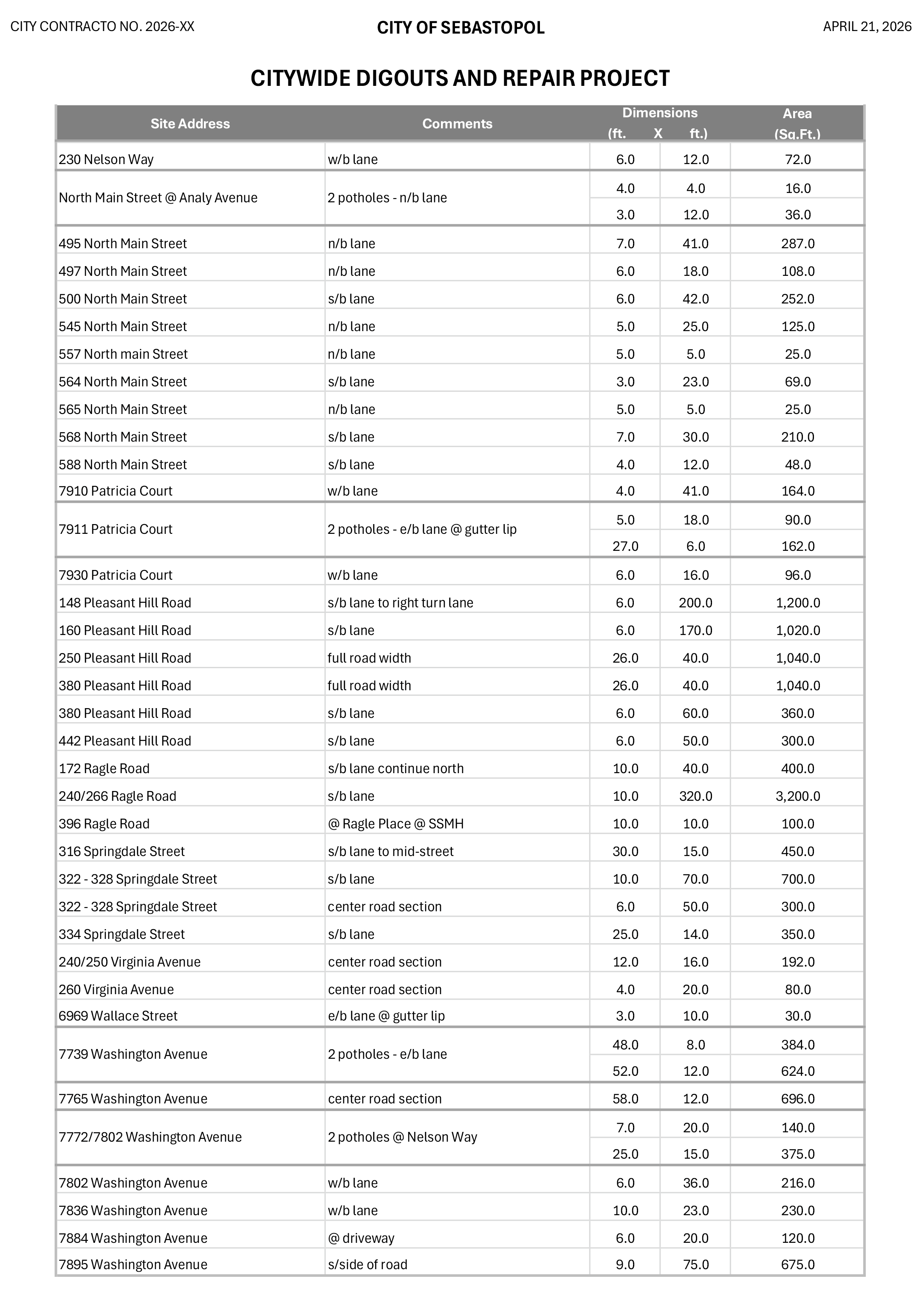
It should be noted that these are not the only street repairs happening in the city. In addition to the massive Bodega Avenue Bike Lanes and Pavement Rehabilitation, Hart sent along a list of the streets that are part of the city’s Digout and Repair Project for 2026/27.