


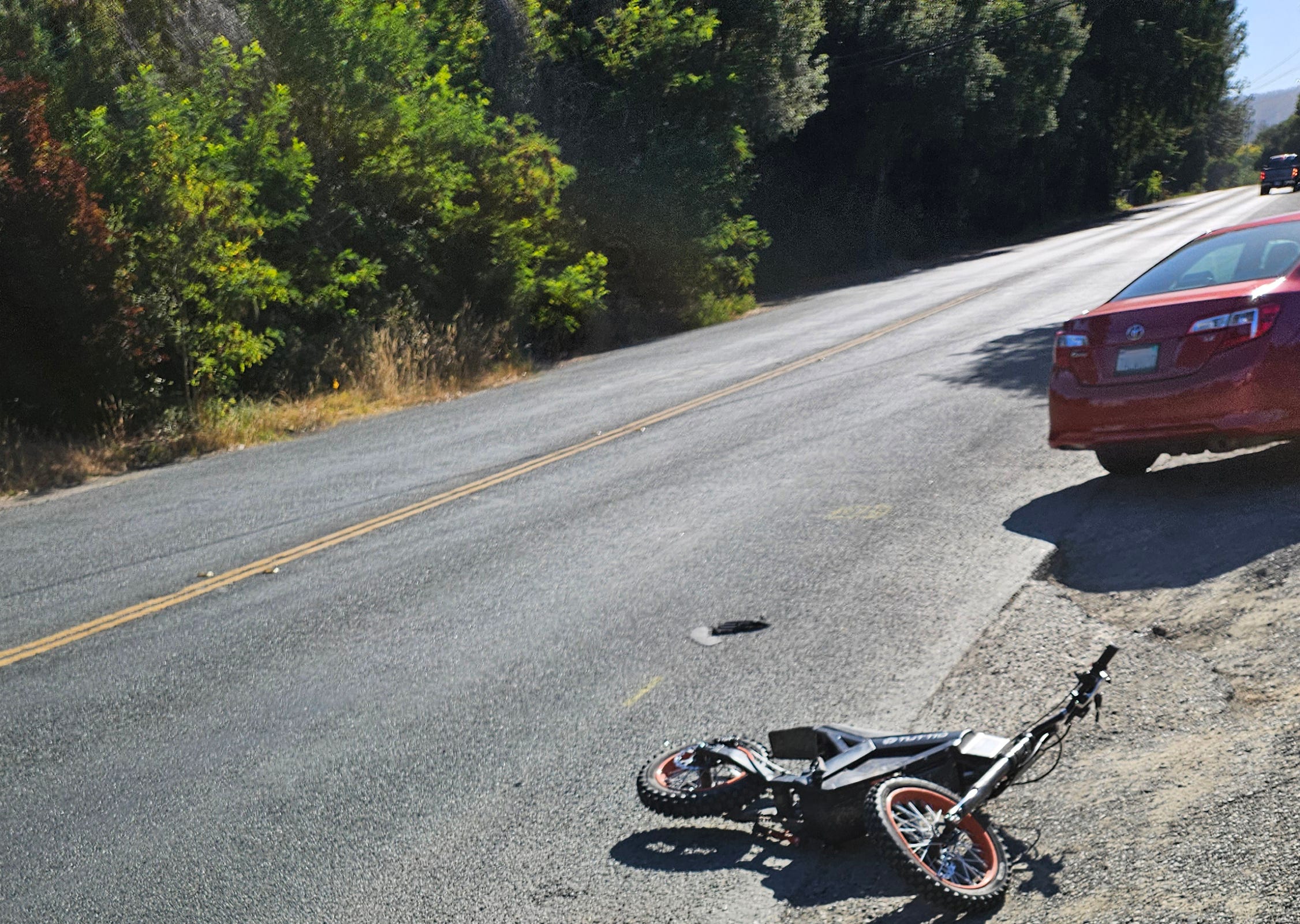
Michael Wilson, an Occidental resident who runs a wood-chipping business, heard the crash while he was fueling his truck at the gas station at the intersection of CA-116 and Occidental Road.
“To my absolute horror, there was a young child folded up, laying on the ground, curled up in the fetal position in the bike lane and a car sitting on the side with a bumper that was half ripped off.”
Witnesses of the crash, including the driver of the Camry, rushed out to check the condition of the boy who, fortunately, was responsive, although seriously injured. The boy was able to state his name, age, and the contact information of his parents.
The drivers of the Camry were unable to reach a dispatcher through 911, so Wilson called REDCOM (the Redwood Empire Dispatch Communication Authority) at 707-576-1365. (Note: Always try 911 first.)
Graton Fire Department and EMS responded to the call and transported the child to the Santa Rosa Memorial Trauma Center around 6 pm.
Later that day, Wilson posted on Nextdoor about the incident as a PSA for REDCOM. The comment section flooded with praise for Wilson’s quick thinking. But it also filled with comments concerning the dangers of e-bikes, anecdotes of children riding recklessly on motorized vehicles, and arguments about whether or not the vehicle the child was riding is technically an “e-bike.” (Spoiler alert: it’s not.)
Wilson, who rode dirt bikes as a kid, once had a laissez-faire attitude toward the whole issue, but that’s changed since the accident. “I am now convinced you shouldn’t let your kids bomb around on e-bikes on the street,” he said.
E-bikes, eMotos, and the law
Existing law defines an e-bike as a bicycle with operable pedals, an electric motor of less than 750 watts, and a speed capability up to just 28 miles an hour.
There are three classifications of e-bikes:
Class 1 e-bikes have motorized pedal-assist up to 20 mph and no throttle.
Class 2 e-bikes have motorized pedal-assist and a throttle. Their motor supports up to 20 mph on both pedal-assist and throttle.
Class 3 e-bikes are the fastest. They have pedal-assist up to 28 mph.
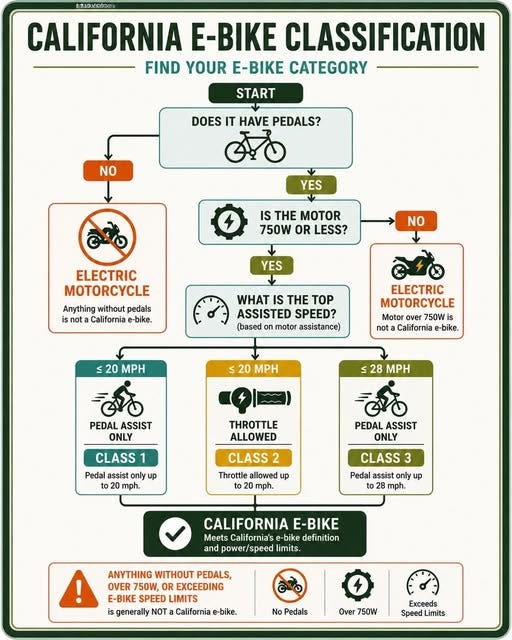
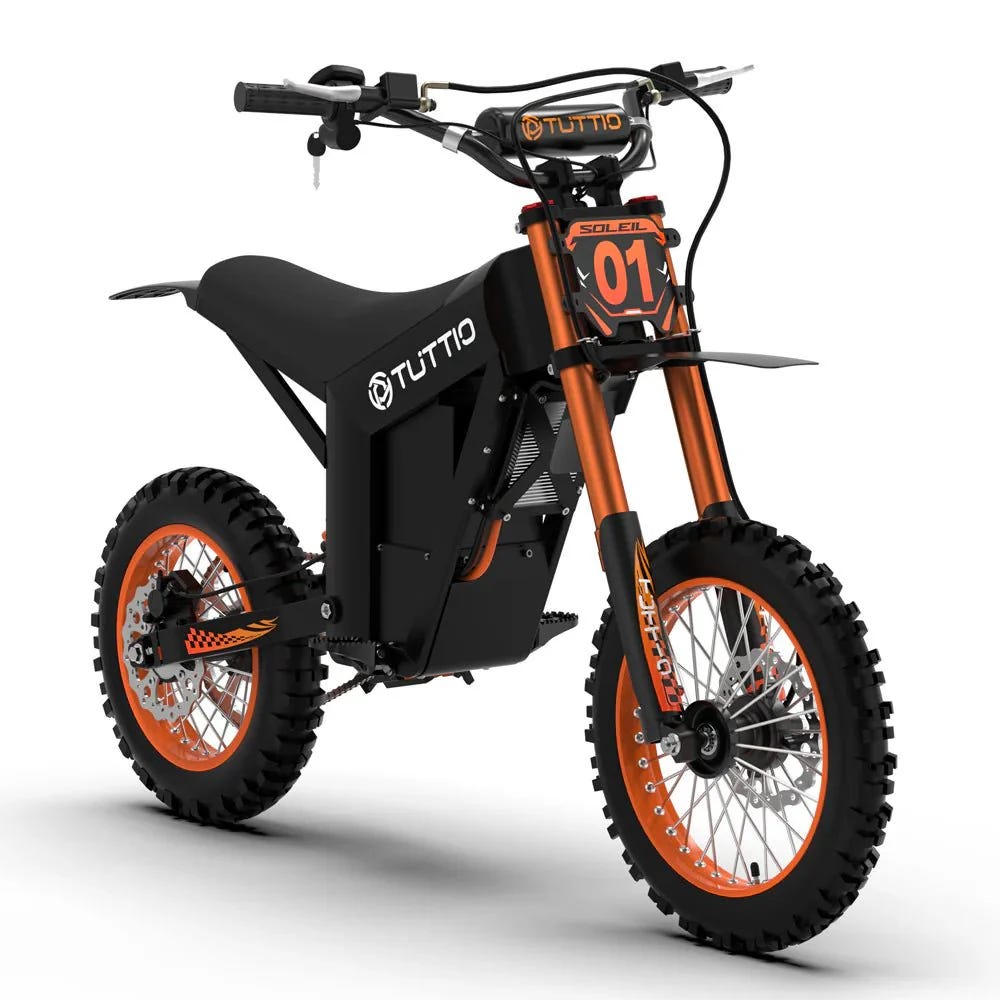
eMotos are not e-bikes since they don’t include operable pedals. The Tuttio Soleil01 that the aforementioned child was operating is powered by a 3,000-watt motor.
Under California law (SB 586), eMotos are prohibited from operating on highways, streets, sidewalks, bike paths, bike lanes, or off-street parking facilities. eMotos are only allowed in OHV-designated areas or on private property. SB 586 also requires eMotos to display a DMV-issued off-highway vehicle (OHV) sticker.
Graton Fire Chief Bill Bullard, who responded to the eMoto accident on July 11, emphasized the importance of “following the rules of the road.” Oddly, there is no minimum operating age for eMotos, nor is there a helmet requirement. Bullard noted that the child involved in the accident “was wearing a bike helmet, not a motorcycle helmet.”
In comparison, e-bikers under the age of 18 are required by law in California to wear helmets. E-scooter riders must have a driver’s license or learner’s permit, and, because of that requirement, children under 16 cannot legally operate an e-scooter on public streets.
Unfortunately, what the law requires and what’s happening on the streets are two different things. eMotos are ubiquitous on local streets and trails—often driven by children or teens—and some say they’re giving e-bikes a bad name.
E-bikes on the trails around Sebastopol and a recent survey asking what to do about them
For the last few years on Nextdoor, people have raised concerns about the conduct of “e-bikers” on the West County Trail, the Joe Rodota Trail, and others.
According to Sonoma County Regional Parks, which has jurisdiction over the West County and Joe Rodota trails, there’s only one class of e-bike allowed on the trails.
“Only Class 1 e-bikes are allowed on trails,” Regional Park Director Bert Whitaker told the Sebastopol Times, quoting from the park’s policy on e-bikes from their website:
Electric Bicycles: Class 1 Electric Bicycles are allowed in Regional Parks wherever conventional bicycles are allowed unless otherwise posted. E-Bike riders must adhere to the same trail rules as conventional bicycle riders. Class 1 E-Bikes are pedal-assist only, with no throttle and have a maximum assisted speed of 20 mph.”
“We have not been receiving regular complaints about pedal-assisted Class 1 e-bikes on the West Co or Joe Rodota Trails,” Whitaker continued. “However, calls about bikes with throttle systems, which are not allowed on Regional Parks’ trails, are becoming more frequent. We are working with the Sheriff’s Parks Unit and having park rangers educate cyclists about regional trail rules, and if necessary, to cite violators.”
Despite Regional Parks’ official policy, anyone who walks the trails knows it’s the wild west out there in terms of motorized bikes.
In April of this year, Sebastopol resident Brad deGraf posted a survey on Nextdoor to gauge opinions on banning e-bikes from the Joe Rodota Trail.
Although deGraf’s language specifies “e-bikes,” the survey drew opinions on a variety of vehicles, including road bikes, e-bikes, and eMotos.
One hundred and twenty people responded to deGraf’s survey, and the results were pretty evenly split. Many responses emphasized the different classifications of e-bikes, as well as the differences between e-bikes and motorcycles.
Many responses argued that even traditional e-bikes should be banned, complaining of a lack of compliance with speed limits and a general lack of courtesy for pedestrians.
Other responses told inspiring stories of how e-bikes have changed the lives of people who do not have the physical ability to ride a road bike along Sebastopol’s gorgeous trails.
Vicki Lessin, an avid e-biker, said that “E-bikes are a real benefit to society,” citing their eco-friendliness and accessibility.
George Curtis, for example, rides his Class 3 e-bike with his wife on bike paths around Sonoma County. The throttle assist feature was the selling point for Curtis, who, at 79, enjoys the motor support for going up hills. “My wife always rides in front. She has the bell, and she rings our bell, and we obey the speed limits. So we don’t go over 15 miles an hour on the trail.”
Some comments described the problem not as electric vehicles in general, but the people riding them. One anonymous commenter noted that the issue is teenagers and kids, rather than people like George Curtis: “We have a real problem with adolescents riding in public parks on the grass and doing “wheelies,” hitting cars, people, including little tots at playgrounds and dogs.”
Curtis said with a laugh, “You know, when I was a kid, I used to do wheelies in grocery store parking lots on bikes that weren’t motorized. So I don’t think that’s a new phenomenon.”
Another anonymous responder to deGraf’s survey voted in favor of allowing e-bikes on Sebastopol trails. The comment simply read “Freedom.”
deGraf said he and his wife often walk on the West County and Joe Rodota trails. The bikes on the trail don’t bother him. “Bikes are great. I’m a biker, but every now and then somebody will blast by on a heavily, mostly motorized bike without paying attention to speed.” It’s startling, and deGraf often finds himself thinking, “Was that a motorcycle?”
When he first posted the survey, deGraf felt that banning motorized bikes from the trail was the only solution. After hearing multiple viewpoints from survey respondents, he’s softened his position. “What would be nice would be to maybe widen the trail, so that there was a bike lane or something,” he said.
Kids will be kids, but will bikes always be bikes?
While the wild ways of teenagers and kids are an age-old problem, new technology intensifies safety concerns.
As Michael Wilson put it, “Kids will be kids, but it’s definitely a little different these days since e-bikes are so stealthy and quiet. Cars can’t hear them like a regular dirt bike.”
He added, “Their parents, I guess, just need to be more aware of what their kids are doing these days. Just be aware of what your kids are doing on a cell phone. Be aware of what they’re doing on their eMoto.”
Eris Weaver from the Sonoma County Bicycle Coalition wrote an opinion piece in the Press Democrat this month arguing that the issue is not e-bikes. Rather, as she told the Sebastopol Times, it is “the sale and marketing of these eMotos, calling them e-bikes, and parents buying them for their kids without understanding that they’re not street legal.”
She continued, “It’s a combination of unscrupulous companies selling things that are mislabeled, uneducated parents buying these things, and the behavior of the kids.”
“We'd like to believe that parents are purchasing these for their kids out of ignorance,” she wrote on Facebook, “not realizing that they are inaccurately marketed as e-bikes when they are much faster and more powerful.”
Weaver cited broader cultural trends. “There’s been a generalized decrease of civility in America, and I see that reflected in kids’ behavior,” she said, referencing the gas-powered minibike chase last week in Petaluma.
Weaver said that the legal system hasn’t caught up with the new technology of e-bikes. “There’s a reason why we don’t let 12-year-olds drive cars, and why we shouldn’t let them drive things that go almost as fast as cars and can do as much damage.”
Weaver said the Sonoma County Bicycle Coalition has been working with school districts and police departments around the county to increase educational awareness around e-bikes and eMotos. She noted that the coalition is also supporting Senate Bill 1167, which would prohibit eMoto manufacturers from marketing their vehicles as e-bikes or bicycles.
As Weaver indicated, this is a multifaceted issue that will take multiple different approaches to address. Among them, signage, enforcement, education, parenting, courtesy, and corporate accountability.
For some Northern California communities, these sorts of changes are not enough. They’re opting instead for legal solutions.
E-bike crackdowns in the Bay Area
About a week ago, the East Bay town of Danville cracked down on the use of e-bikes, e-motorcycles, and e-scooters in public parks. The town council voted unanimously to ban the use of such vehicles within parks and adopted a speed limit of 20 mph on public trails for Class 1 and 2 e-bikes. They also banned the use of Class 3 e-bikes on trails. This ordinance, a response to complaints of vulgarity and dangerous behavior by e-bikers, will take effect on Aug. 6, though a plan for enforcement has yet to emerge.
Last year, Marin County banned children under the age of 16 from riding Class 2 e-bikes.
The state, meanwhile, is working to catch up. AB 1942, a bill in the California legislature, would require Class 2 and 3 e-bikes to be registered with the DMV and to display a special DMV-issued license plate. The bill was introduced in February of this year and is still in the legislative process.
Weaver is concerned about these regulations because she feels they are taking aim at the wrong target by focusing on e-bike regulation, rather than eMoto regulation.
The Sebastopol Police weigh in
Sebastopol Police Chief Sean McDonagh addressed the question of e-bikes at last night’s city council meeting.
“We’re seeing a huge uptick across the nation, California in particular, with these kids actually being involved in fatal accidents—not necessarily themselves, but other people—pedestrians. Or they’re running into other vehicles and killing themselves.”
McDonagh said one of his officers has taken on e-bike enforcement as a special area of interest.
“He loves e-bikes and everything related to them,” McDonagh said, noting that when this officer sees e-bikes being used in an illegal or dangerous manner, “He actively chases them. He’s also interested in the educational side as well, trying to help these kids.”
McDonagh said they went to a recent training about e-bikes, featuring police and attorneys from the city of Huntington Beach.
“They had an enormous amount of e-bike incidents,” McDonagh said. “They had the city attorney there speaking on it, and they went through a number of cases. They’re actually charging parents now with allowing and enabling their kids to do these things on these e-bikes. And when it results in someone dying, you’re looking at manslaughter and some pretty serious charges.”
McDonagh noted that the laws about e-bikes and other motorized bikes are constantly changing. “I feel like they’re trying to catch up and trying to keep up —because it’s just such a fast-evolving industry,” he said, noting it’s a legal space his department is watching carefully. “We’re just trying to keep up,” he said.
Good article for e-bike classification and overall awareness.
I’m a Class 2 rider and “Love My Bike!”.
As a young sprig, mini-bikes and go-carts were the rage.
Before we were allowed to ride, older brothers showed us how.
1) Know your machine (throttle, brakes, kill switch)
2) Ride under control, don’t go too fast.
3) If you play chicken with a car or act like an idiot, your turn is over.
Very clear balanced article... thank you!