

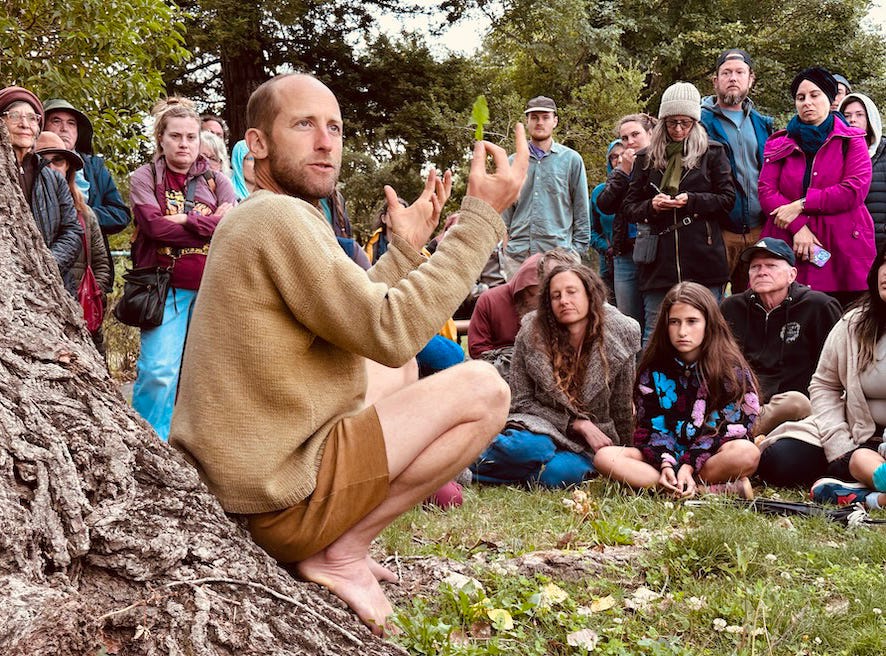
Wisconsin-based activist Robin Greenfield stopped in town last Monday while on his multi-state “Year of Foraging” tour. Greenfield is a kind of niche celebrity. By the time his event, a two-hour foraging walk, began at 6:15 pm, 60 people had gathered, and by 6:30 pm, 80-plus people were in attendance.
It was Day 240 of Greenfield’s experimental year of living 100% off of foraged foods and medicines, and he appeared happy, healthy, inwardly wealthy and wise. His tour route takes him up through Northern California to Oregon and Washington before he hits the East Coast for the next leg.
The crowd, and Greenfield himself, exuded an unusual degree of earthiness — little or no designer labels, logos or makeup were visible on those in attendance. Unkempt facial hair seemed on par for the men, earth-tones the norm for all. One man’s torn, orange down jacket, with its carefully placed, color-matched duct-tape patches, seemed to epitomize the anti-consumer, back-to-the-earth ethos of all those gathered. All in all, the vibe was more reminiscent of 1980s Santa Cruz or Berkeley than today’s Sebastopol.
This reporter felt right at home.
Greenfield launched the event with the words, “I am very much in love with the plants. So my job for the next couple of hours is to share my love for the plants, and also love for the humans, too.”
And with that, the evening commenced.
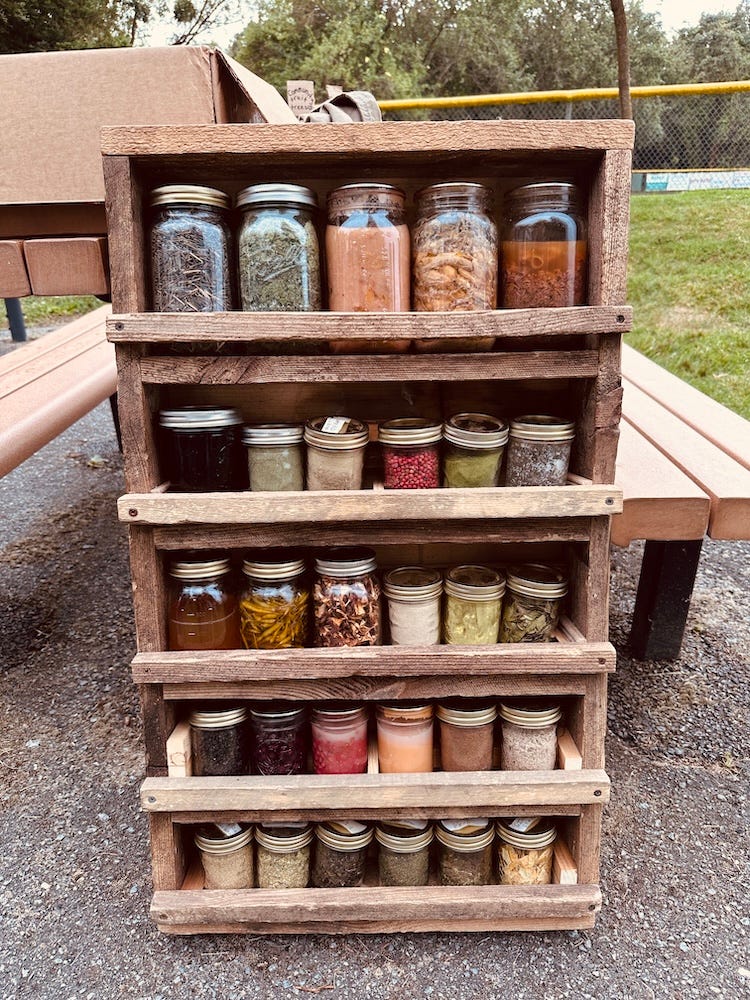
By turns funny, knowledgeable, humble and kind, Greenfield brought the crowd up to date on his life of service and his current Year of Foraging. He then introduced everyone to his portable pantry, a simple wooden rack laden with jars of dried foods.
The walk began with him leading the crowd out along the edge of the Laguna, stopping at seven wild food sources to talk about each one.
Per his website, Greenfield, 39, lives a life consciously dedicated to service. In 2011, he came to the realization that the “American Dream” to which he aspired — to be a millionaire — was in fact “the world’s nightmare.” He then set about transforming his life so as “to live in harmony with Earth, humanity and our plant and animal relatives.” This metamorphosis involved making many changes — such as learning to forage for his food and giving up his bank accounts, credit cards, driver’s license and car — as he sought to align his actions with his beliefs.
In the years since, he’s engaged in countless actions to make the world a better place. He’s started nonprofits; engaged in countless events on his many tours; published videos online; is active on YouTube, Facebook and Instagram; and has written several books (available on his website), including his latest, Food Freedom: A Year of Growing and Foraging 100% of My Food (2024).
He’s also embarked upon numerous highly publicized activist campaigns to raise awareness for food justice and to better the planet and humanity. These include “Share My Way Home” (2014), in which he flew to Panama City without any money or possessions, relying on the kindness of strangers to travel the 4,000 miles back to San Diego while also giving back more than he received through being of service to others; “30 Days of Wearing My Trash” (2022), in which he spent a month wearing every piece of trash he created; and the “Grow Your Own Toilet Paper Initiative!” (2024), in which he mailed people cuttings of the Toilet Paper Plant (Plectranthus barbatus/blue spur flower/boldo) or seeds of mullein upon request, so they could indefinitely grow their own supply of TP.
His books and services are not sold, rather they are gifted to recipients using a donation model. One hundred percent of his earnings from media/books are donated to grassroots initiatives, and his personal income is “no more than the federal poverty threshold per year.”
Greenfield’s accomplishments are in fact so numerous that it’s not possible to list them all here — one needs to visit his website directly to understand the magnitude of the task he’s taken on.
During the foraging walk, he touched on many subjects peripherally related to his edible weed commentary. The crowd learned, for instance, that he eats meat in the form of fish, which he catches himself, and in the form of road kill, specifically venison and raccoon. And that the wild foods he eats are so varied and nutritious that they all constitute medicine. In effect, his diet is his pharmacy.
When asked if he ever worries about harvesting poison hemlock by accident while foraging for wild radish, Greenfield replied “no.” He explained that in order to correctly harvest wild radish he must simply be able to positively identify wild radish, which doesn’t require knowing anything about poison hemlock. He also recommended, incidentally, that people new to foraging double up on their first outings, to pool their knowledge.
In addition, when asked to explain how to determine if wild plants contain pollutants, he pointed out that the entire modern industrial food chain contains varying levels of chemical toxins, and that one needs to determine the pollutants in their food every time they eat, no matter the source.
[To learn about the edible weeds Greenfield discussed on the walk, see the accompanying photo gallery.]
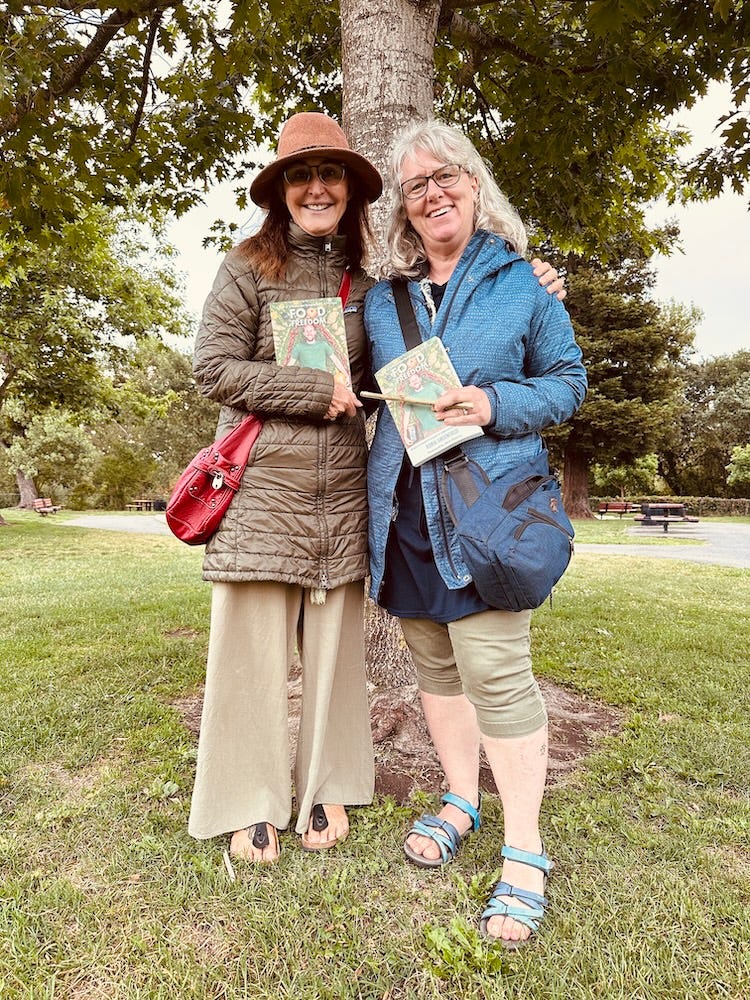
When the foraging expedition ended, Greenfield announced that donations for the walk had exceeded $1,000, which would be used to support the distribution of his book, Food Freedom. He returned to his starting point at the Laguna Youth Park to sign copies of the book and give and receive hugs for the remaining 15 minutes of the event. I mingled with the crowd, engaging in easy banter with those gathered. They were a friendly bunch, prone to calm, direct gazes and equally direct conversation.
Gina Martinez, of Sebastopol, who follows Greenfield on YouTube, learned about the event from a flyer in the Community Market. “It’s just fun being out here in the community, and getting to know the plants in the area a little bit more intimately,” she said of the event, adding, “I’m fairly new here, so I thought this would be a nice way to get to know people.”
Frank Beiser, a Berkeley-ite by way of Memphis and D.C., learned about the event through Fork in the Path, a Berkeley-based outfit that offers a comprehensive list of foraging classes. He was the wearer of the evening’s crowning fashion statement — the orange down jacket with the carefully placed, color-matched, duct-tape patches.
Regarding his reasons for attending the event, he said: “I believe in having a relationship with nature, and I see how the average person doesn’t quite have that. I think it’s so important. And I always was thinking, ‘OK, how can I get people in nature? How can I get people connected to nature?’ And edible plants, medicinal plants — it’s, like, a hook.”
Friends Chris Addicott, from Sonoma Mountain, and Sandy Hennen, of Santa Rosa, each had their own reasons for attending.
“I’m interested because I’m fascinated by plants, and just knowing what’s around us can help us in maybe an emergency situation. So maybe we need a quick snack, and we don’t have the means to be able to grab something. Well, it’s right there to eat,” said Addicott.
“I’ve been following Robin for about a year on Instagram,” said Hennen, “and I’m a gardener, and I love foraging mushrooms. And I thought wild plants would be great to learn more about, too.”
As for me, I’m a new recruit. During Greenfield’s opening statement he said, “My real objective here is to radicalize you, to get you to question societal norms and to break free from the systems that no longer serve us … I don’t have the answer or the way, but I can help to stimulate the question, ‘Am I living the life that I truly want, and are my actions in alignment with my beliefs?’”
Those words haunt me. In a good way. I weigh Greenfield’s philosophical beliefs and actions in my mind and can’t find any obvious flaws in them. He has freed himself from the oppressive paradigm that I — that we — live in and lives a life with meaning and purpose.
But most importantly, the wild radishes growing in my yard have never tasted so good.
To find out more about Robin Greenfield and his many missions, or to make a donation, visit: www.robingreenfield.org.
Gallery of plants from Robin Greenfield’s foraging walk
Photos by Mark Fernquest
Obligatory warning: Many wild plants, including many weeds, are toxic. Don’t just go grazing. As with mushroom foraging, make sure you can positively identify as safe any plant you’re planning to eat.
Dandelion
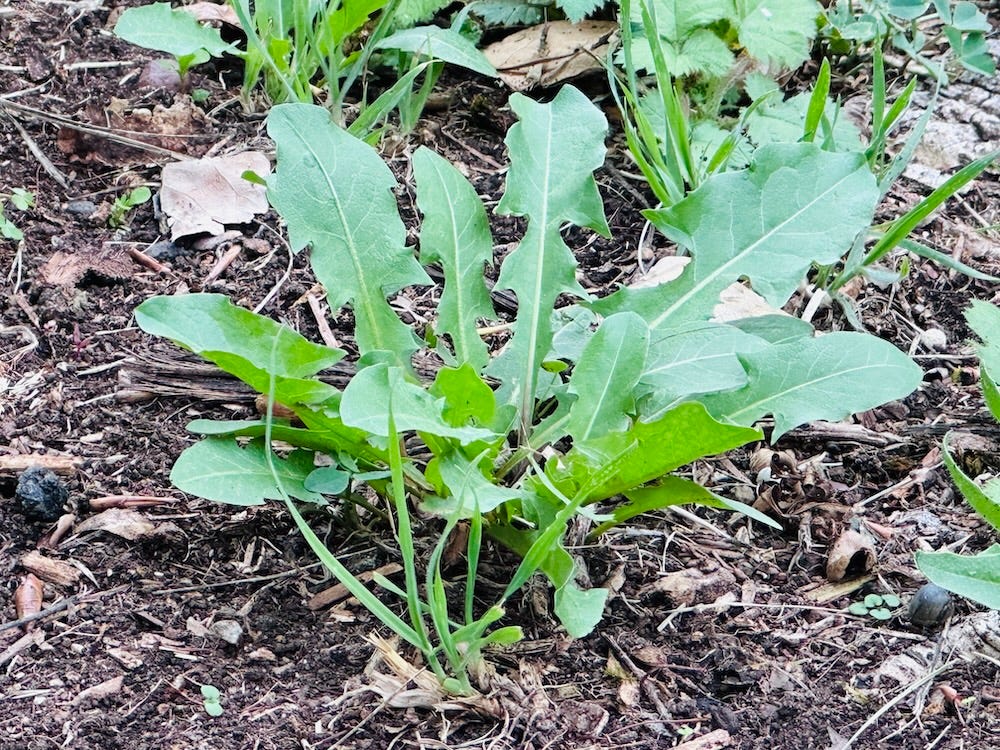
Every part of the common dandelion (Taraxacum officinale) is edible. The roots can be roasted and ground into powder and eaten, or steeped to make a coffee-like drink. The flowers, crowns and leaves can also be eaten. Greenfield recommends eating wild greens cooked, as they become less bitter and are easier to digest.
Per Greenfield, the dandelion is inherently medicinal. He says, “[T]he flavor of dandelion is bitter, and bitter is medicine.” In addition to assisting with digestion, the plant acts as a liver tonic. The flowers can be steeped to make tea, but every part is medicinal.
Wild Grape
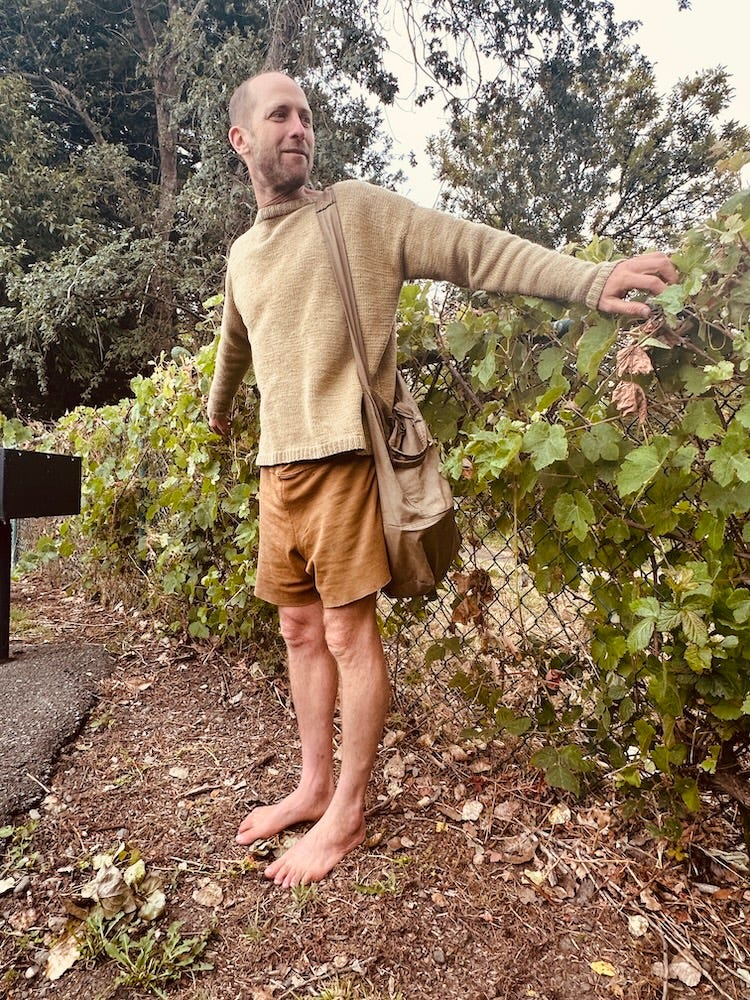
Greenfield discusses the merits of the wild grape (Vitis spp.) as a food source, warning that the grapes themselves can be very tart. In addition to the grapes, the plant’s leaves, tendrils and tips are edible. He says the young, tender leaves taste excellent when chopped and cooked with rice.
Wild Radish
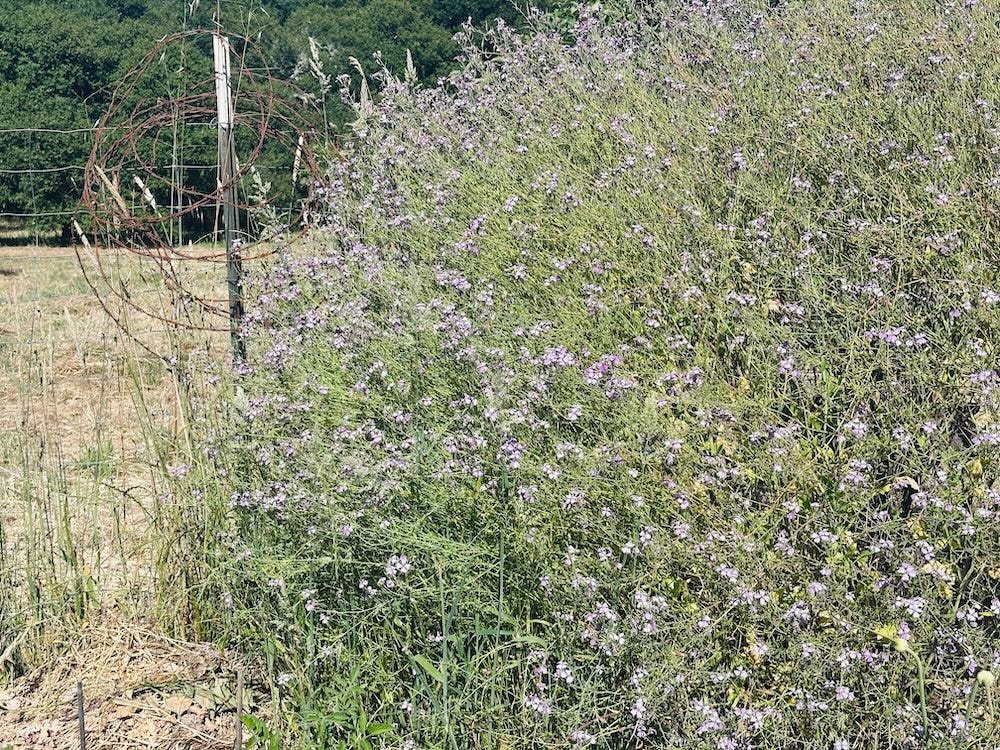
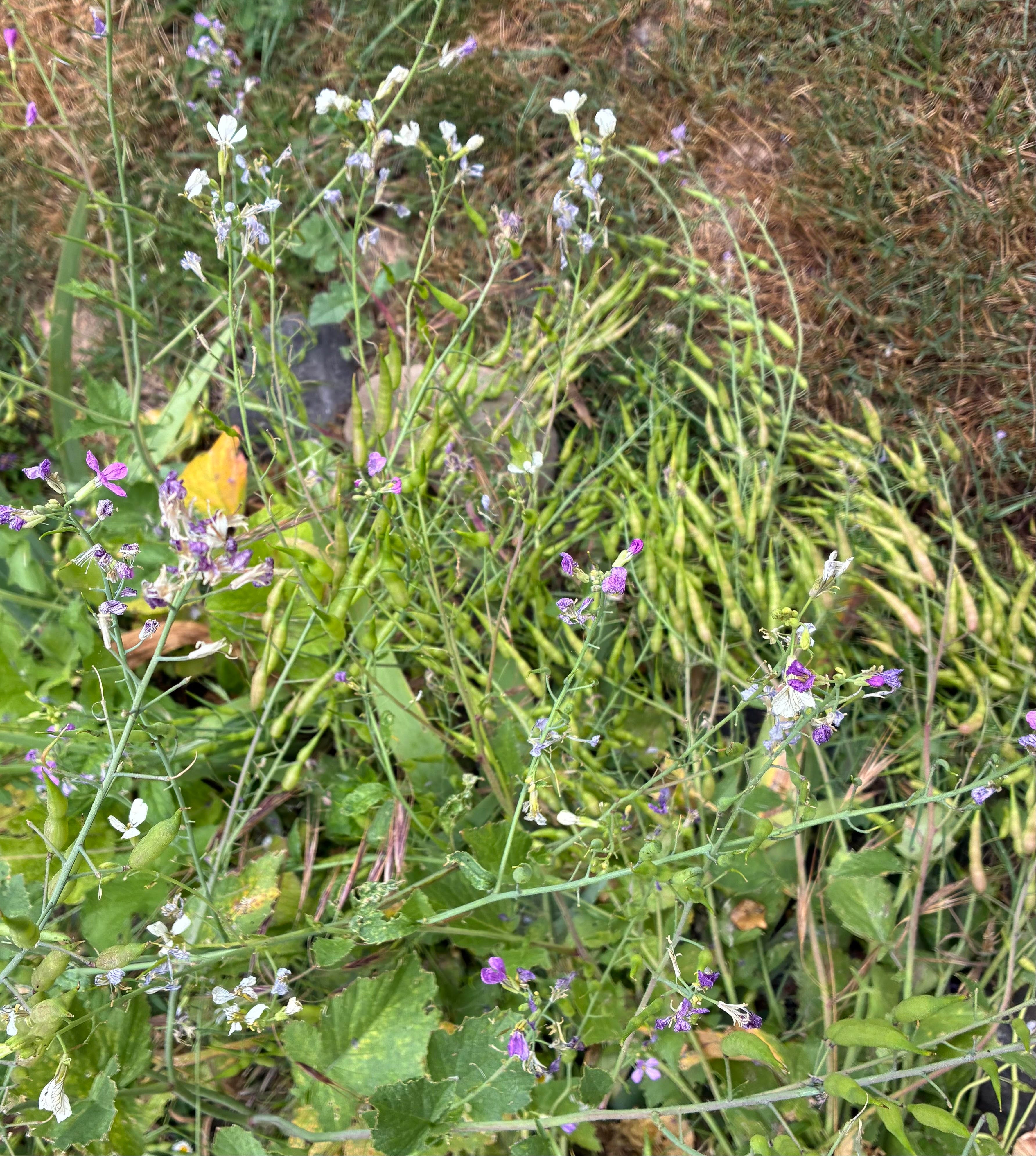
Greenfield’s No. 1 forage food in California, the wild radish, is considered an invasive species. While the entire plant is edible (leaves, flowers, seed pods, stem), the roots may be too woody to actually enjoy. Wild Radish (Raphanus raphanistrum) grows in abundance in Sonoma County. The young seed pods are the tastiest part in this reporter’s opinion.
Wild Mustard
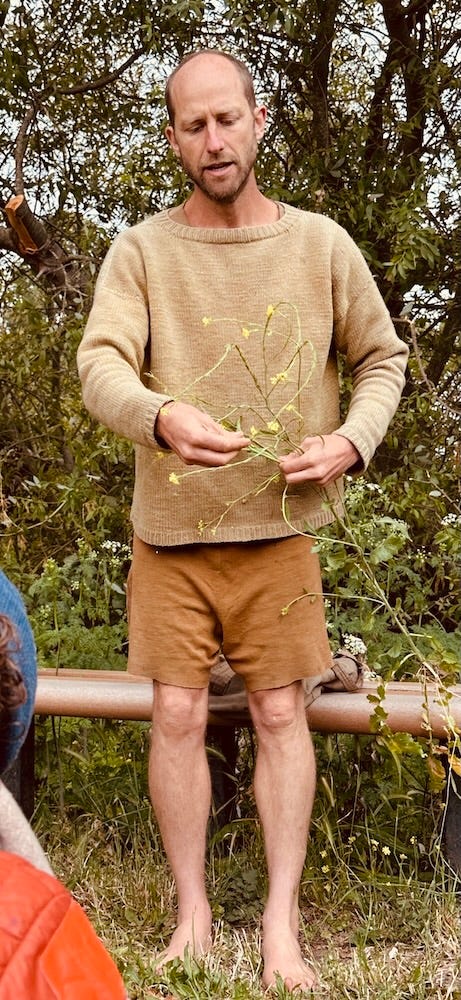
Wild Mustard (Sinapis arvensis) is Greenfield’s No. 1 overall forage food in the continental U.S.
Wild Blackberry
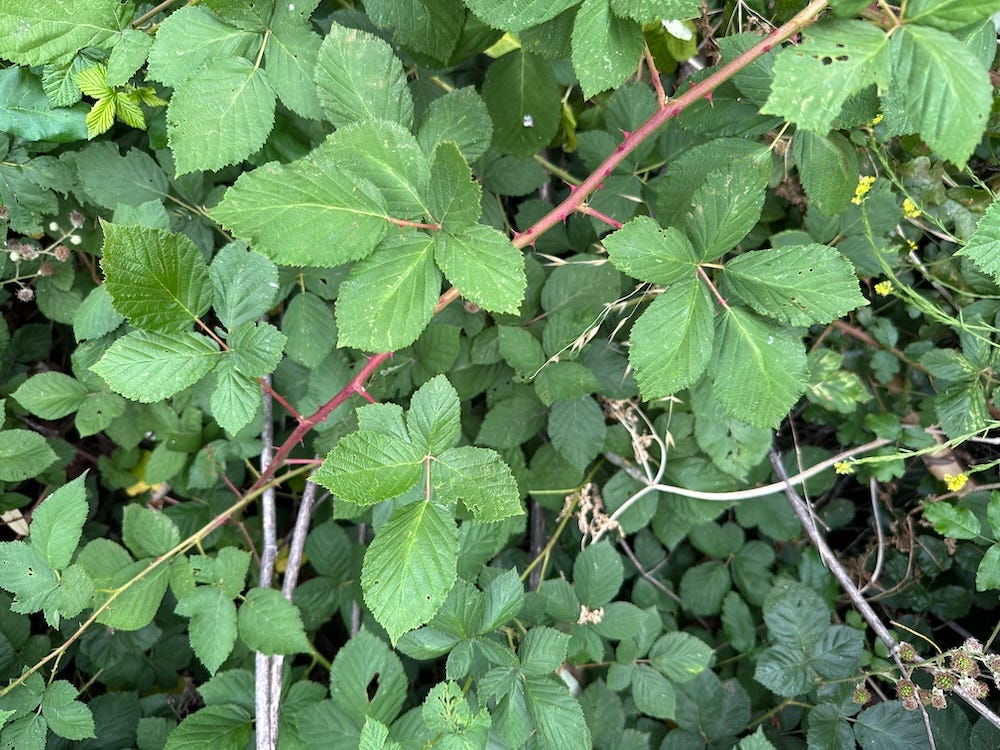
Wild Blackberry (Rubus spp.) grows throughout North America, and both the invasive Himalayan blackberry and the native California blackberry are found in Sebastopol and environs. In addition to the berries, the leaves and the peeled inner core of the young canes are edible.
Common Mallow
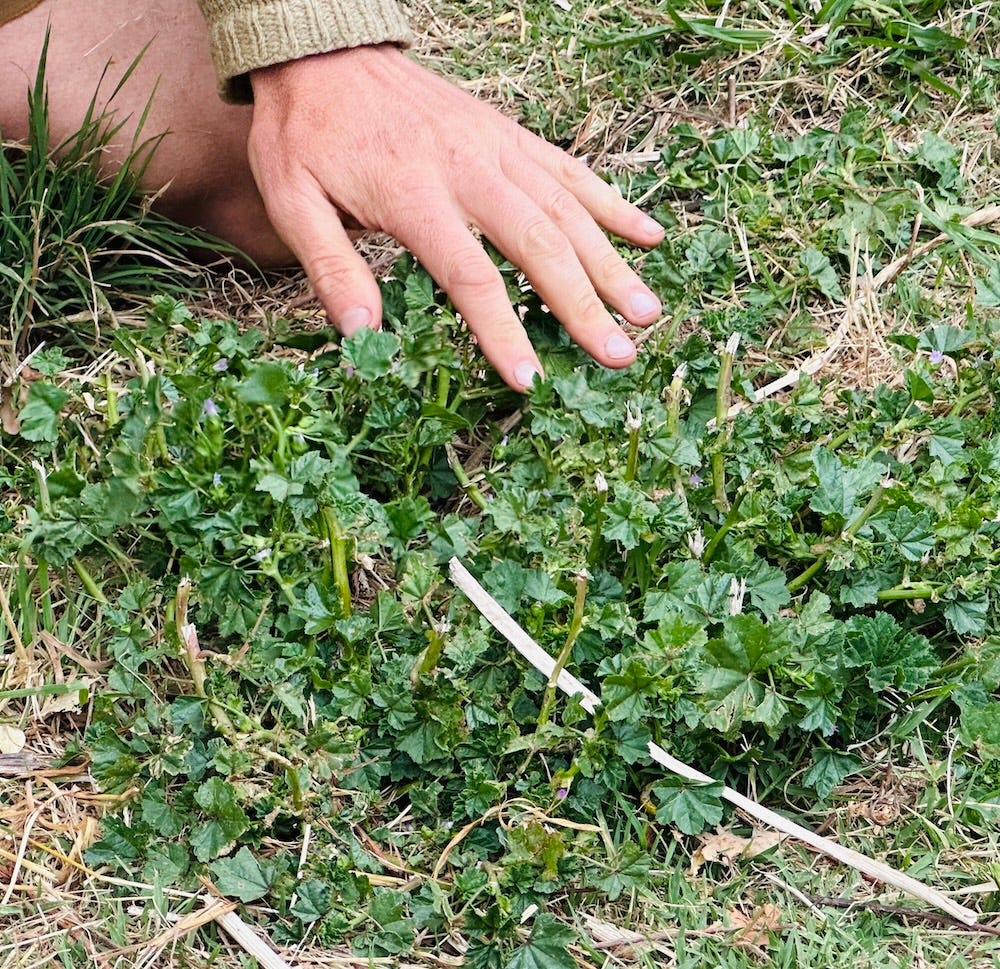
All parts of the common mallow (Malva neglecta) plant, including the leaves, flowers, stems, fruits, seeds and roots, can be eaten raw or cooked. Greenfield says it has a milder flavor than many edible plants. Healing properties are associated with its mucilaginous quality, which is said to soothe irritated throat tissue and assist with coughs. Common mallow, also known as cheeseweed, is cooling and mucilaginous — er, slimy.
Northern California Black Walnut
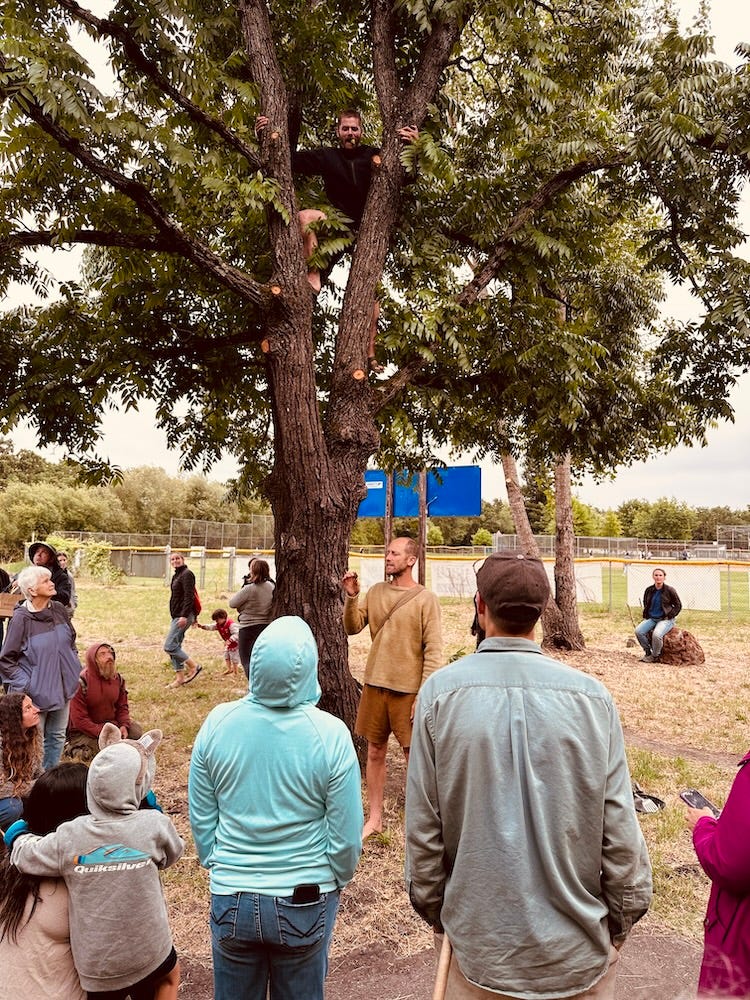
The Northern California Black Walnut (Juglans hindsii), shown here, grows wild throughout Central and Northern California. While the edible nutmeats tend to be small, Greenfield says they are high in protein, adding that the best way to harvest them is to let them fall from the tree, wait for the husks to rot and then crack their shells.

Learned a lot! Great writing.
Wonderful article, Mark! Thank you. Robin is so committed to his mission that people might wonder if he actually could be doing what he says he does. He does. All of it and more.
His clothing is all natural and hand made organic and compostable. His water directly from a well in town, no chlorine. His human manure composting in a Sebastopol garden.
Like an escaped cultivar, Robin lives among us, a faithful renunciate offering the world a message we all would do well to hear.
Watch out! His love for all life on earth is contagious. Johnny Appleseed? Mahatma Gandhi? No, though he reminds me of such figures. Robin Greenfield is a remarkable human being whose life aligns with his values.