

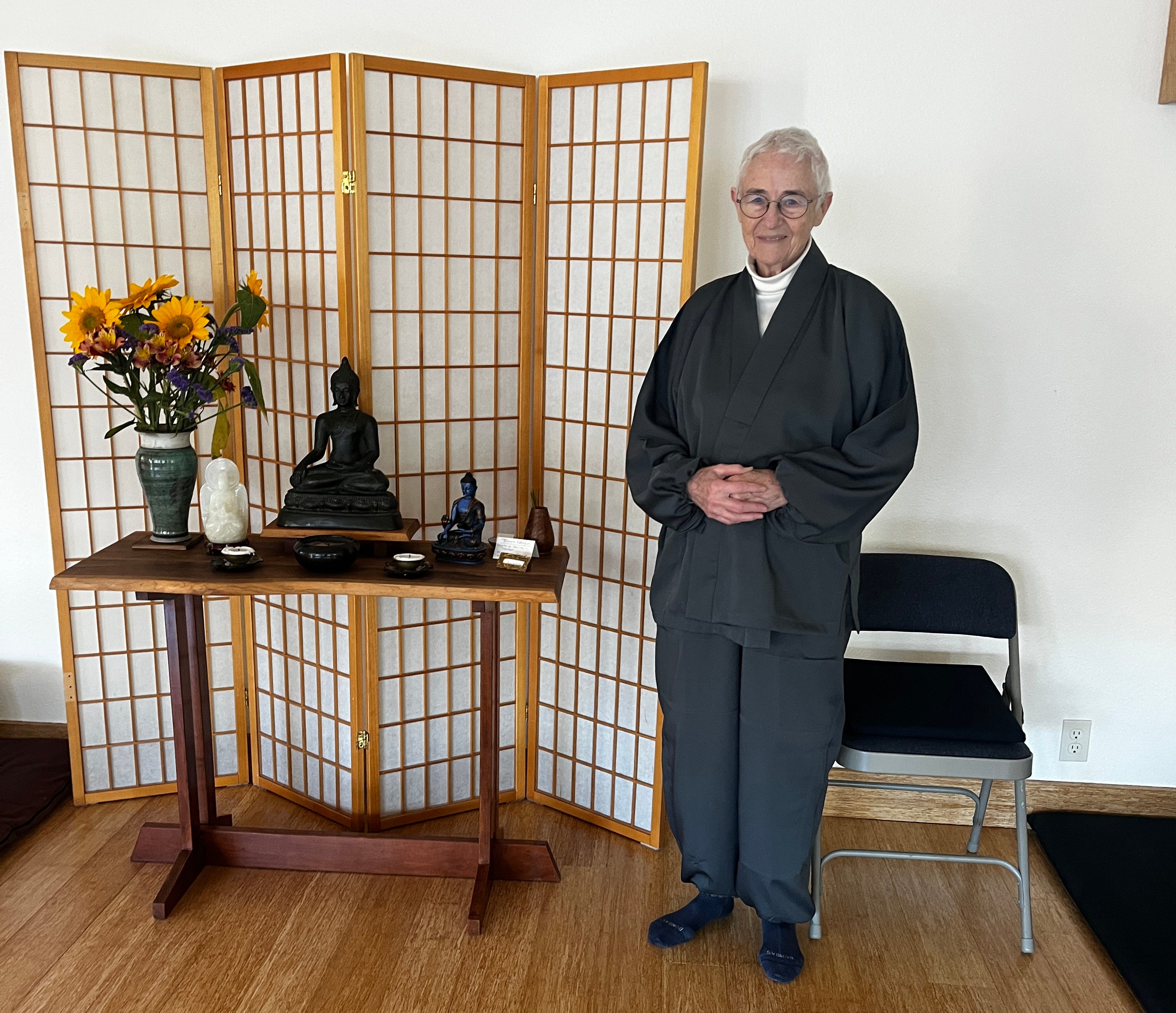
When I received a note that the Stone Creek Zen Center would be celebrating 30 years of operation on June 27, I thought now would be a good time to explore this Graton institution. At first, I assumed the celebration would be widely open to the public, only to learn that it was much more of a Sangha (community) celebration. Be prepared, however, Graton, Taiko Drums will be playing in the afternoon and on display for all to see. Your ears will tell you when.
While learning about the celebration, I found myself asking questions about the Center itself, which led naturally to a wonderful chat with its founder.
Jisho Warner Roshi (Teacher) is a diminutive woman who exudes peace and enthusiasm behind her wire-framed glasses and sparkling eyes. I suppose I should have guessed that the founder and now Abiding Teacher of the Stone Creek Zen Center would be a gentle soul, but I was nonetheless delighted and honored to spend an hour with her as she shared her joy for the center and her life story.
When Jisho first drove the back roads of West County in the mid-1990s, she wasn’t house hunting. She was looking for a place to plant a seed. Warner had just finished her Zen training, earned Dharma Transmission, and decided to start a dedicated Zendo. New England, where she was raised, and Minnesota, where she was trained, weren’t options for various reasons. Her father had moved to Laguna Beach and asked the obvious question, “Couldn’t she come out to California?” She drove around, looked at several places, and kept coming back to one. “This is a good place to plant a seed,” she remembers thinking about Sebastopol.
It wasn’t an accident. Warner had grown up in New York City, lived in Minneapolis, and spent years in rural Massachusetts. She wanted easy access for students, which ruled out more remote spots like Occidental, but she also wanted nothing urban. West County’s small-town, rural feel was a perfect fit. She bought a property on Ragle Road with room to build and went to work.
She designed a small backyard Zendo (meeting room) on graph paper and built it with a contractor who, by coincidence, had a Zen background and was married to one of her first students. Friends helped lay the floors and finish the interior. Warner rented two hours of evening space, posted a flyer, and 10 or 15 people showed up. The group grew slowly from there and officially opened as a Zendo in the fall of 1996. They had foxes as neighbors, and the Stone Creek name came from a stone drainage ditch built as part of the construction.
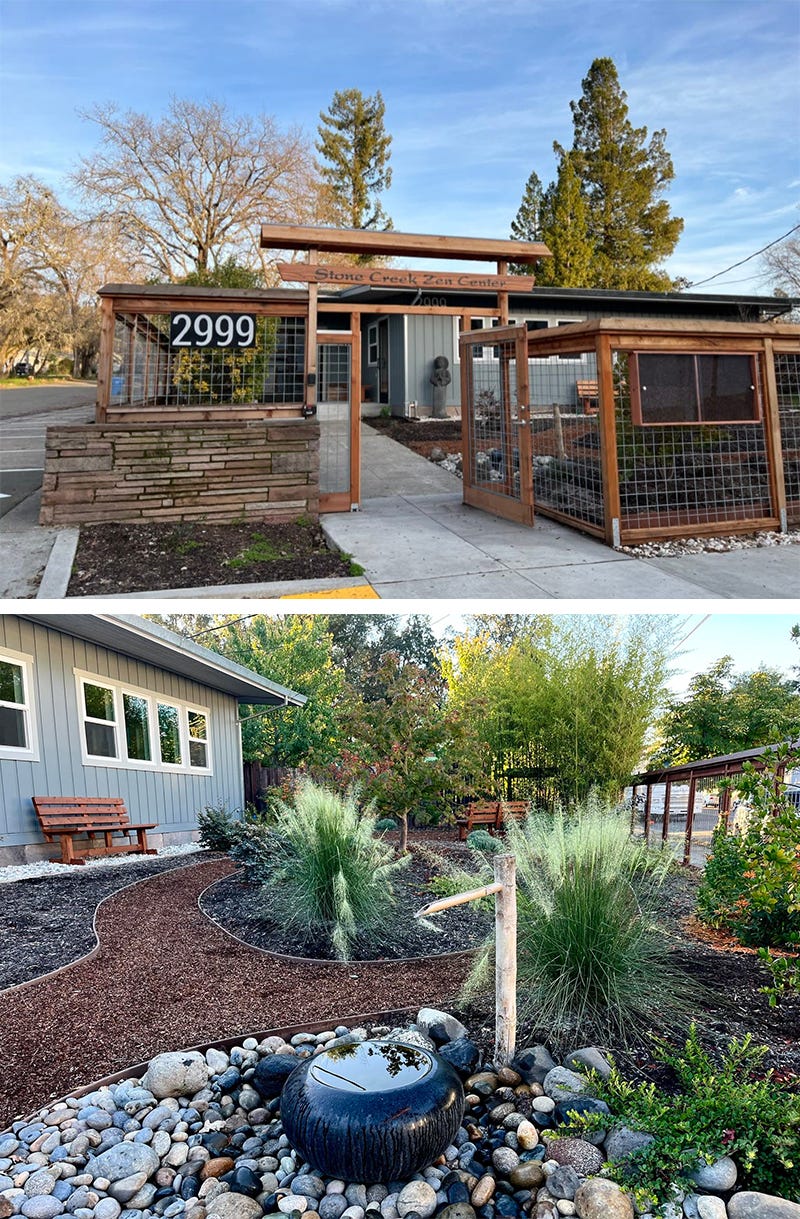
Within a decade, the Sangha (community) had completely outgrown the little backyard space. Jisho sold the property, and the Sangha spent a couple of years renting a converted commercial building in Forestville before landing on its current home: a vacant building in Graton that had most recently been a thrift shop, and before that, in the 1990s, the bilingual Manzanita School. (Its onetime principal, as it happens, was Mario Lopez — the owner of Mexico Lindo and, by local consensus, the informal mayor of Graton.) The building’s history as a school gave Stone Creek a small headstart in navigating the permitting process.
The group initially rented, then had to buy when the owners decided to sell. Buying meant undertaking real renovations — most pressing, making the space ADA-accessible, something Warner had insisted on even for her original backyard Zendo. The Sangha patched floors, moved walls, and, since they were already renovating, decided to expand to add space for a community that kept growing.
Then the pandemic hit, mid-renovation. The project that might have taken a year stretched to three — 2020 through 2022 — handled by one contractor and one carpenter, both connected to the Sangha, who didn’t need Zen explained to them. During the closure, the group met for about a year at the Graton Community Club before reopening in its finished building in January 2023.
The setting at Stone Creek has always been simple and peaceful, with a small altar at the front featuring a Buddha, flowers, candles, and incense. The current building has a beautiful beam that supports a wide-open room, a foyer for welcomes and interaction, and a wide-open space where everyone sits, plus a kitchen and a nice-sized library, where teachers and sangha members interact with each other.
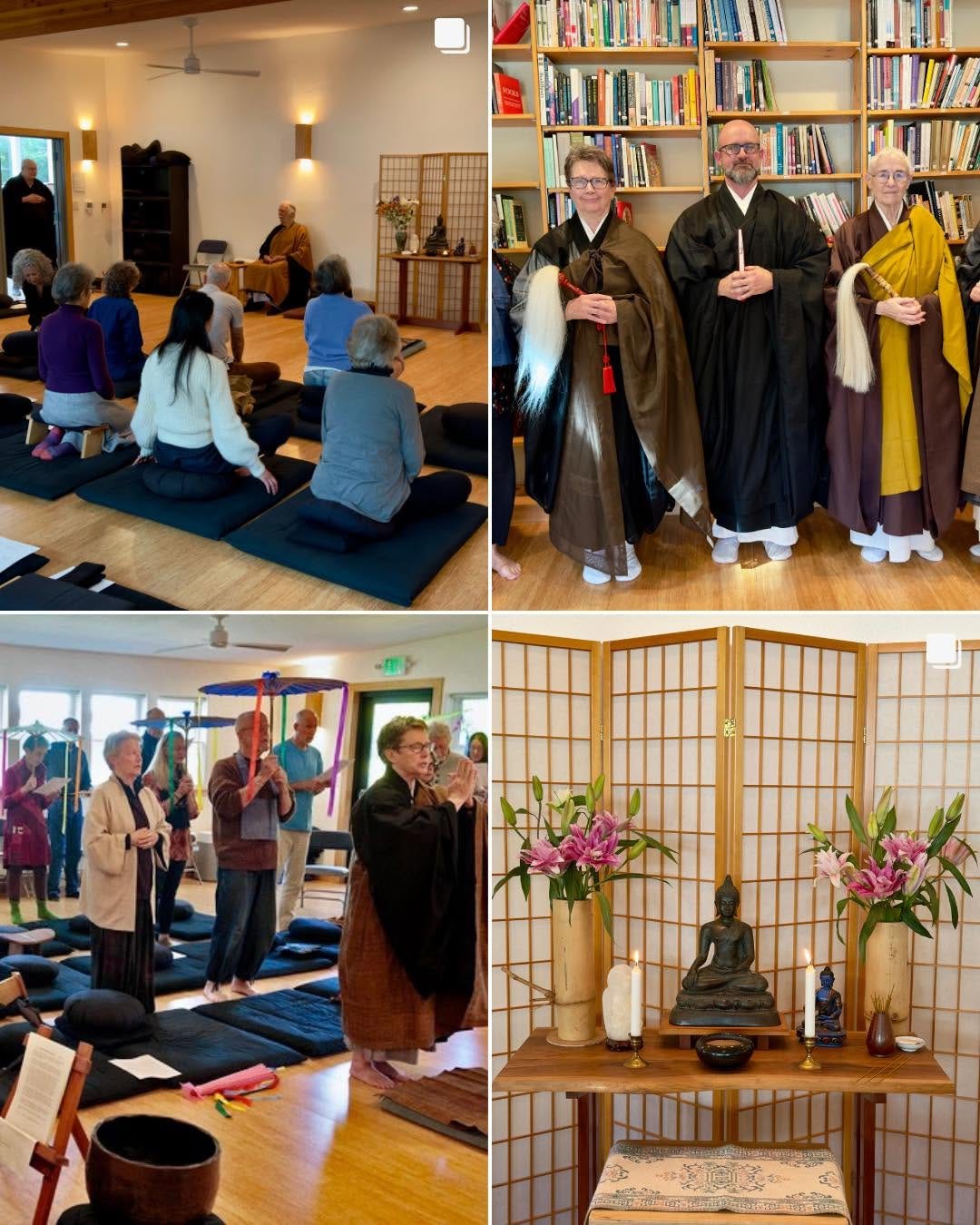
“People poured through the doors,” Jisho said, and she has a theory about why. “When I started practicing Zen 50 years ago, you sought a teacher,” she said. “Now people want community.”
She points to Buddhism’s original framework, in which the Buddha, the Dharma, and the Sangha — the community — constitute the three treasures.
After years of pandemic isolation, she said, people showed up first for connection and found the practice afterward. Membership has grown to roughly 102, with six teachers and two — soon three — priests-in-training. Warner now serves half-time as “Abiding Teacher,” having handed daily leadership to head priest Myogen Kathryn Stark, who joined last November after a national search.
While Stone Creek Zen Center is fiscally sound, and responsibly managed, it still has a mortgage, so it is not actually debt-free at this time.
“We don’t have any big donors,” she said. “The Sangha is the angels here.” Core programs — weekday sitting, Sunday mornings, and monthly meditation instruction — remain free.
Some of Warner’s favorite stories aren’t about the building at all. There’s Barton Stone, an Occidental carpenter who found a regular practice through Stone Creek, was ordained later in life, and now teaches his own outdoor sitting group under the trees. There’s JoE’ Annette, who knocked on Warner’s door before the Zendo had even opened, asking for a teacher. She eventually re-ordained, built a career as a bookkeeper, then retrained as a hospital chaplain and later as a hospice chaplain before returning to teach at Stone Creek.
Warner has also watched the neighborhood around her change. When the Sangha first moved into the Graton building in 2008, the area was rougher — graffiti on the walls, a stolen Buddha statue and wagon wheel, and a break-in. During the pandemic, a homeless encampment grew nearby; Stone Creek offered an outdoor outlet for charging phones and, briefly, access to water, until logistics made it unsustainable. Some neighbors worried the renovated building would become a shelter; Warner suspects there was quiet relief when it didn’t.
Throughout the years, Stone Creek had remained a settled, open place that doesn’t depend on any one person and is simply there when someone is ready to walk through the door — even if, as one recent member admitted, it takes a year of driving past before walking through the door.
“Make sure people hear that we’re friendly and open,” Warner said, wrapping up. “Absolutely.” That certainly reflects who she is.
Stone Creek Zen Center does not require membership to participate in its programs and meditations. It is welcoming to all. Check out their website at: https://stonecreekzencenter.org

What a wonderful tribute to Jisho and Stone Creek!