

A July 18 training in Green Valley will teach neighbors to communicate when cell service fails — and why the next emergency may depend on it
George Greeley remembers the night the Tubbs Fire announced itself not with flames but with furniture. A steel table on his Sullivan Road deck lifted and crashed to the other end of the house. Then, stepping outside, he noticed it was snowing — or what looked like snow. It was ash.
“And then the high-low siren came by,” he recalls. “They had a loudspeaker and said, ‘You need to get out now. This is the last warning.’” He and his wife Marcy threw their go-bags in the car, put the cat in the back, and headed for Petaluma. What normally takes 30 minutes took three hours. There were no working traffic lights. No one directing the gridlock. Just a county’s worth of people all trying to leave at once.
That experience set Greeley on a path that now has him organizing an emergency communications training for Friday, July 18, at the Green Valley home of Bob Dozer and Ellen Barnett.
The event is part of a broader push to equip West County residents with hand-held GMRS radios linked in a neighborhood network—a technology that works when cell towers don’t, the internet goes down, and the roads become parking lots. Bob is secretary of the North Bay Communications Network, a community-driven emergency network established in 2024 to build neighborhood radio resilience across Sonoma County. Its funding comes from a federal grant, community contributions and some cooperation agreements with local agencies.
Greeley is a smiling and cheerful retiree who exudes passion for emergency preparedness. He takes his avocation of saving lives seriously.
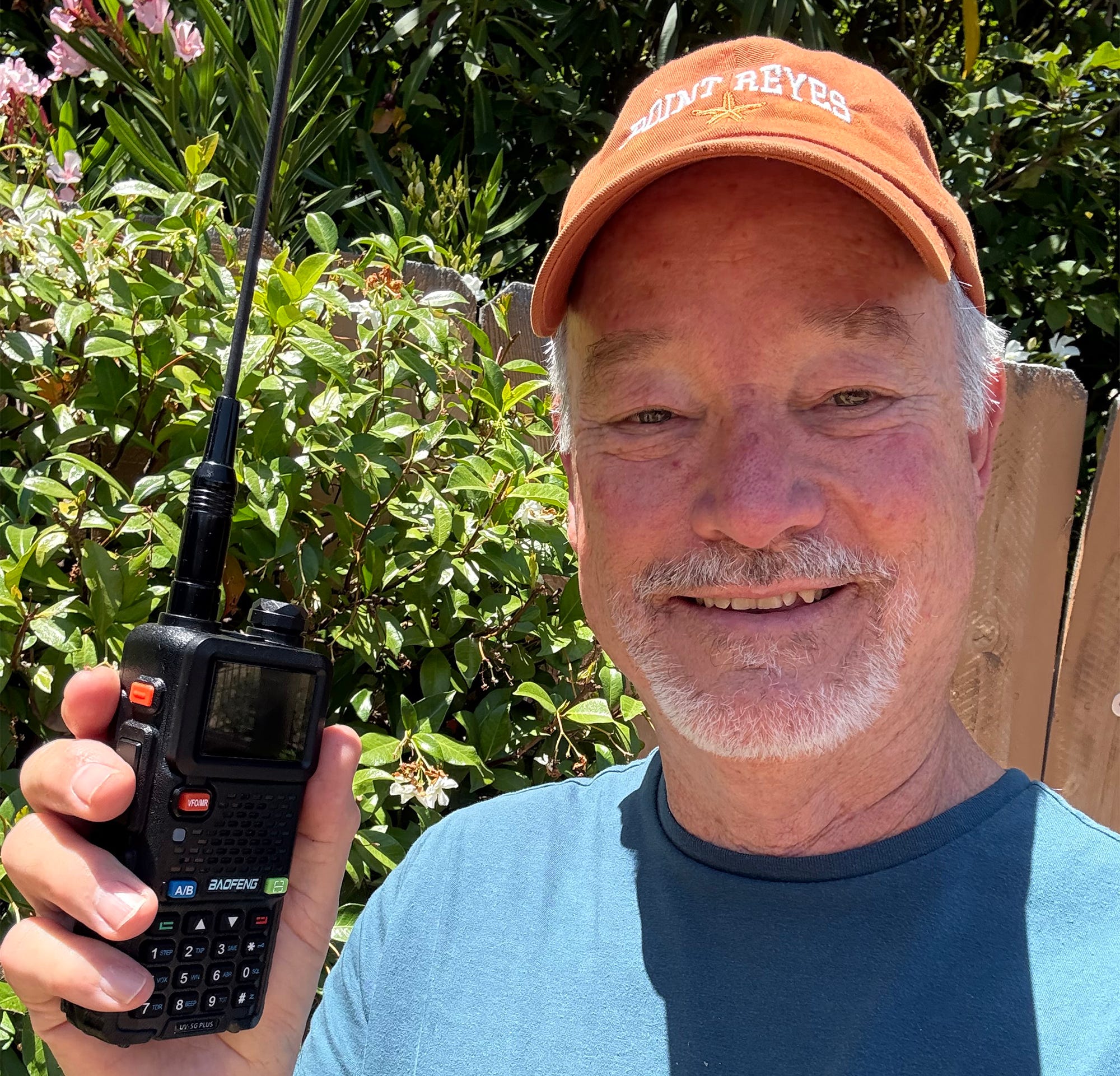
“The first responders in an emergency,” Greeley says, “are your neighbors.”
The radios at the center of the July 18 training operate on GMRS — General Mobile Radio Service — a licensed but widely accessible frequency that requires no cell signal, internet, or landline. Each device runs on a rechargeable battery (with a USB-C connection, like a modern phone), costs around $25 through the organizing group’s bulk purchasing, and can be learned in an afternoon.
Greeley’s entry into the radio world came at a pancake breakfast at the Graton Fire Department after the Tubbs fire, when someone held up one of the small handsets and said that in an emergency, it was all you needed. He was skeptical. He went to a training anyway, got a radio, and was connected to the Green Valley Radio Net — a loose but active group of neighbors who check in regularly and stand ready to relay real-time information in a crisis.
The July 18 event builds on that network. Participants will spread out across the Dozer property to practice transmitting and receiving — many for the first time. That same evening, once everyone has returned home, the group will conduct its first check-in call: an agreed-upon time and channel, led by a “net control” who calls roll and manages the flow of information.
In language I haven’t heard since Army basic training, Greeley admonished: “The first thing you learn is: listen. Keep your speech short and to the point. Don’t ramble.”
The protocols — “copy that,” “over,” waiting for others to finish before transmitting — exist for a reason. Radio signals collide if two people transmit simultaneously, and in an emergency, clean communication can mean the difference between a neighbor getting a generator in time and a medical device going dark.
The value of that real-time network became clear to Greeley as he thought through what a coordinated evacuation might look like. The county has made real improvements since the Tubbs fire — evacuation zones have replaced blanket orders, allowing more targeted and less chaotic departures. But zones and plans only work when information flows. A downed tree on Graton Road, an elderly resident who needs help evacuating, a family without a generator whose medical equipment runs on electricity — these are the problems that neighbors with radios can solve faster than any official dispatch.
“You can have a plan,” Greeley says, “but stuff happens.”
Greeley also spoke to me about new developments in radio technologies, beyond the current point-to-point. Meshtastic and the more robust MeshCore represent the next generation of community communication.
Unlike GMRS, mesh systems require no voice protocols and no radio knowledge. Each device automatically connects to others nearby, passing messages along a chain of nodes until they reach their destination. Networks are already active in Seattle and Los Angeles; Sonoma County’s network is still growing but gaining momentum. The technology originated during wildfires in New Zealand and has expanded rapidly as communities worldwide have recognized its potential.
There are also conversations underway between the North Bay Communication Cooperative — the nonprofit umbrella organization behind much of this work — and the Graton Community Services District about hosting a mesh network node. GCSD’s planned fiber optic buildout, which would extend service from the area all the way to Jenner, could eventually provide a hardwired backbone for a wireless mesh that reaches even the most remote Green Valley homes. Many residents here currently have no internet at all.
Greeley has spent years building that kind of community awareness, from his time on the county grand jury studying evacuation failures, to his work with Meet Your Neighbor West County, the organization led by Skip Jirrels, that brings households together to take stock of who has a chainsaw, who has a generator, who has first-aid training. He volunteers with Safer West County as well. The radio network is one more layer in what he sees as an interlocking system of neighborhood resilience.
The July 18 training is free and open to the community. Radios will be available for $25, and light snacks will be provided. No prior experience is necessary. Training will start at 10 am and go until 12 pm. The address is 3902 Bones Road, Sebastopol. For more information, contact George Greeley at g_greeley@yahoo.com.
“Just let people know, ‘Hey — there’s this opportunity,’” Greeley said. That opportunity could save a life.
Note: SebastopolReady.org is a website operated by the Sebastopol Police Department and it is maintained by the Sebastopol Neighborhood Communications Unit, which holds monthly radio check-ins.
See also:


Apologies to Dewey!! This story initially went out under my byline, which is the default on my computer. I have to remember to change it when I post another writer's story and this time, I forgot. But yes, this story was written by Dewey Watson. It's been fixed online.
Dewey, I think George meant the Kincade Fire in 2019, not the Tubbs Fire of 2017. West County did not evacuate during the Tubbs fire, but did during the Kincade Fire, which was sparked by faulty PG&E equipment. During the Walbridge Fire of 2020, we were under advisory, but also did not evacuate.
Otherwise, great article and I really appreciate the communication system being created.