

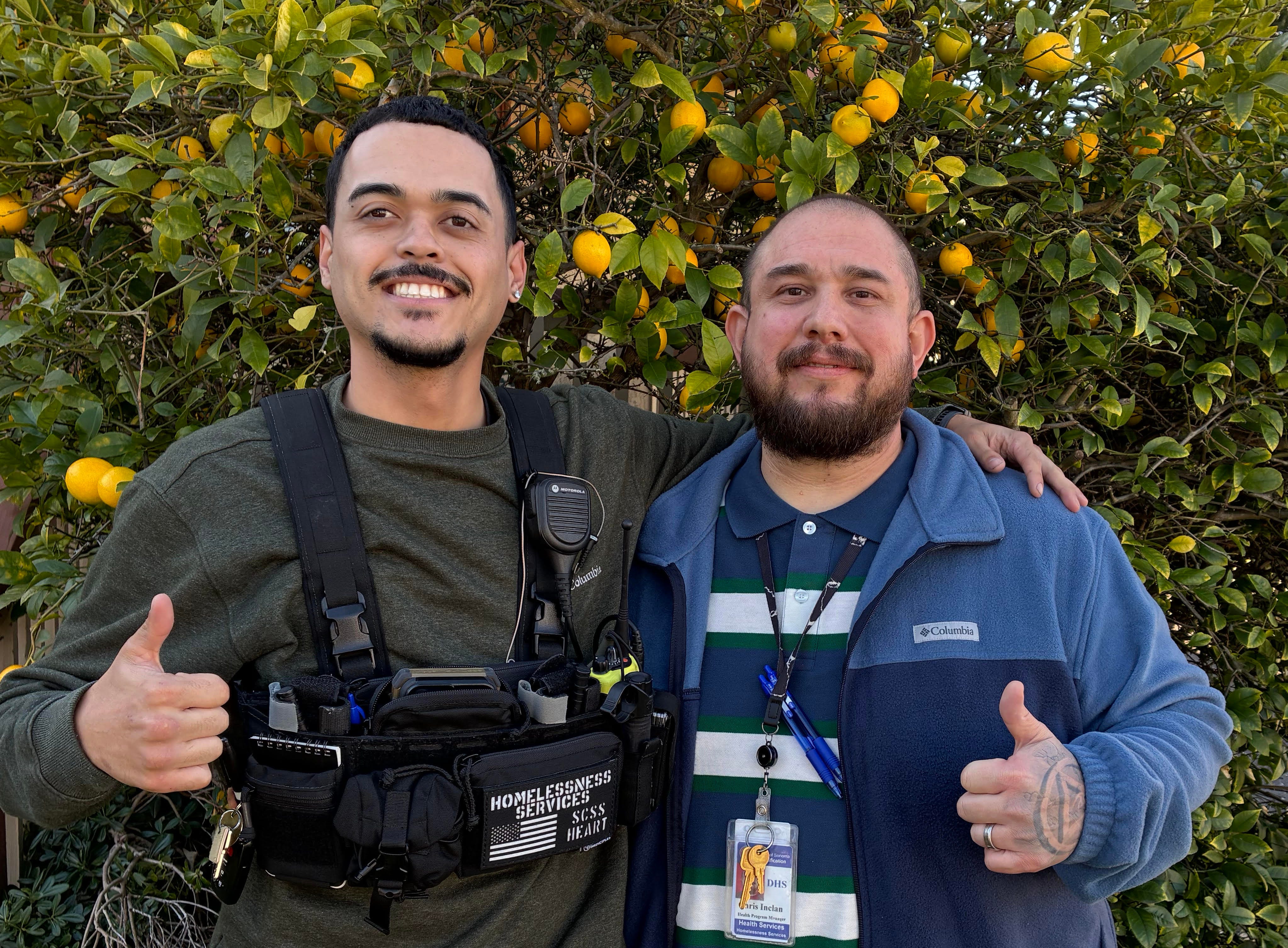
Two representatives from the county’s HEART program, Julian Sanchez and Chris Inclán, dropped by the Sebastopol Times office for a chat yesterday. Senior Client Support Specialist Julian Sanchez started work in Sebastopol on Jan. 20, doing homeless outreach. He’s the point man for the county’s 90-day pilot project in Sebastopol. Sanchez is working out of the police station but makes regular rounds of the city and local trails.
“I’ve made contact with over 20 [homeless] people now, and I have, I think, nine or 10 people signed up on a release of information to start working on case management services,” he said. The release-of-information form allows Sanchez to share an individual’s information with other agencies and groups around the county that work with the homeless. “This allows us to be able to communicate with those different service providers about the things that the person may need and how to best support them.”
HEART’s Health Program Manager Chris Inclán said that “HEART stands for the Homeless Encampment Assistance and Resource Team. This grew out of the issues on the Joe Rodota Trail originally when that grew into a very large encampment. The county got involved and decided to build out a team to help address the encampment and then it just grew into expanding those efforts throughout the county, as other encampments started to pop up.”
Inclán said Sebastopol was chosen as the first city to have a HEART worker assigned to it full-time as a part of a new pilot program.
“There was coming from the city and the community a concern for individuals residing in this area that were unsheltered,” Inclán said. “The concern was, ‘Are they getting access to the resources and help and support that is needed?’ It was a growing concern, so we looked at it and said, ‘Hey, how can we put something together to help support the area?’”
“Homelessness is very complex, right?” Inclán said. “Some people will say it’s a housing issue, it’s a drug issue, it’s a mental health issue. The truth of the matter is homelessness is not a monolith. It could be all of the above or one or the other. Every individual is unique and different. When we’re looking at this, it’s a problem that we all have to work together to solve it, right? There needs to be collaboration and coordination.”
Sanchez has worked with the homeless for about five years. On his rounds around town, he wears a medical kit stamped with the words “Homeless Services.” It’s got a radio and basic medical supplies, including Narcan, which is used to revive people suffering from heroin or fentanyl overdoses.
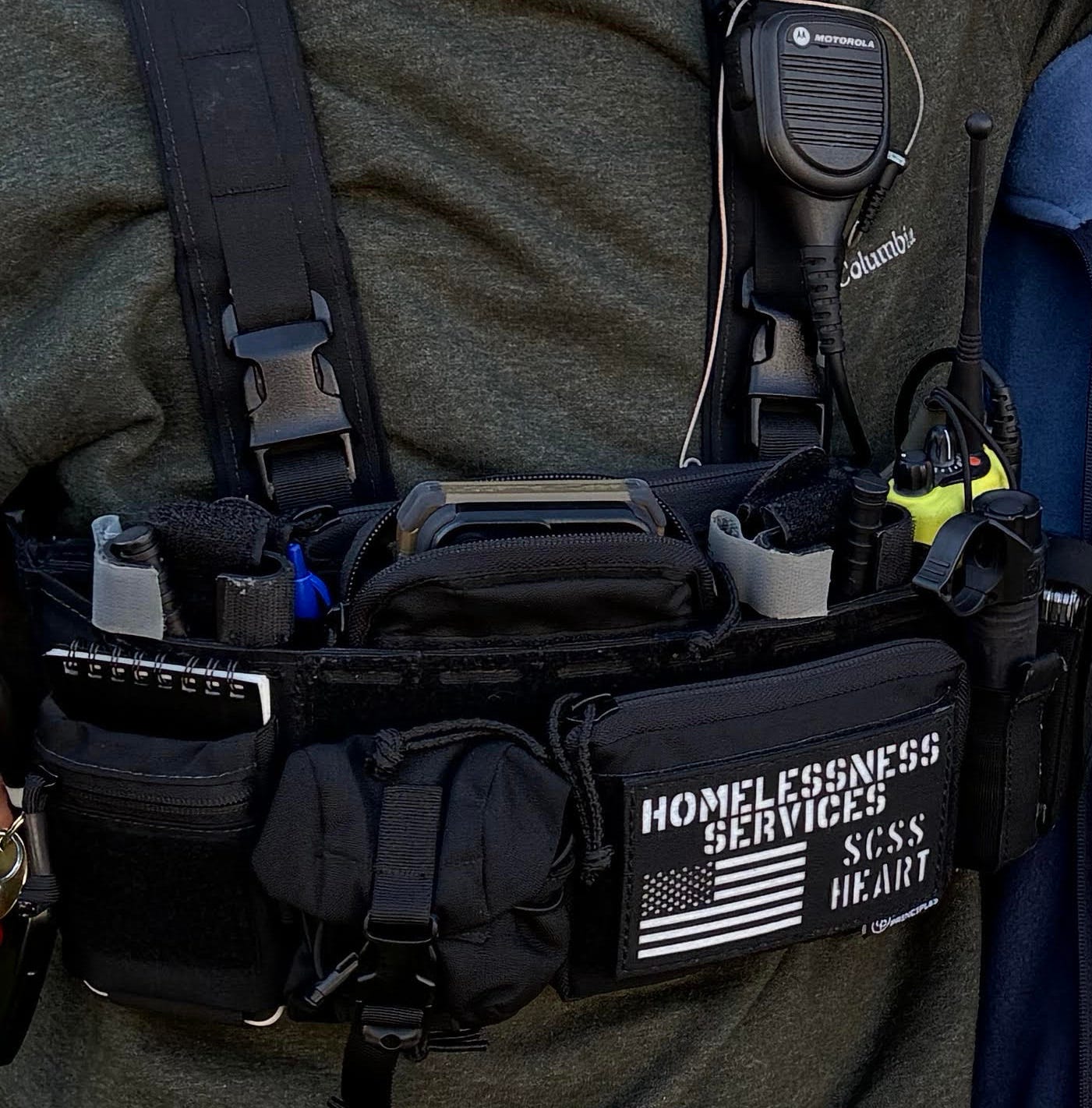
“This is just a medical setup, so in case anyone needs any general basic medical assistance. I have gloves, and I can assess them, do basic necessity stuff until medical comes.”
I was curious about how Sanchez got into this challenging line of work.
“I worked at a medical company that was acting like a triage to rehouse people experiencing homelessness during COVID. I just really fell in love with helping people,” he said. “Originally, I was going to go the medical route, but I ended up helping write the program to bring people experiencing homelessness back into the community with resource navigation and compiling all of the local resources that we had available to people. I just started trying to work the program and help people get out of homelessness.”
What does his typical day look like?
“I get into the office with the police department. I will check in with them make sure there’s no pending calls or anything that they would like me to go out to do. And then I typically just drive around. In the mornings, I’ll drive around and I’ll see who I can make contact with. I do have an ongoing caseload now, with this last week and a half, gathering some people, so I’ll check in with them. I called the health clinic yesterday to see if I could get someone insulin, but we need to get them reactivated [with Medi-Cal] for the state because they’re from Portland. Then I got dispatched to a call—someone in the plaza. So I offered them services, got them to sign a release of information, and we’re going to work on getting them their EBT.”
He said he was also working on hooking this person up with a phone. Inclán said free government phones are available in some areas through Medi-Cal, and they’re basically a survival tool for the homeless.
I asked Sanchez what he had learned about Sebastopol, in terms of the homeless, in the last week?
“I do feel like there’s a lot of empathy in the community,” he said. “It seems like everyone wants to help people who are in this community experiencing homelessness, which seems nice.” Elsewhere, he said he’s seen people being rude to homeless people. He hasn’t seen that here yet. “It seems like everyone’s relatively understanding of the situation that they’re in.”
What about Sebastopol’s other homeless outreach worker?
Sanchez is now the second person in Sebastopol working on homeless outreach. The City of Sebastopol already pays for another homeless outreach worker from West County Community Services (WCCS). The WCCS outreach worker spends 20 hours a week in Sebastopol and 20 hours a week elsewhere in west county.
There’s quite a lot of crossover in the services that the two groups provide. They both try to find and identify local homeless individuals, offer them services and sign them up for the County’s Coordinated Entry system—a funnel that could lead eventually to housing.
Sanchez has already found five people—about a quarter of his new caseload—who hadn’t been entered into the Coordinated Entry system. This isn’t necessarily a ding on Sebastopol’s existing outreach worker. Homeless people move around, and there seems to have been a sudden influx in the last few weeks of homeless people new to the community.
Both Inclán and WCCS’s Director of Housing & Homeless Services Danielle Danforth agree that the HEART Program has more of an emphasis on providing mental health services.
“They have services that we don’t have in terms of mental health and ways to access them,” Danforth said. “They’re a whole different system.”
Inclán said they’re working together with WCCS to avoid a duplication of services.
“One of the things that we’re doing to coordinate with them—to align the work that we’re doing—is doing the trail together on certain days,” Inclán said. “We’re also building out our coordination workflows on how we communicate about the individuals that we’re serving…to make sure that we’re working in tandem and not rowing in different directions.”
Another difference between the two is that HEART’s Sanchez has a closer working relationship with the Sebastopol Police, who actually send him out on calls dealing with homeless individuals acting out in public or having mental health crises.
What will happen when the 90-day pilot project is over?
“Assuming everything goes well, Julian will remain here,” Inclán said. “We’re agreeing to come here and do this for 90 days and then kind of reconvene and ask “Okay, what worked, what didn’t work. What else do we need?”
“Like, how much of an impact did my being here for the last 90 days do?” Sanchez said. “How much did I help? And if there’s something that we can do to make it better, or if we think that there’s another direction we should go in.”
According to Sebastopol’s Interim City Manager Mary Gourley, “There has been no discussion yet with the county regarding anything beyond the 90 days or any future cost to the city.”
This is fantastic.
Welcome. First sign of a coherent plan. There may be hope.