


At their April 8 board meeting, WSCUHSD high school board members learned about a clever, new way to restrict cellphone use on campus, heard a thorough review of Special Education, and got a glimpse of student attitudes in the YouthTruth survey. They also heard some heartening enrollment projections for the next school year at Analy and recognized the legacy of Kirk Lokka.
Kirk Lokka Barn at El Molino
The Ag Boosters asked the Board to approve naming the El Molino barn in memory of Kirk Lokka, who passed away in March.

Michelle Sawyer, president of the Ag Boosters, told the board about Lokka’s dedication as a prominent vineyard grower for over 40 years. She gave examples of him “helping countless students” in ag education throughout the county. Lokka built the barn himself in 2004, and it is “a reflection of a legacy he built.”
Riggs Lokka and his wife, Emily, who teaches in the ag program at Analy, said that his father “wasn’t a person who wanted to be recognized.” He said “He was a doer and built the barn all in one weekend.’ The board approved the resolution unanimously.
The Commons App
While a policy to ban cell phones isn’t popular among students, there isn’t much debate about whether it will happen next year. A State law that goes into effect in June requires it. The best way to implement the cell phone ban, however, is still open for consideration.
One proposal is to have students put the phones in Yonder pouches, which remain locked during school. Another is some kind of lockbox, which requires students to drop off their phones and pick them up at the end of the day. Both have some logical challenges.
The co-founders of The Commons app presented via Zoom a different option to the school board. The Commons app disables phone reception while students are on campus. It uses geo-fencing to block cell phones from operating within the geographic borders of the campus.
The developers said The Commons app was like ‘Airplane Mode for Schools,’ which they’ve trademarked. Their presentation said their goals was “redefining focus in schools, not by removing devices, but by building better habits.”
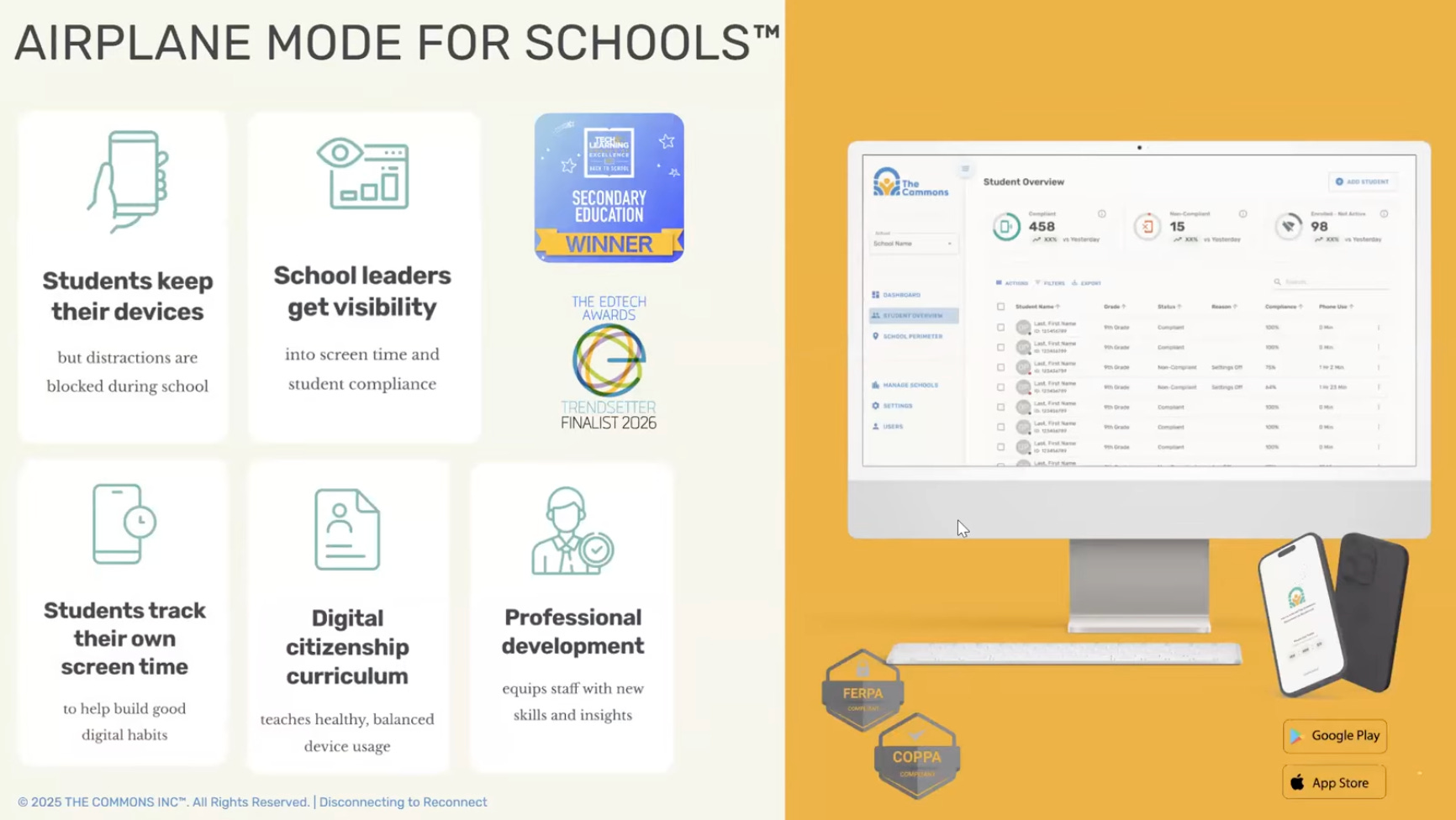
Students would be required to have The Commons App on their phone. Using this app eliminates the need for pouches or checking student phones in and out. It also promises relief to teachers so that “they won’t have to be the cellphone police.” The co-founders of The Commons app said that it does not track students.
In a letter to parents, the District said that “The Commons app is just one of the tools being considered to support next year's bell-to-bell mobile device policy. While we are clear on what our policy will be and why we are doing it, we will continue to work with our community to determine how to implement this change effectively and sustainably.”
The board presentation on The Commons app is available on here on YouTube. Below is a link to the PowerPoint presentation from The Commons App.

BTW, students at the Academy of Innovative Arts are testing the use of Yonder pouches during the last quarter of the school year. At the start of the day, students lock up their phones in a pouch, and they get it unlocked at the end of the school day. While it is a cumbersome process, teachers have seen a reduction in students being distracted by their phones and paying more attention to each other and to what is happening in class.
Special Education review
Special Education can seem like a dark art, not well understood by the public. Laura Schmitt, Director of Special Education and Student Services, gave a thorough presentation that shined light on the district’s programs and how they are managed.
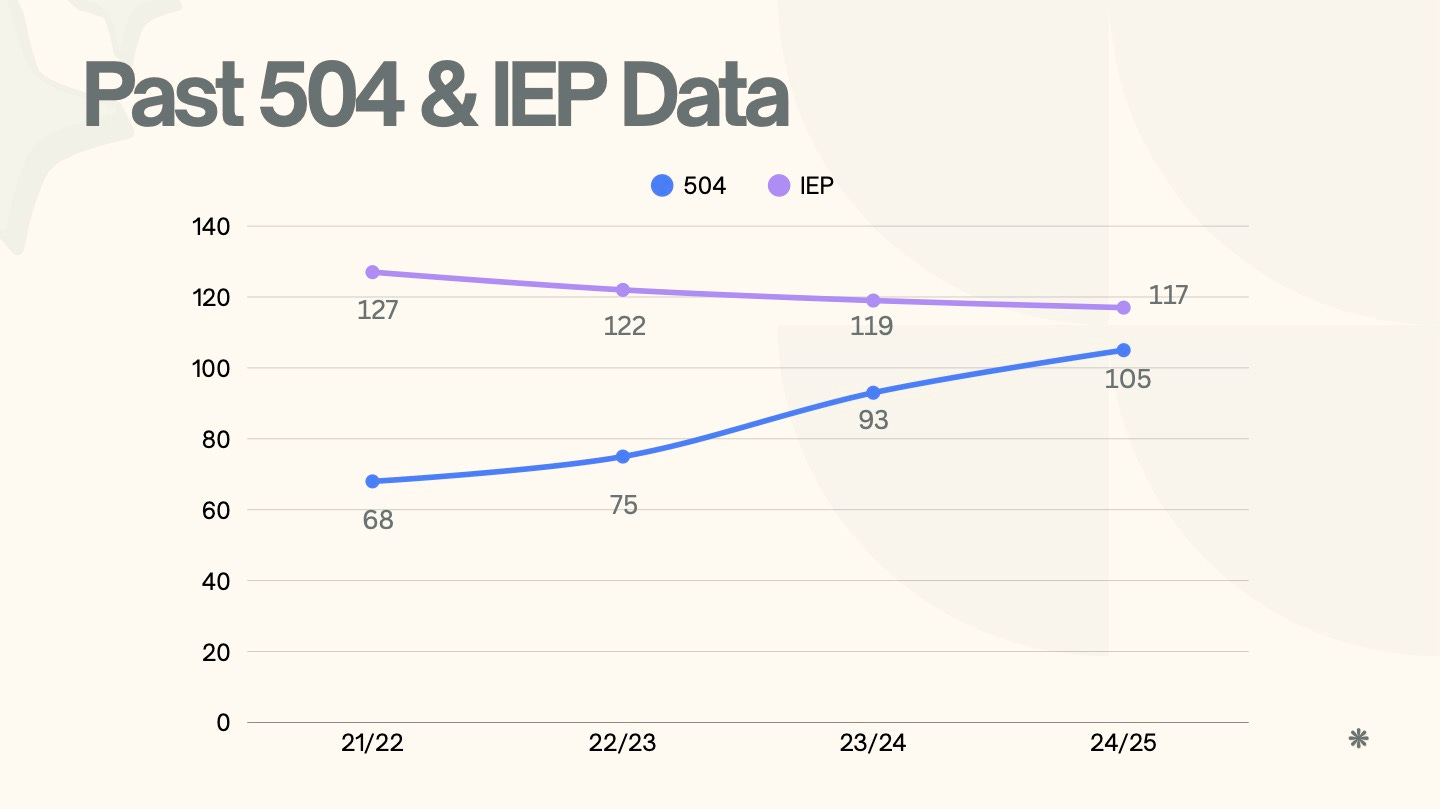
In the high school district, 14.5% of students have Individualized Education Programs (IEP), which compares with the State average of 14.6%. Schmitt said that this comparison indicated that the District was “not over- or under-identifying” students in need of special education services. While there are slightly fewer students on IEPs in recent years, the number of students on “504 plans” has risen from 68 to 105. 504 plans detail how a child with disabilities will have equitable access to learning at school; it provides accommodations and supports for the student.
Schmitt explained that the District pays for students with certain disabilities to go to non-public schools. Six students with autism are placed at the Anova school at a cost of $381/day per student. The most expensive school is run by SCOE at nearly $600/day per student. Schmitt showed the numbers that the District’s own programs that serve special needs students are more cost-efficient. For example, the nine Extensive Special Needs (ESN) students are served by one teacher and four behavioral aids at a cost of $381/day per student. There are two other programs: Positive Engagement Program (PEP) with 14 students at a cost of $161 a day per student; and Young Adult (YA) with 9 students at a cost of $225/day per student
Even though there is some federal reimbursement for special education, the District must foot a $5.5 million bill for special education services. Also, the District has not had any legal or compliance issues since 2022.
YouthTruth survey results
Almost 90% of students (1,284 out of 1,427) filled out the annual YouthTruth survey in January. Analy Principal Chuck Wade gave an overview of the results for students at the board meeting.
The YouthTruth survey gauges student attitudes across six major theme areas, as shown in the summary slide below, revealing Analy’s strengths and challenges.
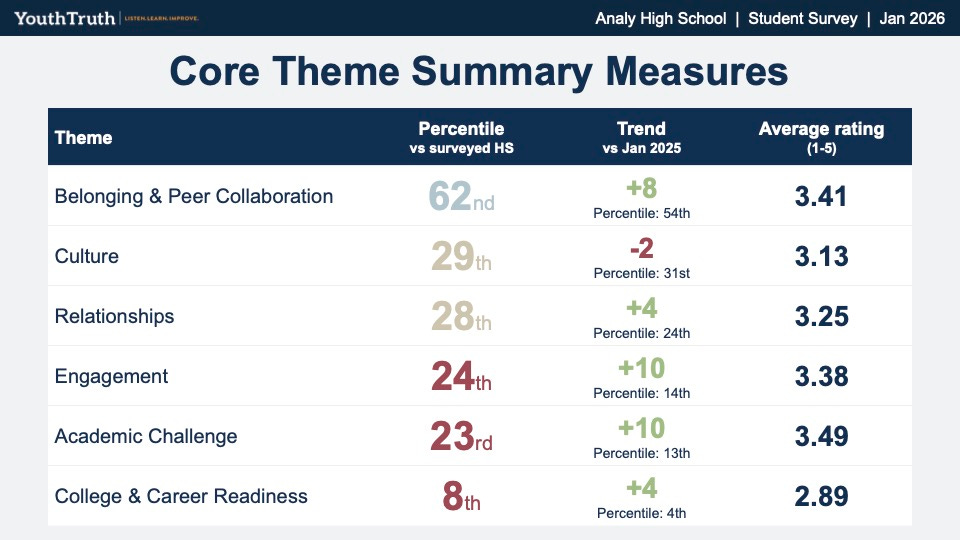
The YouthTruth data compares the District’s ratings to other surveyed high schools; it also compares 2026 results to 2025 results. The District’s lowest ranking was in College and Career Readiness, and its highest was in Belonging and Peer Collaboration.
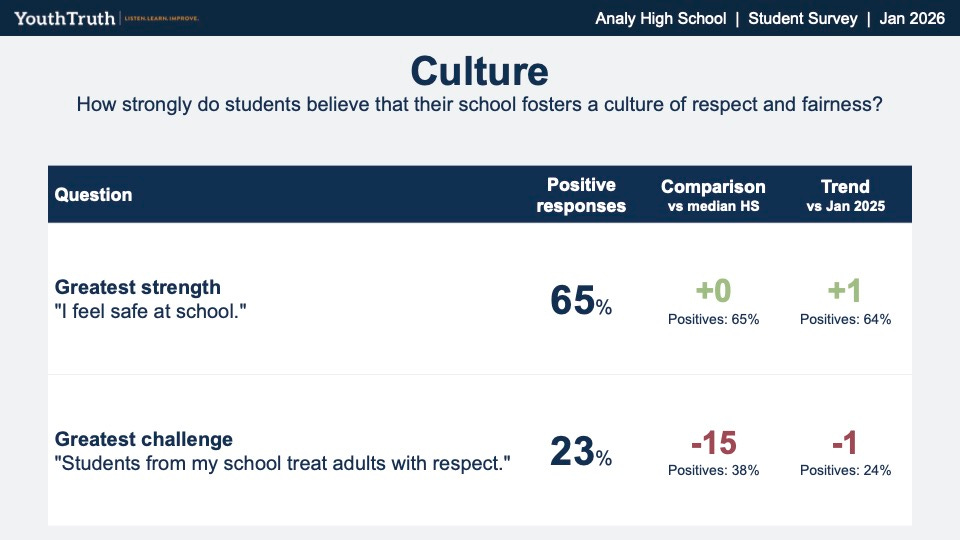
To take one example, under Culture, 65% of students said they felt safe at school, a strength of the school. A challenge was that only 23% of students said that their peers treated adults with respect, a score which was 15 points below the median high school in the survey.
Mutual respect between students and adults is a challenge. “Adults at my school treat students with respect” received a positive response from 52% of students, but the number was 12 points fewer compared to other high schools, and it was trending downward by 7 points from last year.
College and Career Readiness was the lowest-scoring area for Analy in the survey. Though scores in this area improved slightly from last year, just over a quarter of the students said they felt they were being well-prepared for college or work.
27% agreed that “My school has helped me understand the steps I need to take in order to have the career that I want.”
27% also agreed that “My school has helped me understand the steps I
need to take in order to have the career that I want.”
28% agreed that “My school has helped me figure out which careers match
my interests and abilities.”
On College and Career readiness, the survey shows gaps in the responses by grade level.
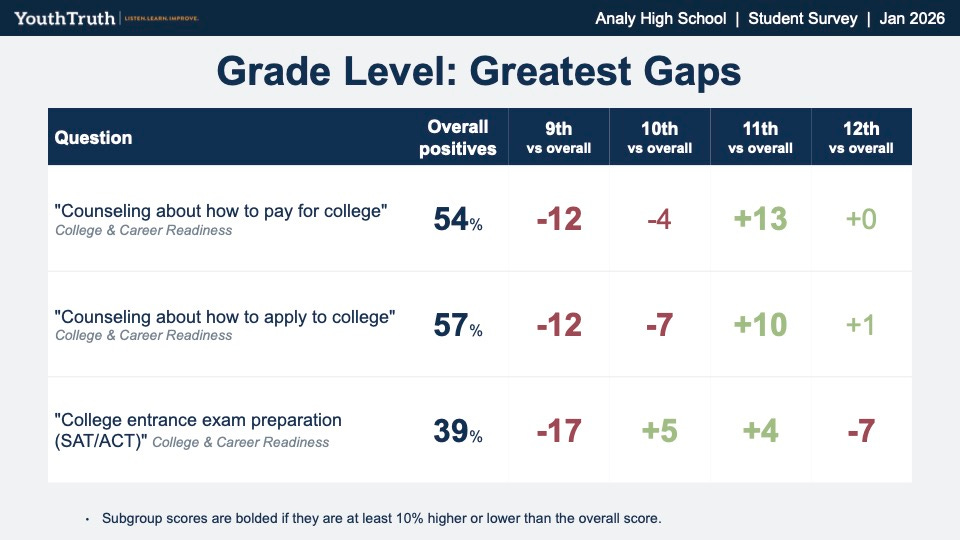
Wade said that the YouthTruth survey helps to show areas of needed improvement. “It’s not an objective assessment, but it is a tool for community engagement,” he said. The YouthTruth survey data can be filtered to look at students by grade level, by gender, by ethnicity.
You can review Wade’s entire presentation at the link below.
The YouthTruth also surveyed staff and families. For the first time, the District has made the entire YouthTruth survey results—for students, staff and families—available at this link.
Pre-enrollment numbers
Superintendent Chris Meredith presented an update on enrollment numbers, which are looking somewhat better than previous projections. Because Santa Rosa City Schools has changed its interdistrict transfer policy, restricting transfers out of the district to Analy, the District was expecting a drop in its next class.
The projection at this meeting shows an increase in the next year’s 9th grade class of about 40 students — 372 next year versus 331 students this year, with a total projected enrollment of 1,439 students at Analy for next year. New interdistrict transfers account for 33% of the next year’s new enrollment.
Projections for Academy of Innovative Arts, which adds another first-year class next year, are around 40 students. Mia DelPrete had several questions about the lower-than-projected enrollment and wondered if the district was doing enough to market the new school. The District’s iAcademy for independent study is expected to stay at 81 students, while Laguna may see a decline in enrollment.
Checking out books
Julie McClellan, the school librarian, is retiring at the end of the school year. She is also the union representative for the District’s classified employees. Under the current plan for next year, her librarian position will be filled by someone who will also share the role of College and Career Counselor.
McClellan spoke out against combining these two jobs and said that the school deserved a full-time, fully trained librarian. She remarked that Analy, as well as other schools, were seeing an increase in the number of books being checked out at the library, which correlates to banning cellphones on campus. “1,500 books have been checked out this year,” she said, indicating that the number was larger than in previous years. “As cellphone use at school goes down, students have shown more interest in reading,” she said.
The entire 3.5-hour April 8 board meeting can be viewed on YouTube.