

This is Part 1 of a two-part, in-depth story from Rollie Atkinson. He begins with a profile of environmental planner, poet and baseball fan Richard Retecki. In Part 2, which will follow tomorrow, Atkinson provides a history of Sonoma County’s first General Plan, which is a saga unto itself. Both go a long way toward explaining why the county we know and love looks the way it does.
If you want to know the secret of how so much of Sonoma County has been preserved as beautiful open space—with over 60 public parks, an unspoiled ocean coast full of trails, camping and beaches—and why the Russian River flows freely through the length of the county with lots of public access, you could find the answers in Richard Retecki’s living room.
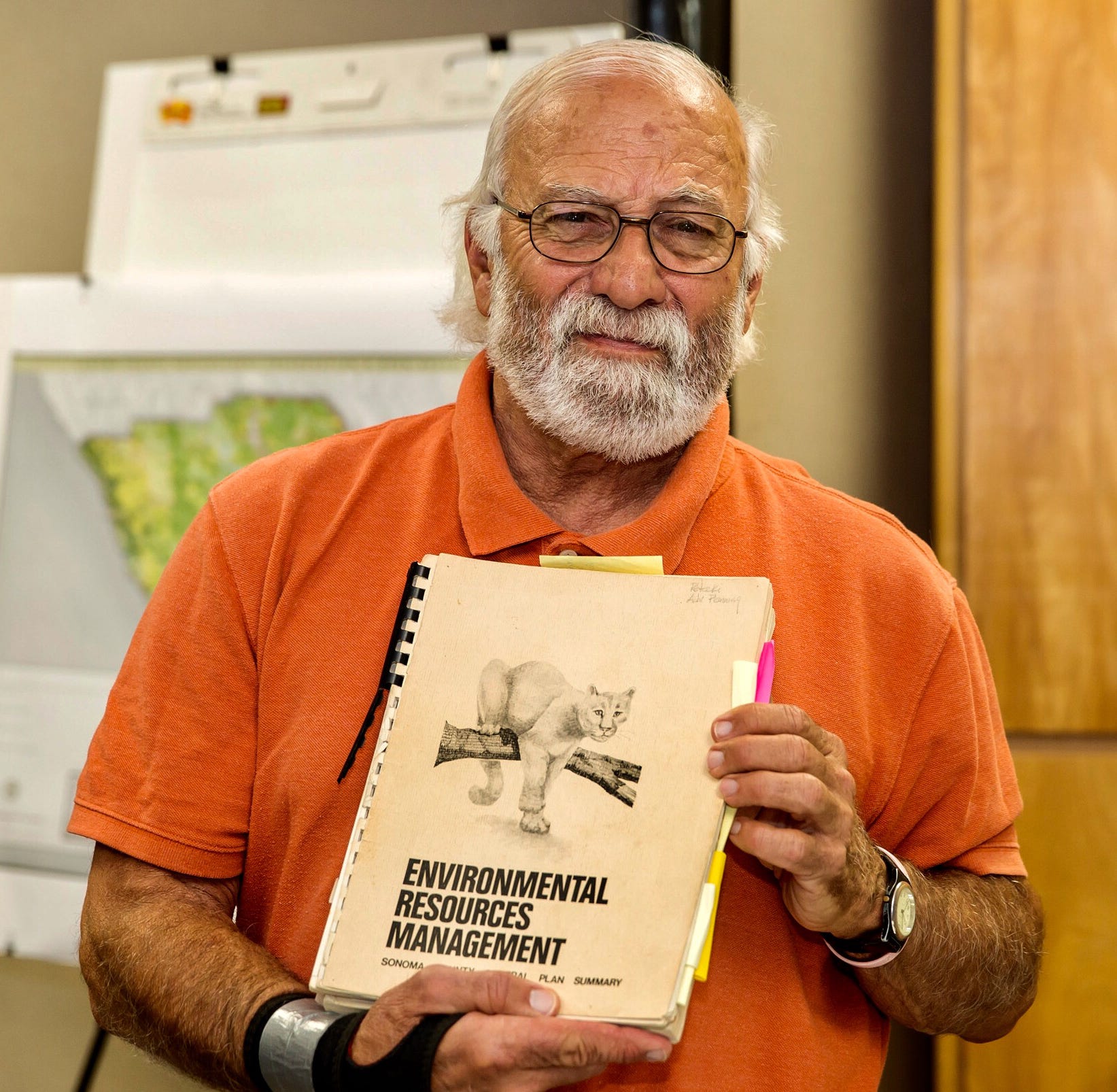
The bookshelves in his cluttered Sebastopol condo are filled with five decades’ worth of historic documents, reports, maps, natural resources surveys and foundational planning documents, most of which he helped write. He also contributed countless hours shepherding these documents through public hearings, citizens’ advisory committees and technical task forces.
These dog-eared and yellowing texts chronicle both the arc of Retecki’s career as a planner and environmental advocate and the story of how Sonoma County avoided a future of suburban sprawl and crowded coastal development. Instead, thanks in large part to Retecki, the county embraced the slow growth and city-centric land-use scheme that exists today.
Fifty-five years ago, Retecki was a wide-eyed convert to a new way of looking at how people could live on the land and expand their cities, industries and farms without destroying the natural resources, sense of community or the county’s rural heritage.
Now, at age 83, Retecki is taking a long look back at his bookmarked and footnoted archives and decades of contributions to a wild and wonderful Sonoma County. He says he has no regrets or requests for any “do overs.”
The Pennsylvania native and Vietnam War veteran was one of a small number of like-minded young people hired in 1972 by the county’s fledgling planning department to write a first-ever General Plan, which was adopted in 1978 by the Board of Supervisors. It took a half-decade of surveys, mapping, many dozens of community meetings and a little “pushing and pulling” to create a final draft.
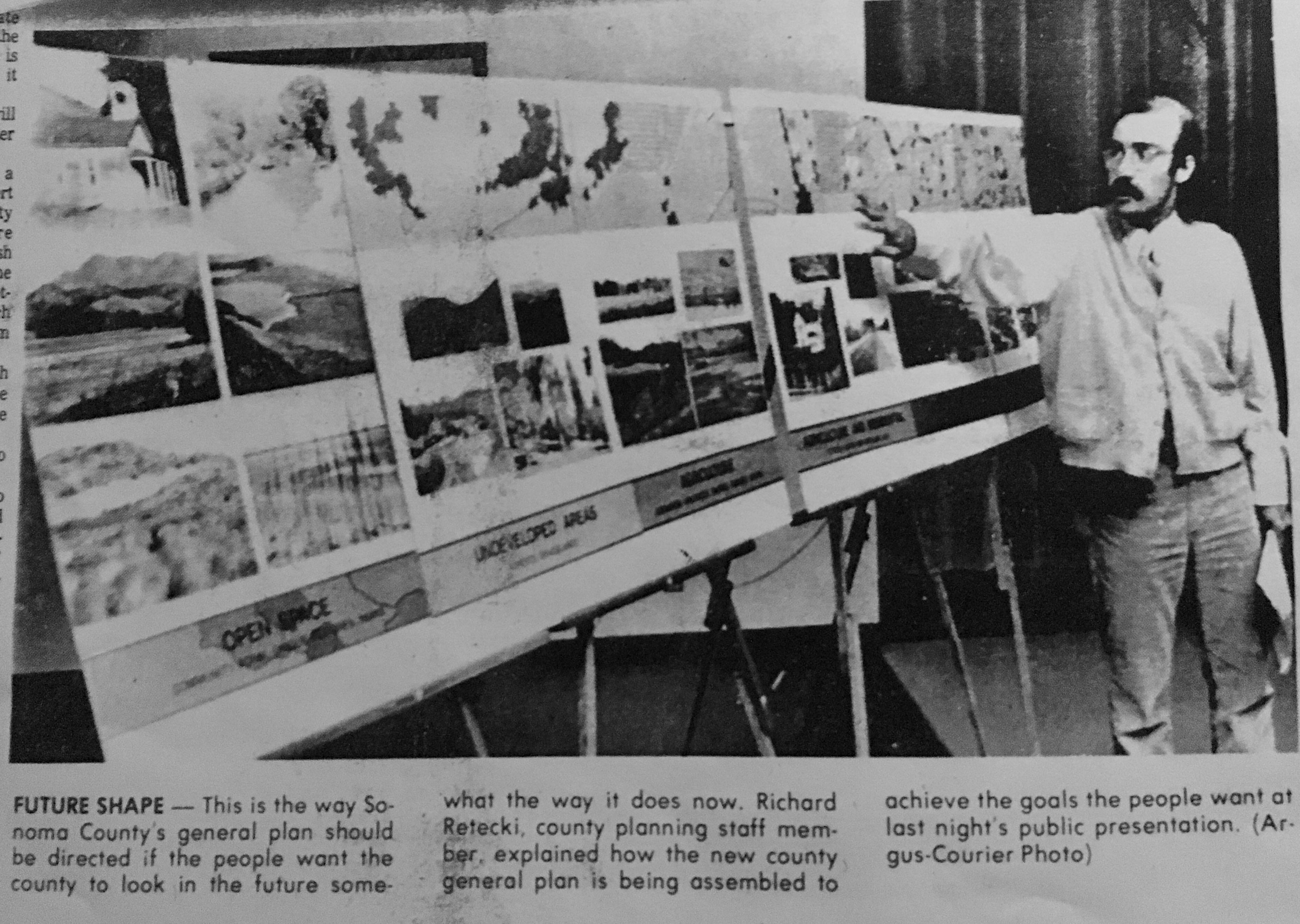
“We were a little bit loony,” Retecki now says about those years long ago when the County of Sonoma hired a dozen or so young men and women under a temporary federal jobs program that paid $3.27 per hour.
“I was hired to write reports on the climate and geography of the county under the jobs program that was only supposed to last three months. But we ended up working on the project for three years, and eventually we all got hired as permanent employees.”
Those few years turned into decades of work for the county’s Planning Department and later for the California Coastal Conservancy, the county’s Regional Parks Department and its Agricultural Preservation & Open Space Authority. His career also included multiple consulting stints with nonprofits like Sonoma Land Trust, LandPaths and others.
Retecki said he and his fellow planners were deeply influenced by the book, Design With Nature, by Ian McHarg, an environmental planner and fabled professor from the University of Pennsylvania. The book can’t be found on Retecki’s bookshelf because it has a more honored place at the center of his dining room table where it is chock full of bookmarks and tabs.
Walt Kieser, another young planner hired in 1972 with Retecki, told him to read the book, and Retecki said it changed his worldview forever. All the young recruits shared McHarg’s book and its revolutionary approach to land use and community planning.
“We all thought Sonoma County was a unique and very special place,” Retecki said. “I think we all saw it was not just the physical beauty, but culturally, agriculturally, historically — for all those reasons we took an approach that had never been done anywhere else. That book was the first to suggest integrating environmental resources into planning, and projecting the impact on the entire landscape.”
But Retecki’s success in preserving the beauty of Sonoma County was founded on more than that book or intellectual movement it inspired.
As a young boy, Retecki almost died from Rheumatic Fever, a disease that still claims more than 100,000 lives a year and has no cure or vaccine.
“I was in leg braces for seven months, but I swore to myself I would push through it,” he says. “It absolutely made me who I am and how I determined to live my life from then on.”
Retecki also remembers how his parents raised him with “tough love” that added to his mental strength and semi-rebellious approach to most things he went on to encounter in life.
Many political battles
“We just had a lot of young energy, and we believed in what we were doing.”
The drafting of the county’s first-ever General Plan in the 1970s was fraught with dozens of political skirmishes, including a successful recall election of two sitting county supervisors in June 1976.
At one point, 24 of the 27 planners were fired, leaving just Retecki and two other young staffers to finish the final versions of the plan eventually adopted in 1978. The other two planners were Toby Ross and Richard Lehtinen.
Their boss, Planning Director George Kovatch, was unceremoniously fired in the midst of the bitter supervisors’ recall election that saw environmental candidates Bill Kortum and Chuck Hinkle removed, and ultimately replaced by pro-growth advocates Robert Theiller and Wayne Bass.
According to an article about the 1978 General Plan by Press Democrat reporter Carol Benfell, “Laid-off planners staged a public mock funeral of the draft General Plan at Kovatch’s house—complete with small wooden coffin and burial. But the funeral was premature.”
In the next election—just five months later—a new pro-General Plan majority—Eric Koenigshofer, Helen Rudee and Brian Kahn—were elected to lead the county in 1976.
“Brian and Eric really became good friends. They were a breath of fresh air,” said Retecki. “And Helen, too.”
Retecki and his fellow planners completed seven alternative growth plans, all of which included the integrated planning policies of open-space preservation, community separators, city-centered urban growth and preservation of agricultural lands and resources. The population projections for the various alternatives ranged from a population of 380,000 to 630,000 by the year 2000.
The supervisors opted for the planning scenario titled “Slow and Moderate Growth” with a population projection of 430,000 by the year 2000. (The actual 2000 Census recorded 458,600 county residents.)
“We just had a lot of young energy, and we believed in what we were doing,” Retecki said.
Asked, in hindsight, if he believed the 1978 General Plan would be followed as closely as it has been over the past 50 years, Retecki answered, “Absolutely, yes. I believed it then, and I believed it the whole time.”
Following the adoption in 1978 of the General Plan, Retecki and others went on to help establish the voter-approved Agricultural Preservation & Open Space District in 1990 and an expanded Sonoma County Regional Parks system.
A few years later, all nine incorporated cities in the county adopted voter-approved Urban Growth Boundaries and a Local Coastal Plan was adopted that curtailed most residential and commercial development along the county’s 62-mile coastline.
Coastal Protection, Oil Leases and Gravel Wars
Retecki was at the center of the coastal plan drafts that set firm limits on development around Bodega Bay and required Sea Ranch developers to preserve multiple public access points and a new county park at the mouth of the Gualala River. He also wrote a pivotal energy resources and environmental impact report that helped block a federal government proposal to award Outer Continental Ocean Shelf Leases for petroleum and mineral drilling in 1980.
On June 24, 1980, a unanimous Board of Supervisors voted to “recommend deletion of the Bodega Basin from Lease Sale #53 and oppose the entire Outer Continental Shelf Lease Sale for Central and Northern California.”
Retecki also remembers fighting in the “Gravel Wars,” along the Middle Reach of the Russian River, where private gravel mining companies led by Syar Industries fought efforts to end in-stream and benchland gravel mining.
“I had enemies,” said Retecki, who was working for the Coastal Conservancy at the time. “Nick Tibbetts was one of them. He was on the other side working for the gravel interests.” In the end, new county land-use laws outlawed in-stream mining and other impacts to the underground aquifer.
Retecki is also proud of the acquisition of almost 300,000 acres by the county’s Agricultural Preservation & Open Space District, including large tracts in the Willow Creek and Jenner Headlands coastal watersheds.
“Change is the main thing we all confront through all of our lives.”
Other pursuits: poetry and baseball
Retecki’s life wasn’t all planning tomes and public meetings. Retecki has lived in Sebastopol since 2009, but for much of his career, he lived in Oakland, where he worked at the California Coastal Conservancy. While there, he was a founding member of the Martin Luther King Jr. Freedom Center and joined several poets’ circles and publications. And he kept up most of his “loony” habits of having too much fun at work, writing poetry on the office chalkboard and pausing many mid-days to play catch or hit baseballs.
He collaborated with poet Tom Clark at the U.C. Berkeley Paris Review magazine, and he published a series of his own poetry chapbooks, which share pride of place on his crowded book shelves. He also raised his son Ted there with his wife, Sally Hart, whom he first met during his Sonoma County General Plan work sessions. Between his daytime job and writing poetry, Richard stayed immersed in another one of his passions, which was coaching baseball, including his son Ted’s Little League team.
Among the many honors Retecki has accumulated over his long life (and it is a long list), he said one of his most cherished moments was throwing out the first ceremonial pitch for the 2019 Sebastopol Little League.
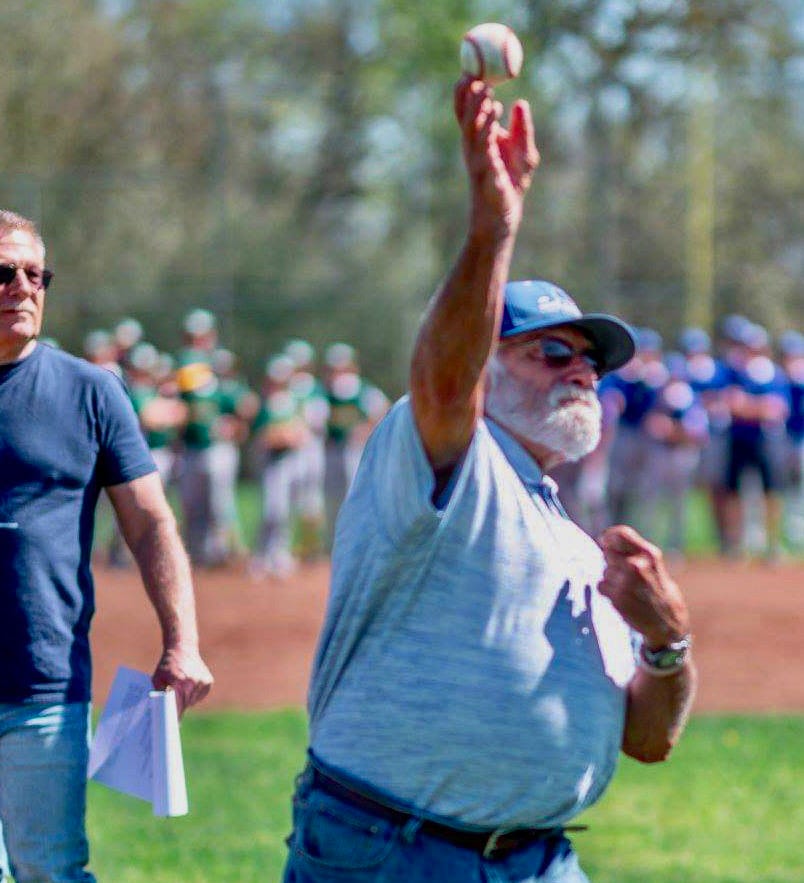
“Coaching those boys was a true joy,” he said.
He especially enjoys the moments when a former player, now grown up, stops him on the street or at the grocery store to say hi or introduce him to their own young children.
When asked what the throughline was in his varied pursuits, he gave a one-word answer: “Change.”
“Change is the main thing we all confront through all of our lives,” he explained.
Understanding how to deal with change led him through his long planning and consulting career and was also a major theme in much of his poetry. He said he even taught “the challenges of change” to his young 11-12 year-old Little League baseball players.
“Each year, with each new team, I always told my players about change — to figure out how to know it’s coming and what you need to do to make it work for you,” he said.
Looking back on a long career
The retired planner now moves slowly with a cane to get to and from “too many” doctor visits and health screenings each week. Asked what else he cherishes the most about his full life, he said wryly, “That I’m still alive.”
Still, he’s rightfully proud of what he accomplished.
“When we adopted the first General Plan in 1978, only 1% of the county’s one million acres was protected,” Retecki said. “With all the many acquisitions by Open Space and the Regional Parks, that total is now 24%. The goal is to reach 30%.”
Today, when residents and visitors look around at Sonoma County’s rolling hills, valleys full of vineyards and pastures, and a Russian River that flows among old redwoods and westward to an unspoiled ocean coast, it’s hard to imagine that anyone might call its safeguarding a “loony idea.”
Gualala
back lit
wind rustled
cypress limbs
gulls rise
gliding diving
wings not a factor
fog drip
drums a rooftop cadence
swells run
one after another
waves pound
within a high tide
the precious dance
of earth rituals
continues
continues.
—Richard Retecki
January 1, 2008
Every day, Sebastopol Times brings you truly local news. Please consider becoming an annual subscriber today and support our work.

What a great piece. We who have loved the relatively unspoiled beauty of this county since those heady days remain so grateful for this small cohort of hard working idealists and merry pranksters. Good to be reminded of what it took.
I love learning about these heroes who live among us. Thank you to the Sebastopol Times for enlightening us and to Richard Retecki for his lifetime of contributions to making this wonderful place continue to be the treasure that it is.