

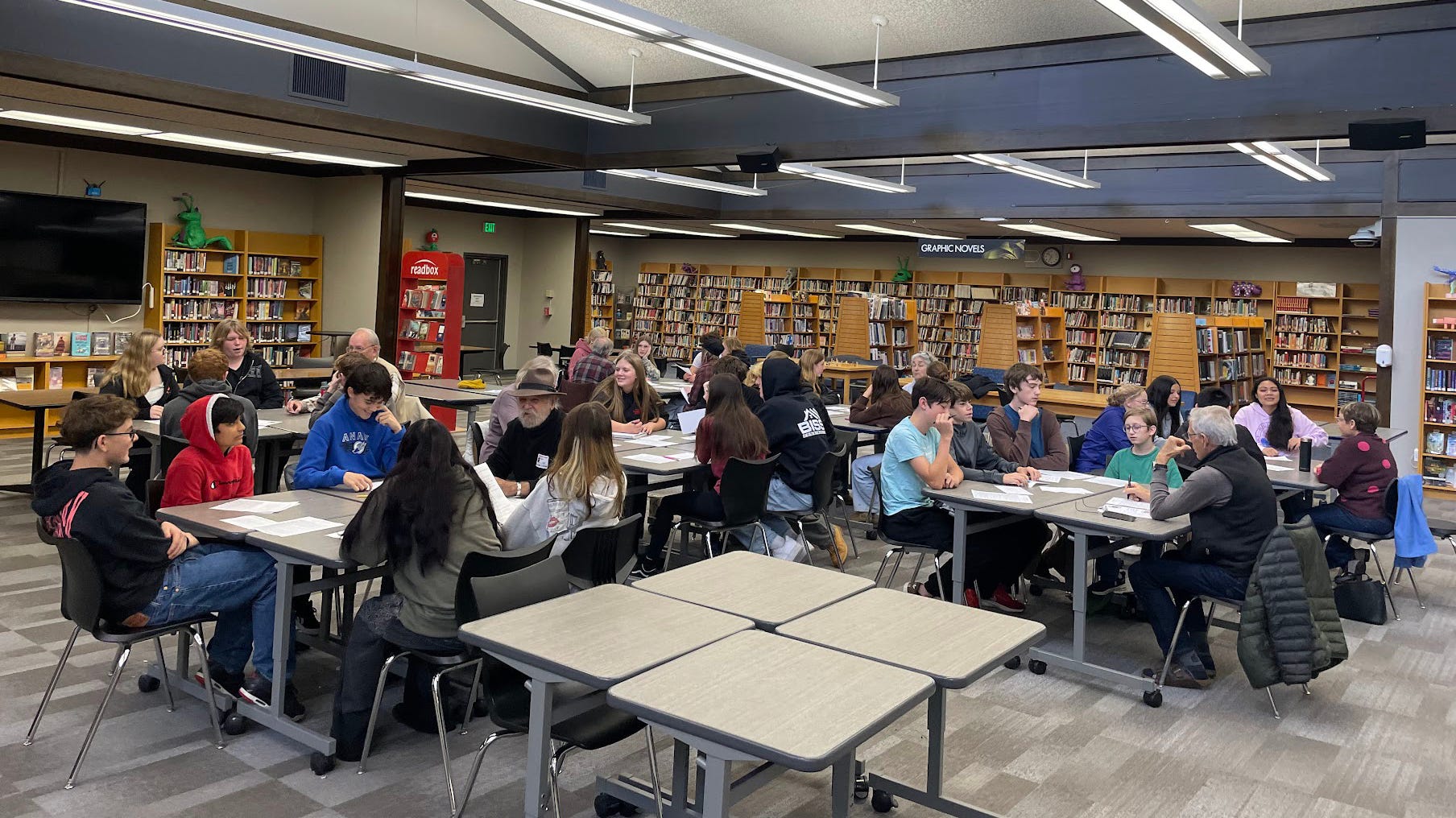
Last month, students at Analy participated in a special program to bring Sebastopol’s youth and seniors together. In what Analy calls “Intergenerational Conversations,” students enrolled in Global Studies classes get a chance to interact with seniors from the Sebastopol Senior Center. This unique experience gives students and seniors alike an opportunity to engage with each other and hear each other’s stories. Although it might not be what comes to mind when most people think of high school field trips, it certainly is something that bridges the gap between generations and provides both parties with thoughtful insights.
Global Studies is a course offered to freshman and sophomore students at Analy. The class is described as a course that encourages students to think of themselves as global citizens, empowering them to understand current issues in their communities and the world around them and to make positive change. There are two sections of Global Studies, one taught by Rachel Ambrose and another by Nicole Housh, both of whom have their classes participate in the Intergenerational Conversations. The point is to give students a chance to talk to older community members who might have additional perspectives or wisdom that students hadn’t considered when exploring a topic.
During an intergenerational conversation, students spend part of a class period in discussion groups with participating seniors. In the past, students have gone to the Sebastopol Senior Center for the conversations; more recently, seniors who signed up to participate have joined students in the Analy Library.
The topics of the dialogues are tied into the curriculum of the class, so students get a chance to talk to seniors about what they are learning. For example, during a unit focused on the similarities and differences between folk and pop culture, students might ask questions about the slang used when the older adults were in high school and compare it to the slang used today.
Rachel Ambrose, who teaches Global Studies, Ethnic Studies, and Advanced Placement United States History, directs the Intergenerational Conversations program, which is also sponsored by the Sebastopol Area Senior Center and Gravenstein Health Action. Ambrose described it as a time for students to build connections and learn from the life experience of seniors.
“It’s targeting two groups in society that are misunderstood,” she said, noting that “Teenagers are underestimated in their abilities to understand, listen, and be compassionate.” In addition, she explained, seniors are often seen as a burden on society. Ambrose explained how this program helps students “See old folks as an asset rather than a burden.”
She also said that both teenagers and seniors are often isolated, with limited contact outside of their close group. “People have a real need to have real, genuine human connection,” she said. Intergenerational conversations bring these two groups together, giving them an opportunity to interact and learn from each other. “It’s good for the well-being of both parties,” Ambrose concluded.
Analy students seem to be enjoying the dialogues. When Ambrose announced to her class that they would be doing another conversation, the students erupted in excitement. In addition, an anonymous survey that students filled out at the conclusion of their conversations revealed that almost all of them enjoyed the experience.
“Our conversations were really fun and interesting. It was nice to talk to people from another generation and hear that they care and want to know about us,” one student wrote.
“I loved this activity. It was really interesting to compare and contrast her life versus ours at this age. Teaching her about slang was really entertaining. 10/10 would do this again,” said another.
An additional student reflected, “I really enjoyed this activity and the conversation we had. I really enjoyed hearing [their] stories because they gave me a new perspective on people her age…in all, this was a great experience, and I would like to do it again.”
Mary Lou Schmidt from Gravenstein Health Action has been involved in the program from its inception two and a half years ago. She said the genesis of the program came from a suggestion by a Gravenstein Health Action intern from UCSF, who had the idea of getting teens and elders together so the teens could provide tech help for the problems the elders were having with their phones.
“There wasn’t one person who got their cell phone problem worked out that day, but they started talking, and it was like, let’s go with the flow. It looks like this is something that these two groups like to do, because they all went out saying, ‘Yeah, I’d like to do this again,’” she said.
Schmidt, who declined to state her age, has also been a participant in several Intergenerational Conversations. She said they start off with prompts provided by the teachers but quickly move beyond those.
“Often, you don’t really finish the questions. Most often, you just go off into a conversation, and I think that’s really good,” she said. “It’s good on both sides to get to know that that person of that age—whether you’re coming at it as a senior or as a high school person—are real people, as opposed to somebody sitting there with gray hair, or, you know, a kid with a hoodie on or whatever. There’s an actual person behind there, and once you get done talking, you can hear that and appreciate that.”
Eighty-two-year-old Gary Bachelor is on the board of the Senior Center and has also participated in Intergenerational Conversations. “I think it was a great idea getting kids and the seniors involved, because it’s good for the seniors and good for the kids,” he said. “I loved it. I thought it was great, and I’ve recruited a couple more people to join me next time.”
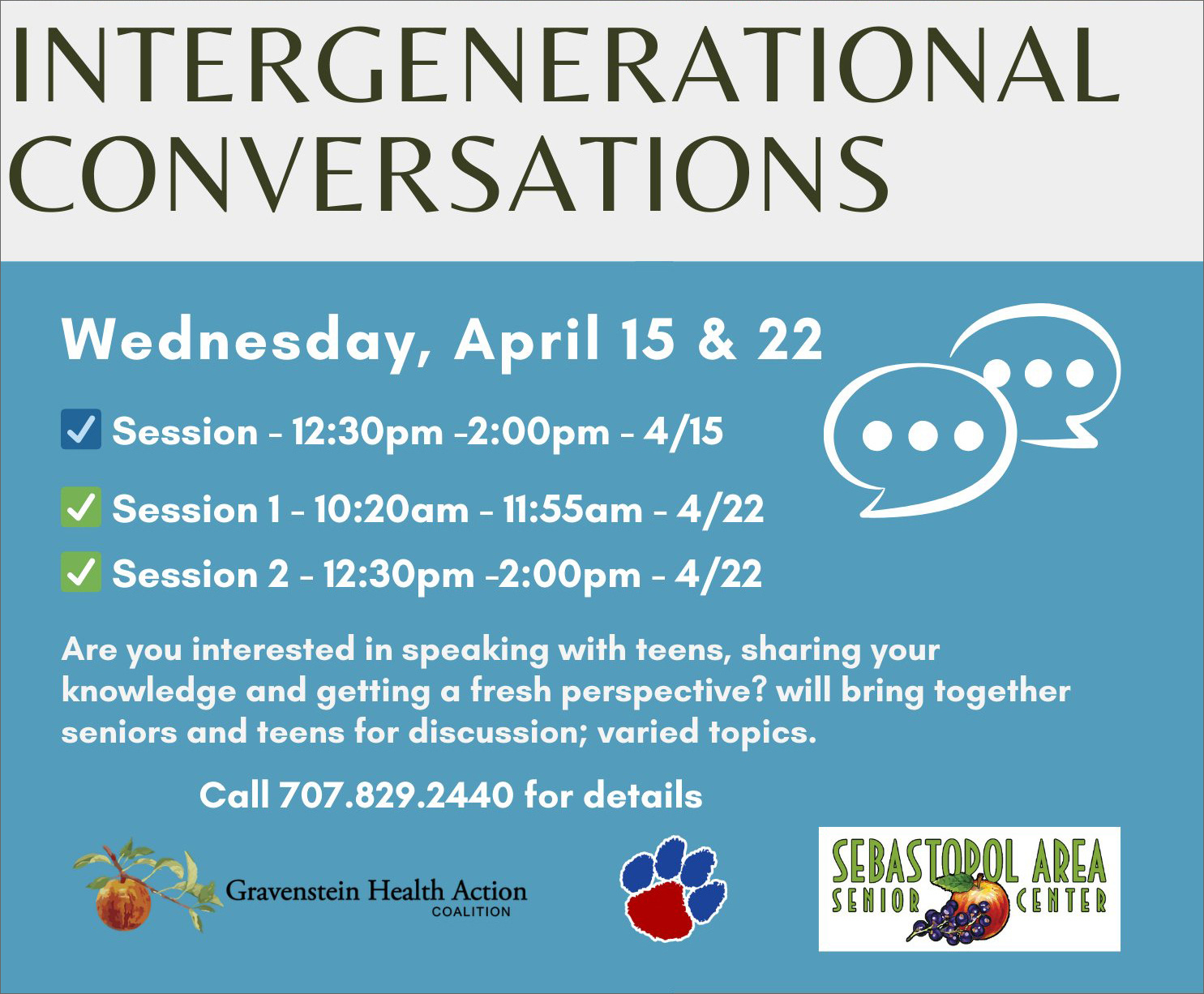
The Sebastopol Area Senior Center is currently looking for elder participants for the next Intergenerational Conversations, which are scheduled for April 15 and April 22. If you would like to be involved, contact the Senior Center at 707-829-2440 or at info@sebastopolseniorcenter.org.
Lawson Gaylord is an Analy student and publisher of the West County World, Analy’s student newspaper.

Wow! What a wonderful opportunity for both generations. It also might facilitate conversations between students and their grandparents, who may live in another community.
What a great idea to help foster communication between the young, and elders. Thank you for a good article explaining the idea and how it can work.