


In this relatively short council meeting, the Sebastopol City Council held a brief public hearing on the adoption of the California Building Code, then discussed whether to move forward with the EIFD (Enhanced Infrastructure Financing District). At the end of the meeting, there was the annual changing of the guard as Vice Mayor Jill McLewis became mayor for the upcoming year, and Councilmember Sandra Maurer became vice mayor.
Mayor Stephen Zollman, Councilmember Phill Carter, Councilmember Neysa Hinton, and Councilmember Sandra Maurer were present in chambers for the Dec. 2 Sebastopol City Council meeting. Vice Mayor Jill McLewis attended via Zoom, but came to chambers at the end of the evening for her elevation to mayor.
Consent Calendar
The consent calendar consists of items that are routine in nature or don’t require additional discussion, often because they’ve been discussed extensively at a previous council meeting.
In addition to approving minutes from previous meetings, the council unanimously approved the following items:
Receipt of the incoming mayor’s request for committee assignment submissions from councilmembers for committee assignments and liaison positions. Recommendations and appointments will be made at the January 6, 2026, city council meeting.
Accepted a Notice of Completion for the Calder Creek Storm Drain Repairs Project. As a part of this, the council adopted a budget amendment resolution for an increase of $10,250 for additional work required on storm drain project. They authorized the interim city manager to approve a purchase order to Miksis Services, which performed the repairs, for a total of $58,309.
Adopted a revised Employee Travel and Reimbursement Policy. According to the staff report, “The policy will apply the most current IRS mileage rate and meal allowance updates in accordance with evolving federal standards.” See details.
Received a preliminary list of Capital Improvement Projects developed as a part of the ongoing Water Master Plan Update, which will be presented to council in January or February 2026. See the preliminary list of projects here.
Approved the extension of a contract with 4LEAF for planning department consulting services. The city is interviewing candidates for the position of planning director this month. 4Leaf will continue to provide planning services until the city finds a new planning director.
Councilmember Maurer requested that a consent calendar item regarding the grant of an easement to PG&E for the installation of smart meters at Park Village be moved to the regular agenda for discussion.
Public Hearing: Adoption of the California Building Code
Sebastopol’s Senior Building Inspector Steve Brown gave a brief, pro-forma introduction: “So what I have in front of you is a request to approve this ordinance that basically adopts the state codes verbatim…If we don’t adopt it now, it would automatically be adopted on January 1.”
According to the staff report, it included the following amendments as appendices: “The proposed amendments include the adoption of Appendices H (Signs), I (Patio Covers), J (Grading), O (Emergency Housing), and Q (Tiny Homes), which provide clarity and uniformity in regulating elements beyond the core building code. Additionally, the adoption of CALGreen Tier One standards—developed in collaboration with the Climate Action Committee—will significantly enhance energy efficiency requirements for new construction.”
Councilmember Carter asked if this would allow people to build faster, and Brown replied, “What it means is that our code will be the exact same as every other city and county in the state, with no variances, so they [contractors] can use the state code. Hopefully, it will make things clearer for contractors and speed things up.”
Regular agenda
Council votes to continue exploring the EIFD (Enhanced Infrastructure Financing District)
After a long discussion, the council voted unanimously to approve a non-binding resolution of intention to form the Sebastopol EIFD. An EIFD is a financing tool that captures a portion of tax revenue generated within the EIFD district as new development occurs and property values increase over time. (It does not increase taxes but rather captures a portion of the natural increase in property taxes caused by rising property values.)
The council heard a presentation from Joe Dieguez of Kosmont, the consultant the city has hired to do a Feasibility and Fiscal Impact Analysis on the EIFD concept. Dieguez gave a brief history of the city’s exploration of EIFDs, which began in November 2023.
The city hired Kosmont to define the borders of the EIFD, determine what percentage future tax increments to capture, and develop a list of projects to be funded by the EIFD. Kosmont recommended the following:
An EIFD boundary that is focused on the main corridors of the City;
A level of tax increment revenue allocation of 25% of the City’s future share of property tax within the boundary, with a County dollar match;
A broad and inclusive list of potential projects to be funded.
Here’s the map that Kosmont is suggesting for a Sebastopol EIFD:
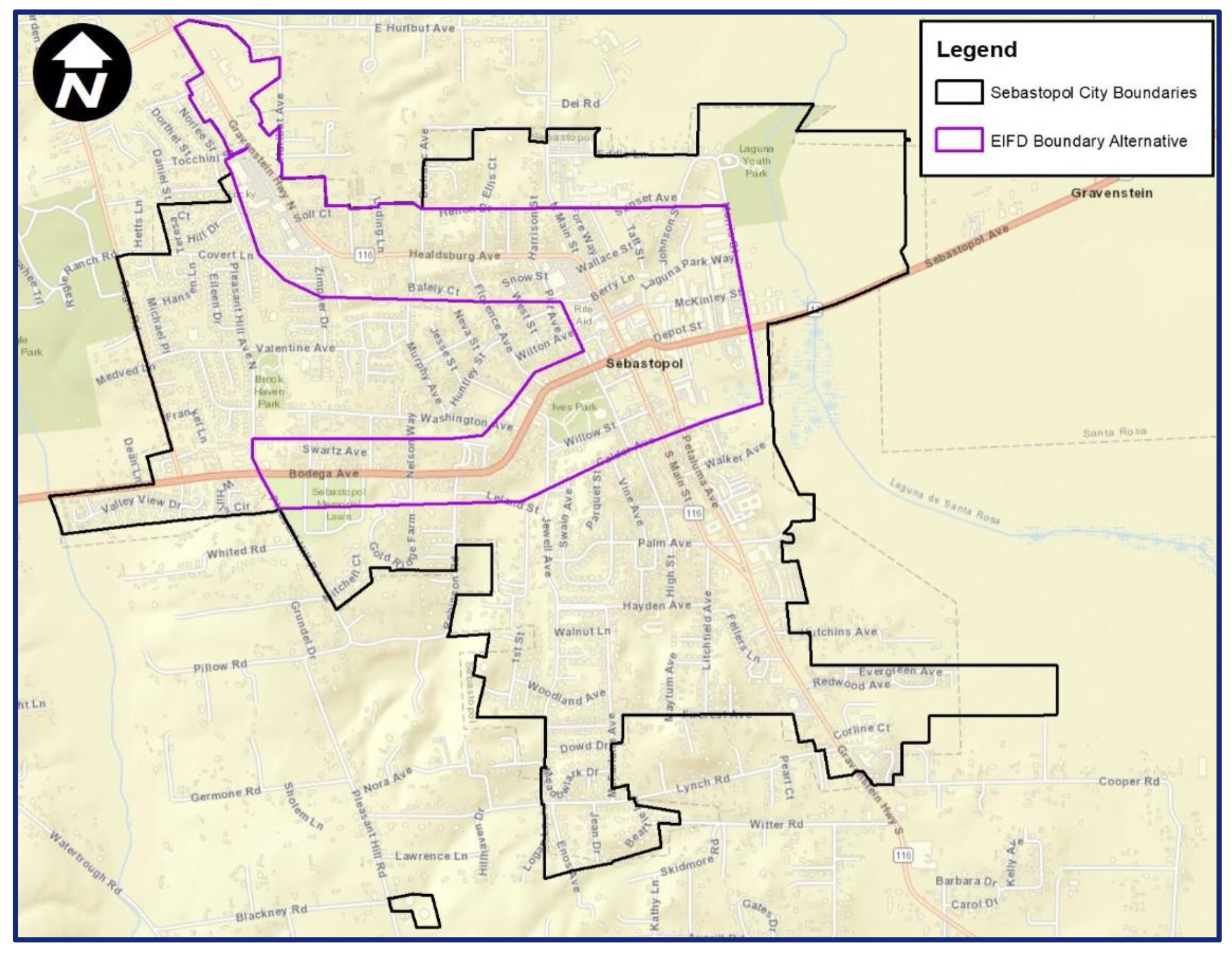
Councilmember Carter asked why the district didn’t expand down Hwy. 116 into South Sebastopol. Dieguez explained that you need to leave a significant portion of the city outside of the EIFD so that the city can continue to fund itself from property taxes generated elsewhere in the city.
That same logic applied to the decision to take just 25% of future property tax growth within the EIFD boundaries. The city could take more, but Dieguez said that that would reduce the amount of money going into the city’s general fund, which, over time, would be unsustainable.
“It’s always a balancing act. If you go all in and pledge all of your future property tax within that boundary, sure you can generate a whole bunch of funding capacity to pay for some infrastructure, but it would be at the risk of the general fund…so there’s always a balancing act between them,” he said.
As background for this discussion, Dieguez described how property taxes are distributed:
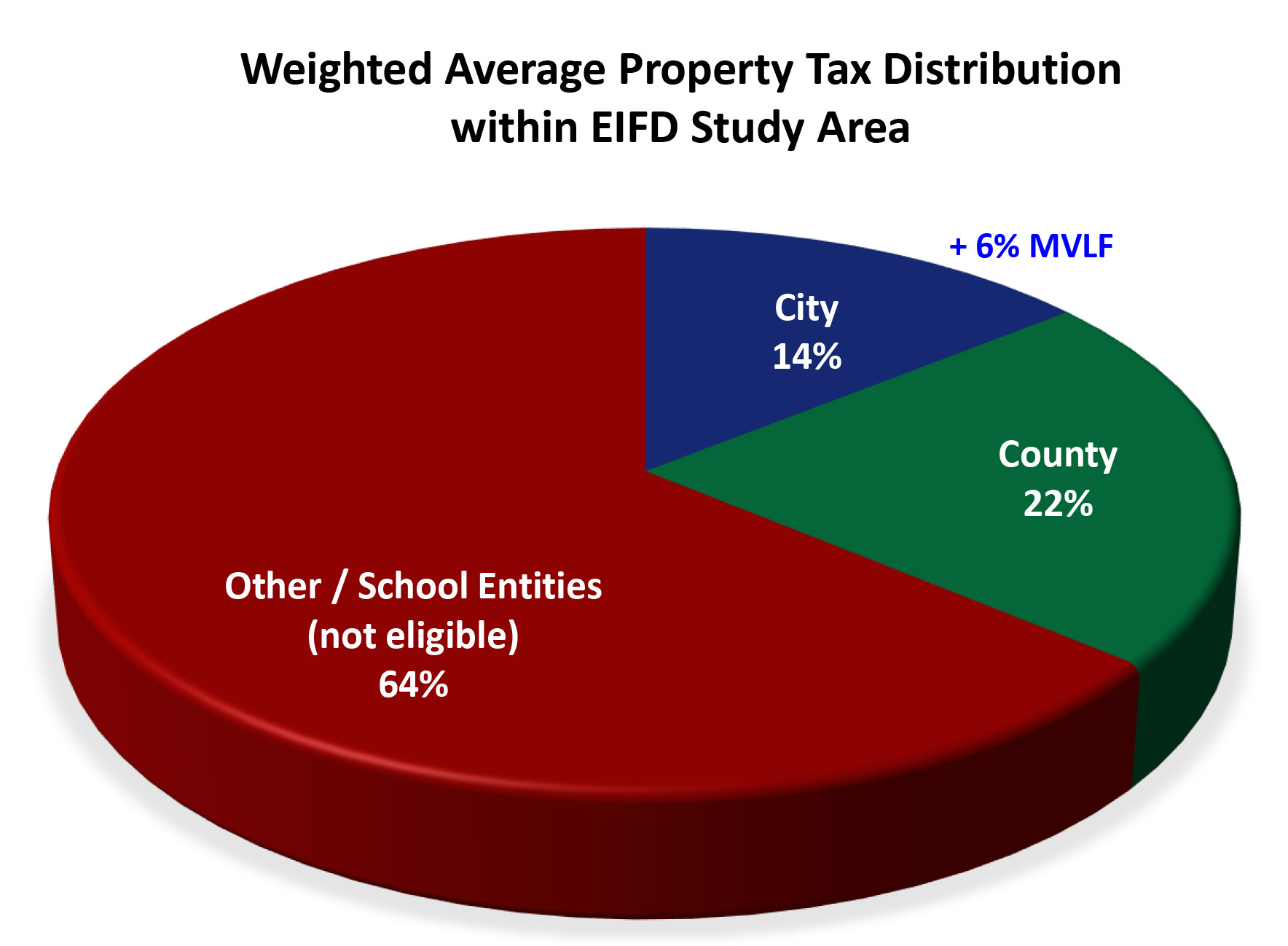
The biggest chunk of property taxes goes to the state to fund public schools (48%), special districts and other entities. (These are represented in the red area above.)
Only a small portion of your property taxes goes to your city (the blue slice). A larger portion goes to the County (the green slice). The only portions of the property tax pie above that can be used for an EIFD are the blue and green slices (i.e., the property taxes that go to the city and county).
Dieguez mentioned that the city should only consider doing an EIFD if the county “would be a matching partner for the city,” something the county has indicated it would be willing to do. “That’s the only way it should make some sense—if it makes sense at all—25% from the city and 23% from the county, essentially matching the dollar for dollar.”
Dieguez explained the slight percentage difference—25% versus 23%—this way: “Since the County gets a slightly larger ‘piece of the property tax pie’ compared to the City, it takes a slightly lower percentage of their share (23% compared to 25%) to match the City dollar-for-dollar.”
Essentially, an EIFD is a way for a city to claw back a little of the local tax money that would normally go to the county.
Councilmember Hinton said as much when she urged the council to move forward with the EIFD as soon as possible, before more cities get in line and the county gets cold feet. “There are districts being funded in every single supervisor district, except for District Four,” Hinton noted.
Dieguez said that the funding that an EIFD generates starts off relatively small, but it builds over time:
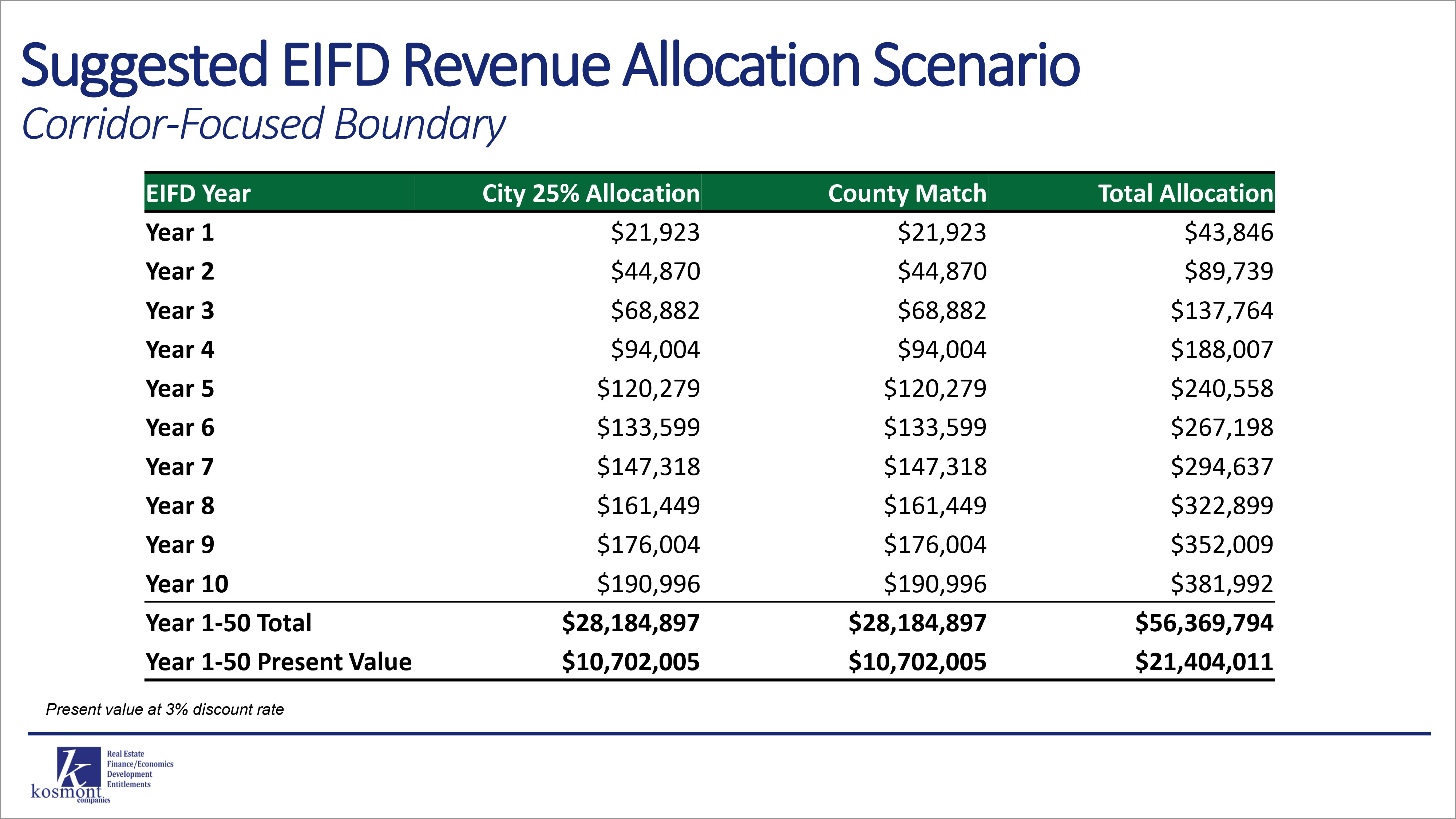
He also noted that these funds can be used as collateral for a bond after five years and that having an EIFD in place helps with getting grants.
“It increases your scoring for grants, particularly for State Housing and Community Development Department grants, which give you more points on the scoring rubric for cities and counties that have explicitly these types of districts in place,” he said.
After a long discussion and after assuring themselves that approving a resolution of intention to form an EIFD didn’t actually require them to do so, the council voted 5 to 0 to accept the Kosmont report and approve the resolution to form a Sebastopol EIFD.
For a deeper dive on this issue, see the staff report, which includes Dieguez’s PowerPoint presentation.
Council approves PG&E easement for Park Village
The city council granted an easement deed to PG&E to replace the existing meters with smart meters at Park Village, a city-owned low-income housing park.
Maurer asked if PG&E had informed the tenants of the changeover. Company representatives said they had not, though they said they had plans to do so. Maurer asked the council to hold off on the easement until the residents had been notified and apprised of their right to refuse a smart meter.
Maurer said she was worried about the installation of a large number of smart meters in a high-density area like a mobile home park, emitting EMFs (electromagnetic frequency radiation), though, interestingly, she didn’t use that term.
She noted that the “opt-out is not really protective of communities like trailer parks, where you could have meters in close succession. In one trailer park, one trailer slot could be 10 feet wide, and then you’ve got another meter and another meter…one person can opt out on their own, but they could have another neighbor’s meter aiming right at their bedroom. It’s hard to know,” she said.
Maurer requested “to postpone this to be sure that PG&E notifies everyone, and that gives us some time to negotiate with PG&E or hear from the residents.”
“I worked at the CPUC on this,” Maurer said. “I helped get the opt-out for all California residents, and I just think the city has a responsibility to be responsible on this and make sure that PG&E is accountable. So that’s my request, and that’s my motion—to postpone it and have the city bring it back to tell PG&E to make sure they do that meeting and give the residents notice.”
There was no second to this motion, however. Vice Mayor McLewis countered with a motion of her own to grant the easement, and everyone but Maurer fell in line.
The passing of the gavel
Sebastopol’s mayorship changes hands in December. Mayor Stephen Zollman stepped down as mayor. (He’ll still be a councilmember.) The council unanimously approved Vice Mayor Jill McLewis as the new mayor and Councilmember Maurer as vice mayor for 2026.
Mary Gourley presented outgoing mayor Stephen Zollman with a bouquet of white roses, adding a personal note of appreciation. “I just want to say personally that working with you for the last year has been really an honor. It’s been an inspiration, and the amount of work that you have put in is truly admirable.” Coming from Gourley, who is known statewide for her phenomenal work ethic, that’s high praise.
Zollman thanked his fellow councilmembers and the people who voted for him when he ran for office in 2022. “For a small gay boy who grew up in an isolated rural area who never in his wildest dreams thought that any of this could happen, it’s very powerful and something that I will remember forever,” he said with a catch in his voice.
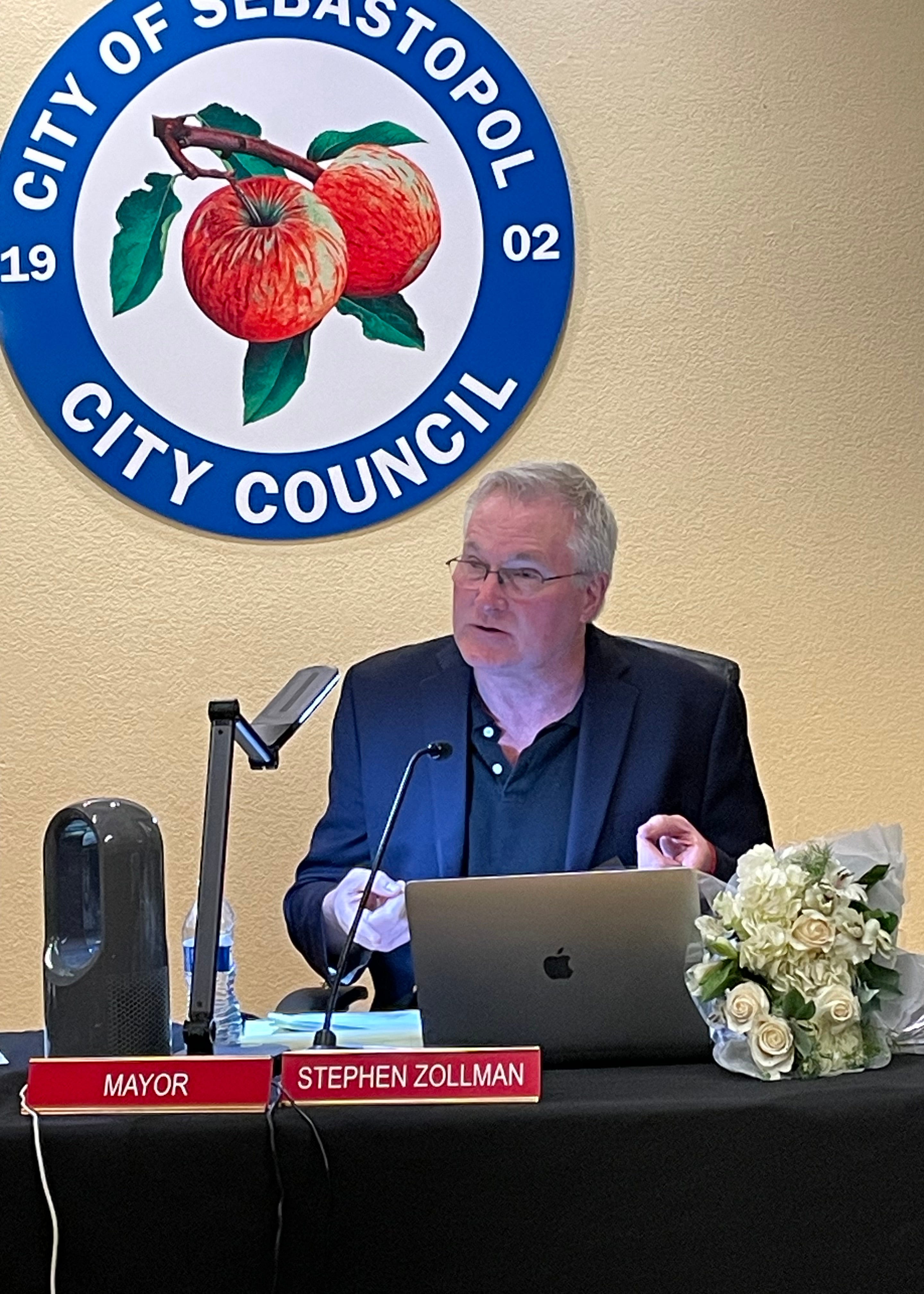
He quoted Margaret Mead: “Never doubt that a small group of thoughtful, committed citizens can change the world. In fact, that’s the only thing that ever has.”
Zollman mentioned the importance of working to help the city’s youth and his pride in city policies that recognized “the marginalized parts of our community, which are—I always have to say it—BIPOC, queer (especially our trans brothers and sisters at this point), those that are differently abled, and those with few financial means.”
In closing, he said, “I’ve already thanked Mary [Gourley], but I cannot thank her enough. Whoever sits in this seat, you’re not gonna be able to do anything without her.”
The passing of the gavel is often a lengthy affair with long speeches from both the departing and incoming mayor. This year it was more subdued.
Councilmember McLewis, who is still undergoing treatment for cancer, attended most of the meeting via Zoom, but appeared in person at the very end of the meeting to accept the role of mayor. Sans hair and masked due to an immune system compromised by chemo, she looked fragile but determined.
“It’s been a rough six months, and I just wanted to say that I’m truly honored to serve as Sebastopol’s mayor for 2026,” she said. “In the year ahead, I really am committed to advancing our shared goals that we’ve all worked on this year: strengthening our fiscal stability, a vibrant downtown supported through our collaboration with our community partners, and the well-being of our Sebastopol residents. I just thank you all for confirming me tonight. I know it’s been odd with me on Zoom and everything, and I really just appreciate you all understanding that. I actually only have two more weeks before my last chemo treatment, and then I have no other treatment required after that. So I’m hoping to be back here in January, according to what the doctors have told me, just to give my immune system a little bit of time to recover. So thank you all so much for confirming me. I really appreciate it, and it means a lot to me.”
You can find the agenda and documentation for the Dec. 2 city council meeting here. The video will be posted here. The next Sebastopol City Council meeting is Dec. 16 at 6 pm at the Sebastopol Youth Annex, 425 Morris St., Sebastopol.
Once again, thank you Sebastopol Times for going and creating a bite-sized summary for the rest of us.