

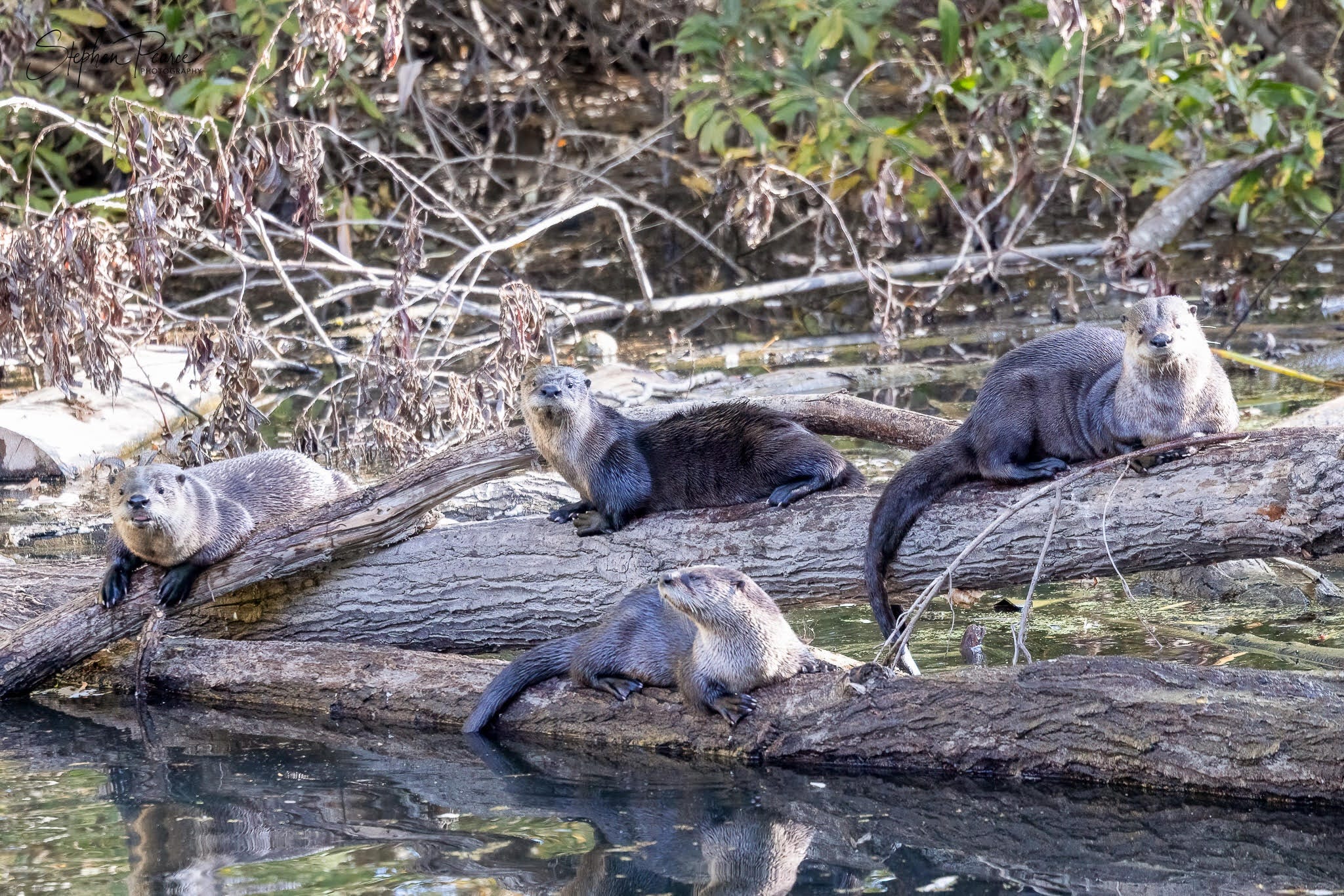
A group of otters on land is called a romp. In the water, they are a raft.
“A group of ten is pretty large for river otters,” said Curtis Cavin who captured the 12-second video below in early February. He is a trail camera hobbyist who operates a half-dozen cameras. “I’ve been at it for about ten years,” he said. He also considers himself something of a “citizen scientist” who makes periodic reports to different agencies and databases. “I let them know what I am seeing on the Laguna and on Blucher and Roseland Creeks.”
The River Otter Ecology Project is one of the groups that Cavin mentioned. They started keeping track of otters when they started migrating back into Bay Area waterways.
I reached out to Megan Isadore, Executive Director of the River Otter Ecology Project, and she responded to several questions by email about river otters in the Laguna de Santa Rosa and the Russian River.
When did river otters begin migrating back into Bay Area waterways?
River otters (Lontra canadensis), missing from much of the SF Bay Area since the early 20th century, began making an under-the-radar recovery during the 1980s. They were never absent from Laguna de Santa Rosa, and were well-known to be continuously-present in the Russian River. The California Department of Fish and Wildlife (at that time Fish & Game) range map from 1995 shows river otters as present in the Laguna but not found in many other areas of the Bay. Please see map for specifics, and Story Map for detailed information.
Does their return mean that the ecosystem improved?
River otters are an indicator species, meaning their presence tells us something about the waterways. As SF Bay lost 95% of her wetlands to development and pollution, fish stocks dwindled and so did river otter presence. With the passage of the Clean Air and Clean Water Acts and other environmental laws and policies, restorations and cleanups began and Bay Area water quality improved. Fish and other wildlife began to return, and by 2012 when ROEP began our investigations, river otters were found in most waterways in the Bay Area. We know small actions make big change; we have seen it. This goes both ways – either when we abuse or neglect waterways, or when we enact laws that protect our environment – the effects ripple into the future.
Are there estimates for the number of river otters in the Laguna and its tributaries?
No, we have no way of estimating their numbers. We measure numbers of river otters at some sites in Marin County, which gives us a reasonable idea of the number of otters using the area, whether they’re increasing or decreasing or staying the same. They are increasing and thriving!
Do otters move around throughout the waterways or do they have a specific territory?
Otters move around easily, though when they find the food and lodging (habitat) satisfactory, they often remain in the same area for years. Young male otters are more likely than others to move around to find mating opportunities. They’re not very territorial, and large groups of otters often socialize and play together. Curtis’ video is likely a group of male otters hanging around together at the Laguna, though it could also be a group of females with young of last year. Otters do fight with each other on occasion, usually during mating season, but we have never seen it. Female otters often raise their young along with other related females and their young. Males have nothing to do with raising young, and do not normally spend much time with females except for mating.
What does the River Otter Ecology Project do?
We are a water conservation organization, leveraging the charm of river otters to support healthy waterways for all. We build community, awareness, and stewardship, provide noninvasive field research and community science research, advocate for waters, and educate people about conservation and stewardship. We provide docent walks, in-person and online educational presentations, volunteer opportunities, and are often found at environmental tabling events. Check out our website and sign up for monthly email updates about our work and for upcoming event notices.
We are becoming a national organization, collect sightings throughout the United States and Canada, and have partner projects in Arizona, Utah, Virginia, and Minnesota where we use our expertise and platform to support local conservation goals.
If you see an otter anywhere, please report your sighting to our Otter Spotter platform, www.riverotterecology.org. If you can snap a photo, that’s even more helpful. Bad photos are fine; we just want to know it was an otter.
Youtube @riverotterecologyproject
Facebook /Bayareaotters
Instagram @riverotterecology
The Sebastopol Times published another video from Curtis Cavin of a raft of otters swimming in Blucher Creek in May 2023.
I think I saw one this morning but he/she was smaller and looked more brown. Is this a young otter? Or something else?
What a great story! I get so excited whenever I see an otter. I can't imagine seeing a whole raft of them!