

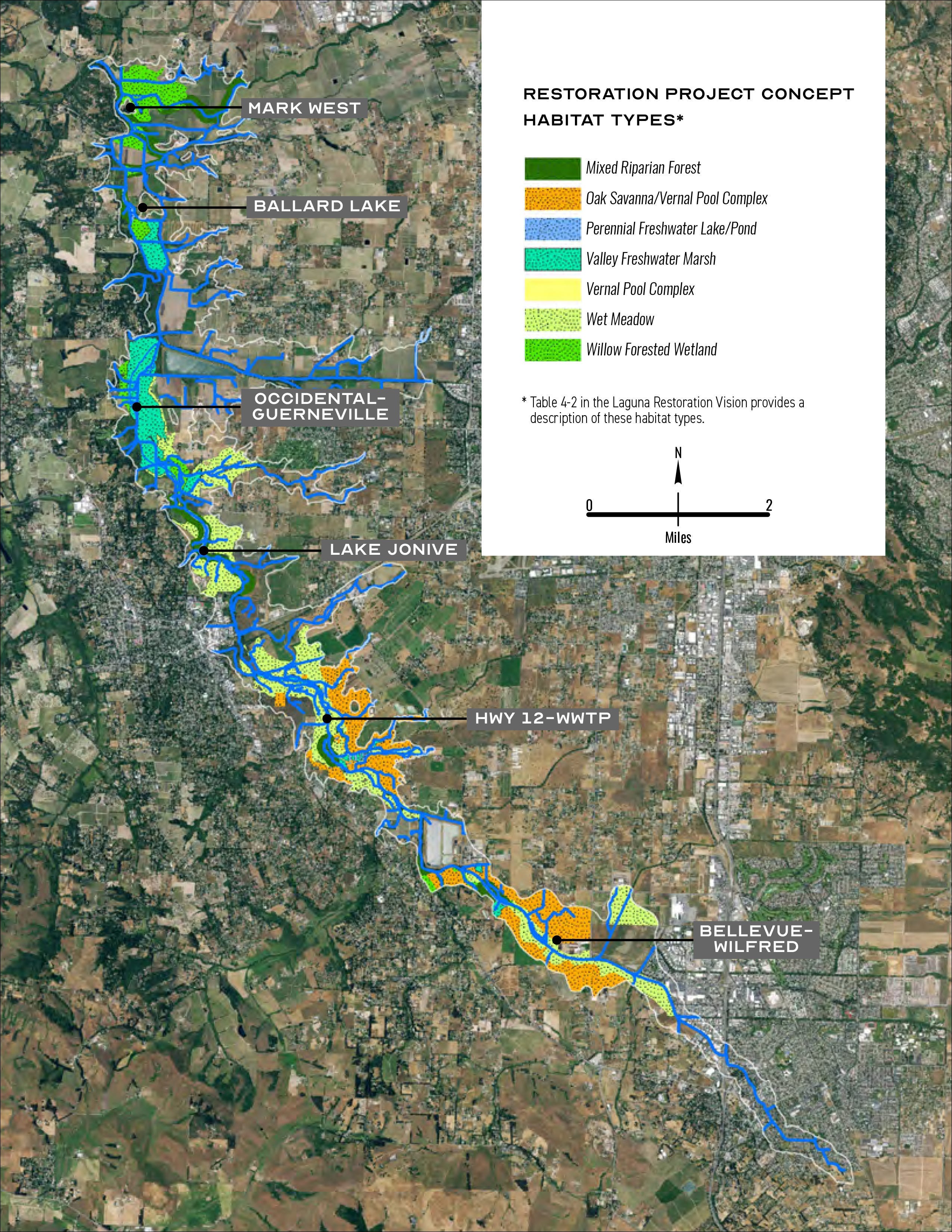
Two years ago, in February 2024, the Sebastopol Times reported on a Restoration Plan for the Laguna de Santa Rosa. The plan featured six restoration concepts for different parts of the Laguna, stretching from Rohnert Park up past Sebastopol to River Road.
Yesterday, the Laguna de Santa Rosa Foundation announced that they have received a $1,045,694 grant from the California Wildlife Conservation Board to start work on a section of that restoration plan. The grant will pay for the design and environmental permitting to prepare for the restoration of 175 acres of riparian and wetland habitats along the Laguna de Santa Rosa between Sebastopol and Forestville.
“This is an important milestone in the Laguna Foundation’s 37-year history,” said the Laguna Foundation’s Executive Director Anne Morkill. “It represents the largest singular project that we and our partners have undertaken to date in the Laguna de Santa Rosa floodplain.”
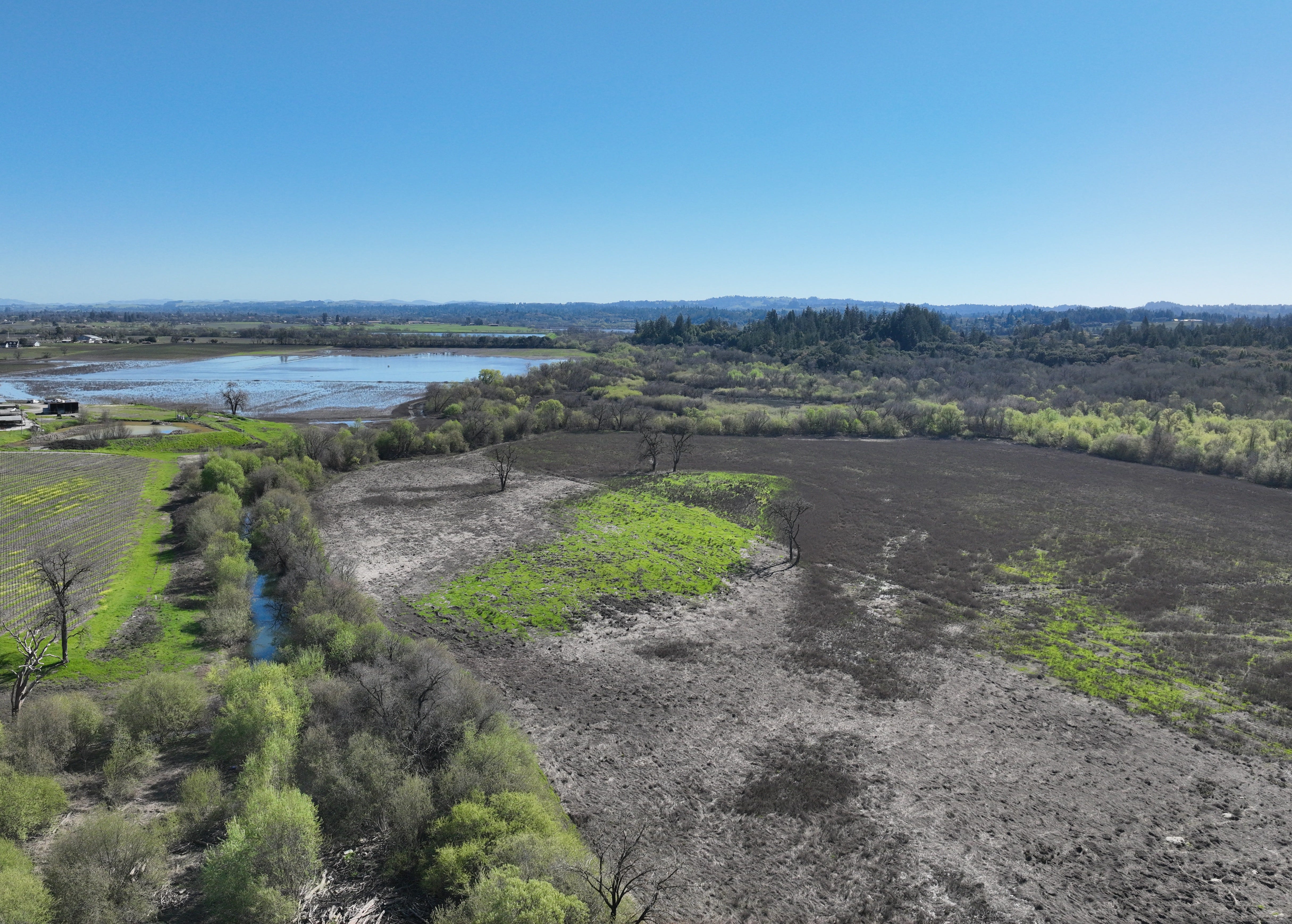
The project site, which is located along a 6,000-foot reach of the Laguna de Santa Rosa channel, is regularly flooded in fall, winter and spring from a combination of runoff from the watershed, as well as backwater from the Russian River.
In terms of where it’s located on the Restoration Plan for the Laguna de Santa Rosa, Morkill said, “It falls between the Ballard Lake and Occidental-Guerneville Road areas of the plan.”
The first piece of the puzzle
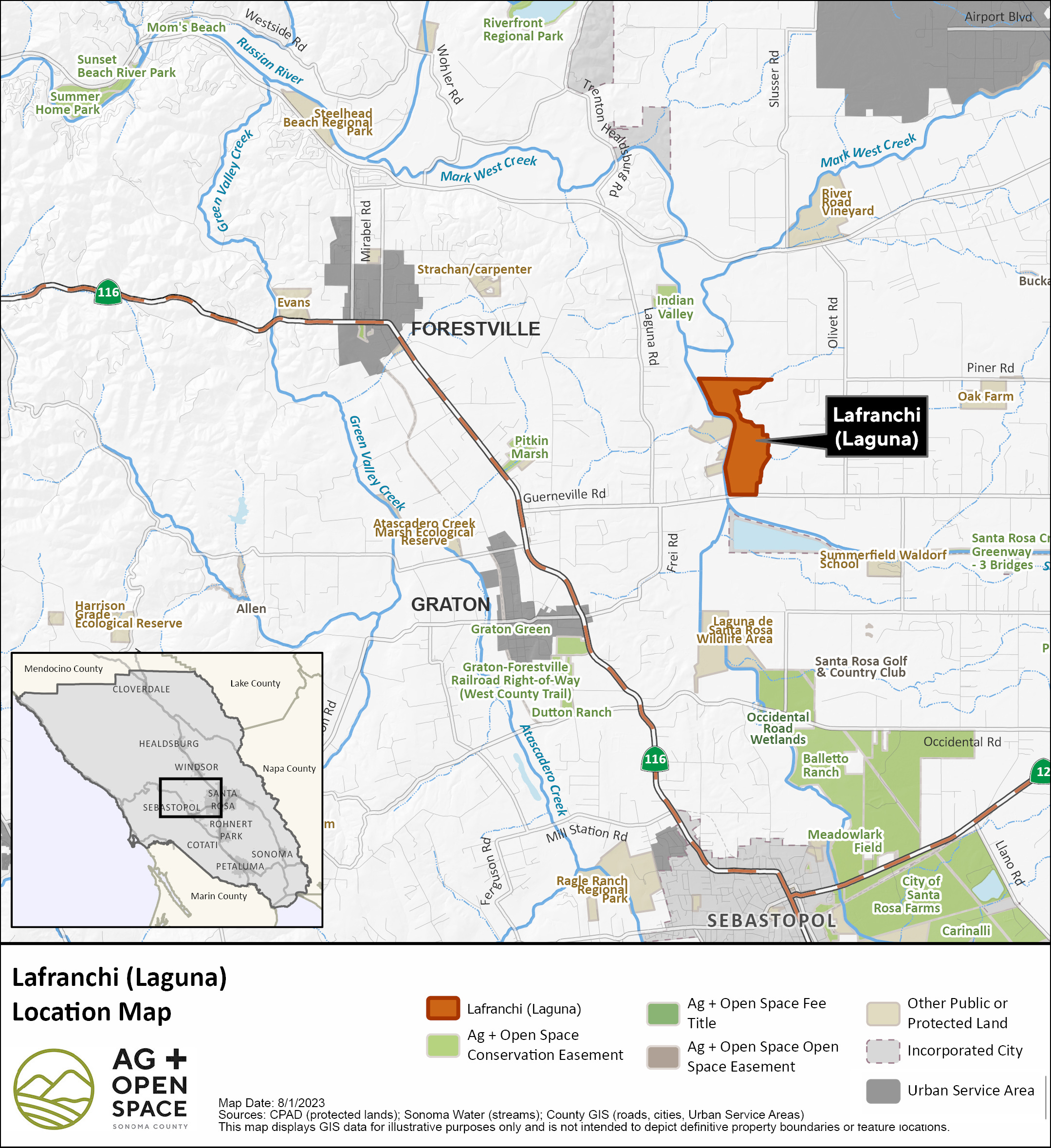
The grant project is located on the Lafranchi Ranch, off Guerneville Road, which the family has owned and farmed for three generations. The Sonoma County Ag + Open Space secured a conservation easement on a portion of the ranch in 2024, ensuring its permanent protection.
Currently, the site consists of 119 acres of farmed wetland, producing corn; 40 acres of converted farmland now left fallow with periodic plowing to control invasive weeds; a degraded 16-acre oak woodland; and strips of mixed riparian forest. Vineyards border the site to the east, and the west bank of the Laguna is dominated by riparian forest and rural residential properties.
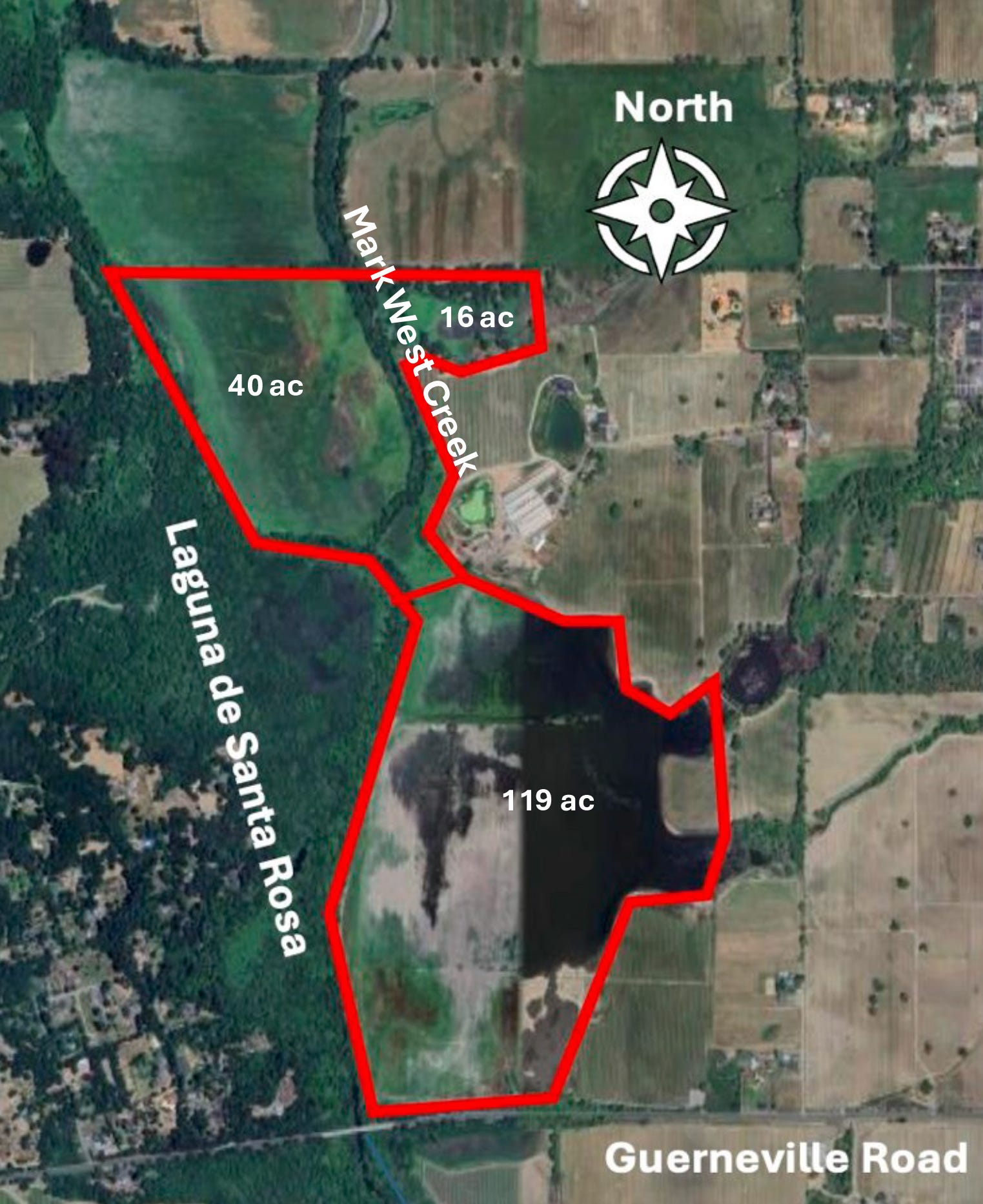
According to the grant application, the project includes designs and permitting for the three zones of the property, outlined above:
90% and 100% design and permitting for a 119-acre Laguna channel realignment and floodplain restoration to maximize wildlife habitat and control invasive vegetation, like Ludwigia.
Conceptual, 65%, 90% and 100% designs, CEQA compliance and permitting for the 40-acre floodplain and 16-acre oak woodland riparian-to-upland transition, as well as lower Mark West Creek stream enhancement.
The point of the percentage designs (known as interim designs) is to allow projects to be built in phases, when full-scale restoration is too costly or complex.
In addition, the grant also covers field assessments; hydrological studies; collaboration with the Federated Indians of Graton Rancheria on project design and integration of traditional ecological knowledge and stewardship practices; and community meetings and outreach.
The cost of these activities breaks down like so: studies and design, $853,513; regulatory compliance, $273,784; and project management, $54,050.
The designs and permits are expected to be completed by the end of 2028.
The Laguna Foundation will be working closely with PCI Ecological, a civil engineering and landscape architecture firm based in Sebastopol. “PCI Ecological is honored to partner with the Laguna Foundation and the Wildlife Conservation Board with design and regulatory compliance on this high priority project,” said Christopher Woltemade, PCI’s principal hydrologist. “We are excited to be a part of this first step toward broader restoration across the Laguna de Santa Rosa watershed.”
The grant paves the way for, but does not include the actual, physical restoration of the site, which will involve converting agricultural fields back to freshwater wetlands and enhancing stream and oak woodland habitats. Once restored, the property will support migrating coho salmon and steelhead, as well as mammals, such as American badger, river otter, and pond turtle.
“A very preliminary cost estimate for the actual restoration work (channel realignment, habitat plantings, etc.) is $10 million,” Morkill said.
I am thrilled about this...💖👏😊
Good things!