

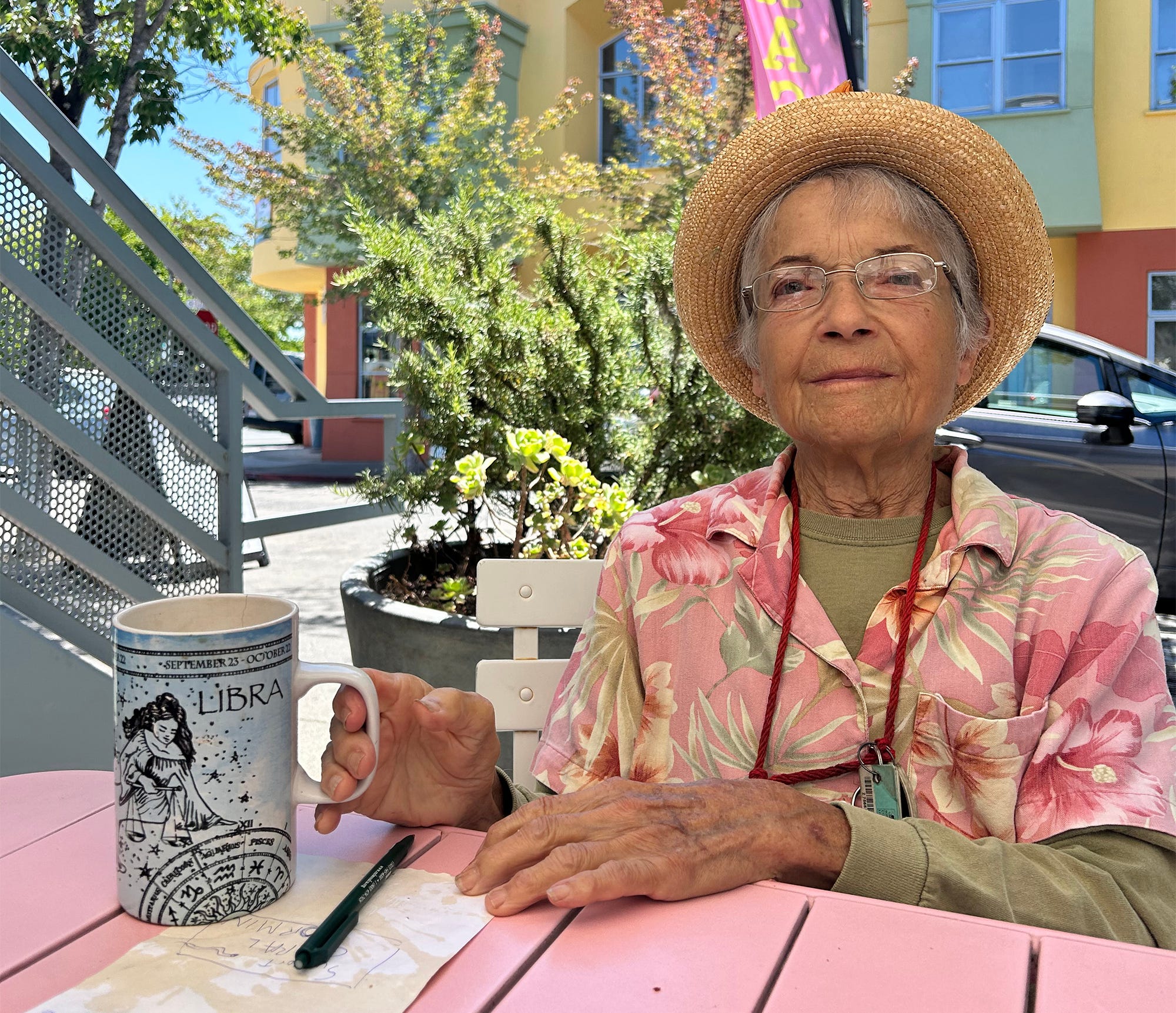
Like the tree in her name, Marilyn Madrone is a West Coast native. She was born a Libra in 1939 to an Italian family in the North Beach neighborhood of San Francisco. At 86 ½ years old, she lives right here in Sebastopol, leading a life of curiosity, candor, and hope.
Many of you might know Madrone from her work with the Master Gardeners, the Sebastopol Grange, the seed garden at St. Stephens Episcopal Church or the Senior Center. Maybe you know her from the Fircrest Mobile Home Park or the Center for Spiritual Living. Maybe you know her from around town; you saw her dancing at HopMonk, or she complimented your tomatoes at Community Market while waiting for her Fiery Phoenix sandwich on a soft roll. No matter how you know her, if you do, you also know that she’s willing to talk to anybody.
On Monday, June 22, I had the privilege of sitting down with her outside of Retrograde, another one of her haunts. She identified all the plants around us—star jasmine, ribes (a kind of flowering currant), mimulus—with special appreciation for the California native species. Then she pulled out a piece of paper and a pen and began to ask me questions.
Affability comes naturally to her. “One of the things that I got from my father was gregariousness. His middle name was Gregorio. Gregarious means friendly. I’ve been talking to strangers for I don’t know how long. Maybe because I’m little, and I’m not scary,” she said. “That enriches my life, and it also moves the whole weaving of this community forward. It kind of ties us more together. I think a lot of people in this town say hello for no reason. You walk down the streets, and they never saw you before, but they don’t pass you by like ships in the night.”
Growing up on the Bay
Before making a home for herself in Sebastopol, Madrone grew up in the Marina district of San Francisco. She got to know her neighbors well, and they got to know her and her family well, particularly through the boisterous noise from her family’s many musical instruments.
Madrone’s father was a jeweler with a store on Columbus Avenue, but he came from a family of fishermen in Italy. He caught fresh seafood from the bay, and as a little girl, Madrone ate sea urchin, octopus and squid. She developed an appreciation for cooking good food and knowing where that food comes from.
She also developed a taste for adventure: “We would go out on the San Francisco Bay with a little too much alcohol,” she recalled. “None of us knew how to swim…I can’t believe we did that.”
Although she jokes about all the “hoopla” aboard her father’s 36-foot cabin cruiser, her sailing experience prepared her for life’s unpredictability: “A few times a year of boats on the Bay, it’d be sailboats. Oh my god, here comes a sailboat. Sailboats are not so controllable, because they’re by the wind, and so you have to watch out for them…It was an adventure.” Madrone recounts these memories fondly, as experiences that taught her to trust herself to figure things out as they come.
Her grandmother, who also lived in the Marina, introduced her to what would later become another important passion: horticulture. “So, my grandmother and I would go around in our little garden in San Francisco, and she would show me—as you’re walking in the garden, and maybe you’re watering—you eat out of the garden. Take those really vibrant, life-affirming little vegetables—maybe an onion—take off a little onion top or little basil or something, and you just eat it right there. She showed me how to tend the garden. That was important.”
Although those lessons in the garden imprinted on Madrone’s young mind, she didn’t practice her love of cultivation until her 30s.
Her love of adventure, however, was suited to her young adult life: after graduating from UC Berkeley with a bachelor’s degree in psychology and a teaching certificate, Madrone traveled to Europe with a friend and no plan. She had saved some money, bought a plane ticket and simply stayed there a while. She explored the Levant and behind the Iron Curtain, following her curiosity.
By the time she returned from her travels, Madrone’s family had moved to Marin County, where she took an herbalism class, reawakening a long-dormant connection to growing plants. Her boyfriend at the time had come into some money and found a piece of land in Sebastopol to spread out on.
They moved up together. She taught fourth and fifth grade in Cotati, while also trying to get a landscaping business going. The year was 1977. There was a train going down Main Street, and Marilyn Madrone watched her life, her gardens and the community around her grow.
Roots in West County
“I took an organic gardening class at the junior college. Wow, that just opened up so much, and then I was encouraged. I worked for a farmer woman up on Calistoga Road. When I left my boyfriend, I lived there at the little farm on Calistoga Road. I remember rattlesnakes…I helped this farmer woman, and I saw how she sold things at the farmers’ markets. She was a Master Gardener.”
In 1983, Madrone applied and joined the Master Gardeners. It connected her to other avid gardeners and the gardening public. For 40 years, she served with the Master Gardeners. She spoke to strangers about their peach leaf curl problems and deepened the roots she put down in the West County community.
She juggled both teaching and landscaping jobs and volunteered for the Gravenstein Apple Fair and Food for Thought in Forestville. “It’s good to get different careers going. There’s people that stay with one, but I found it was in my nature to experiment…So I guess I’m a curious person. In this town, there’s a lot of places to be lured into.”
Indeed, Sebastopol is home to a plethora of alluring places and projects, many of which sprouted up during Madrone’s time here. She remembers when Community Market moved from Santa Rosa to Sebastopol. She remembers Jim Corbett when he was a music teacher at Oak Grove School District. She remembers Sandy and Jeff Mays when the Center for the Arts was just an idea, when it started near what is now Goodwill. “It’s interesting to see the evolution,” she said.
What’s she up to now?
Marilyn Madrone is a very busy woman. She teaches a fitness class over Zoom for the Senior Center and attends many Senior Center events. She’s learning about the Tao at the Center for Spiritual Living. A self-identified seed hoarder, she works closely with the seed garden at St. Stephen’s Episcopal Church and the Sebastopol Grange.
She’s even trying to learn how to take naps. She has a chart to track her napping, but she has been forced to accept a difficult truth: “I’m busier than anybody. There’s just no time for a nap. It’s not going very well. And I put a sleep mask on because that helps, but I’ve only napped once in the last month.”
Alas, she is too busy to take naps—exploring new places, trying new things, and meeting new people.
Madrone is an expert at meeting new people. “When I go to a Grange event, and it’s a potluck, I try not to sit with people I already know,” she said. “At Community Market, I already know a lot of people, but I talk to everybody about what they got in their basket: ‘Oh that’s interesting,’ ‘Do you buy that often?’ I am curious. I want to know. It’s not just making conversation.”
Her ability to make new connections translates conveniently for her work in the St. Stephens seed garden, which services the community by collecting and distributing free locally grown seeds to home gardeners. “I brought a new guy in today, which is really a conquest. That has become my role, because I’m out and about. I meet people to bring in new people, but if I can bring in a young muscular guy, I think I should get a pay raise.” She adds, “My pay is currently zero.”
A master of digression and observational humor, Madrone continues, “I always have my eyes out for young, muscular men [for the garden], especially because sometimes I go to events, and I’ll go, ‘Are men allowed here?’ It’s all women, because older women run this town…Just like the cabbage butterfly, you only see the females.”
A large part of how Madrone makes meaningful connections is that she keeps her red iPhone 5 in the box that it came in. “I don’t plan to have it be an appendage…I don’t take it in the garden. It could get dirty. But that means I don’t have music in the garden, so okay, I don’t have music. I listen to the bees and the birds.”
That isn’t to say, however, that Madrone doesn’t love music. For music, she frequents Peacetown concerts, Center for Spiritual Living services and HopMonk, when the event is “age appropriate.” She also listens to music in her Nissan Leaf, which she affectionately calls LeafyLou.

“Well, I had been driving this 35-year-old Toyota pickup truck. I did not know nothing about electric. Nothing, and I took the key, and in the first 48 hours, I locked myself in my car at 9 o’clock at night. Now, what do I do? I sleep here or what? In my carport?” she details. “The door has a million buttons. That was the one for locking in your kids, locking in everybody, including you.” She has had a few other “troubles” with LeafyLou, but after some adjustment, it’s been smooth sailing.
Sailing by the wind
Marilyn Madrone, effortlessly charming and disarmingly candid about her own mishaps and misadventures, makes a rather compelling case for how to weather life’s storms: embrace unpredictability.
“When I was a landscape gardener and did plans, I did plans in pencil, always pencil. Because who knows?”
In fact, unpredictability is one of the qualities that continues to excite her about gardening: “A whole flock of new birds migrated, or the weather became windy and blew all the seeds over there, or, oh goodness, there’s gophers. You put gopher wire, but they made a ramp and went over,” she said with a laugh.
The complexity and variability of gardening keep her connected to the community. For example, she is currently dealing with some zealous wisteria plants and looking for a summer camp that can weave baskets out of her dozens of clipped wisteria strands. The new challenges that gardening brings each day keep her young.
Lessons from Lina
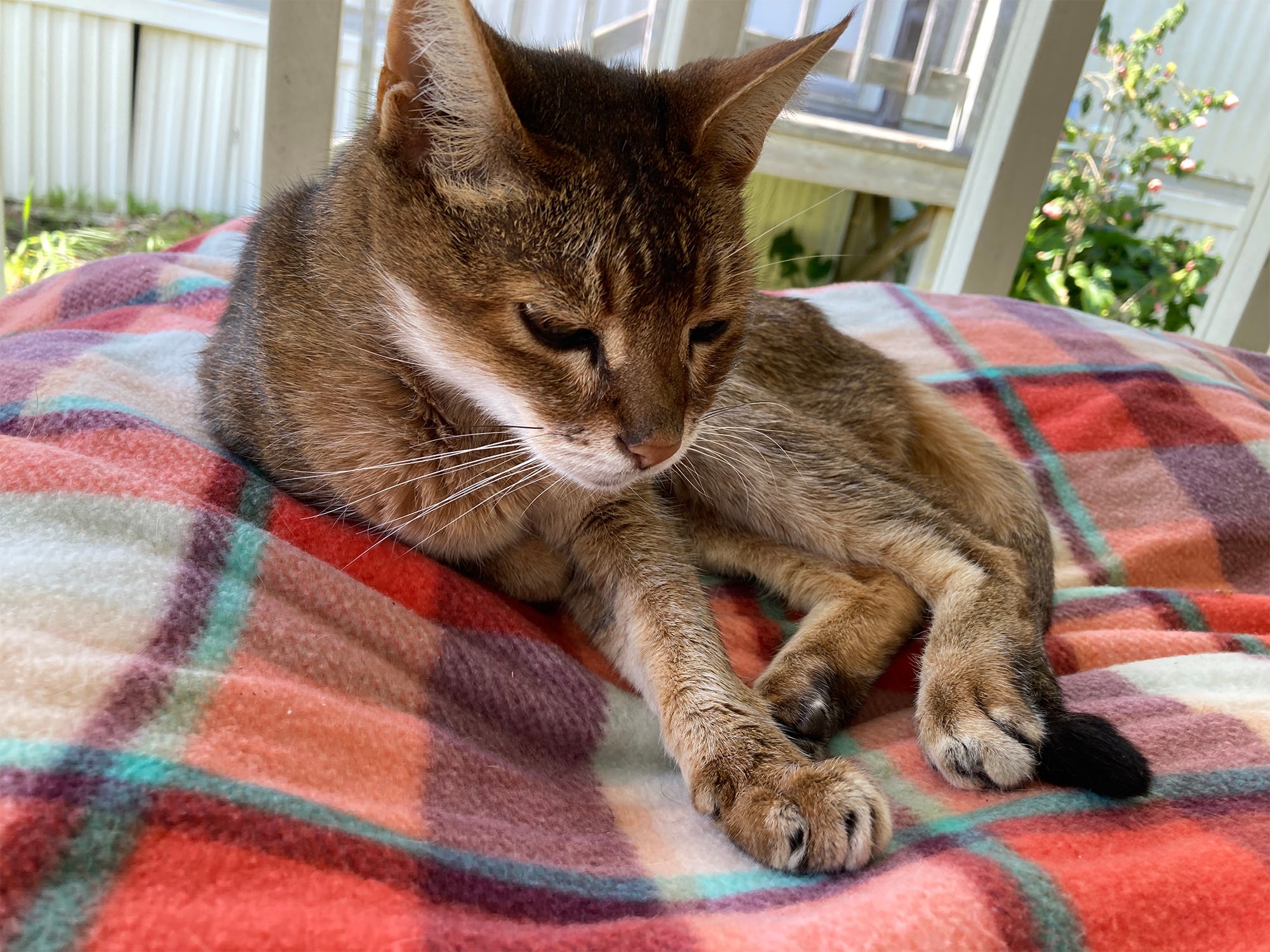
Madrone suspects that another secret to a long, healthy life is something her late cat Boobalina (Lina for short) practiced: “She ate the whole animal.” The animal Madrone refers to is the gopher, or rather, the many gophers that Lina consumed during her almost 19 years.
Although she was only seven pounds, Lina could eat as many as four gophers a day. “Once they had to take an X-ray of her digestive system…you could see pelvis, skull, pelvis, skull.”
The ferocious hunting habits of Lina, an adorable Abyssinian and domestic short hair mix, not only contributed to her long life, but serviced Madrone’s living community. “I live in the Fircrest Mobile Home Park. We hardly have any more gophers.”
Madrone said that Fircrest Mobile Home Park is a community where neighbors really support each other. Madrone has her hair cut by one of her neighbors, and since she hates vacuuming, another one of her neighbors helps her out. When Madrone was at work, Lina would often find neighbors to stay with. “She would go in their houses and hang out there for hours.”
When Lina died, Madrone went to H & M Landscaping on Llano Road, looking for something to use as a gravestone. “I know the owners, so I looked around for something I could use…and ‘Oh, what’s that?’ It was a heart. It’s a big cement heart. I just got chills. I said, ‘Oh my god, I think I want that.’ ‘You could have it. It’s free,’ they said. So they loaded it into my car, and I got my neighbor to unload it onto Lina’s grave.”
Lina is buried in a biodegradable coffin (a paper bag) next to the triple-crown thornless blackberry, which, according to Madrone, is a very good place to decompose. Madrone plans to paint some gopher teeth on the big cement heart.
She misses Lina but doesn’t think she’ll get another cat.
“I have little cat dates with my neighbor’s cats…So I’m kind of satisfied with other people’s cats because for me to take on a cat, I’m already busy enough, and I’ve got my garden to take care of, so I’ve come to let go of having a cat, and it’s with sadness I relinquish that search.”
Madrone shared a serenity prayer that guides her: “Grant me the serenity to accept the things I cannot change; courage to change the things I can; and the wisdom to know the difference.” She said, “It buoys me.” The prayer helps her in her grief, with grouchy people, and with the state of the world at large.
Surviving the current moment
Madrone has a few specific practices that help her in times of political and cultural darkness: “Gotta do dancing. I figured this, this country the way it is? You gotta have antidotes for hopelessness,” she says. “Horticulture, humor, and dancing. Those three, those are the antidotes.”
Humor helps. Every day she opens The Press Democrat to find its editorial cartoon. “I do enjoy mocking. That’s a kind of laughter. Mocking is warranted, considering some of the ways our government has gone.”
She also uses humor to support causes she truly believes in. Madrone plans to put up a sign outside her house that says, “SUPPORT GLOBAL WORMING,” a pun she delighted in.
As overwhelming as global issues can be, Madrone takes pride in Sebastopol’s efforts at progress. “Everything is in flux, and it’s becoming better locally.” Though Sebastopol, Madrone admits, still has a lot of work to do. “I wish it could afford to have more people of color living here…I keep hoping that this town provides a place for more people of diverse backgrounds,” she said, lamenting the various injustices surrounding the Woodmark Apartment complex.
From the Laguna de Santa Rosa Foundation’s work conserving wildlife habitats to the collective move toward acknowledging Miwok and Pomo history of the land, Madrone feels strongly about the work being done to build a stronger, more diverse and more sustainable Sebastopol community.
“There’s so much to be done in the world, but this little town is doing constructive stuff, except that it’s too expensive to live here.”
A life of growth and giving back
Marilyn Madrone has lived a life of authenticity and meaningful connection. Even after almost 50 years in the same zip code, Madrone approaches each day with playful curiosity about the plants, people and places she sees. She spends her time spreading love, herbal knowledge and permission to be one’s true self. She leads by example with a relentlessly generous spirit.
In fact, during the course of our conversation, she gave me three gifts.
The first gift was a slice of Gâteau Basque from Marla’s Bakery in Santa Rosa. “Everything they do is fabulous,” she said. She bought the slice at Retrograde. “Only on Mondays,” she said, and warns, “If I were you, and you wanted that on Mondays, I might even call them because people are starting to discover it. I’m having to compete with people.” (I hope she understands my work as a journalist in divulging some of her secrets…but the cake is too good not to share.)
The second gift was a bundle of pens from Redwood Credit Union. Madrone explains. “Anytime you go to Redwood Credit Union, you just ask for a pen, and you end up with—I have found in my car tucked under everywhere—17 pens, yes. Today I just found seven. Time to clean the house!”
The third gift, of course, was her willingness to share herself with such wisdom, humor and generosity. At 86 ½ years old, Marilyn Madrone’s spirit is as young as ever—fighting for goodness in this world.
Hopefully, she finds some time for a nap, but if she doesn’t, she’ll keep living Madrone-style: eating local, talking to strangers, tending to the garden, loving, dancing, laughing.

This is journalism at its very best! Uplifting stories of people living well in our society today are in short supply these days, and we’re all hungry for this kind of journalistic nourishment.
I have been fortunate enough to know Marilyn for years, and she’s truly a delight. This profile included things I discovered I share with Marilyn: we’re both Libras, old Blues from Cal, sailboaters, and among yesteryear’s elementary school teachers. That she is an antidote to despair and hopelessness I already knew.
I hope you guys do more profiles like these. Sebastopol is home to many remarkable, original, creative, amazing treasures disguised as people. I love reading about them!
Marilyn is a true Sebastopol treasure. She’s one of my very favorite people to run into when in town and she’s always an inspiration and a joy. Thanks to Kavya and the Sebastopol Times for sharing her story and her spunk with our community.