

Nancy Carroll and her husband, James, lived in their house on Pine Meadow Drive in Coffey Park for 16 years. One feature of their property that she especially liked was a grove of redwood trees that lined the back of the property. “The grove was part of Santa Rosa Creek at one time before the creek was diverted,” said Nancy. They had a backyard deck that looked out on the grove. “It was really a spectacular property,” she said.
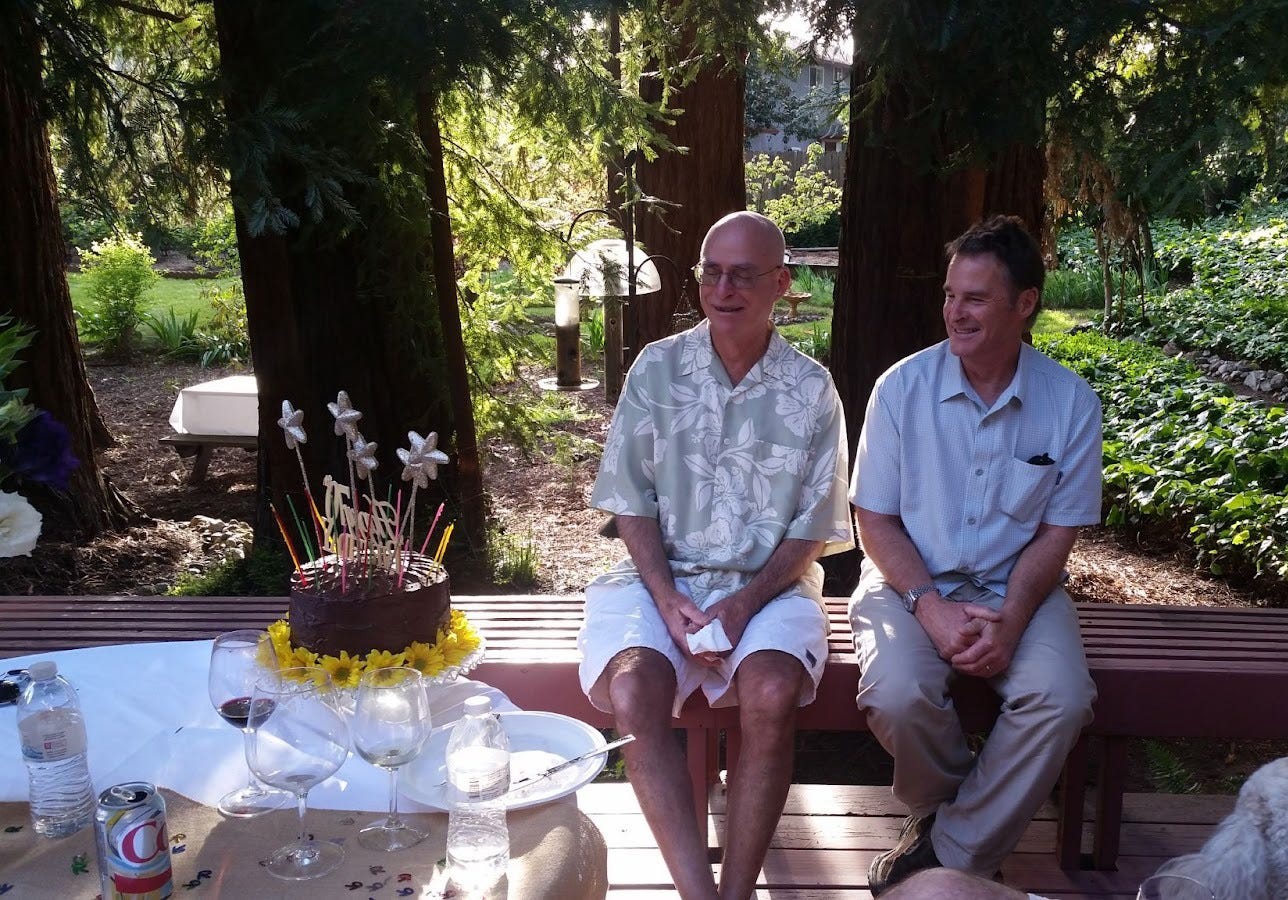
The Carrolls enjoyed that property until the Tubbs Fire swept through Coffey Park in 2017 and burned down their home. “The fire took out everything,” she said. “It was pretty devastating.”
The redwood grove survived the fires, but with some damage. “An arborist was brought in to evaluate the trees, and the arborist, of course, had to say that the trees were a liability and wouldn’t survive,” she said with growing frustration. “They’re redwood trees. Of course they would have survived!” Nancy paused, with emotion in her voice. The day came when a crew arrived to cut down the redwoods. “My husband went down to the property and brought back three rounds—they call them cookie cuts —and brought them back for me.”
The couple decided not to rebuild their home in part because the cherished redwoods were no longer there. “It was never going to be the same,” she said. They moved in with their daughter for six months and eventually sold their property to one of their neighbors and relocated to a townhome in Windsor. She brought along the redwood rounds to her new home.
“We put one of the rounds at the doorstep of the new home,” she said. “It has a beautiful metal sign that says ‘home.’” For the other two rounds, Nancy knew she wanted to do something special with them. “I’m an artist, and I tried to come up with different ideas, but I basically always wanted a table.”
At a Christmas crafts fair in 2024, Nancy met the Litwin brothers, Kai and Parker, who had started a woodworking business after high school and were there showing off their work. She asked them if they could turn the two rounds into a coffee table. The brothers said, “Sure, we can do it,” but they also admitted honestly: “We’ve never done anything like this before.” Nancy described it as a “leap of faith,” believing that Parker and Kai could create the table she desired from the two redwood cookie cuts.
The Litwin twins
Parker and Kai Litwin are identical twins in their twenties; Kai is the one who wears glasses. They have a wood shop in a Quonset hut behind a home off Eddie Lane in Sebastopol. The hut is unheated with no insulation, but it works for them. The brothers look for scrapwood and iron and make things out of them. They sell them at the farmer’s market and other craft fairs.
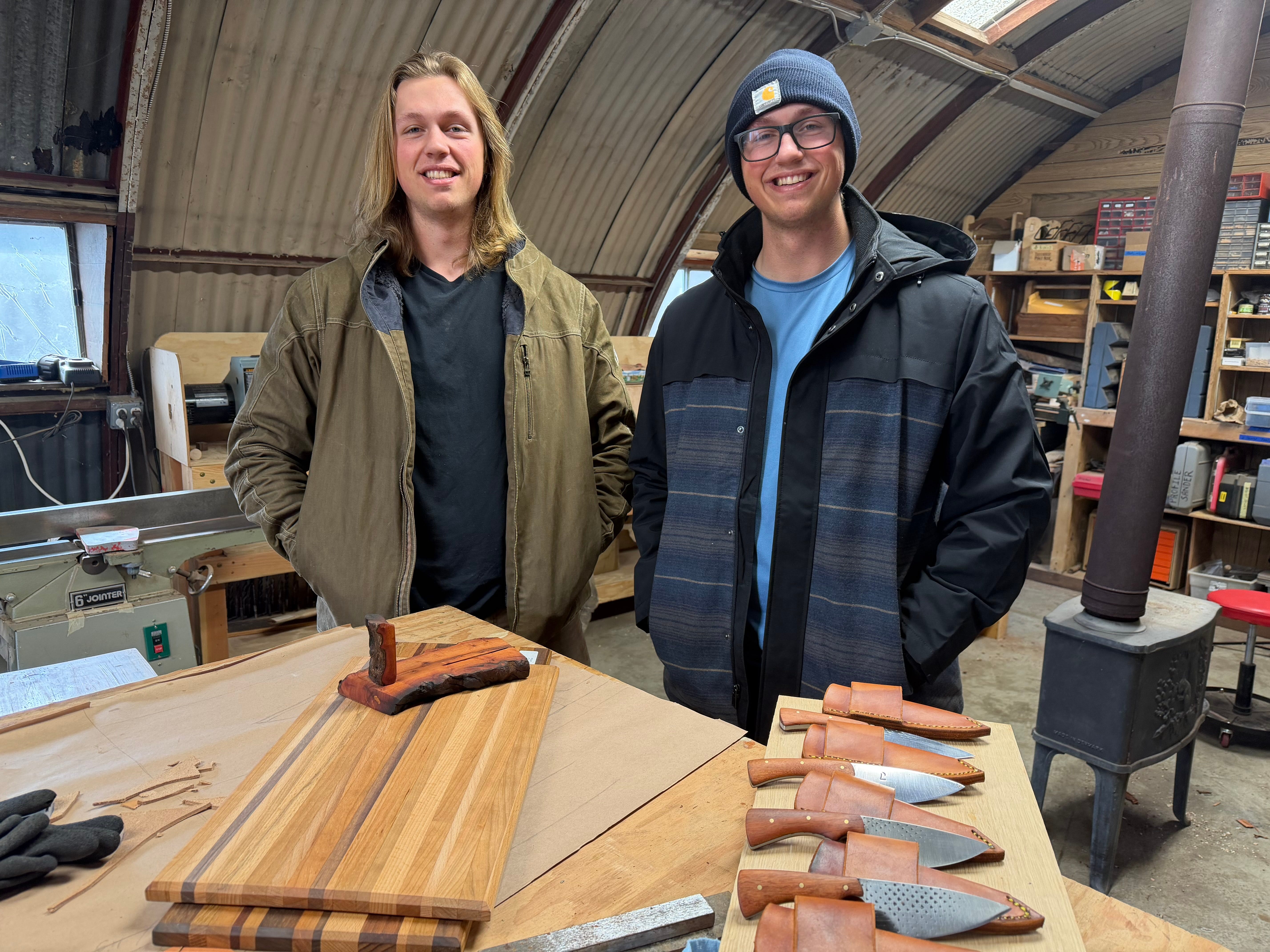
While the Litwin brothers don’t have a lot of professional experience, they’ve been doing woodworking for as long as they can remember.
“Our first woodshop class was in kindergarten, and we pretty much have had one every year since,” said Parker. They were able to do woodworking at Brookhaven, and they took four years of woodworking at Analy, although the woodshop was closed during COVID.
“Outside of school, our dad would build stuff with us,” said Kai. “We’d build forts and catapults and different fun structures, such as tables, garden beds, and some worm beds.” Parker added, “If it wasn’t woodworking, it was other things like blacksmithing that we got into when we were nine years old.” He said their dad noticed their interest in forging when they stuck a metal rod in a fire pit in the backyard and then began pounding it. Their father found them a master blacksmith in Sebastopol who offered three-hour blacksmithing classes on Saturdays. Both Kia and Parker are members of the California Blacksmiths Association.
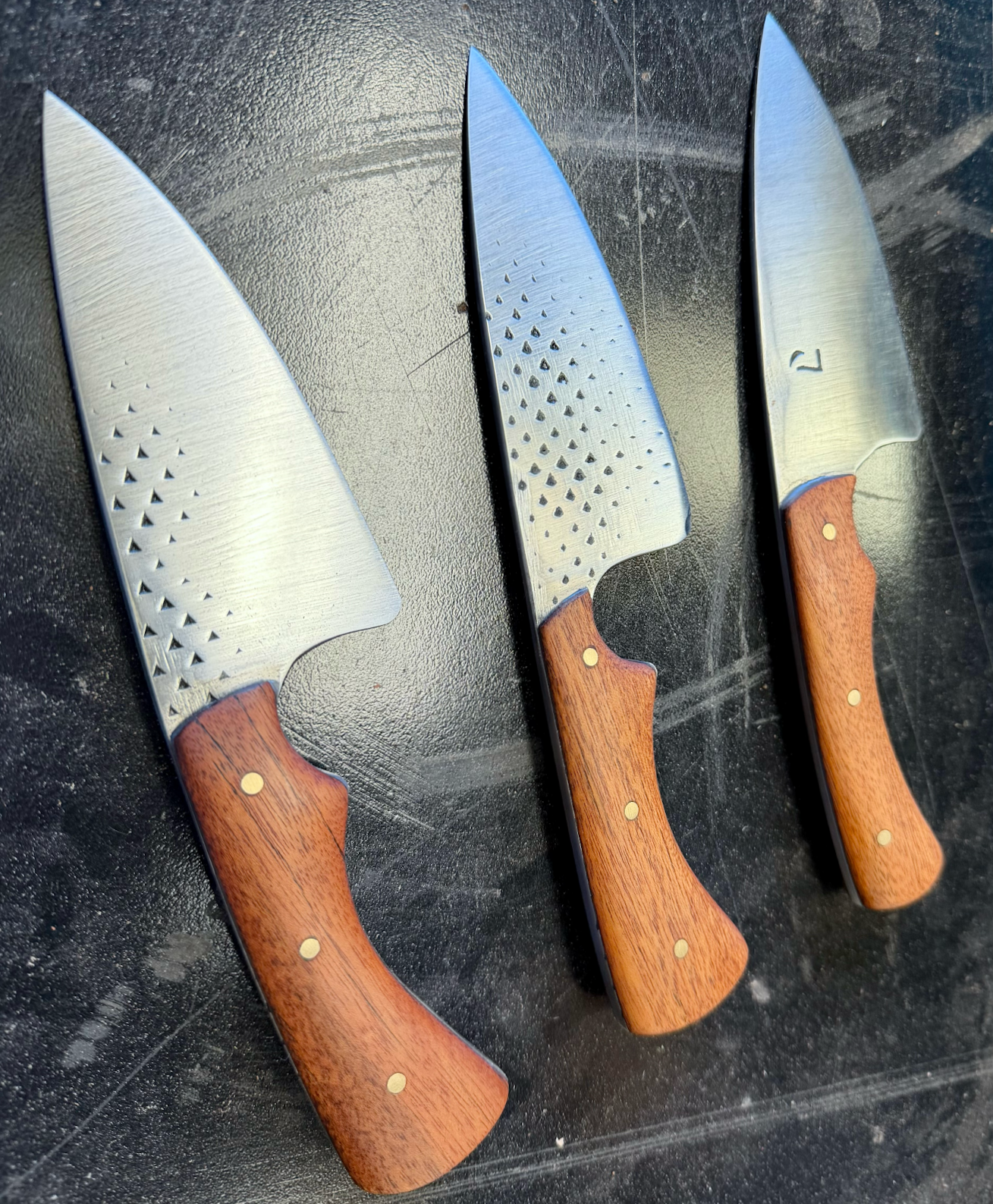
The brothers showed me a set of knives they made from iron from a ferrier’s rasps.
Making the table
“When we met Nancy, she told us that she had some redwood rounds that were all she could salvage from her property after the Tubbs Fire,” said Kai. “She said the trees that were close to her house meant a lot to her; she really loved them.”
One day, Nancy showed up at their shop with the two rounds of redwood and a lot of pictures of the kind of table she wanted. She specified an epoxy table, which is made by pouring liquid epoxy resin into the spaces within and around wood to create a solid, colored surface.
“She wanted a very natural look, trying to keep that live edge,” said Kai. She wanted to preserve the shape of the rounds, instead of having them cut into squares. “This is hard to do with cookie cuts, especially two of them,” said Kai. “The thickest end was close to 4 inches thick.” After doing some sanding, the thickness was reduced to 3.5 inches. The table itself would end up measuring about three-and-a-half feet long and 26 inches wide.
“The rounds were actually in pretty good shape,” said Kai. The brothers counted the rings of the tree and thought the tree was about 70 years old. As they exposed some of the wood, Parker said that they uncovered an old nail in the fifth or sixth ring. “I’m not sure why it was there, but it was put there so many years ago for some purpose.”
While one round was left wholly intact, the other had a big split in it halfway through, and they noticed the split even more after drying it. “It was going to fall apart pretty easily, and we talked to Nancy about it and suggested that we take the split further and pull apart the two ends,” said Parker. Nancy liked that idea, and they went ahead and split the round. “Thankfully, it split evenly,” said Parker. The full round became the center of the table, and the split ends were placed on each side of it.
They had to remove some rot and pieces of leftover bark. “We needed to clean all that away because you can’t have that in an epoxy table, at least not in the condition that this was in,” said Kai.
As they began working with the wood, they realized that there was still quite a bit of moisture in it, so they had to let it dry for about six months. “For any woodworking project, but especially epoxy, the moisture in the wood has got to be really low,” said Kai. “Once you pour, if the wood shrinks slowly over time, nothing’s going to stop the shrinking, and it’ll crack the table.” They built a makeshift kiln to help speed up the drying process, but it just took time.
Then they built a square mold to surround the wood, and that would hold the epoxy. “We put in the epoxy to cover the whole table,” said Kai. The epoxy is poured one layer at a time with a blue dye. “This was a deep pour, so it dries very slowly,” said Kai. It took about a week for each layer to dry.
The two issues that they had in their shop were controlling the temperature and creating a dust-free environment. “You don’t want dust because you can see the dust in the resin once it dries, and it’ll make it stick less. So we were cleaning it, getting all the loose things off,” said Kai. When all the layers of epoxy were poured and sufficiently dry, they had a solid block of epoxy resin that held the table within. The redwood was like a fossil in amber. Their Instagram reels show what the block looked like after it was taken out of the mold.
After they sanded down the surfaces and polished them, they took it to a machine that cut the table out of the epoxy, following the rounded shape of the wood.
The last step was to put a finishing seal on the table, which they captured in an Instagram reel.
Did they have any doubt that they could do this project? “Before we did anything,” said Parker, “we did a vast amount of research. One thing that a lot of videos said was that you’re gonna make mistakes your first time, and this was our first time, so that made us nervous. And boy, we were really surprised when it came out really clean.”
The entire project took a year, but there was a lot of downtime waiting for things to dry.
Delivering the table
Nancy enjoyed working with the Litwin brothers. “They always responded really well when I called to check in,” she said. “We’d chat back and forth. I knew what I wanted.” Last November, Kai and Parker brought the finished table to her house. At first, the legs for the coffee table were too tall, so they had to take it back to their shop and get shorter legs from the hardware store. The finished table was delivered earlier this month.
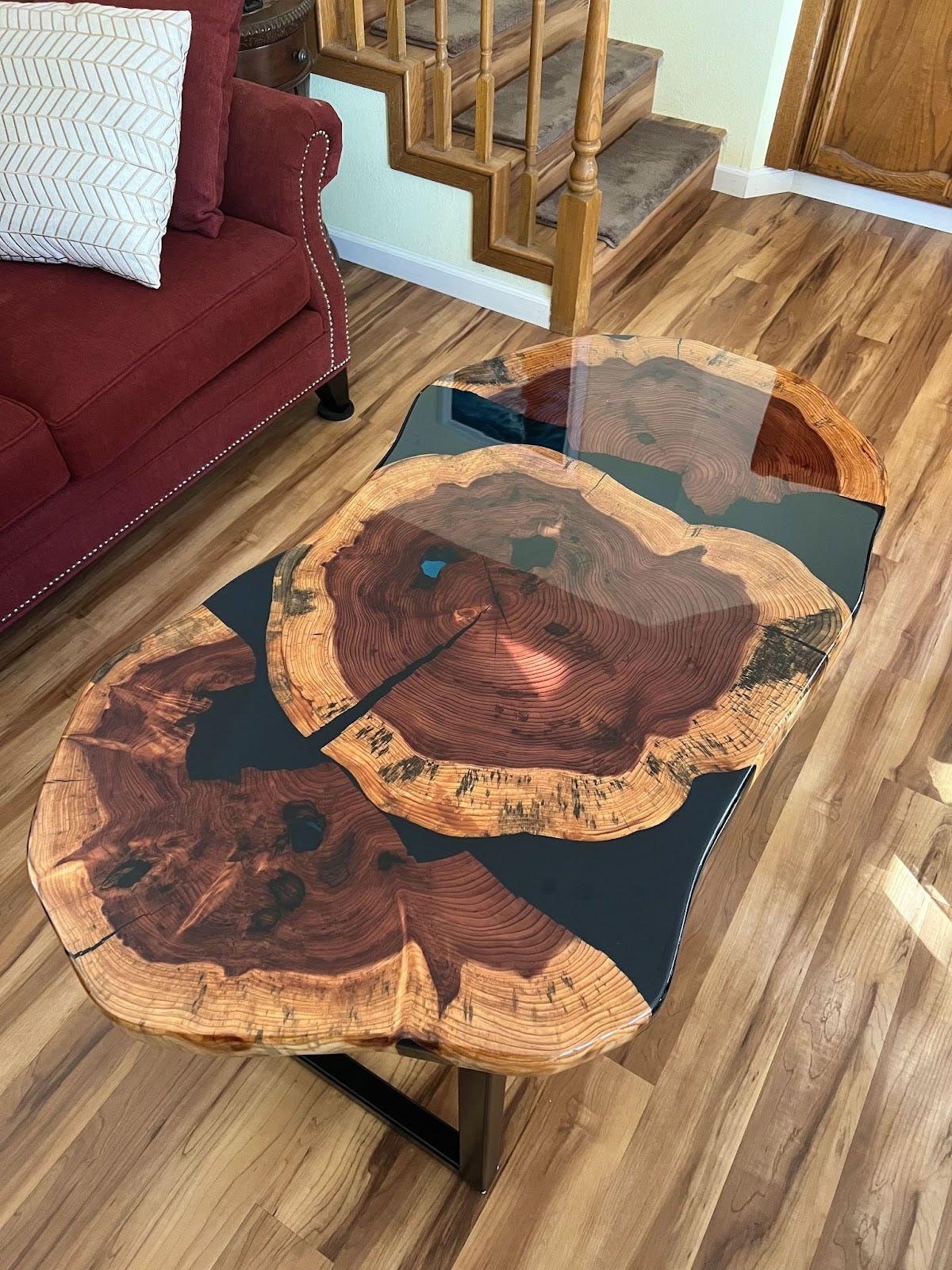
“She told us that she was very excited to finally have a piece that she can have in her house and admire,” said Kai. “She’s very happy because it brought back memories of her old house.”
“I said to Kai and Parker: ‘I bet you learned a lot.’ And they said, ‘Oh yes, we learned we never want to do this again.’ I think it was hard, but ultimately it turned out lovely and beautiful,” said Nancy.
“The sad part was my husband passed away a couple of months ago, so he never got to see the finished product,” she said.
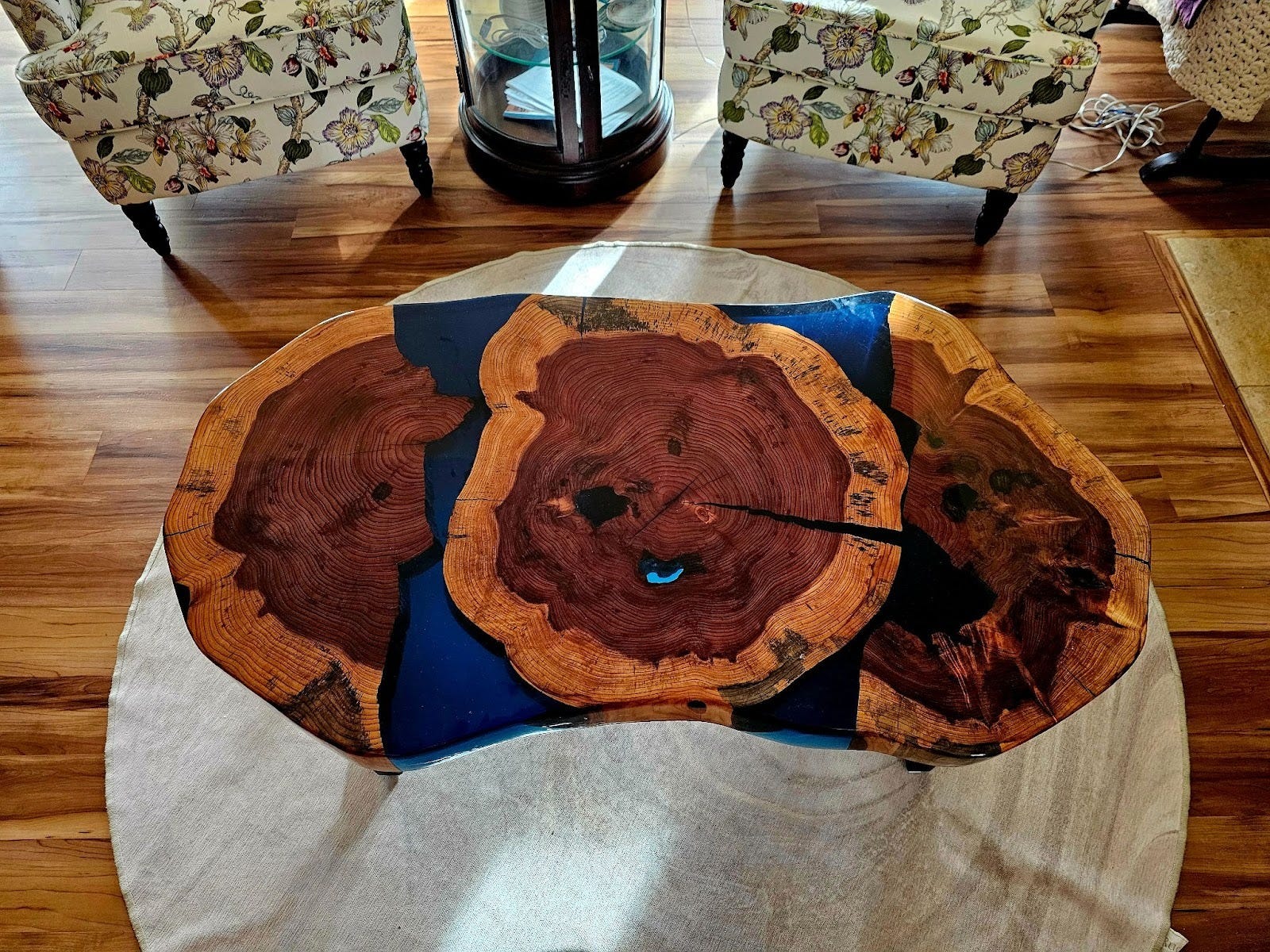
Nancy knows people in Coffey Park who have had to move many times since the fires. She’s happy where she is in Windsor. “It was all devastating to go through, but ultimately, we were one of the lucky ones,” said Nancy.
You can follow Kai and Parker Litwin of Litwin Productions on their Instagram or contact them at custom@litwinproductions.com.
Correction: Nancy’s last name is Carroll, not Holland. -DD
Oh, my. What a detailed and inspiring story, with such a fabulous outcome. Thanks, Dale, for your detailed coverage. And I wish the twins continued success in their future endeavors!