

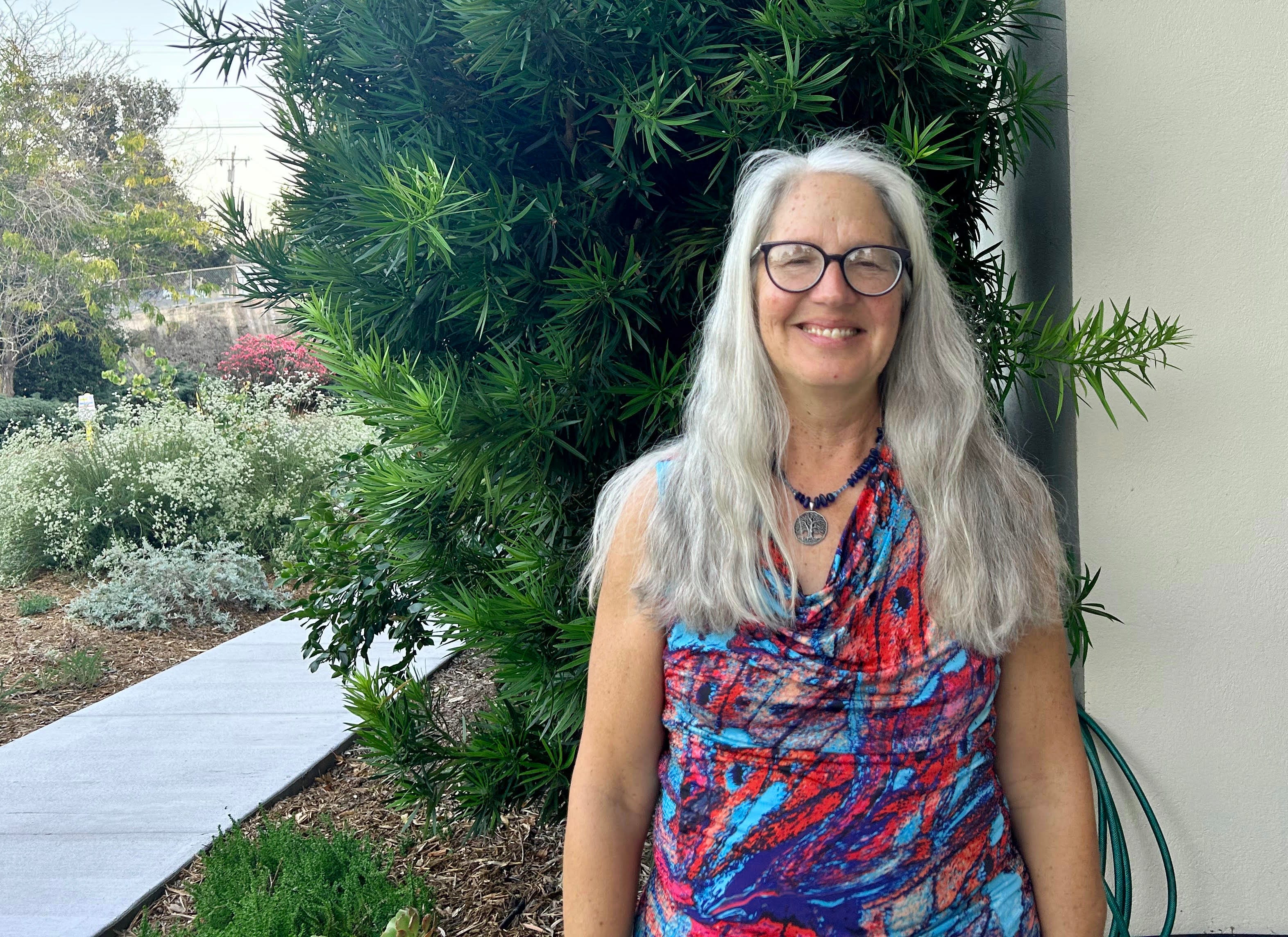
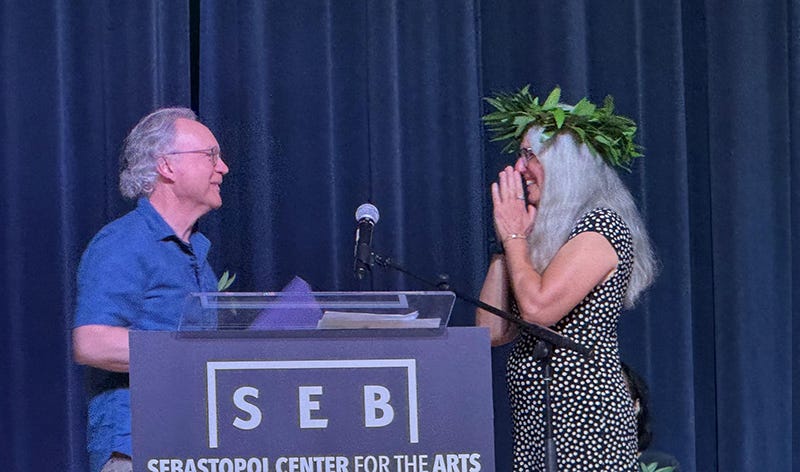
On July 12, Sebastopol resident Claire Drucker was inaugurated as the Sonoma County Poet Laureate for 2026-2028.
The role of the Poet Laureate is to reach into the community, to find poets, and to help them sing. Dave Seter, who previously held the role, said, “There’s a lot of closet poets, which is okay. It’s okay for people to write for themselves. But I think when we share, we learn more about our shared humanity.”
Each Poet Laureate embarks on a project during their tenure. Drucker, who grew up in an intergenerational home and was very close with her grandmother, proposed a series of events called Voices Across Time. The project will connect teenagers and adults to write documentary poems about each other; they will interview each other about a significant life event and write poems about the other’s story.
Drucker, an educational consultant who helps students through the college admission process, shared the thought process behind Voices Across Time. “The elders get to tell their stories and have more contact with young people, and the young people get some volunteer opportunities that they can not only learn and grow from, but also they can put on their applications for college.”
Drucker’s background in education and community-based work situates her uniquely to reach into the community and pull in all kinds of writers: young, old, shy, enterprising, even those who have never tried writing before.
“I’ve had so many students in my classes say, ‘Oh, I don’t like poetry. Oh, I don’t understand it. I don’t know how to write it.’ They are my favorite students because if you can walk, you can dance. If you can talk, you can sing. If you can lift up a pen, you can be a poet.”
Growing up with stories
Drucker grew up on Long Island, New York. A dancer, reader and the daughter of a Holocaust survivor, she was raised with an urgent sense of the importance of storytelling.
She began her undergraduate degree in English at SUNY Oswego. Halfway through, seeking a more rigorous curriculum and to try something new, she transferred to the University of Virginia (UVA).
Steeped in the conservative culture of 1983 Virginia, Drucker studied the Western canon. At 19, Drucker came out as a lesbian. It was lonely.
“I took a creative writing class at UVA with this old woman with the little spectacles that went down on her nose, and looked like she had been there forever. And I wrote a story about these two girls. And it’s somewhat ambiguous, but if I looked back at it now, it would be glaring that they were falling in love with each other. And I think they were like 13. And we’re all workshopping my story, and the teacher looks at me, and she puts her little glasses on her nose, and she says, ‘This story isn’t about lesbians, is it?’ And my little 19-year-old self is so terrified. I was like, ‘How can you know? They’re 13!’...Yeah. So that was my UVA experience.”
Drucker pored through the library, looking for queer voices. She found Adrienne Rich, and not much else, but in her search for work that felt contemporary and relatable to the marginality of her experience, Drucker took refuge in the words of Black women poets: Audre Lorde, June Jordan, and Nikki Giovanni.
These mentors saved her. “I was miserable,” Drucker said. “I still have anxiety dreams where I didn’t graduate, and I’m still trying to get my degree.”
She graduated, worked, saved some money, and six months later, she was in San Francisco. There, she got her first poem published in Common Lives/Lesbian Lives, a literary journal that no longer exists.
Drucker went on to complete her MFA at the Jack Kerouac School of Disembodied Poetics at Naropa University, where she was taught by dancers, choreographers and beat poets like Amiri Baraka, Diane di Prima, and Allen Ginsberg.
“When I took classes with Allen Ginsberg… God, he was a trip…He always had a camera, a 30-five millimeter Pentax, around his neck, and he always had an entourage of very young boys around him who were just fawning over his every move…I mean, they had some really interesting personalities.”
Having come from UVA’s traditional literary curriculum, which included Shakespeare, Chaucer and not a single woman, the energy and modern sensibilities of the Beats were a tonic to Drucker. Though the “disembodied” aspect of Naropa’s poetry program resonated less as Drucker learned the very embodied practice of contact-improvisation—a movement practice she continues to this day and said is inextricable from the way she understands the world.
“I loved that they [the Beat poets] were all really actively writing and performing, traveling around the world performing. Their craft was essential to them. So they really weren’t academics. I don’t think they really knew how to teach craft because that wasn’t in their training. They were writers, and they just wanted to share what they knew about writing, which in a lot of ways was what I needed.”
It wasn’t until Drucker started teaching that she felt she learned about craft.
After her MFA, Drucker worked as a massage therapist and continued doing body work as she moved to Sonoma County in 1995. She also began teaching English and Creative Writing at Santa Rosa Junior College.
In teaching her students, she learned a more technical approach to writing: “To really have to focus on metaphor, figurative language, the musicality of a poem, line breaks, and voice was a great way for me to really pinpoint those things in my own writing.”
She taught part-time, making room for her other passions, writing and dancing among them. It was through contact-improvisation that she met the father of her daughter Gracie, who was born in 2000.
“I was one of these women that was like, ‘I’m just not ever going to be with a man. That’s just not going to be me.’ But I was kind of curious, actually…I just started having all these feelings for one of the guys, one of the dancers, and we ended up having a baby together. We lived together until my daughter was four, and then we went our separate ways to separate houses and co-parented really closely together.”
Through all of this—through dancing, teaching, raising Gracie—Drucker wrote, though she kept her writing largely to herself.
“I’ve always been the kind of poet where I write, and it sort of just lives in my journal and I don’t really spend much time sending it out. I keep it really close to the bone.”
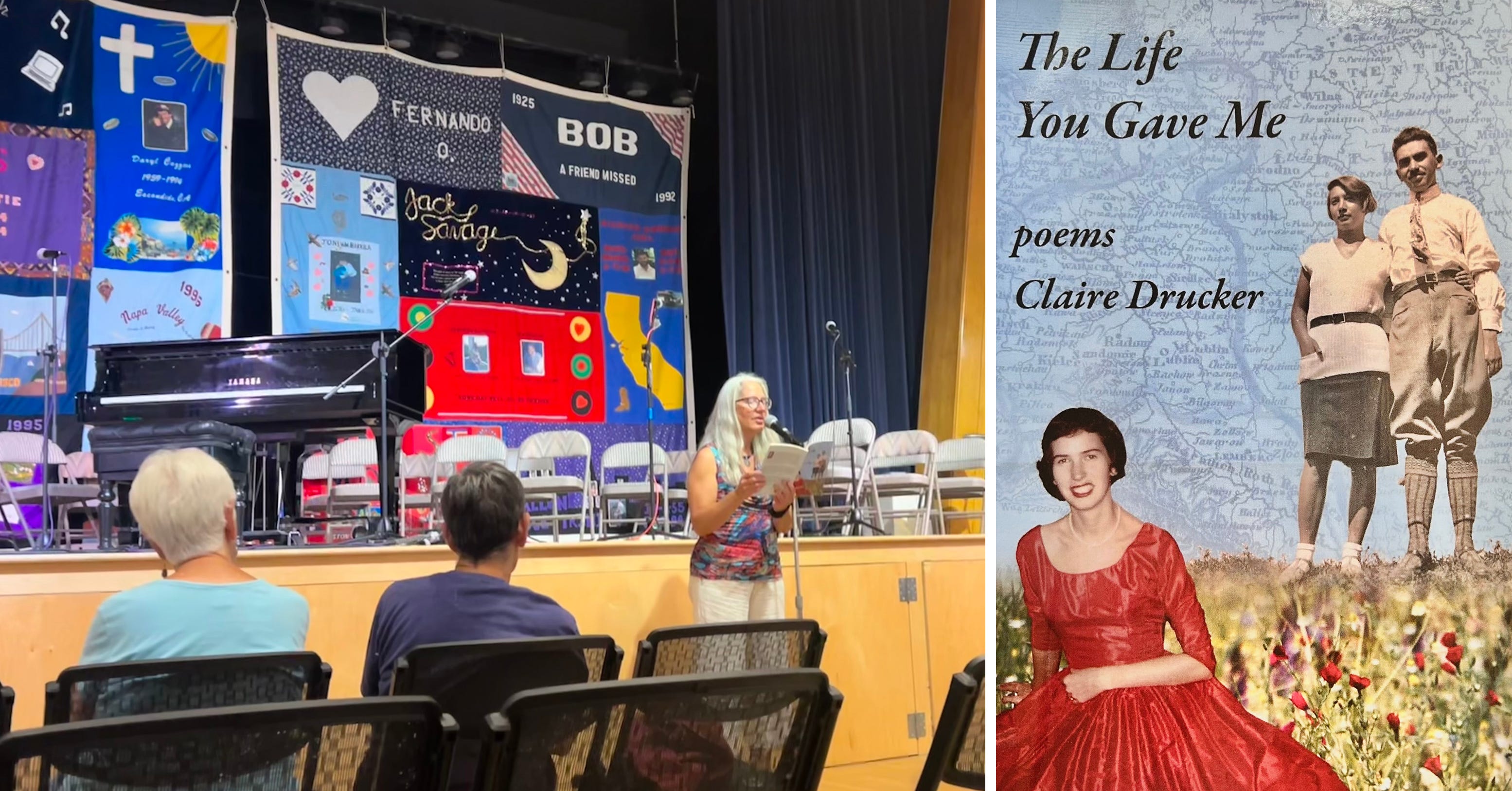
In 2014, she published a chapbook entitled The Fluid Body. Her most recent book, The Life You Gave Me, was published in 2023.
The searing family story behind The Life You Gave Me
Because Drucker isn’t particularly promotional about her work, the poems in The Life You Gave Me were written over 23 years. She calls it a poetic memoir.
The collection braids together meditations on motherhood, odes to the natural beauty of Sonoma County, pointed critique of the current political regime, documentaries of natural disasters, humorous prose and elegies.
At once devastating, humorous, and tender, The Life You Gave Me arcs through eight different sections, spanning decades of history and reconciling generations of family trauma.
The first poem in the collection, however, stands alone, acting both as an epigraph and a prologue to the rest of the book. “His Name” tells the story of Drucker’s maternal grandfather.
The poem does not tell in clear narrative style the story of Drucker’s grandfather’s death, nor the story of her grandmother’s escape to the US, but operates in impressions, a “note on the wooden table,” “a handful/of refugees in the hold.”
Drucker explained that she kept the details of her grandfather’s death purposely vague. “So many millions of people have lost their loved ones, lost their country, lost their culture, lost their language and had to flee. And I think, on some level, I wanted it to be a little bit more universal.”
Her grandfather’s life is also not a story that can be captured in a single poem.
As we sat on her back patio, she told the story:
He came from a large family. He was one of nine, and they were actually—at the point in the late ’30s when Hitler came to power—they were very successful. He was an inventor. He was an engineer, and he had invented these new textile machines. They lived in this very beautiful part of Vienna.
My grandmother had a really difficult childhood. She had been in an orphanage for seven years because her father died when she was young, and her family couldn’t afford to feed all of them, from when she was 12 till she was 19.
They waited a long time. They had family members who got out earlier, but they were in denial. They really didn’t think it was really going to be as bad as everybody was predicting. And Kristallnacht had already happened just a few months earlier.
There was a moment my grandmother told me about where they spread the maps down on the table, and they thought about fleeing to Brazil or China. There were places that would take them in, but my grandfather had fought in the First World War. He’d almost died so many times. He had left the war with, I’m sure, PTSD.
He came from a teeny little town called Strojenetz, which, depending on the moment in history, was occupied by all these different forces. You know, the Russians had it, and then it was part of Austria-Hungary, and then it was part of Czechoslovakia, and then it was part of Romania, so the borders just kept moving…The United States wasn’t taking in any more Romanian Jews. My grandmother was Austrian, but when you were married, you were under your husband’s quota…
So he researched and he must have gone to various embassies and libraries to get this information, but he found out that if my grandmother was a widow, she would revert back to her Austrian status, and the United States was still taking Austrian Jews. He didn’t tell her any of this, of course.
And he killed himself…
And my grandmother blamed him. She felt so abandoned by him. There she was, alone with two small children.
One of her neighbors in the apartment building was the wife of the Austrian consulate, and she knocked on her door and basically dropped onto her knees and begged for visas. And the woman must have taken pity on her.
Drucker’s grandmother immigrated to New York with her children and lived with an uncle and his family, where she worked as a maid in their house.
This survival story wasn’t relayed to Drucker in such detail as a child.
Her grandmother, who later lived with Drucker’s family, was angry. Her mother saw her father as a hero—his suicide both an act of abandonment and an act of noble sacrifice. It meant something different to each member of the family. The tension created by the intergenerational fallout of his death resulted in a great deal of silence about what had happened.
When Drucker was 32, she was clearing stuff out of her mother’s closet. She found a box of letters that her grandfather had written to her grandmother. As she rifled through, she found, at the bottom of the box, his suicide note.
And in the note, it was clear: “He knew that by taking his life, his family would be saved. And the truth is also that he could not have started over. It was too difficult for him.”
With this inheritance of sacrifice, abandonment, fear, grief, and immeasurable strength, Drucker writes a path toward healing—taking care of her aging mother, raising her own daughter and taking action against injustice.
Drucker is currently working on a new collection, titled B is for Banned, an Abecedarian of Erased Words. The book will be arranged in alphabetical order based on words the Trump administration has banned from government documents—words like gender, equity, diversity, immigrants, and community. The book will end with the letter W. “The last word is woman,” Drucker said.
Regarding its political content, she promised, “No holds barred.”
As a poet, Drucker is open, honest, and accessible. As the Poet Laureate, she hopes to be the same. She invites anybody, no matter their experience with writing, to contact her for support, mentorship and conversation about poetry. You can reach her at drucker@sonic.net.
Poems by Claire Drucker
The Life You Gave Me
for my grandfather
It could not fit in a velvet box with a
velour ribbon tied twice nor could it be worn,
an evening gown blue as the generous, sad sea.
Not a stone, not a car, not a dog with pleading
eyes to please get the bone before it’s gone forever.
It wasn’t green, it didn’t sing but started quiet
as an egg splitting in the waters. Not chapped hands
in winter, not webs behind the bed, not the pitch
perfect way oaks whip in a storm.
Listen to this gift burn. Air coming and going
in a nostril. Upper eyelid drooped and creased,
a delicate gate. The way I open the door with my left,
close it with my right. Footfall on tile. You watching me
in my dreams, reaching your eyes out as if to say
take it, I don’t need it where I’m going
arms laden with white roses, one for each year
you lost, one for each of mine.
From the Shore
(Editor’s note: A poem for her daughter)
I could almost see the shape of her miles
off, as if my glasses were triple washed—
first azure, zinc, then the foreground of
oystercatchers digging for clams.
As if an invisible knife on the
diagonal, cutting the ocean
in half, could twist
these many years into
more wanting I can hardly touch.
She will start again, newly born and my
womb will insist not enough time
to go back, start again but the door
already opened, stands waiting.
I want to give her the frozen and the heat,
bodies that will love and leave her,
as if her own heart in its small shell
is a boat sailing off, all of us waving
from the shore, as she recedes
and emerges on the other side.
As if there is anything else.

I was so touched by this portrait of Claire and her mission to create opportunities for young people and elders to not only hear each other's stories, but to write poetry inspired by those meetings. Congratulations, Claire! We are lucky to have you as Sonoma County's newest Poet Laureate.
Maybe it's just me, but I'm having a hard time caring about much of anything besides our escalating descent into theocracy/dictatorship and environmental armageddon.