

Every now and then, the Sebastopol City Council makes a decision in good faith, only to face a massive blowback at the next council meeting. That’s what happened on Tuesday night, when they faced a council chamber full of supporters of Micah’s Hugs, who were furious at the council’s refusal, two weeks before, to co-sponsor a free Narcan distribution box in downtown Sebastopol.
Micah’s Hugs is a nonprofit dedicated to preventing substance abuse and fentanyl poisoning through education, awareness, and stigma reduction. The founders of the organization, Micah and Michelle Sawyer, lost their son Micah to fentanyl poisoning six years ago. They started Micah’s Hugs in his honor.
At the beginning of Tuesday’s meeting, 17 people stepped forward to speak during Public Comment for Items Not on the Agenda. Normally, this first public comment session is limited to 20 minutes, but the council agreed to double that to hear all the speakers—in person and on Zoom—who’d shown up to speak that evening.
The first person to speak was Michelle Sawyer, one of the founders of Micah’s Hugs, who accused the council of making an uninformed decision based on fear-mongering and stigmatizing language. She said she realized they’d done this out of concern for public safety, but that that concern was misplaced, as Narcan had the potential to save children’s lives—and the lives of many others—not harm them.
One by one, people who’d lost family members to fentanyl overdoses, government harm reduction experts, pharmacists, recovering addicts and others stepped forward to beg the council to reconsider their decision.
How did this happen?
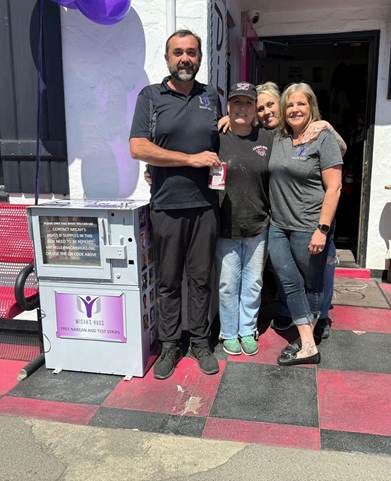
The idea of putting a Narcan distribution box—which would be free and accessible to anyone—in downtown Sebastopol was first mentioned at a council meeting on September 16, 2025, when the Sawyers gave a presentation about Micah’s Hugs to the city council. During this presentation, they mentioned a new program they were starting, where they were re-purposing old newsstands to use as free Narcan distribution boxes. A local businesswoman, Breanna Christenson, who was attending the council meeting that night, volunteered to host one in front of her business, BC Therapeutics, at 207 N. Main St.
At the time, most of the council seemed enthusiastic about this concept.
It took several months to get this on the council agenda, but at the January 20 city council meeting, the council was asked to consider co-sponsoring a repurposed newspaper stand for Narcan in front of Breanna’s business. The city was required to co-sponsor the box because it would be located in a city right-of-way on Main Street. In the staff report, city staff recommended that the council approve the co-sponsorship. Many assumed this would be a slam-dunk, including Micah and Michelle Sawyer, who were so certain that it would pass that they didn’t even attend the meeting, thinking it a done deal.
Mayor Jill McLewis led the offensive by questioning the need and safety of having a free and public Narcan distribution box that could be accessed by anyone, including children. She asked why the box, which was originally going to be placed on private property, was suddenly now being put in the public right of way. Given her past experience, she worried about city liability.
“I’m a licensed respiratory therapist who worked in a hospital for 20 years, and I’ve assisted and given Narcan over 1,000 times, just because it’s easy for the elderly to be over-medicated when you’re working in a SNF unit [Skilled Nursing Facility]. And every time we have to actually secure the people with their arms and their legs, because when you give Narcan, it causes a violent reaction…they hit, they spit, they bite. There’s a lot of different reactions that can happen. So the liability portion of that is what I’m wondering about. So if someone gives Narcan on the street and someone gets injured, where’s the liability?”
She was not reassured when City Attorney Alelx Mog said, “The only way to eliminate any liability for the city is to not do that,” meaning not to have the city co-sponsor the box in a public right of way. “Liability can be further limited by having the person who’s willing to sponsor it obtain insurance and agree to indemnify the city.”
In public comment at that same meeting, Oliver Dick warned darkly that Narcan had been “weaponized” by gang members—something this reporter was unable to substantiate.
Other councilmembers, including Phill Carter, Sandra Maurer and Neysa Hinton, worried about having a box with Narcan that anyone, including curious children, could access anytime. In the end, this concern, more than any other, won the day, and council voted against sponsoring the box.
Unfortunately, there was no one in chambers at that January 20th council meeting—no medical or legal experts—that could have told councilmembers what Narcan advocates swore was the truth: that Narcan (also known as naloxone) has literally zero effect on people who don’t have opiates in their system and that the state of California has virtually indemnified from liability anyone who administers Narcan or distributes it (including municipalities).
Tuesday’s testimonies
These points were driven home in comment after comment at this week’s Feb. 3 city council meeting.
Shelley Alves, a health program manager with Sonoma County’s Department of Health Services, made the public health case for free Narcan distribution.
I’m here this evening in an informational capacity to share public health context related to naloxone access and the overdose prevention and to support continued education and informed discussion on this topic. From a public health perspective, naloxone is recognized by both the Center of Disease Control and Prevention and the California Department of Public Health, as well as the local Sonoma County Department of Public Health, as a safe and effective medication used to reverse opioid overdoses. It works by restoring breathing when opioids have slowed or stopped respiration. Naloxone has no abuse potential and has no effects if opioids are not present. State and federal public health agencies consistently identify increased naloxone availability as a key component of overdose prevention efforts, particularly in the context of the ongoing opioid crisis in California. The California Department of Public Health has emphasized that community access to naloxone, paired with education, is associated with reduction of overdose-related deaths…The CDC does not identify naloxone distribution as a public safety risk for any person of any age. While naloxone can bring on opioid withdrawal, which may be uncomfortable and disorienting, public health data does not support the idea that naloxone access leads to increased violence or community harm.
Elementary school teacher Sam Prohoroff addressed the legal question of legal liability.
Regarding liability with naloxone, California law is very clear about this. Under the state’s Good Samaritan Law and naloxone immunity statutes, individuals who administer naloxone in good faith are protected from civil liability, and entities that distribute naloxone, including cities, are also protected. There’s no requirement that a person be medically trained to administer naloxone, and there’s no documented pattern of cities being held liable for injuries resulting from bystander administration. The greater legal and ethical risk is knowingly restricting access to a life-saving tool that is widely recognized as safe over the counter and protected by statutes.”
The Sebastopol Times followed up with Micah’s Hugs’ Michelle Sawyer to get the specifics on the legal question. She wrote back as follows: “I believe the speaker was referencing two protections under California law. The first is the Good Samaritan statute (Health & Safety Code §1799.102), which protects individuals who provide emergency aid, including naloxone, in good faith. In addition, California Civil Code §1714.22 specifically provides liability protection for entities, including municipalities, nonprofits and organizations that prescribe, distribute, or train others to administer naloxone. These laws were created to ensure that fear of legal exposure does not prevent communities from making overdose-reversal medication available.”
Some of the most moving public comments addressed people’s personal experiences with the opioid epidemic. A woman named Chantal, who said she was appalled by the gross misinformation on display at the last council meeting, gave this searing testimony.
I’m a millennial, and the opioid battle is very specifically my generation’s battle. I know firsthand the detriment the opioid epidemic has caused. I was 12 years old the first time I saw a kid steal pain killers from their parents. I was 13 years old the first time I saw someone decide to snort those painkillers. I was 14 the first time I had to call 911 for a friend. I was 15 the first time I lost a friend to an overdose. The helplessness I felt in these situations still shakes me—clearly. I’ve witnessed this drug take over my friends and family. I recently just came back from visiting my cousin who has had two brain surgeries and a heart surgery due to not having proper intervention early on in his overdose, which could have been prevented by having access to Narcan—without going and paying $50 at CVS, or having to ask a store clerk or having to go and do anything that’s going to be deemed shameful or potentially get them in trouble.
Two members of the George family, who are Native American, spoke about the loss of their 16-year-old son and brother. Valerie George, the boy’s mother, explained that there is an extraordinary amount of stigma around drug use in the Native community. In spite of that, she said, “I’ve been able to get a Narcan distribution box in front of our local clinic here in Santa Rosa. We have a Narcan box on the reservation. We have a Narcan box in the Kashia Tribal office. If Native Americans can get past the stigma, so can the city of Sebastopol.”
Several speakers reminded the council that fentanyl is not just a problem for drug addicts. The prevalence of fentanyl-laced pills of all types puts even casual drug takers (like kids at a party) at risk.
Speaking of the council discussion at the previous council meeting, Sawyer said, “We were disheartened to hear repeat references to “drug users”—as if naloxone exists only for one type of person. That framing is harmful and inaccurate. Naloxone is not for “them,” it’s for all of us. It’s for families, friends, classmates, coworkers and bystanders. Overdoses don’t only happen to people we label. They happen to people we love. Scare-based narratives actively undermine the work we’ve been doing to change the stigma, encourage openness and get life-saving tools into the hands of people before an emergency happens. Shame does not prevent overdoses. Silence does not prevent overdoses. Preparedness does.”
One of the most interesting comments came from Kimberly Saxelby of Sax’s Joint, which has a Narcan distribution box outside of the cafe. She read an email from someone with the subject line, “You saved a life yesterday.” The letter said that the Narcan the email writer had taken from the box at Sax’s Joint had been used to save someone’s life in Petaluma.
The question of liability
During a break at Tuesday’s meeting, Councilmember Maurer asked City Attorney Alex Mog about the liability question. Mog said there was still a risk of liability for the city, even though that risk was very low. (Bottom line: Anyone can sue anyone for anything—whether it’s reasonable or not.)
In preparing to bring this issue before the council, city staff requested feedback from their risk pool, CIRA, to evaluate the risks associated with a Narcan box. CIRA responded with the following statement, which was printed in the staff report:
“Barring any laws that prevent the distribution in this manner, we believe the risk can be transferred. We would recommend treating this situation similarly to a restaurant placing tables outside its business in the City’s right of way, where the City would require indemnification and insurance as part of an encroachment/license agreement. While we understand that it’s difficult to overdose on Narcan, we would recommend requesting coverage limits as required by the City’s encroachment permit. This way, if an incident occurs, the nonprofit would be potentially liable. If the City opts to deploy Narcan itself, there is currently no exclusion to the CIRA or PRISM MOC. We have heard that some cities are making Narcan available within their facilities so they can monitor its use. We are unaware of any that has placed a dispenser outside that is always available to the public. If the City chooses this option, it may be liable in the event of an incident.”
Michelle Sawyer said other cities haven’t had these qualms—or if they did, they overcame them.
“We have not had to indemnify or carry insurance for the boxes that we have previously placed,” she said. They currently have boxes in front of Sax’s Joint and The Mail Depot in Petaluma, at Napa Auto in Cloverdale, and at the Russian River Senior Center in Guerneville.
“We are working with the Sonoma County Library, and we will be placing a box at the 211 E. St. Santa Rosa location,” Sawyer wrote the Sebastopol Times. “We have plans for one at the Windsor Library, Healdsburg Library, and the Cloverdale Library. We had plans for the Sebastopol Library until the council denied our box location at the previous meeting. The library assumed they would’ve denied us placing one at the [Sebastopol] library since it’s owned by the city. However, we are getting added back to the agenda to discuss other locations and so far, two council members have expressed a desire to have our box housed at the Sebastopol Library.”
Going forward
Those two councilmembers are Phill Carter and Stephen Zollman—the latter of whom was the only vote in favor of putting the Narcan box on Main Street.
After listening to all the comments at Tuesday’s meeting, Councilmember Phill Carter admitted he’s having second thoughts about having voted no. “I should have done more research,” he said. “I really had no idea that Narcan was, like, inert if you don’t have opiates in your system.”
Carter said he was working with Councilmember Zollman to bring the issue back to council as a proposal that would include multiple possible sites for Narcan distribution in Sebastopol.
Thank you for your detailed report! It is good to hear both sides' concerns and experiences.
Excellent reporting. Thank you for this important journalism.