

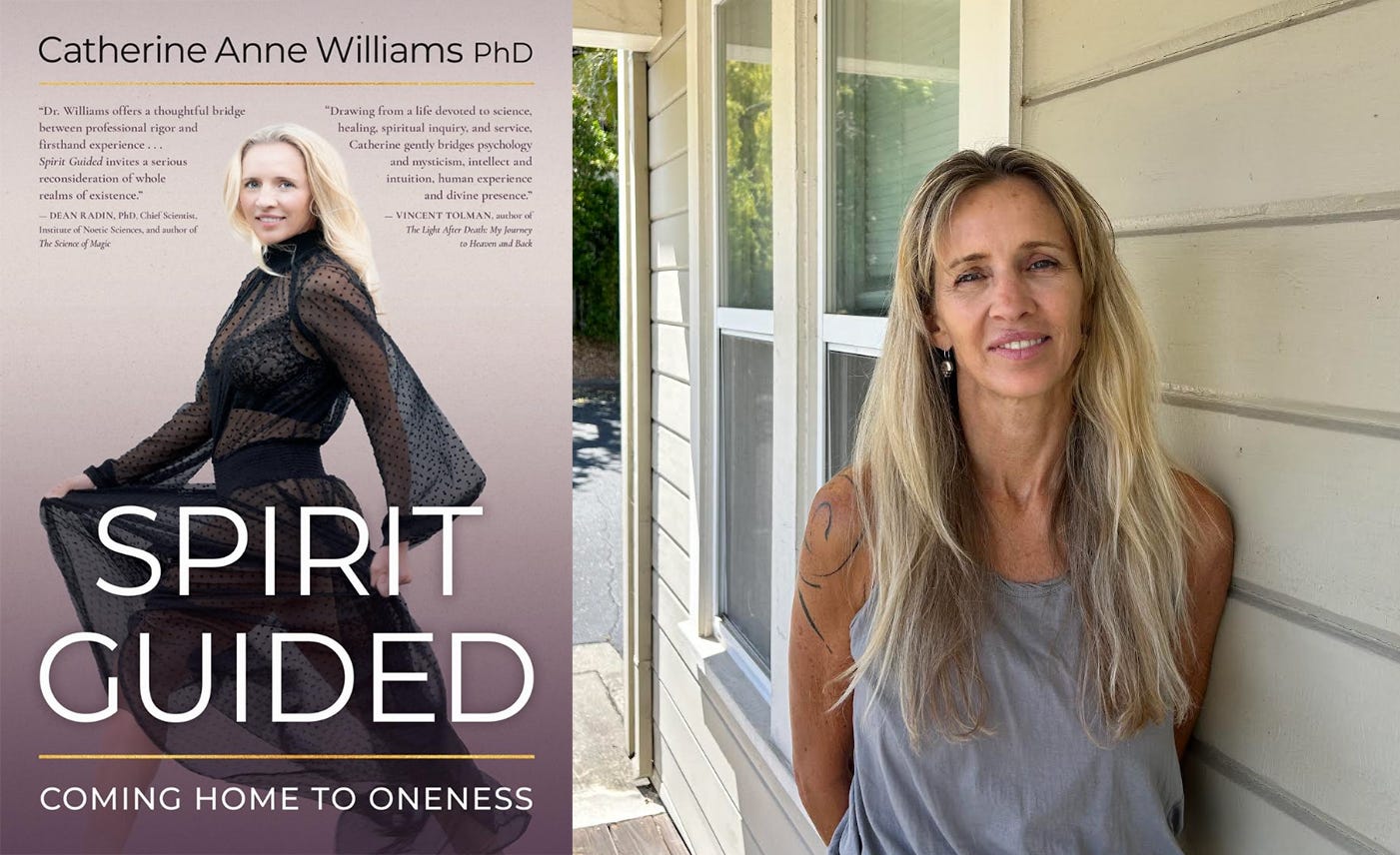
Dr. Catherine Anne Williams—a Sebastopol clinical psychologist, educator at the Santa Rosa Junior College, mother, and Sebastopol resident of 20 years—recently made her debut as a writer.
The title of her book is Spirit Guided: Coming Home to Oneness, and Williams is keenly aware of the judgment that this spiritual language might elicit.
Early in her book, she writes, “I was raised by a wolfpack of skeptical scientists…the public admission that I communicate with spirits that don’t have bodies is more damning in my family…than if I were to admit that I was a robber or a telephone spam operator. Both of those identities still operate within their worldview.”
But Williams chooses to honor her personal understanding of the world. She didn’t arrive at it easily.
The book begins with a near-fatal bike accident.
“I landed on the pavement twenty-five feet from my bike, its front tire still lovingly cradled by the yawning pothole … Through teeth floating in my mouth, I gargled out a prayer.”
Although Williams started her spiritual journey before this traumatic event, it was this incident, she says, that led to her commune with a spirit guide.
The writing of this book began as Williams’ mediation of the guide’s voice. At some point, Williams said, the guide stopped speaking and pointed her finger at Williams, as if to say, now tell your story.
The book at its core is a memoir of a woman who has journeyed through addiction, life-threatening traumatic injury, and the spiritual and relational disconnection that plagues so many modern societies.
She reconciles these events through her personal process of understanding a tie that binds almost all human beings across time and space: a sense of connection to ourselves, each other, and perhaps a high power. This triad of connection constitutes Williams’ definition of spirituality.
Growing up
It’s called a spiritual journey for a reason. Williams was not raised with belief in a higher power at all. She was raised with the rather rigid pillars of Western scientific inquiry.
Her mother, a professor of dermatology at UCSF, and her father, a leader in the field of pharmacology, were analytical, driven and hyper-successful.
“If there’s a religion for Western science, I would say my parents are card-carrying members,” Williams said.
She grew up in San Francisco in the 70s, so alternative ways of thinking weren’t too far out of reach. When she was a teenager, her mother and stepfather moved to Muir Beach. Their new home happened to be next to the Zen Monastery.
Williams connected with adults involved in the monastery and asked them questions. Although as a child, Williams says, she saw auras and spoke to animals, her conversations with Kathleen were the first time she heard spiritual ideas verbalized by another person.
She was a teenager and in a time of exploration. Some of it was spiritual and intellectual, and also, she said, “Part of where I went exploring was through drugs and alcohol.”
Finding her way through addiction
Williams explained that addiction runs in her family. Her father and aunt both struggled with alcoholism, though they got clean when Williams was nine.
“All it took was my freshman year of high school and to feel like I was on the outside of the popular crowd and they were all doing it for my anti-smoking belief to vaporize. Then next thing, you know, I was smoking,” she said. “And my high school still had all the vestiges of being a hippie school where there’s no power trips between the faculty and students. So my high school had a smoking section where the teachers would smoke, and the students would smoke. Kind of mind-blowing now. So at 14 I was smoking with upperclassmen and also teachers, and it just gave me an identity.”
From there, Williams developed a habit of partying hard. She eventually got arrested for having a fake ID, and trust with her family deteriorated. “I crashed and burned early on,” she said.
At 19, as a sophomore in college, Williams found herself in a pattern of getting high every day.
“Eventually it became clear that all of my problems had a commonality, which was the substance use that I was doing. So eventually I did get willing—it’s the suffering that makes you get willing to go into treatment.”
She went home, said goodbye to all of her friends, and entered treatment. In 12-step treatment, Williams developed relationships with people who mentored her, including a woman named Teri.
“She was the one who really taught me what it would be like to be in a close, loving relationship with spirit…she offered that as a model to me. Relationships are essential to our own healing process. We need the love of others when we’ve been so cut off from self-love.”
In recovery, Williams took classes on psychic development out of curiosity. She began volunteering with teens who were in recovery and then worked for a year at a dual diagnosis (substance abuse and mental health) treatment facility for adolescents.
Ready to give back, and perhaps ready to follow in the ambitious footsteps of her doctor parents, Williams graduated from college with a degree in psychology and started a PhD.
Although Williams had developed a sense of her own spirituality, she chose the PhD route because it opened more doors for her career.
Bridging the spiritual and the psychological
In 2011, Teri passed away. Williams went with her friend Michele (who would later be present during the bike accident) to a psychic reading.
They felt Teri’s presence palpably, she said. “When I walked out of that reading, I knew I could not go back to how I was living my life before. I knew that if spirit could be that physically present, that intense, that everything in my life had to be about spirit at the center…I then kind of dove into developing these spiritual abilities of clairvoyance and mediumship at the same time that I was working as a psychologist and teaching college classes.”
But Williams’ research through her bachelor’s degree and her doctorate focused on the importance of spirituality. She studied correlations between spirituality and substance abuse in adolescents.
Bridging the spiritual and the scientific for therapeutic purposes has been explored by neuroscientists in recent years. A central point in Spirit Guided is the reconvergence of Western science with non-Western medicine and spiritual practice. For example, psychedelics, which have been used for millennia in spiritual sacrament, are now being studied again for therapeutic use.
Williams is fascinated by the states of “spiritual emergency” that psychedelics can induce, in the sense that one’s sense of self starts to fall away and forces you to question who you are.
She experienced a similar process during her bike accident: “I lost my ability to work, I lost my intelligence, I lost my beauty. I lost it in an instant. It caused me to question the core of my life.”
However, these acute events of intensity are not the only way to draw awareness and deep connection with others, she stresses.
“But,” she continued, “When we strip away all the layers of our identity, we understand that there’s still something we can come home to. So what is it that I’m coming home to?”
Coming home to oneness
There are many ways, she said, to begin answering this question.
“I think I make the point throughout the book A) I don’t want you to follow my path because everybody should follow their own path; and B) My path includes hitting my wall in drug addiction and then crashing my face on the pavement. So please don’t follow my path,” she said with a laugh.
“There’s an easier, softer way … than addiction recovery or taking hero doses of psychedelics.”
Williams said that she has practiced different methods over time based on what feels right to her. “For me, right now, it could be ecstatic dance — that’s the thing that helps me step out of my identities and get into the flow of the world.”
She emphasized that these practices could be anything, depending on the person: painting, prayer, swimming in cold water, developing meaningful relationships, or getting high from licking a toad.
“It is daunting, and it is personal, and I would be wary of anybody who offered me the way,” she said.
On her website, Williams explains how she brings her spiritual experiences to her practice as a psychotherapist:
“I am fluent in both languages,” she writes.
I can talk with you about your twin flame, your galactic family, or your astral body—and also about attachment theory, the vagus nerve, and brain circuitry networks.
I hold safe, ethical space with the training of a psychologist and the reverence of a minister.
I believe in both/and healing: the best of Western medicine alongside indigenous wisdom, plant medicine, and energetic practices.
Williams said she’s excited to share her new book with folks in Sebastopol and West County: “From the volunteer firefighters who picked me up off the pavement that day to the friends and family who made my life possible while I was recovering from a brain injury, this is a Sebastopol story. It lives here. It is fed and nurtured here.”
Find Spirit Guided: Coming Home to Oneness at Copperfield’s Books on Main Street or online. Her audiobook will be released soon. You can find out more at catherineannewilliams.com.
