

On Monday night, a group of planning and urban development consultants held a listening session for a project called “Sebastopol Growing Together: A Strategy for a Livable Community,” a proposal to amend Sebastopol’s zoning code to allow for denser workforce housing development along the 116 corridor.
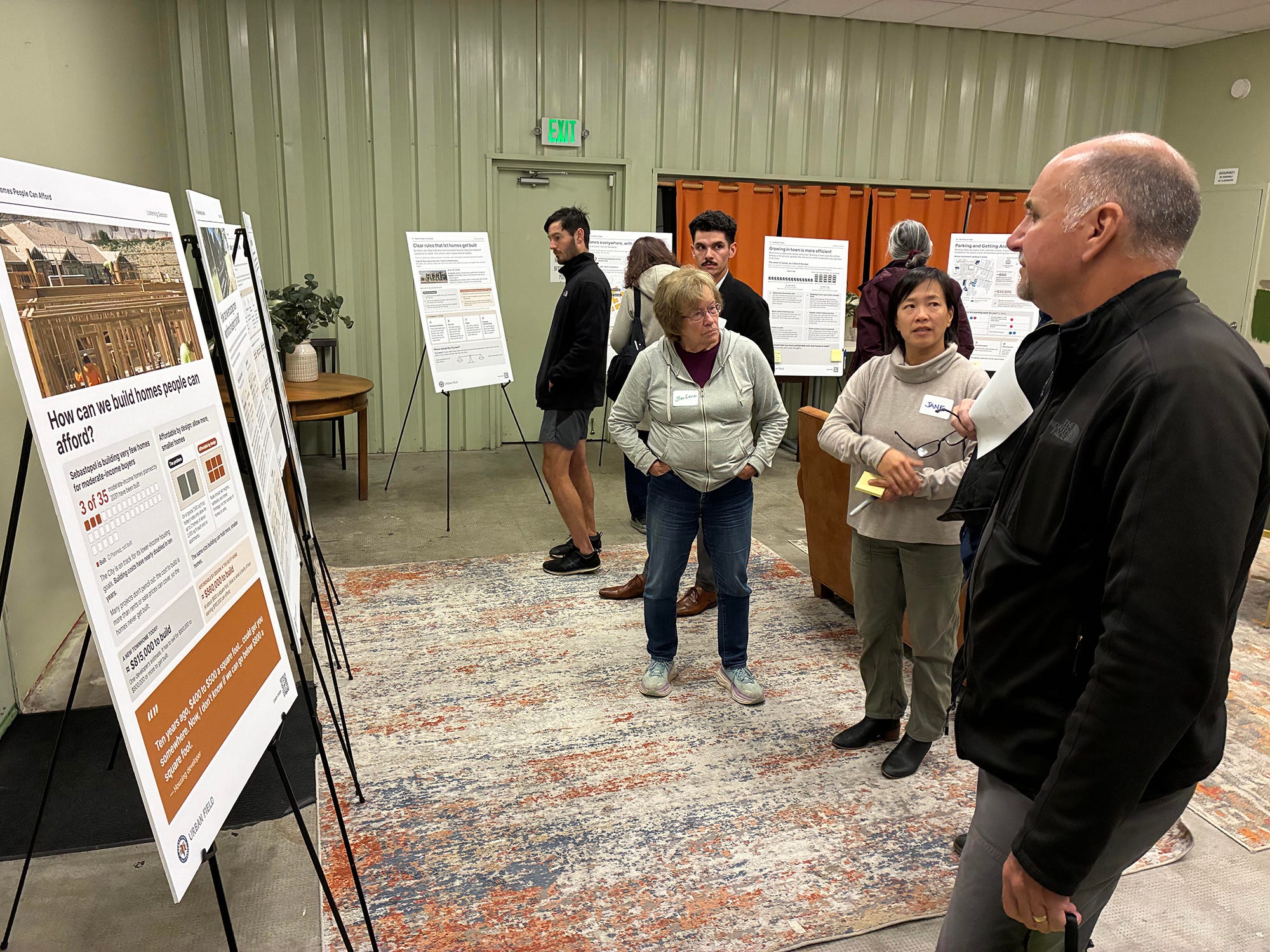
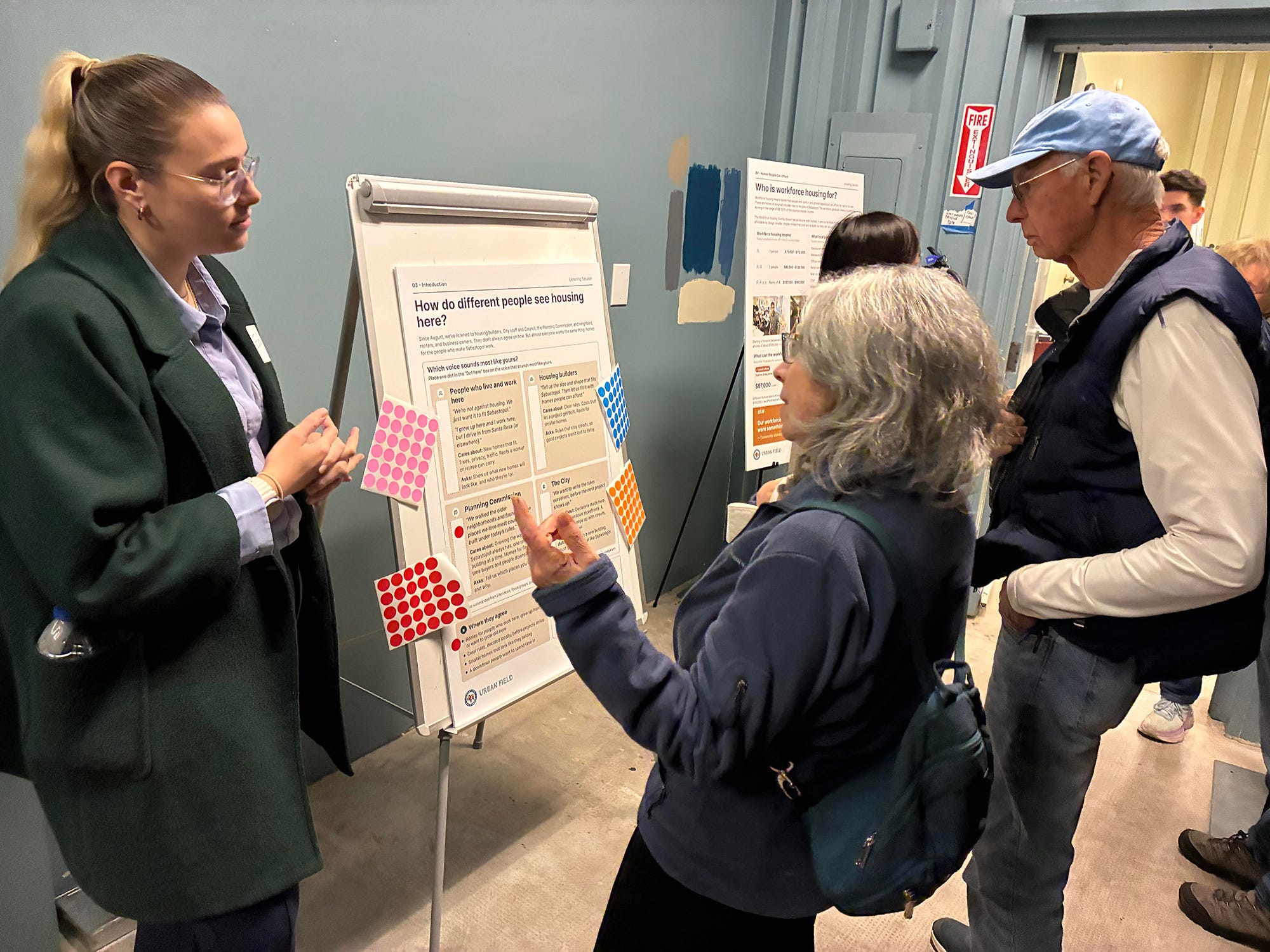
There was no formal presentation, just a series of large, handsome and information-rich posters — 15 of them (!) — posted around two rooms of the Sebastopol Community Cultural Center. Participants wandered from board to board, perusing, then adding their comments using sticky notes. There were also several consultants, as well as Sebastopol planning staff, on hand to answer questions.
This meeting was a long time in the making.
“Sebastopol Growing Together” grew out of a $250,000 grant the city won in 2023 to develop a workforce housing program. Because of constant staff turnover in Sebastopol’s Planning Department, the grant languished for a few years, but now it’s back in play.
Sebastopol was eligible for the grant in the first place because it’s a member of —warning, acronyms coming hard and fast — the Priority Development Area (PDA) program, a partnership between the Metropolitan Transportation Commission (MTC), the Association of Bay Area Governments (ABAG), and local cities and counties. Through the PDA program, local governments identify areas for future housing and job growth that are also served by transit.
Because the city’s planning staff hasn’t had the bandwidth to administer the grant, PDA partner ABAG hired a consultant to put together a team of consultants in land use, urban design, economics, and traffic to administer the grant for Sebastopol. Team members come from several consulting firms, including Urban Fields Studio, BAE Economics, and Leshner Planning.
For the last six months, Urban Fields Studio has been holding meetings with city staff, developers, affected property owners, businesses, housing advocates, and design professionals. With their input, the Urban Fields team developed the poster board presentation for Monday night’s meeting, which marked the first time the public has been invited into the project.
Urban Fields Studio partner Ryan Call described his company’s work this way: “We’re a small firm in the Bay Area, and we focus on urban design and planning policies. We help figure out how cities can incrementally up their density and standards, but not lose who they are.”
At the listening session on Monday night, Urban Fields Studio founding partner Jane Lin laid out the purpose of the project and the listening session.
“We’re really trying to think about how to make it possible for someone who works in Sebastopol to live in Sebastopol. If you already live in Sebastopol, you’re a very, very lucky person. There are many people who work here who would love to live here. So really, it’s about trying to think about the city’s rules and how we can make space for them. So it could be that you build more on each parcel. It could be maybe that you make a trade-off between land for parking and for housing. There’s not a set way that we want to do it. We want to hear from you on thinking about how that might work, where it might go, and how it might look. So that’s what all these boards are about.”
She also encouraged participants—and those who missed the meeting—to take an online survey that will help inform the consultants’ work.
Where in Sebastopol is this project located?
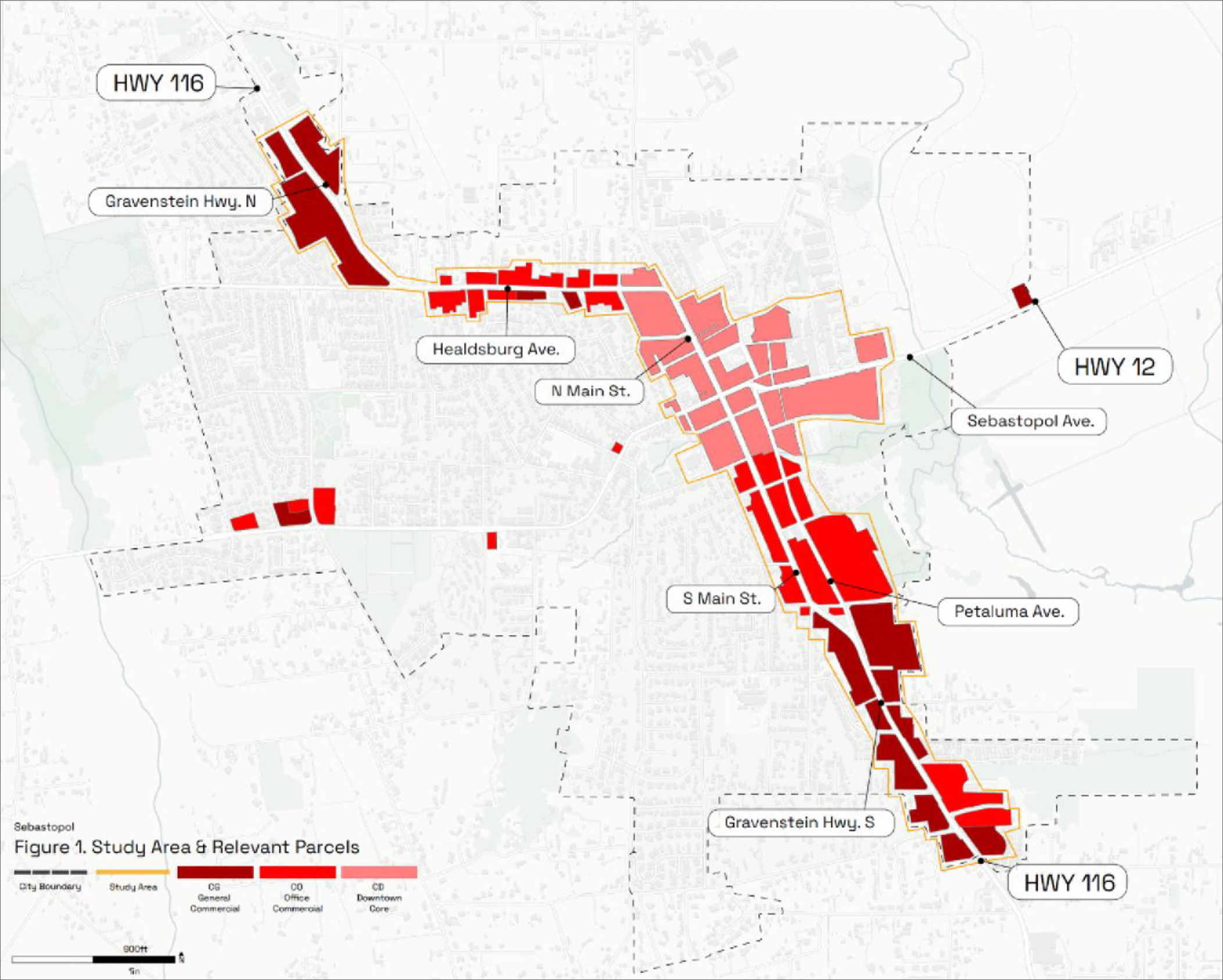
Sebastopol Growing Together is focused on creating more workforce housing along the 116 corridor, which is also, not coincidentally, roughly the same area Sebastopol identified as the Sebastopol Core Priority Development Area when it joined the PDA back in 2012. Earlier this year, the Sebastopol City Council approved a new zoning layer for this area called the Workforce Housing Overlay.
Part of the Sebastopol Growing Together mandate is to put this overlay into action: opening these areas up for residential development; creating new, simpler objective design standards; and then applying the new zoning rules one by one to the majority of parcels on this map:
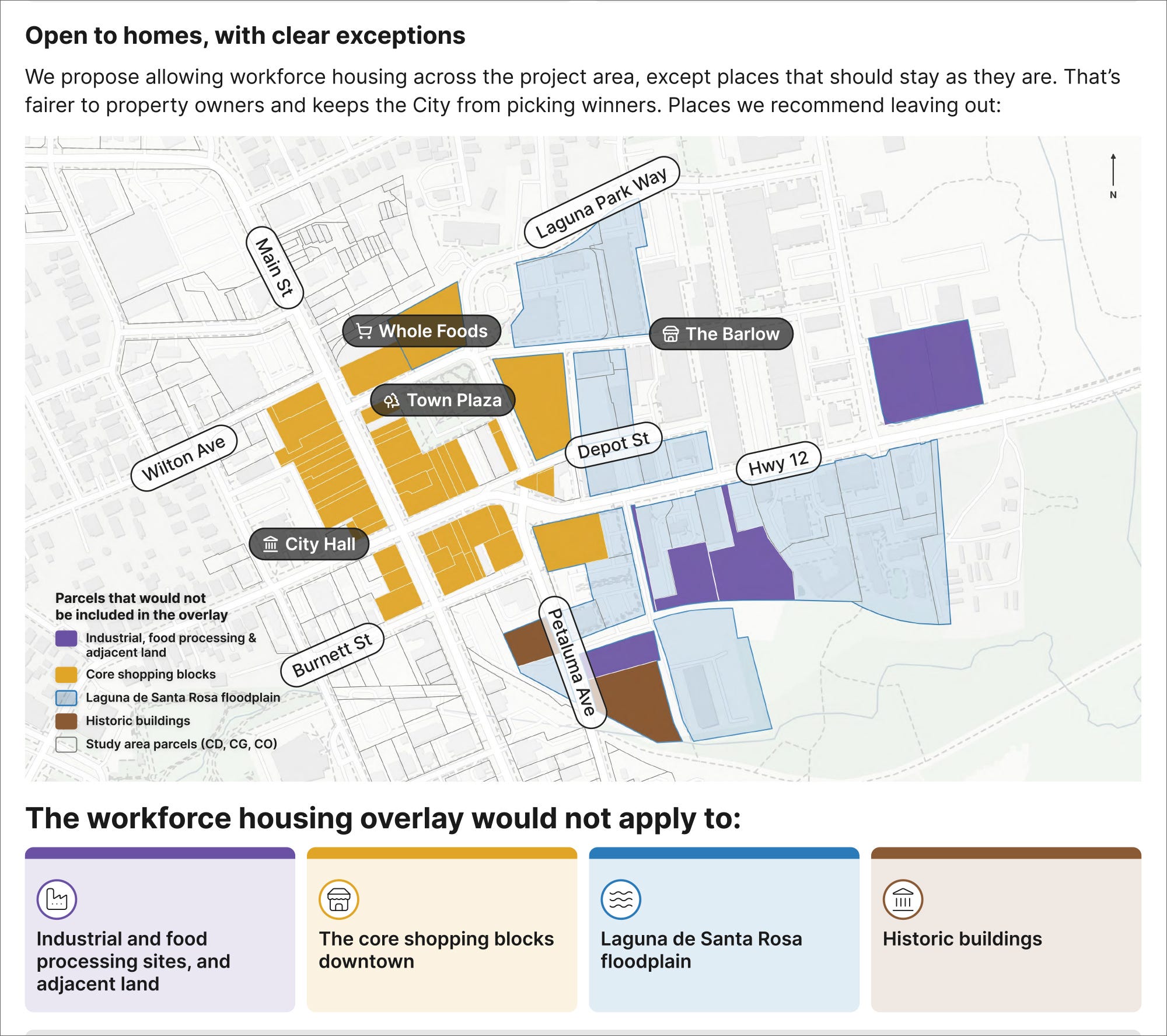
There are a few areas on this map where housing won’t be allowed, including the core shopping blocks downtown, the Laguna flood plain, as well some historic and industrial parcels.
What defines ‘workforce housing’ in Sebastopol?
Workforce housing targets the middle and lower ends of the economic spectrum. At the Oct. 27 Planning Commission meeting on Sebastopol Growing Together, team member Stephanie Hagar, principal at BAE Urban Economics, explained what this meant:
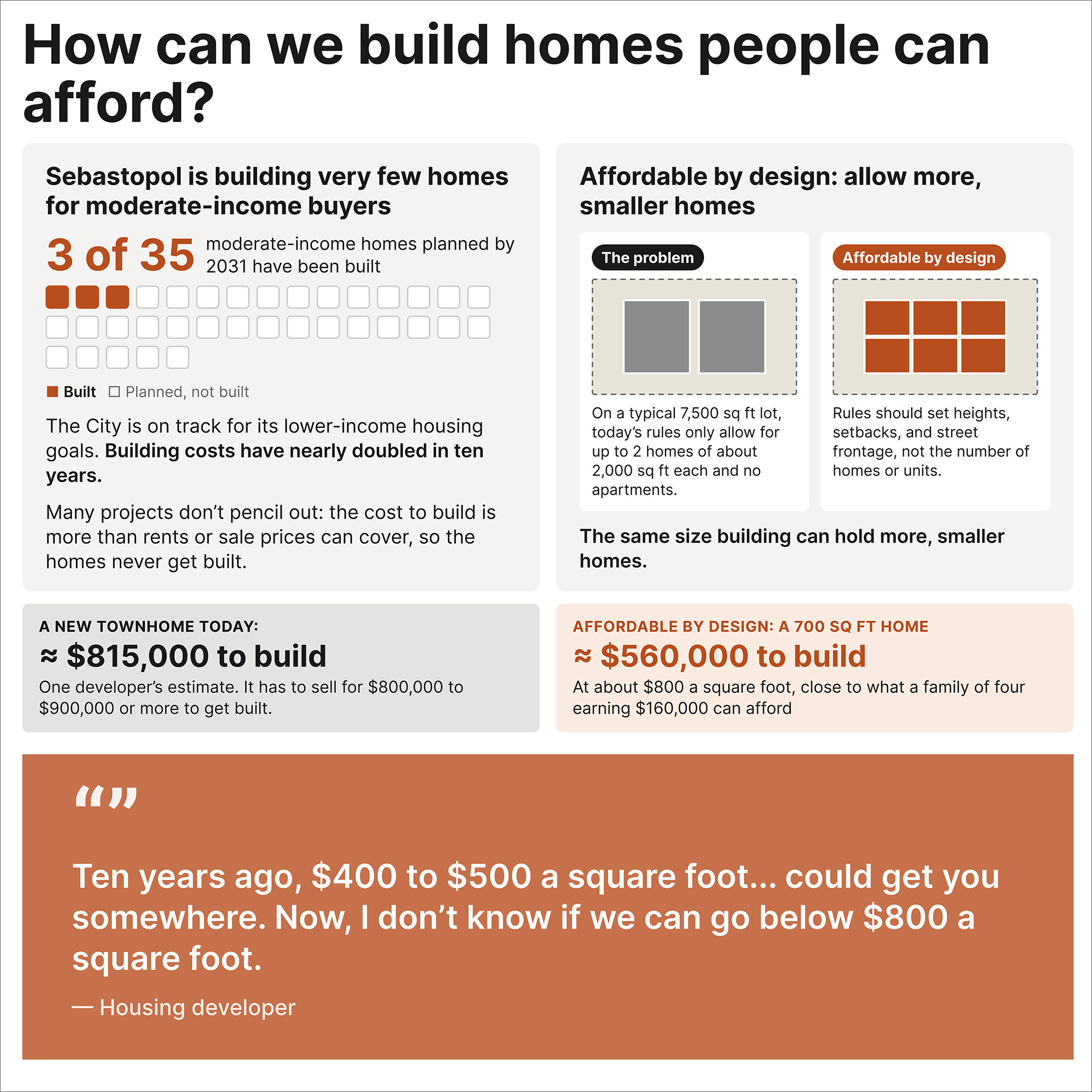
“We looked at what affordable housing means for households in Sebastopol in Sonoma County. A household with an income of about $160,000 a year with four people is considered a moderate-income household. A household with that income level can afford a home sale price of about $540,000, or a rental rate of about $3,700 a month. A low-income household in Sonoma County is defined as a household with an income of $132,000 per year. That’s for a four-person household, and at that income level, a household can afford a sale price of about $440,000, or $3,000 a month.”
She also noted that most homes in Sebastopol are out of reach for this demographic.
“New townhomes in Sebastopol, at least from one of the comps we were looking at, are starting at higher sale prices than what would be affordable to either a low or a moderate-income household, and are actually starting at a level that’s higher than what a household at 150% of AMI can afford.”
What can be done?
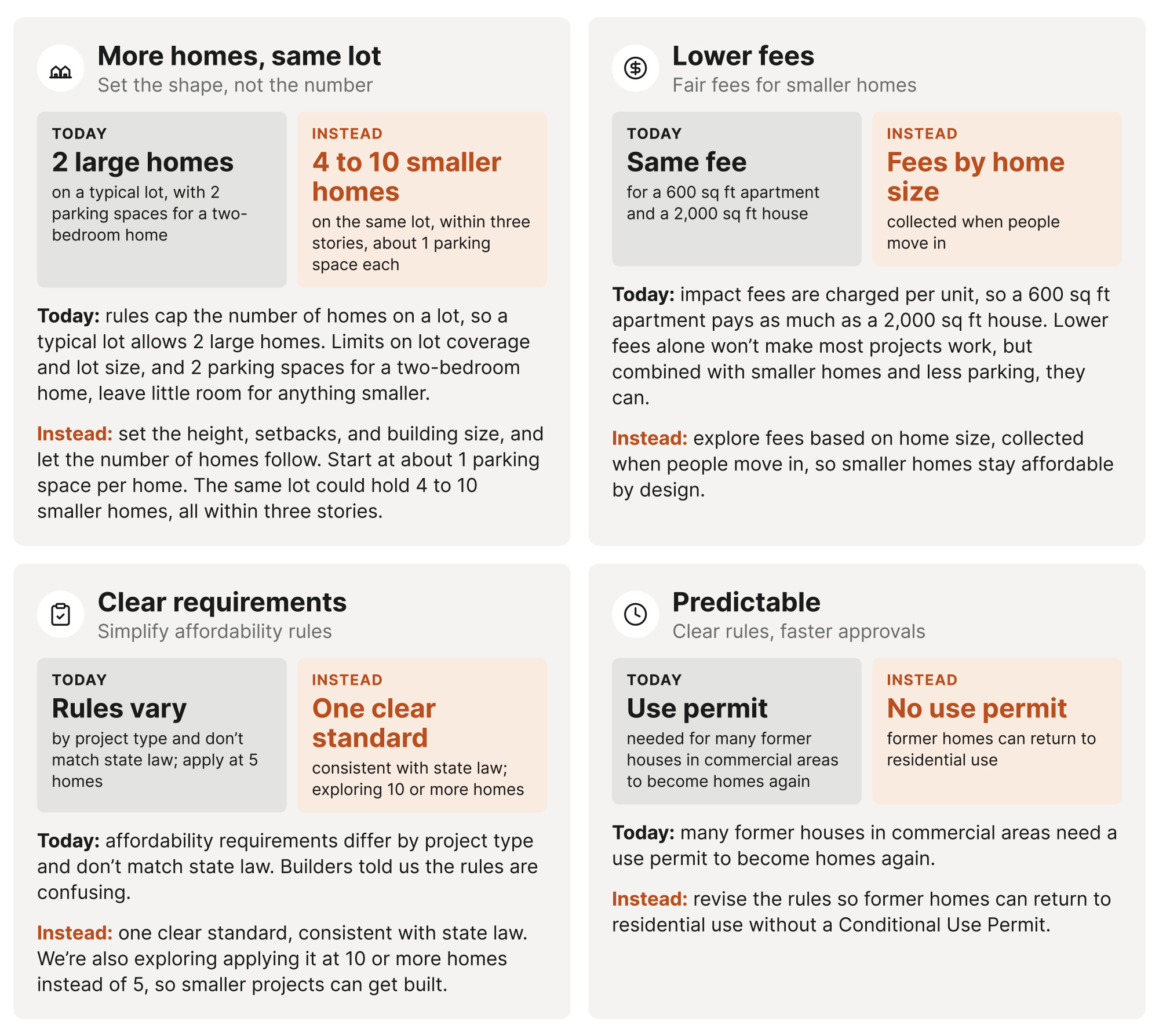
The Sebastopol Growing Together team has several suggestions about how to make homes more affordable in Sebastopol: these include more homes on single lots, smaller homes of various types, and reduced parking requirements. Many of these changes can be addressed through zoning amendments, which is one of the main focuses of the Sebastopol Growing Together project. Other suggested changes include lower fees for smaller homes, a predictable permitting process and faster approval times to make building in Sebastopol more attractive and less expensive.
Responses ranged from hopeful to skeptical
So what did some of Monday night’s participants think of the project?
Steve Pierce saw some things he liked. “Allowing smaller units, allowing conversions from commercial to residential where appropriate, all makes sense,” he said. But he drew the line when it came to lowering parking requirements. “Reducing parking requirements—people will still have cars; the consultants acknowledge that—so you’re just pushing the problem out to the surrounding residents, the commercial areas, and their customers.”
Pierce was also concerned about the influence of developers on the project—one in particular. “I’m a bit concerned that Gallaher was at the stakeholder meeting. It’s hard to see how Gallaher is a Sebastopol stakeholder—with the history around the fire evacuation, suing the cities of Santa Rosa and Windsor to rescind their electrification requirements, putting in a million dollars to defeat the SMART train.” Pierce wondered why Gallaher should have any say about what happens in Sebastopol.
Barbara Deedler and Michelle Kelly were worried about the effect that increasing housing density would have on the feel of the town.
“It feels like you’re building a warren,” Deedler said. “Like, is it going to be too tight? Does Sebastopol have to be so compact?”
Michelle Kelly was sympathetic to the idea of workforce housing, but worried about the heritage trees that would be lost to development and the possibility of ending up with an apartment complex towering above her backyard. She wondered if there was a way to increase housing and “still have a backyard next to a backyard and not a four-story apartment block.”
Councilmember Phill Carter liked what he saw on Monday night.
“This is both an education and a way for me to present policy with carrots and sticks to get building costs down so that housing is built closer to downtown in a way that provides density.”
Carter, a renter who would like to own a home in Sebastopol someday, said this proposal was an improvement over the current situation for moderate-income residents. “I mean, people that are making between $160K and $200K, they don’t really have an option. They’re doing pretty well, right? But they don’t have an option to buy. So this is a way to get into this community, and they’re going to be a really good part of the community.”
See the presentation for yourself
The description above is a very brief summary of a rich and detailed project. We urge readers to check out the presentation boards themselves, which are captured in this PDF.

At the request of one of the participants at Monday night’s meeting, Urban Field Studio has also produced a 30-minute video summary of the project with Urban Field’s founder Jane Lin.
For more information on Sebastopol Growing Together, see the project website or read the Planning Commission staff report on the project. The survey will be open until Nov. 30.