

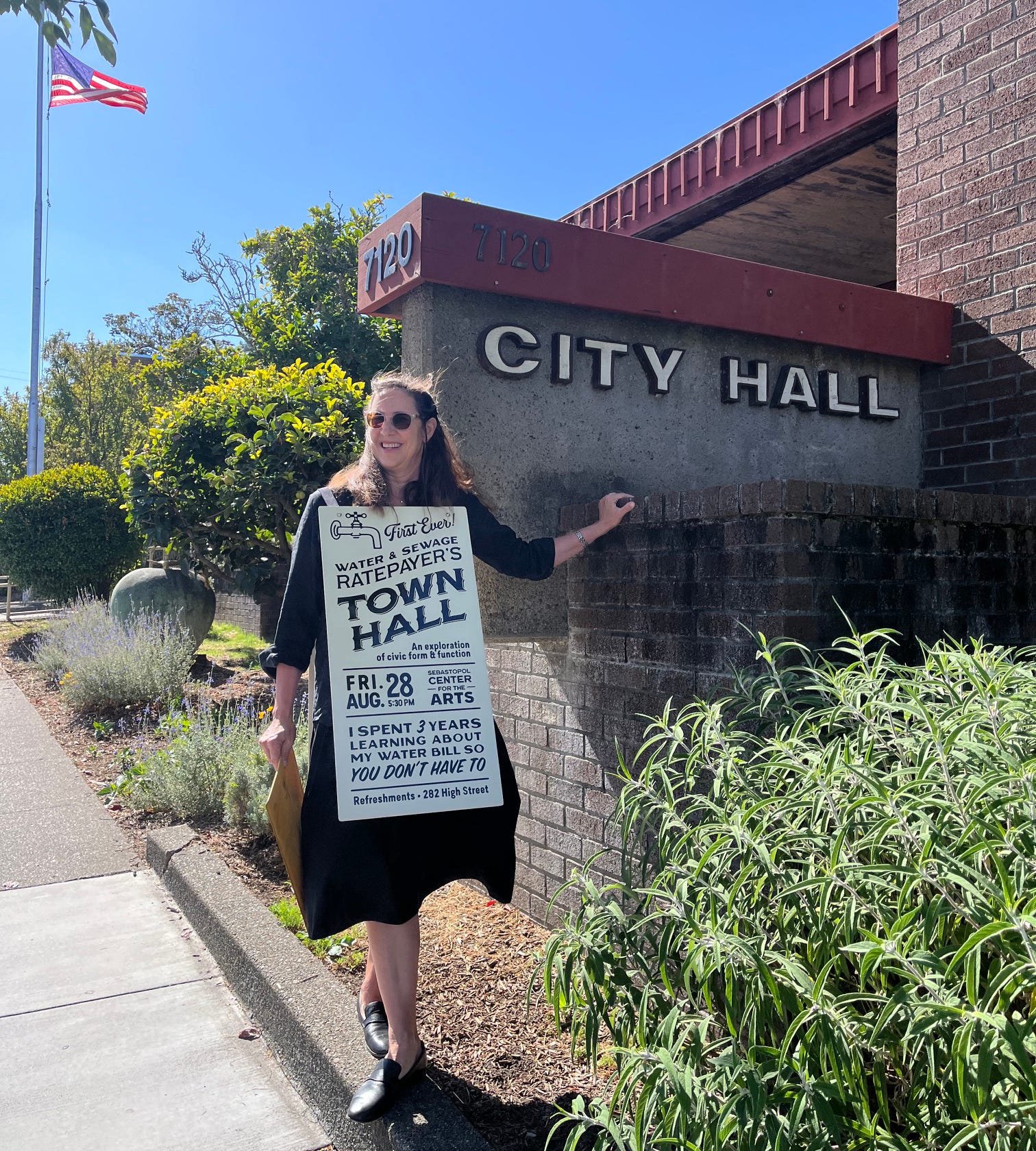
It’s hard to draw a big crowd for an hour-long disquisition on water and sewer rates, but that’s exactly what Kate Haug managed to do at the end of August, with her Ratepayer Town Hall at Sebastopol Center for the Arts. The Town Hall was the final event for her month-long exhibit at SebArts, a retrospective of her work as a conceptual artist.
The event was an interesting combination of an art history lecture followed by a detailed breakdown of how the city of Sebastopol has mishandled its water and sewer funds over the last several years—a debacle that has led to rising rates and water and sewer infrastructure badly in need of repair.
When politics becomes art
The first part of her presentation began with a reasonable observation: “You might be wondering why you’re gathered together with an artist to discuss your town’s water and sewer administration. Here are some reasons: artists are not politicians trying to get votes. Artists are not employees trying to keep their jobs. Artists are comfortable with dead ends. Artists create new objects, experiences, situations, and representations. Artists change the framing of ideas, traditions, and practices, generating new perspectives. Artists see connections that might otherwise be hidden and articulate them in their artwork.”
She also mentioned that she was a member of the city’s Enterprise Funds Oversight Committee (EFOC), but noted that this Town Hall performance was not a part of her work with the EFOC or condoned by the city.
Kicking off on a heady note, she quoted performance artist Alan Kaprow’s description of art-like art and life-like art:
“The root message of all art-like art is separateness and specialness, and the corresponding one of life-like art is connectedness and wide-angle awareness. Art-like art sends a message on a one-way street from the artist to us. Life-like art’s message is sent on a feedback loop from the artist to us, including machines, animals, nature, and around to the artist. You can’t ‘talk back’ and thus change an art-like artwork. The ‘conversation’ is the very means of lifelike art, which is always changing.”
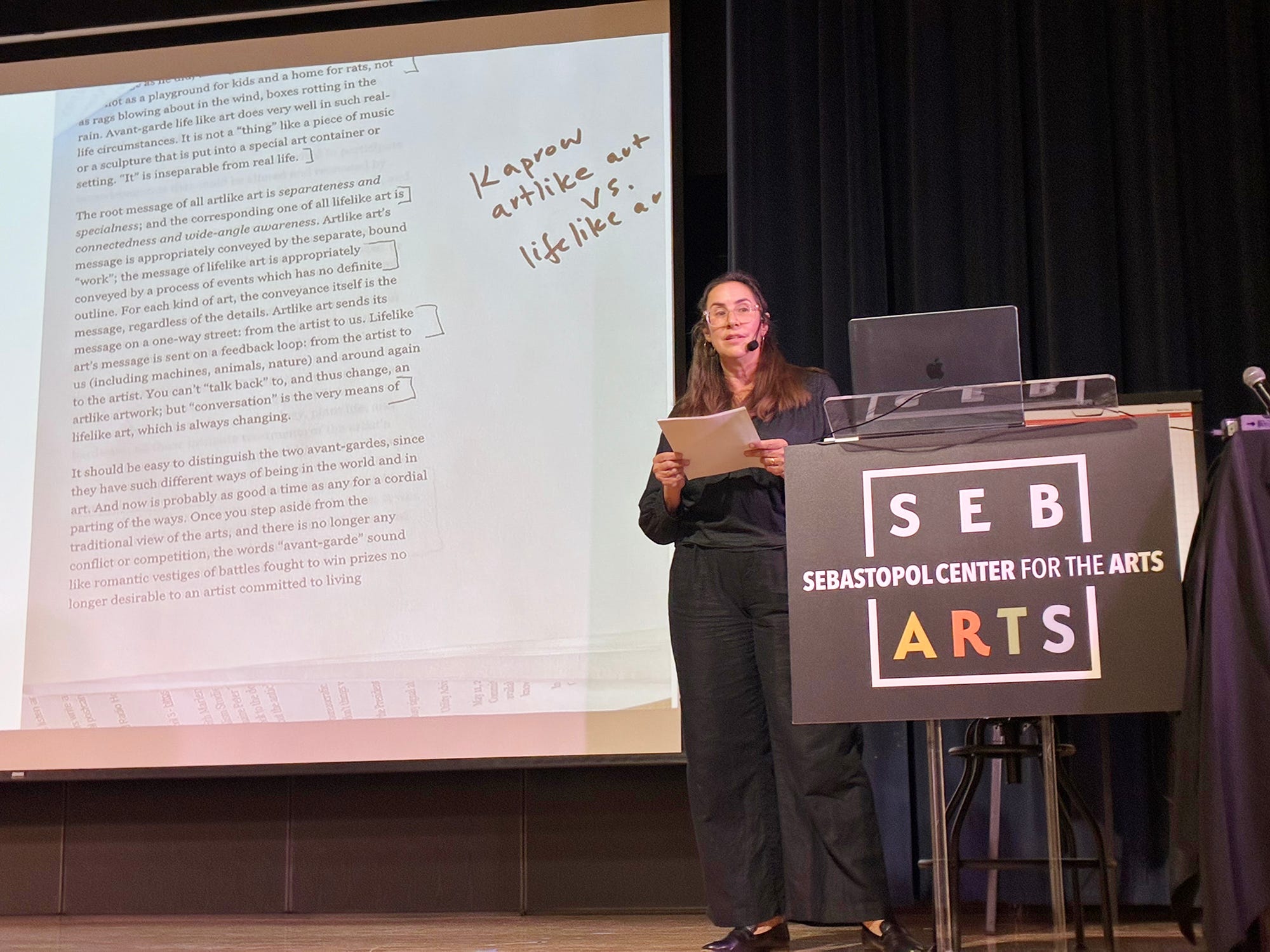
“Lifelike art is what will transpire tonight,” she said, “ and what I’ve been embarking on with Ratepayer Town Hall is more like Reality TV than a museum piece.”
As examples of artists stepping into politics—or making politics their medium—Kaug mentioned her own work “We hold democracy together,” in which she hired a plane to send a message of unity into the skies above New York City the day after the election of Donald Trump in 2024.

She said she was also inspired by the work of Susannah Dakin, who ran for president as an artist in 1984, with the slogan, “The nation is the artwork; we are the artists” and the work of Lowell Darling, who among other things, ran for governor of California in 1978 to 2010. (No, Haug isn’t planning to run for office any time soon.)
A third inspiration she mentioned was Ravio Puusemp, a conceptual artist, who ran for Mayor of Rosendale, a village in upstate New York, and won his election. “Rosendale, much like Sebastopol, was in the financial crisis and had a failing sewer system,” Haug said. “Puusemp realized the small village could not afford to fix its massive infrastructure problems on its own. He subtly guided the divided community—longtime conservative residents and newly arrived hippies—to realize that their best option was to disincorporate.”
Haug’s husband, Kurt Noble, has suggested in the past on social media that Sebastopol should disincorporate, effectively moving its financial woes from the City to the County. In her presentation, Haug did not directly endorse this idea—which would involve dissolving the Sebastopol city government.
She did suggest later in her talk that one possible solution would be to take management of water and sewer out of the hands of the city and create a separate water and sewer district.
“The question is,” she asked, “Can direct action by an artist change bureaucracy?”
Understanding the landscape
Readers of the Sebastopol Times are probably familiar with the outlines of Haug’s case against the city and its management of its water and sewer department. The Sonoma County Grand Jury released its damning report on Sebastopol’s water and sewer funds this spring, arguing that the city needs to reimburse its water and sewer funds for over $5.5 million. The EFOC’s finance subcommittee, of which Haug is part, produced its own long and detailed report soon after—the result of Haug’s three-year deep dive into the subject.
At a city council meeting on June 2, Haug was given just five minutes to explain this complex 45-page report, with its 13 detailed recommendations.
Like many political revolutions in America, Haug’s began with her pocketbook.
“The council’s proposed rate increases in 2023 were excessive in my mind,” she said. “Water and sewer rates had risen dramatically over the last 15 years. Why? Water prices rose 240 percent, even though the cost of water—zero— had remained the same.” She noted that Sebastopol sits on a large aquifer, and that Sebastopol, unlike some other cities, doesn’t have to purchase water from elsewhere.
“All rate increases were based on increased funding for capital improvements,” she said. “Yet there was no evidence of significant capital improvements. The radical increase in rates for water, which the city received for free, made me suspicious.”
Haug’s first task on Friday night was to get everyone in her audience up to speed about how the system works.
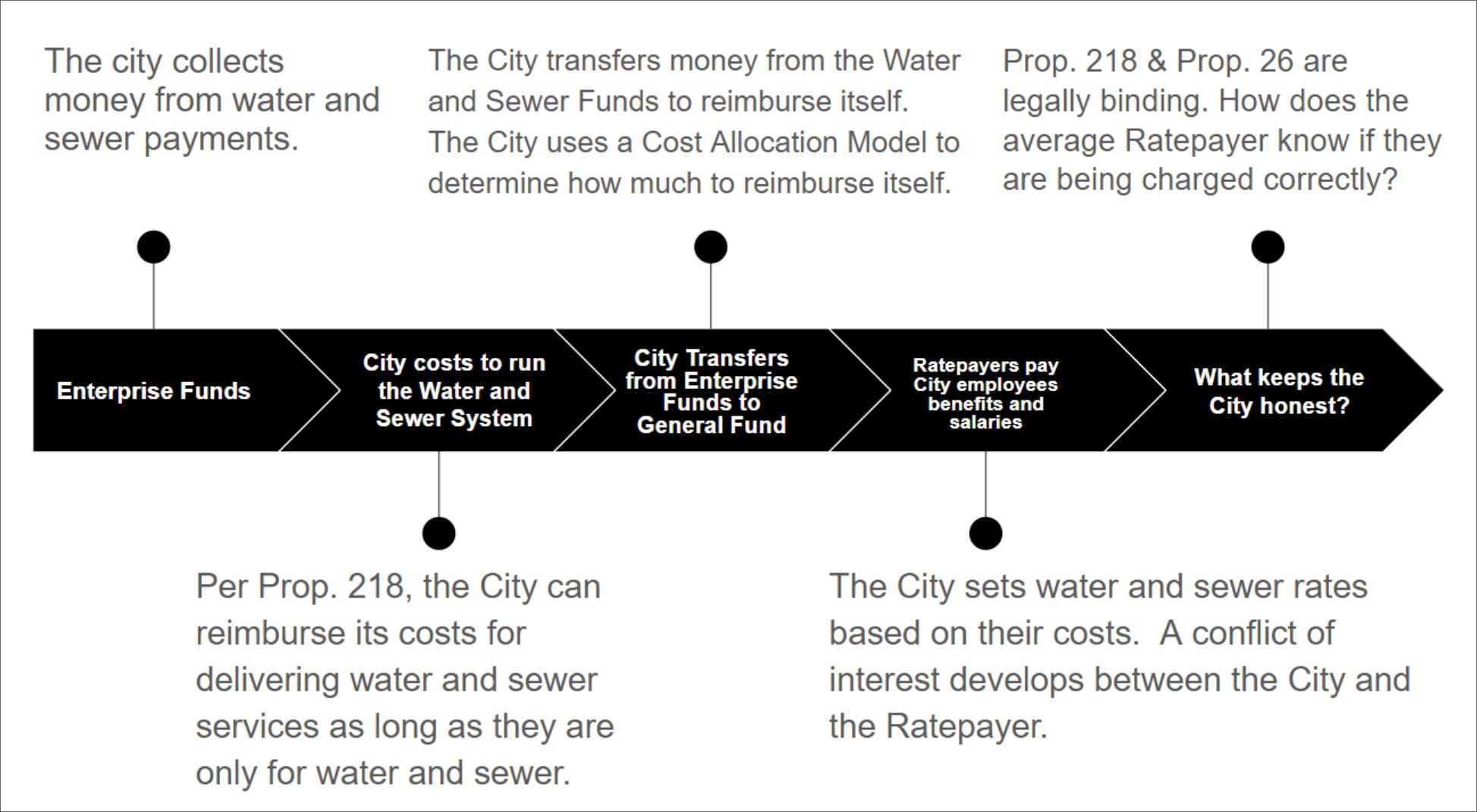
The money paid by Sebastopol’s water and sewer customers goes into the city of Sebastopol’s Water and Sewer Funds. These are called Enterprise Funds because they operate like a private business within the government, relying on user fees for service instead of general tax dollars. Unlike a private business, however, they are not allowed to charge more than it costs to deliver water and sewer to the ratepayers.
The money in the city’s Enterprise Funds is kept separate from the city’s General Fund, which relies on a combination of sales taxes (39%), property taxes (24%) and a variety of smaller taxes and fees and other things (37%).
The only chink in this wall of separation is that the city is allowed to charge its Enterprise Funds for the cost of city services—like billing, administration, legal and public works—required to run the city’s water and sewer system. The amount of that cost is determined by a Cost Allocation Plan. This Cost Allocation Plan is in turn incorporated into a Water and Sewer Rate study that determines how much ratepayers are charged.
And this, according to Haug and the Grand Jury, is where the city of Sebastopol got into trouble.
Sebastopol’s Cost Allocation Plan, which was supposed to be updated every 3-5 years, hadn’t been updated in 25 years.
Haug acknowledged that the passage of Proposition 13 in 1978 meant that cities around the state, particularly small towns, are perennially strapped for cash—and that the constant unfunded mandates being handed down from the state and federal government exacerbate this problem.
The creators of Proposition 13 realized that it would be tempting for financially strapped cities to raid their Enterprise Funds by having a Cost Allocation Plan that overestimates how much it costs to run their water and sewer systems.
To prevent this, the same people who brought you Proposition 13 also brought you Prop. 218 in 1996, which mandates that local water and sewer rate increases cannot exceed the cost of providing services. It also prohibits cities from using Enterprise Fund revenue for general government use. This was followed in 2010 with Prop. 26, which redefined many local fees and charges as taxes and reiterated that charges for service should not exceed the cost of delivering those services.
Haug summarized this situation like so:
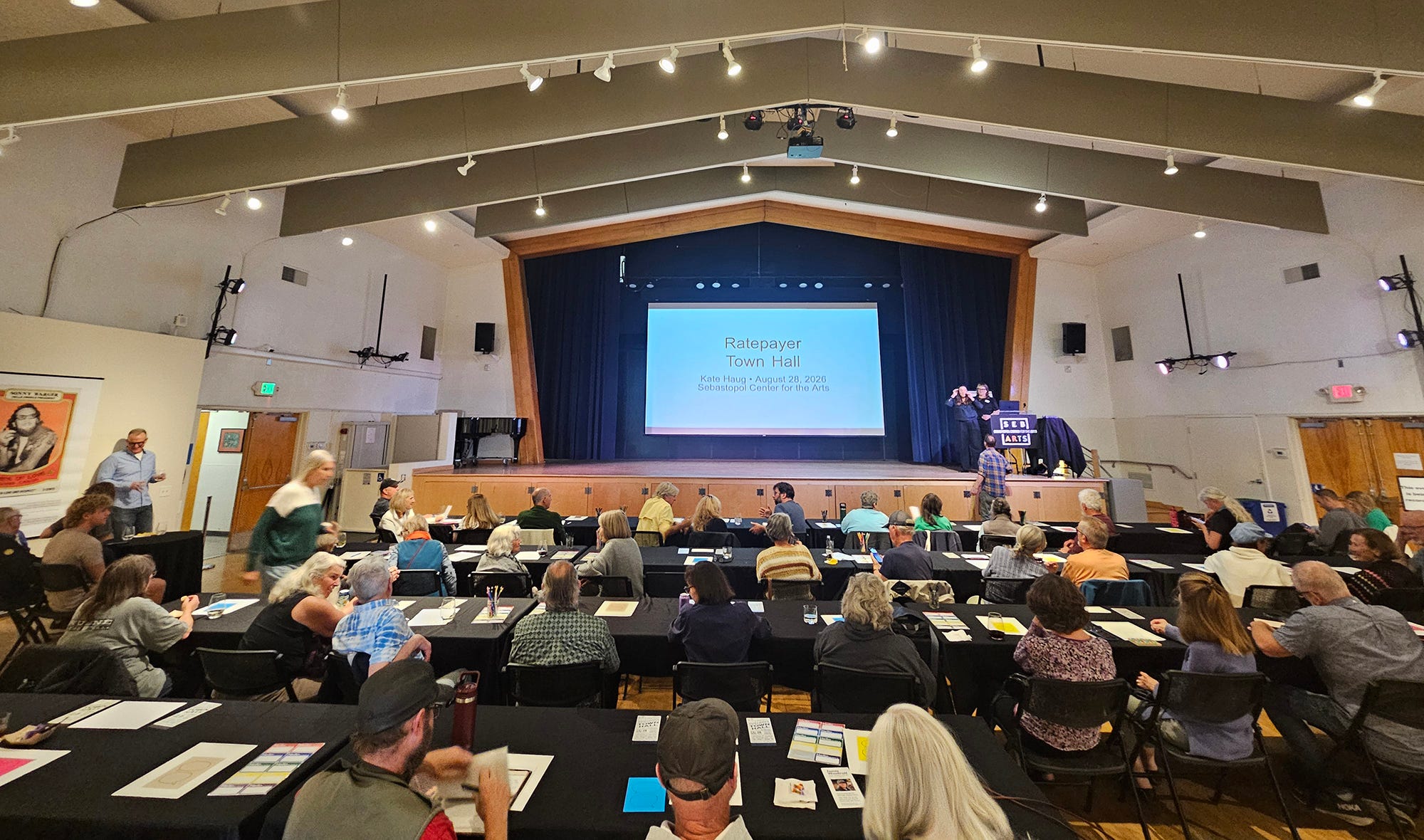
Like the professor she once was, Haug then gave the audience a couple of exercises to reinforce their understanding of these concepts.
What she found
In her investigations, Haug identified a number of irregularities, many of which will be familiar to Sebastopol Times readers from previous stories.
Although the number of water and sewer connections and services provided remained consistent, there was a dramatic increase in Cost Allocation expenses from 2014 to 2019:
Total Allocation Costs for Water in 2014 were $609,619, which jumped to $1,013,422 in 2019 — an increase of 66%.
Total Allocation Costs for Sewer in 2014 were $476,690, which jumped to $837,433 in 2019 — a 75% increase.
FINANCIAL/ADMINISTRATIVE SERVICES for Water and Sewer tripled over nine years, going from $306,248 in 2015 to $944,971 in 2024, despite the fact that the number of accounts remained stable. (Though she didn’t mention in her lecture, the reason for this increase was that the old cost allocation was based in part on a percentage of expenses, and as the Finance Department added employees, the cost allocation increased accordingly, even though the number of people needed to serve water and sewer ratepayers stayed the same.)
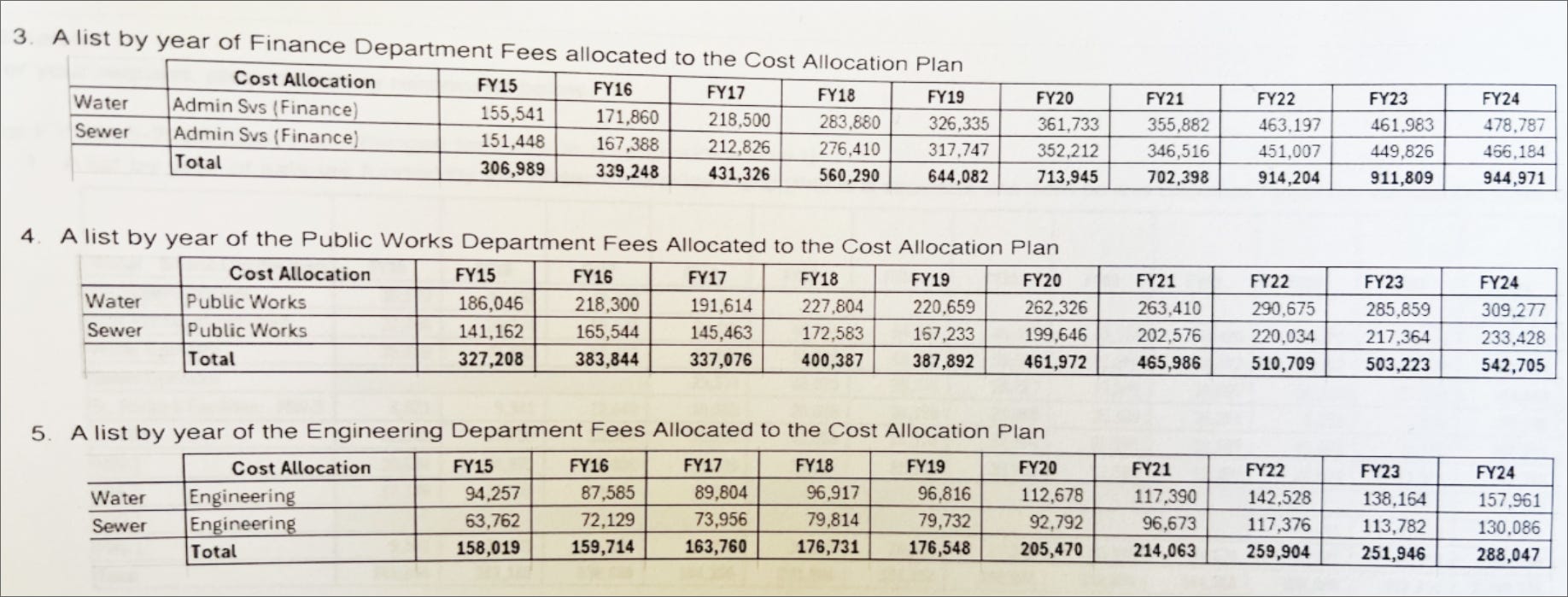
LEGAL EXPENSES: Ratepayers were charged $184,587 for legal fees in FY 24/25, while records show that only $13,850 were actually billed by attorneys — an overcharge of $170,737. For FY 25/26, $189,263 was charged, but city records show attorneys only billed $9,651.50 in billing. Haug noted that, under pressure, the council switched legal costs to direct billing rather than cost allocation this summer.
CITY MANAGER AND CITY COUNCIL: A new cost allocation plan, approved by the city council this year, continues what Haug views as the overcharging for City Manager and City Council oversight.
THE SYSERCO LOAN. The Council took out a $5,000,000 loan for SmartMeters for all ratepayers in the city in 2021, under the impression that it would save money in the end. Haug contends that the money would have been better spent fixing water and sewer’s ailing infrastructure. She would like to shift the burden of repaying this loan from the Water and Sewer funds to the city’s General Fund.
These revelations had a powerful effect on her audience. Throughout her presentation, the hall was filled with gasps of shock, surprise and angry muttering.
It was a tour de force performance.
Haug wrapped up by noting that the EFOC had made 16 recommendations to the council but that they had only acted on one so far. She asked, “Why did the Council only use 1/16 of the EFOC’s recommendations and what does that do? If you attempt to build a table and only follow 1 out of 16 steps, do you have a table?”
Looking back at the EFOC’s recommendations from Haug’s report at the June 2 city council meeting, this seems to overstate the case. Her original report had just 13 recommendations, of which five have been finished or started:
Remove tiered water pricing and do not raise water prices (DONE)
Recommended that all financial decisions [related to water and sewer] be presented to Enterprise Oversight Committee prior to council and that Enterprise Oversight members represent ratepayers in council meetings. (DONE)
Implement Time Tracking Software for Employees to Record Time (IN THE WORKS)
Refund Enterprise Funds $350,354 for excessive Attorney Fees for 24/25 and 25/26. (DONE)
Recommended forgiveness of the $1.2M Sewer Enterprise “loan” to the General Fund. (DONE)
“In my talk, I was giving that as an example of instructions that have multiple steps to complete a functioning object,” Haug wrote to the Sebastopol Times after the event. “I should have maybe been more specific to my recommendations.”
Haug admits she’s impatient with the pace of change in the city.
“The City has a tendency to slot items into the CIP [Capital Improvement Plan] and never complete them,” she wrote. “That’s why there is such a backlog on infrastructure. Roads and sidewalks are other examples. How long has the ADA pathway in Ives been discussed? Four years? Five years? And that's a pretty straightforward project that requires much less capital than water and sewer items.”
She had some practical next steps for her audience:
Attend council meetings, speak in public comment and say you want the Council to adopt the EFOC recommendations, including the CAP reforms and the Syserco Loan transfer.
Let the Council know that if they don’t spend 50% of the meeting talking about Water and Sewer, they are in Prop. 218 violation. You can do this every meeting.
Make sure City Council candidates know about this issue. What is their position? It is a serious issue impacting affordability and public safety.
She also invited interested citizens to attend EFOC and city council meetings.
But the real kicker of the evening was this series of questions:
Does our civil bureaucracy feel like democracy in action?
Do you have more or less trust in your local government? Why?
Does our bureaucratic form fulfill its democratic function?
Do you think government is working for your basic needs? Is that important?
Does our local system work?
Do you think it is odd that you’re getting this information from a conceptual artist?
Everyone laughed at that last line.
Haug closed with a video of Kyle Falbo’s amazing performance as “a humble pirate of the municipal seas” from the June 2 Sebastopol City Council meeting. This is both one of my favorite and least favorite city council performances I’ve seen in 40 years of reporting. Favorite because it was funny and audacious—he even handed out pirate hats to the council members. Least favorite because, in this soliloquy, he suggests (in full pirate brogue) that city staff and members of the city council saw their opportunity, then planned and carried out a purposeful theft of public resources.
Even Kate Haug did not suggest that. When someone in the audience asked who was “lining their pockets” with these misallocated funds, Haug demurred.
“I think this is a case of ignorance is bliss,” she said. “As I said before, the council members are not trained in Prop 218. They’re not trained in Prop 26…I don’t think there’s like a nefarious conspiracy. I think there was just an unawareness of how much it had escalated.”
What the listeners thought
After Haug wrapped up her presentation, the room was abuzz with conversation.
Carly Quaglio said, “I think it’s surprising in the ways that, wow, the mismanagement just runs so much deeper than I thought. I don’t think it’s malicious. Like I don’t think anybody on the city council is intentionally doing this. I think it’s just incompetence, lack of resources to dedicate to fixing anything. But I think the impacts are the same. Like, this isn’t good for the city. It’s not good for us as ratepayers. I’m sympathetic because Prop 13 really limits our ability to raise revenue. I was shocked to see that 19 cents of every dollar is all the city gets [from property taxes]. So I just feel like we’re in this crunch of our own making, and I don’t know what the solution is.”
George Noel said he really admired the work Haug put into this project. “It was most informative…and I hope the council actually pays attention to what she’s trying to say.”
Sue Corbaley said she hoped people would follow Haug’s recommendation to start attending city council meetings and paying attention to what is happening in the city.
“What really surprised me was the surprise in people’s comments about what they were hearing for possibly the first time, and I do think that Kate’s advice that people start to attend city council meetings and provide comment to our council is well worth following.”
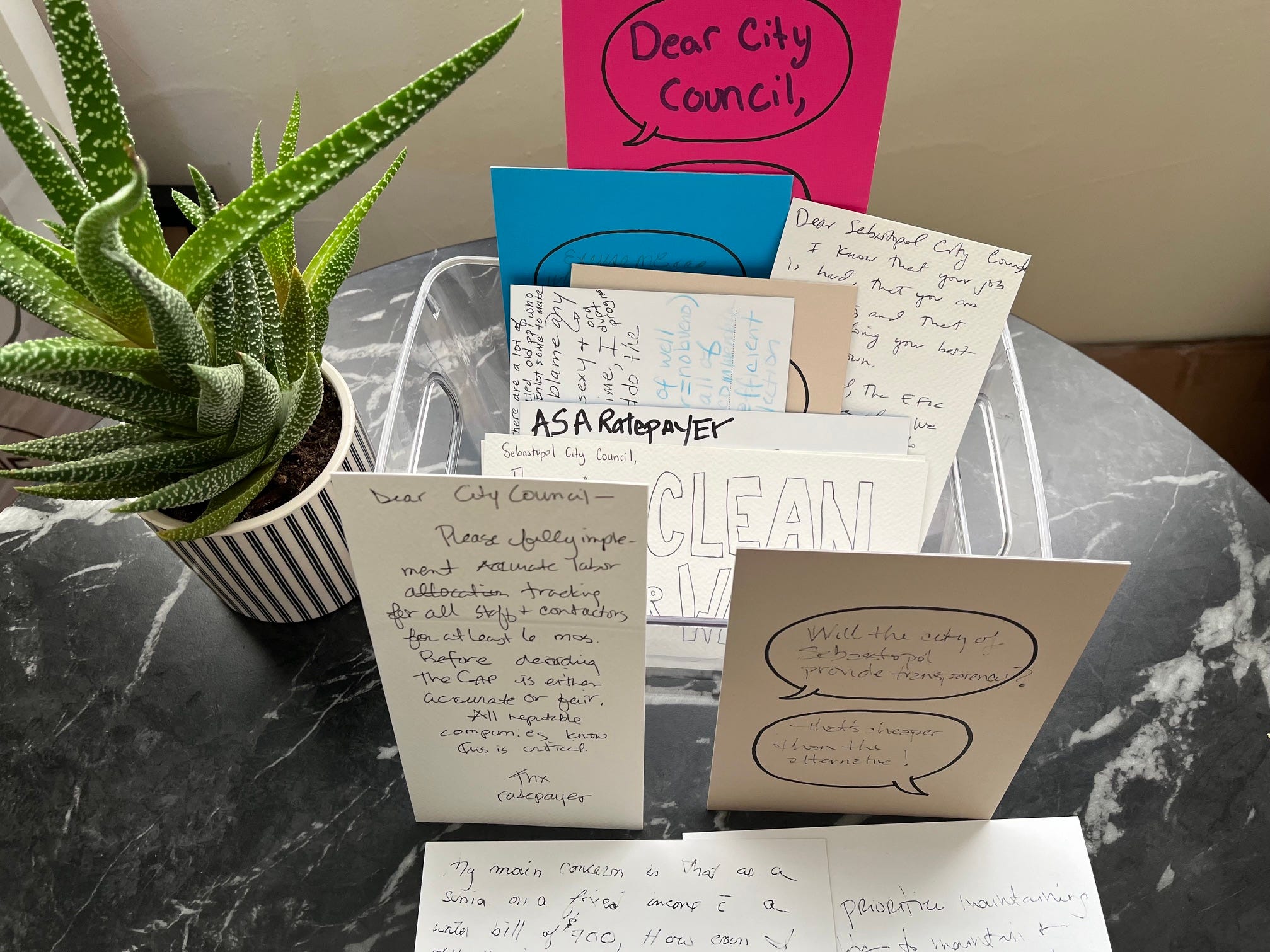
I appreciate the kind words about the performance, even if I disagree with the interpretation.
Kate may very well be right that “ignorance is bliss” and that there was no nefarious conspiracy. My point was not that anyone was personally lining their pockets. The piracy was a metaphor for what happened to ratepayer funds.
But ignorance is not much of a defense when laws and public money are involved. We generally do not accept “I didn’t know” as an answer when someone violates the law, and I’m not sure why we should expect less accountability from governmental institutions with decades of experience managing public funds.
Whether these decisions resulted from malice, negligence, institutional inertia, or a failure to understand the law is an important distinction when judging the people involved. It does not change the need to identify what happened, correct it, reconcile the past, and put controls in place so it does not happen again.
That was ultimately the point beneath the pirate hat.
Yes, great article. And her work makes me so happy. Having vision can be used in many ways and it's beautiful when they intertwine in non-typical ways.
The one thing I still want to see are names. Who is responsible for this? It's not about blame but it matters tremendously with an election coming up. Who made these decisions? Do they have connections to current candidates? Why is there such a lack of personal accountability - are we just being polite?