

On July 30, 2026, the Woodside Fire ignited along Highway 1 near Salt Point State Park and Timber Cove. Compared to some of Sonoma County’s recent fires, this fire burned relatively few acres, at only 152 acres, destroyed only four structures, and was 100% contained by August 8, 2026.
However, because of smoke and wind conditions, within the first two days after ignition, the fire didn’t have to be large to cost one local award-winning winery its harvest. Halleck Vineyard was forced to drop the fruit from its one-acre estate vineyard after the sitting smoke raised concerns about taint—a risk that can threaten not only a vintage but also a producer’s reputation.
“We dropped all the fruit,” said owner Ross Halleck, estimating the loss at about a ton. Halleck said the winery would make white wines but no red wines from the estate vineyard for the 2026 vintage, following the heavy smoke that hung over their estate vineyard after the fire.
The decision stemmed from the winery’s positioning as a luxury brand. “If there’s smoke indicated, you know, we think of ourselves as a luxury brand,” says Halleck. “There’s nothing that would betray that trust more than going, ‘Well, let’s keep our fingers crossed.”
Despite the Woodside fire being relatively small, a tremendous amount of smoke was blown into Sebastopol when the grapes were nearing peak ripeness, a very sensitive point in the growing season.
“So you’ve got to understand it had to do with the timing, of course. We were right near fruition. So we were through veraison, and we were coming to the peak of fruition, and these grapes are living things. You know they’re respiring, so they’re taking in carbon dioxide, and they’re exuding oxygen, and if what they’re taking in is polluted, they’re taking that in too, and it taints the fruit,” Halleck said.
The result is a difficult judgment for growers and winemakers: whether to trust smoke taint tests, take a gamble on the crop, or drop the fruit.
“The ingredients that contribute to smoke taint are not entirely known, and then when you have a wine that you make that was ostensibly tainted, you could open it up in a year or two, and it could be perfectly good, and then you could open it up six months later, and it could taste like you’re licking the inside of an ashtray,” Halleck said.
That unpredictability led them to drop the estate fruit to protect its high standards, rather than gamble on what the wine could become. Ross also stressed that smoke taint is not necessarily a desirable characteristic in wine, as it may be in some cuisine or spirits such as Mezcal and Bourbon.
A small estate vineyard, a broader supply network
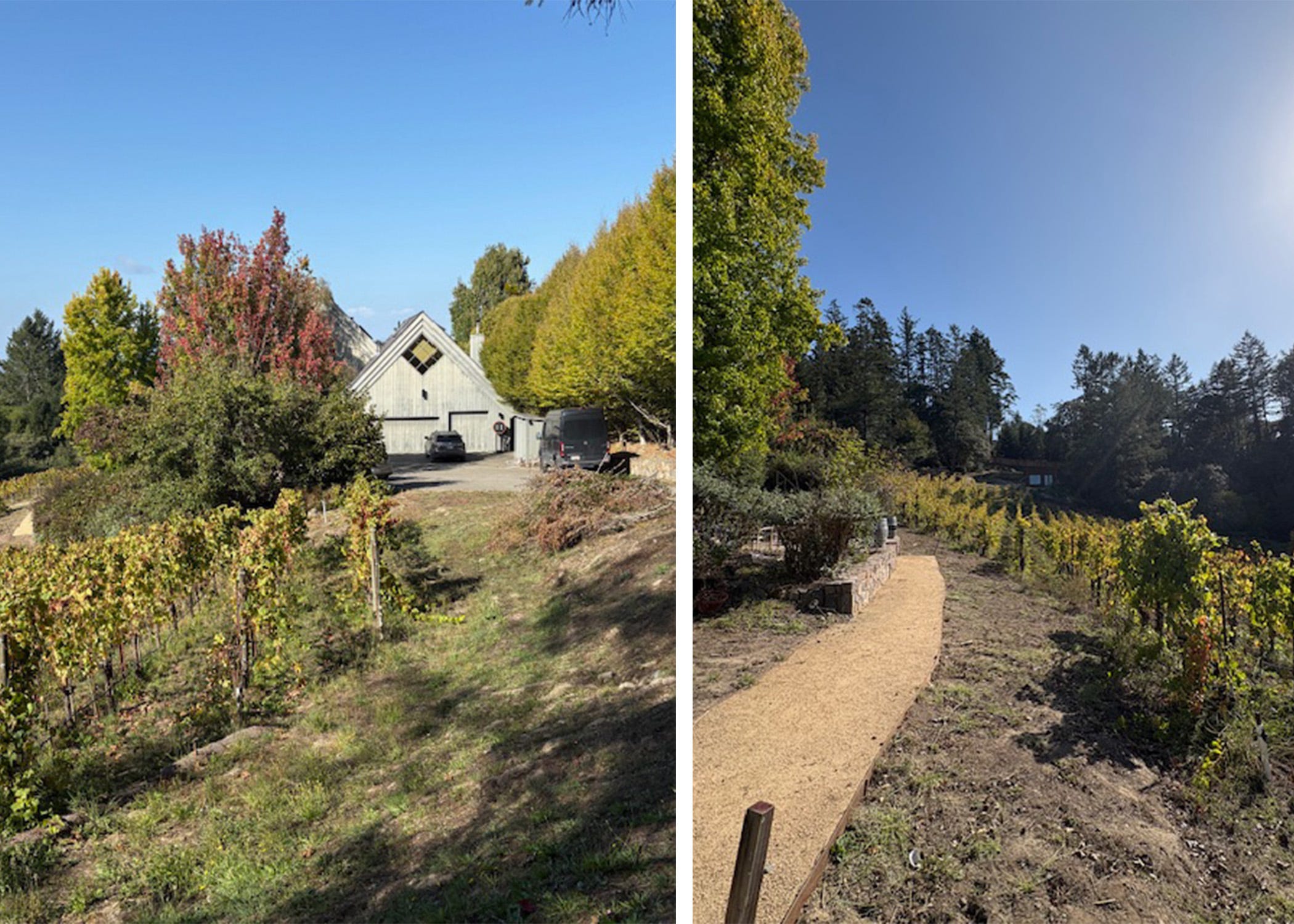
Halleck Vineyard estate covers roughly one acre and sits above the Russian River watershed, flanked on the west by the slopes of the Pacific Ocean. Its yield varies widely: it has produced as many as 150 cases in some years, said Ross, while producing next to nothing in others. This is the third time in about 25 years the vineyard has lost a crop.
The earlier losses had different causes. In 2005, a wet season led to mold before the grapes could be picked.
“So in 2005, God, it was just a wet—a very, very wet—season. It never warmed up all through the summer, and the ground never dried up. There was rain in the middle of the season, and when the grapes were ready to pick, we called it. By the time we went there to pick, it was all moldy. So we cried.”
This year, smoke was the concern, but both events point to a range of conditions that can undo a harvest, even for a small vineyard.
While Halleck has its own small estate vineyard, it has roughly 20 acres under contract with other vineyards and makes about 2,500 cases per year. Like many other small local wineries and producers, broader sourcing gives the team other options.
“We can just buy more fruit to fill in the gaps,” Halleck said.
For less well-capitalized vineyards and wineries, of course, this is not an option—and the financial losses can be devastating.

Halleck Vineyard plans to manage the missing estate vintage by adjusting releases and drawing on other fruit from its contracts. Its current releases are from 2022 and earlier, and it typically holds its reds for three or four years before release. That schedule provides some flexibility; sadly, the estate crop will be absent from the 2026 lineup.
Fortunately, Hallack, like many other Sonoma County wineries, produces four other varietals—a Sauvignon Blanc, a Chardonnay, and a Dry Gewurztraminer as its white wines—in addition to its three small-production Pinot Noirs.
Halleck said the fruit drop is more of an emotional setback than a financial crisis. Sourcing non-estate fruit cannot replace the fruit it chose not to harvest. It is a loss of a crop and a piece of the vineyard and winery’s story.
Halleck’s business model centers on direct relationships. It does not sell through retail stores, and about 20-25% of the wine goes to high-end restaurants and private clubs. The winery also serves wine club members and hosts visitors by appointment only.
Halleck said the winery relies on its reputation, reviews, and word of mouth rather than traditional advertising and retail distribution. This makes a questionable vintage a particular risk. Releasing wine that later develops an unwanted character could damage the relationships the winery worked so hard to build. Dropping the fruit means accepting an immediate loss to avoid that possibility.
Winemaking, after all, is agriculture. Weather, smoke, and other conditions can affect the harvest in hard-to-control ways, and a decision made in the vineyard may shape wines released years later.
The Woodside fire may have burned relatively little acreage, but smoke reached the Halleck estate vineyard at a consequential point in the 2026 growing season. The winery’s response illustrates how a fire can affect a vintage without destroying any vines; sometimes the harvest is lost not to flames but to the risk of a damaged reputation and the possibility that the resulting wine will no longer meet the high standards customers expect.
Learn more about Halleck Vineyard at halleckvineyard.com.

Australian science agencies and universities have developed multiple early detection and real-time monitoring tools for smoke taint in the last few decades.
They include:
* Wine Industry Smoke Detectors ("Wizards")
* Portable Biosensors
* Non-invasive Spectroscopy, and
* Metabolite Testing
Metabolite testing uses a diagnostic assay measuring glycosidic grape metabolites to assess smoke exposure levels, and has been utilized in Australia for many years now.
Wine grape growers and viernes in Australia (and also in Pacific NW, I believe) have made marketable "smokey" brandy by distilling smoke taint affected grapes and wines ...
I'm a retired research scientist totally comfortable with researching and testing some of these Australian smoke taint analytic methods here ... so I guess I might contact Hopland AG extension folks? Smoke taint is difficult, but likely to be with us for some time now. Looking ahead, wildfire risk is not going away. I'd like to help local wine grape growers adapt. Thank you :)
Thank you for this article. I’ll take reduction in fire risk to our community and care for the ecosystem any day over someone’s premium glass of wine.