


Residents of Sebastopol—and all those who walk, drive or bicycle through its downtown—still have time to weigh in on a selection of four major traffic realignments now being proposed by Fehr & Peers, the consultants the city of Sebastopol has hired to “reimagine” Sebastopol’s downtown.
Now is the time to make your opinion known on the four alternatives. The online survey for the “Reimagining the Core” project closes this Sunday, Feb. 8.
Public input matters. Community support is one of the five criteria for selecting a final plan. The other criteria include safety and comfort; access and mobility; downtown vitality and sense of place; and feasibility and cost.
The survey and the downtown core project on which it is based are being funded by a Caltrans’ Sustainable Transportation Planning Grant for $230,178. The city of Sebastopol provided a local match of $29,822, for a total of $260,000.
The goal of the project, according to the consultant’s most recent report, is “to create a vibrant Main Street that reflects Sebastopol’s unique character and community values, creates inviting public spaces where people want to linger, prioritizes safe and comfortable travel for those walking and biking, and supports thriving local businesses, while balancing the needs of local access and regional traffic circulation.”
Caltrans controls the configuration, maintenance and traffic controls of the two largest streets that run through Sebastopol’s downtown because those streets are also state highways: Highway 12 (going east and west) and Highway 116 (going north and south).
Following more than two years of planning, including two well-attended community workshops and multiple stakeholder meetings, the consultants will submit their final four alternatives to the Sebastopol Planning Commission at its meeting on Tuesday, Feb. 10. According to Planning Commission member Paul Fritz, “At the meeting next week, the commission will be making a recommendation to the city council.”
The city council will consider whether to accept that recommendation at its meeting on March 3. According to Interim City Manager Mary Gourley, “The first presentation will be March 3rd—the agenda report will include the Planning Commission’s recommendations—with the adoption scheduled for April 21st.”
That’s why it’s important to make your opinion known while you still can.
Geoff Rubendall of Fehr & Peers is one of the city’s planning and engineering consultants for the project. Referring to the survey, he said, “We’ve received over 180 votes so far. I don’t want to say too much since voting is still open, but so far I’d say it’s a pretty close 50/50 split between keeping Main Street one way and converting it to two-way.”
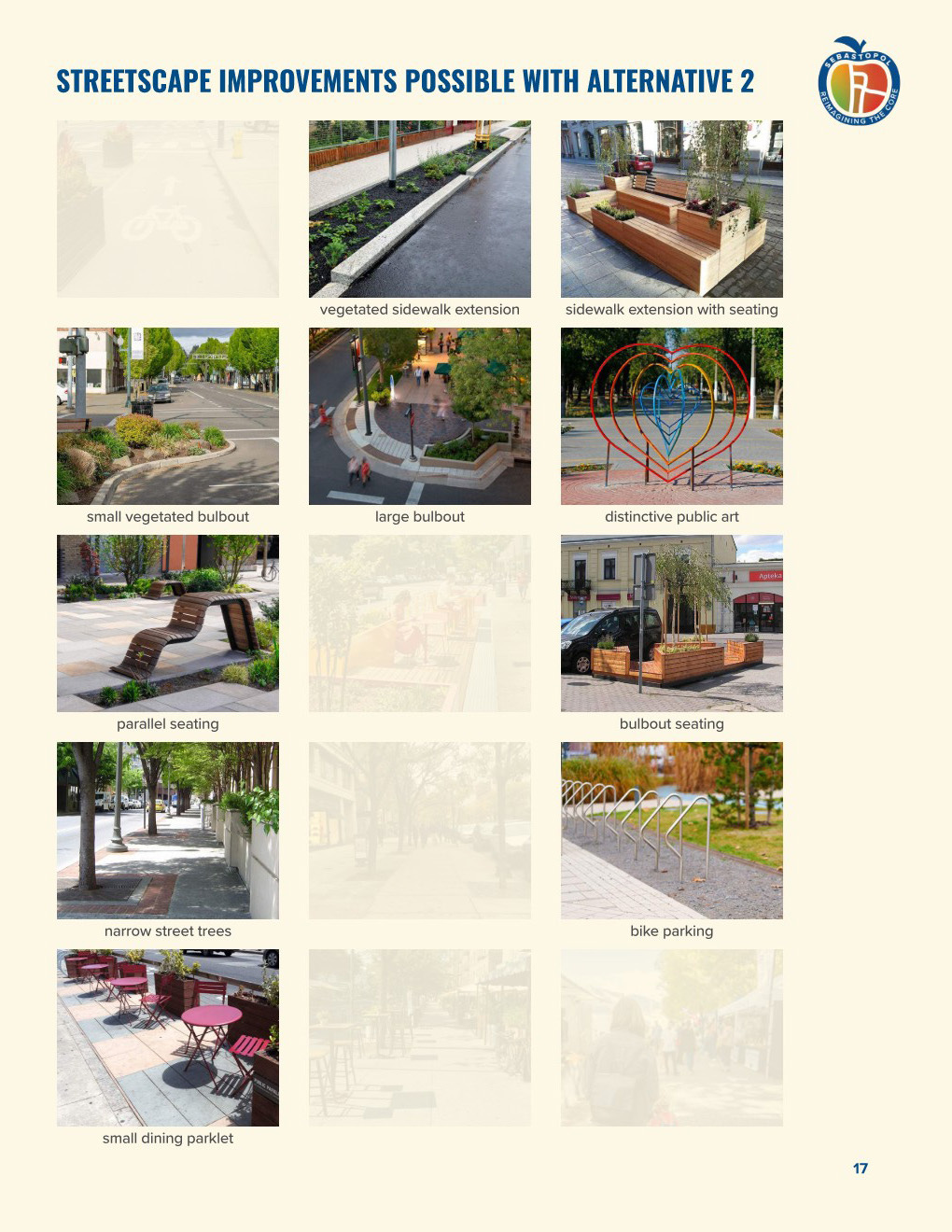
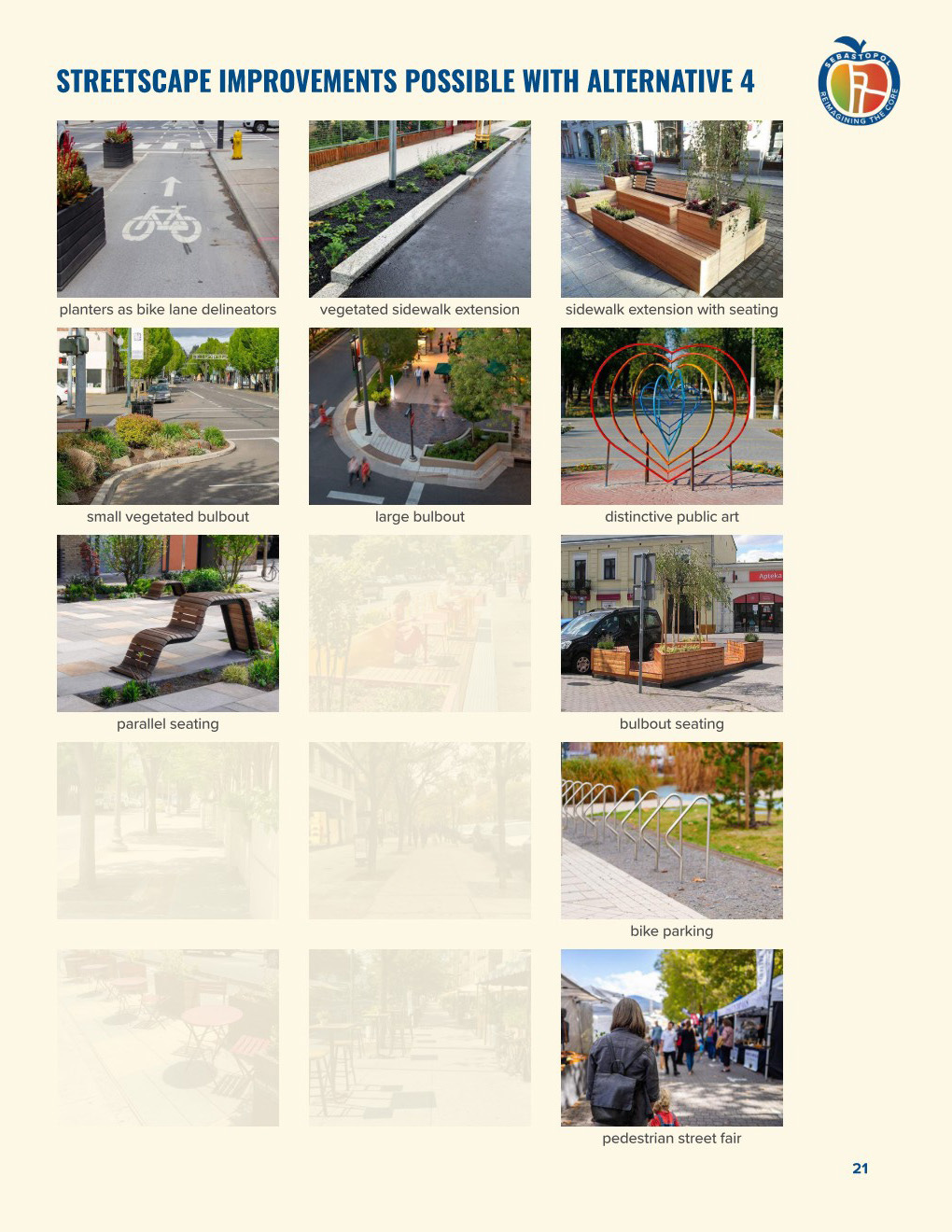
Rubendall also said the survey responses have been very supportive of the proposed pedestrian-focused improvements. All of the alternatives would add bulb-outs at several intersections; extend the Joe Rodota Trail across Petaluma Avenue to Main Street near the post office; upgrade bikeways to Class IV separated lanes; and add pedestrian and gathering space improvements to the downtown plaza. All of the alternatives provide opportunities for streetscape improvements such as street trees and seating.
The current situation
Since horse-and-buggy and electric railroad days, Sebastopol has endured a mix of traffic and transportation blessings and curses. The intersection of the two main highways has marked Sebastopol as western Sonoma County’s largest marketplace and the gateway to the Bodega coast and the Russian River region.
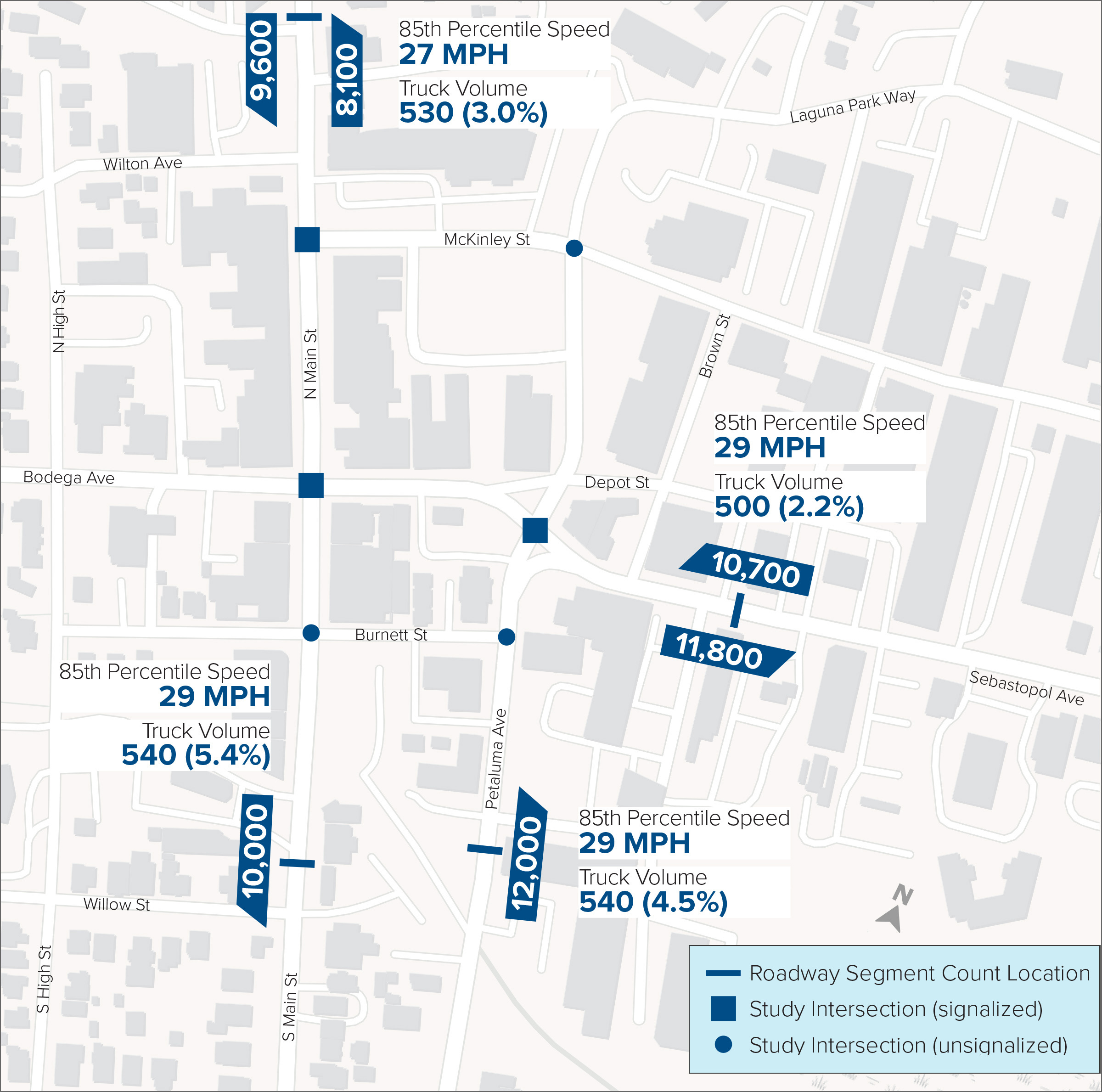
Tens of thousands of vehicles traverse State Highways 12 and 116 through town on a daily basis. Fehr & Peers collected traffic data in November 2024 and developed this image to show traffic into and out of the downtown.
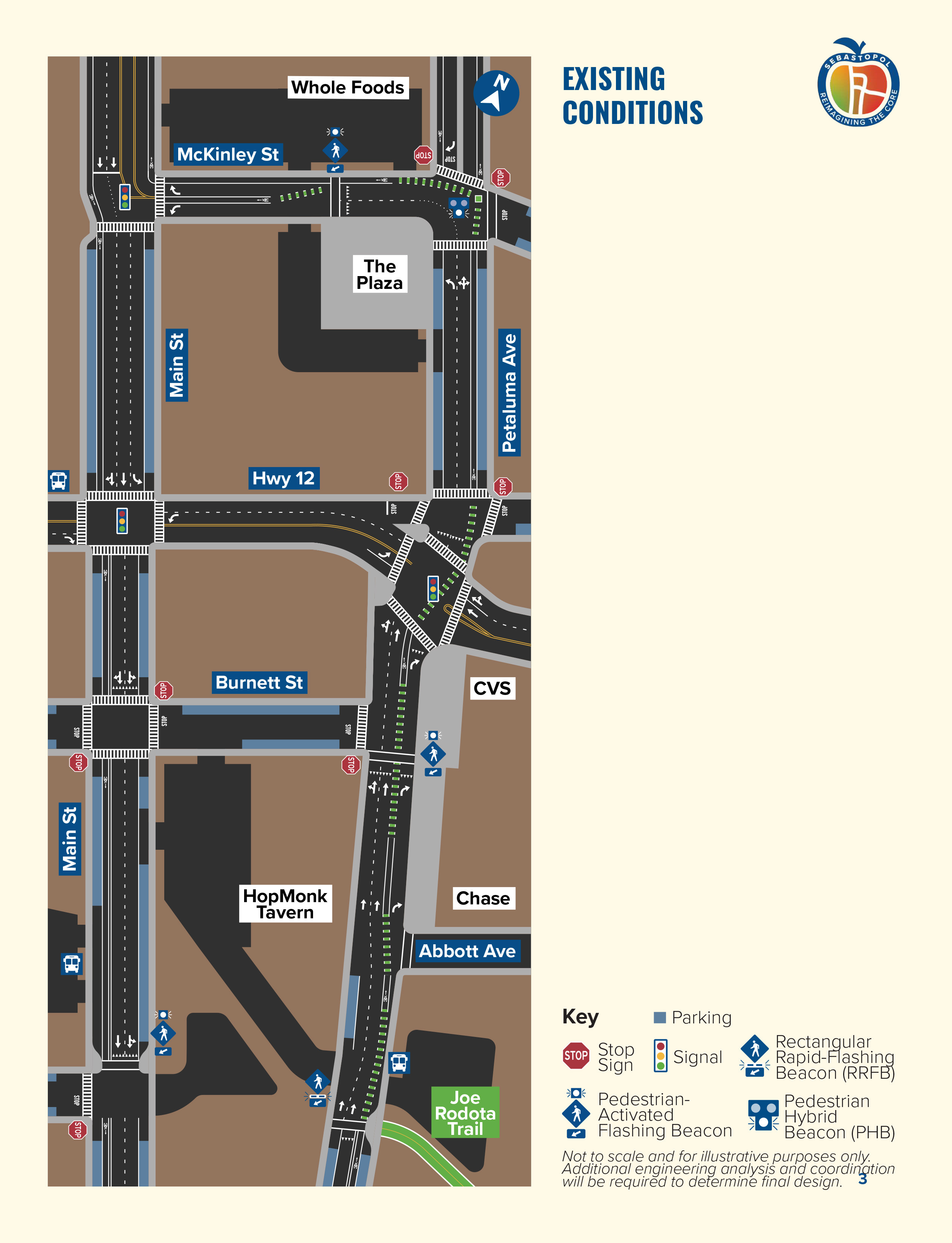
Here is their rendering of the current street configuration.
Four alternatives for downtown
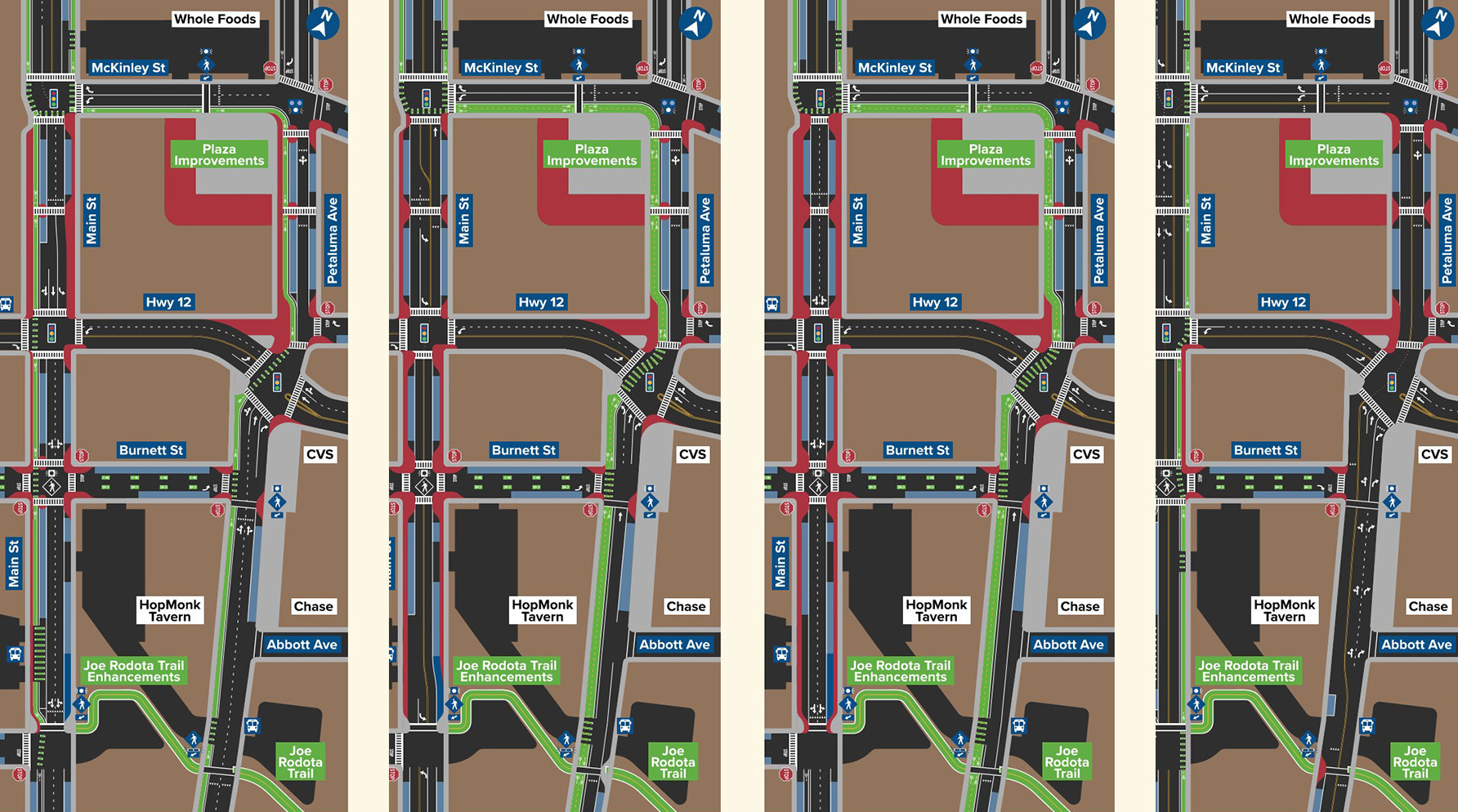
Here are the four alternatives developed by the Fehr & Peers team. (The images below are best viewed on desktop.)
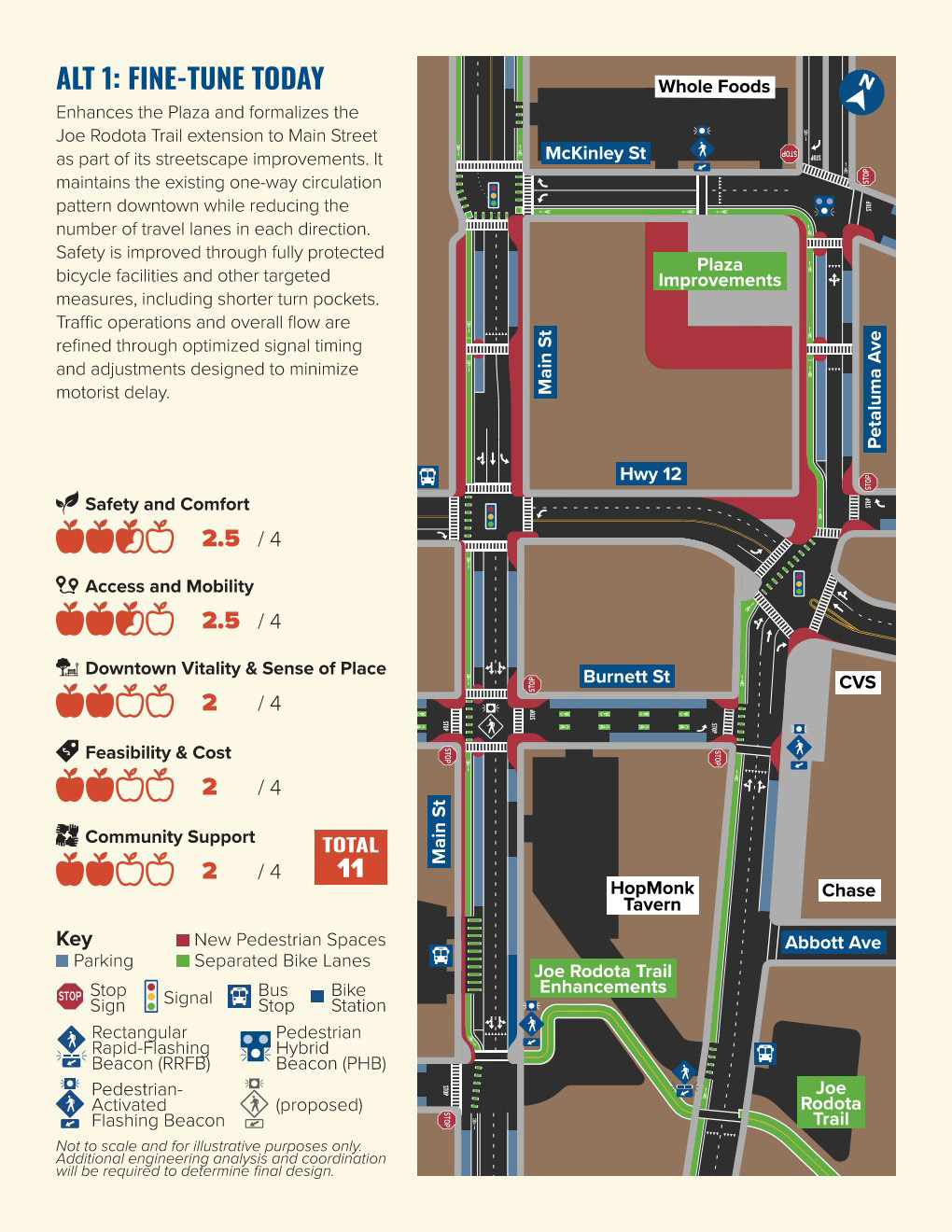
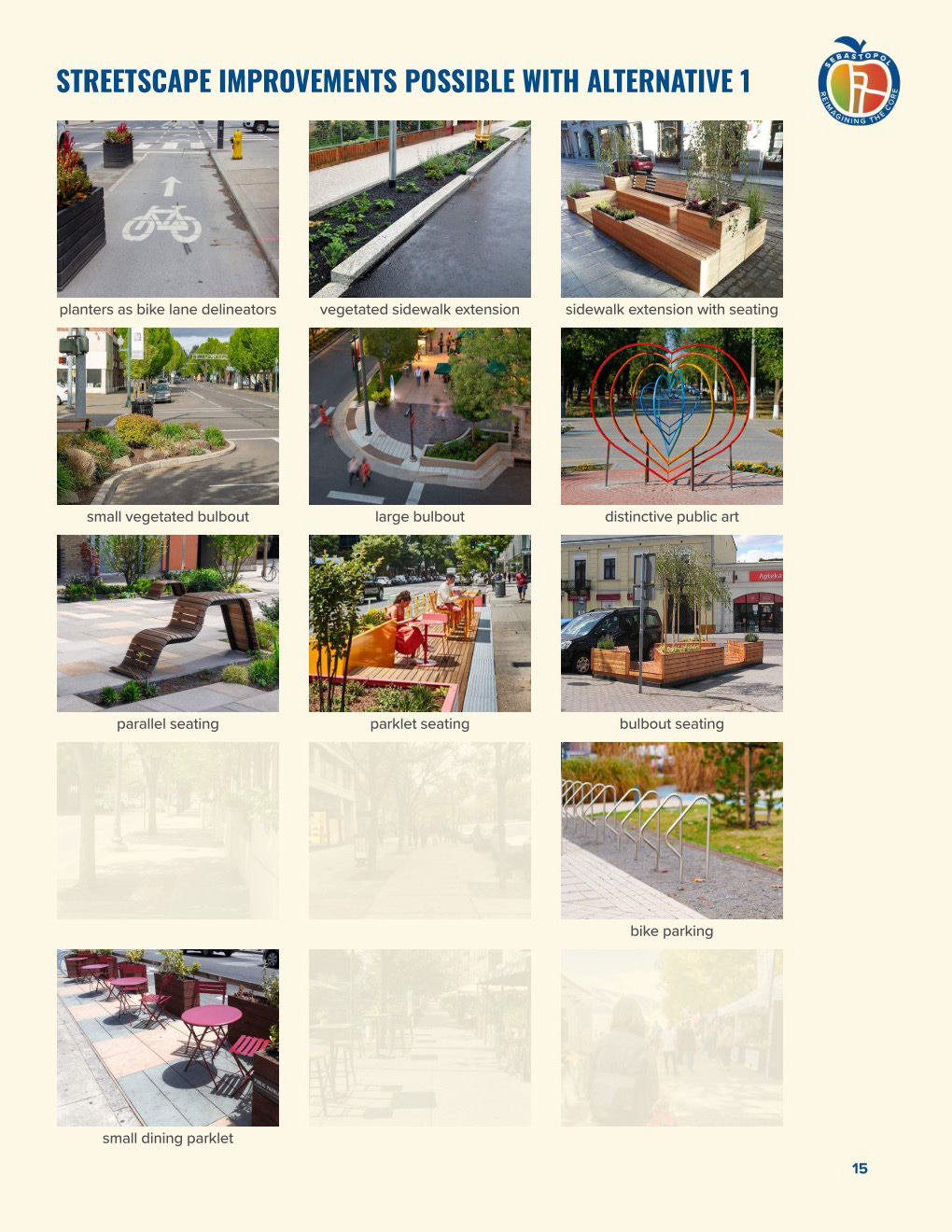
Alternative 1: Fine Tune Today
This plan maintains the existing one-way traffic patterns, adding Class IV protected bike lanes in the same direction as each street.
Alternative 2: Test the Two Way
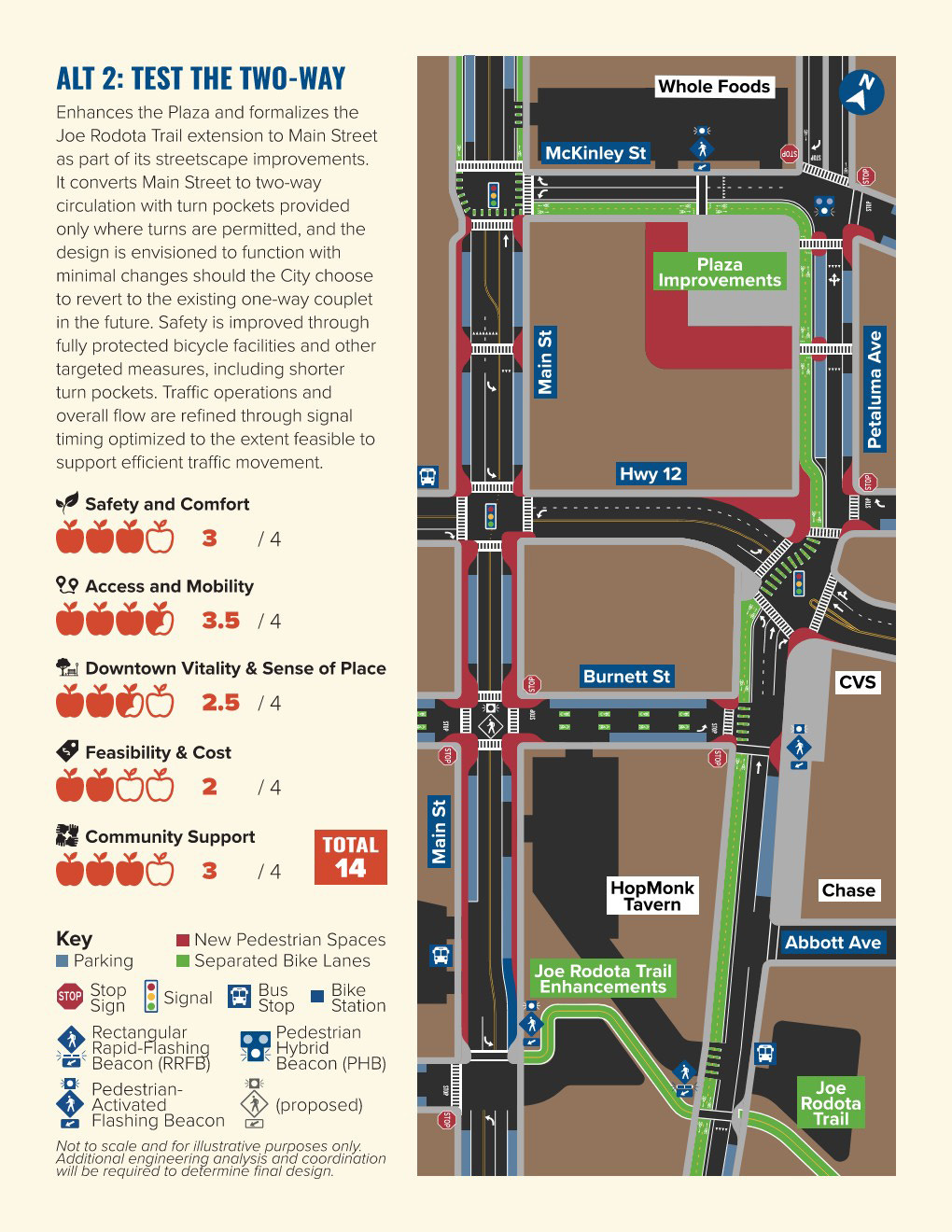
This plan would convert Main Street to two-way while Petaluma Avenue would remain one-way, with new protected Class IV bike lanes.
Alternative 3: Walkable One Way
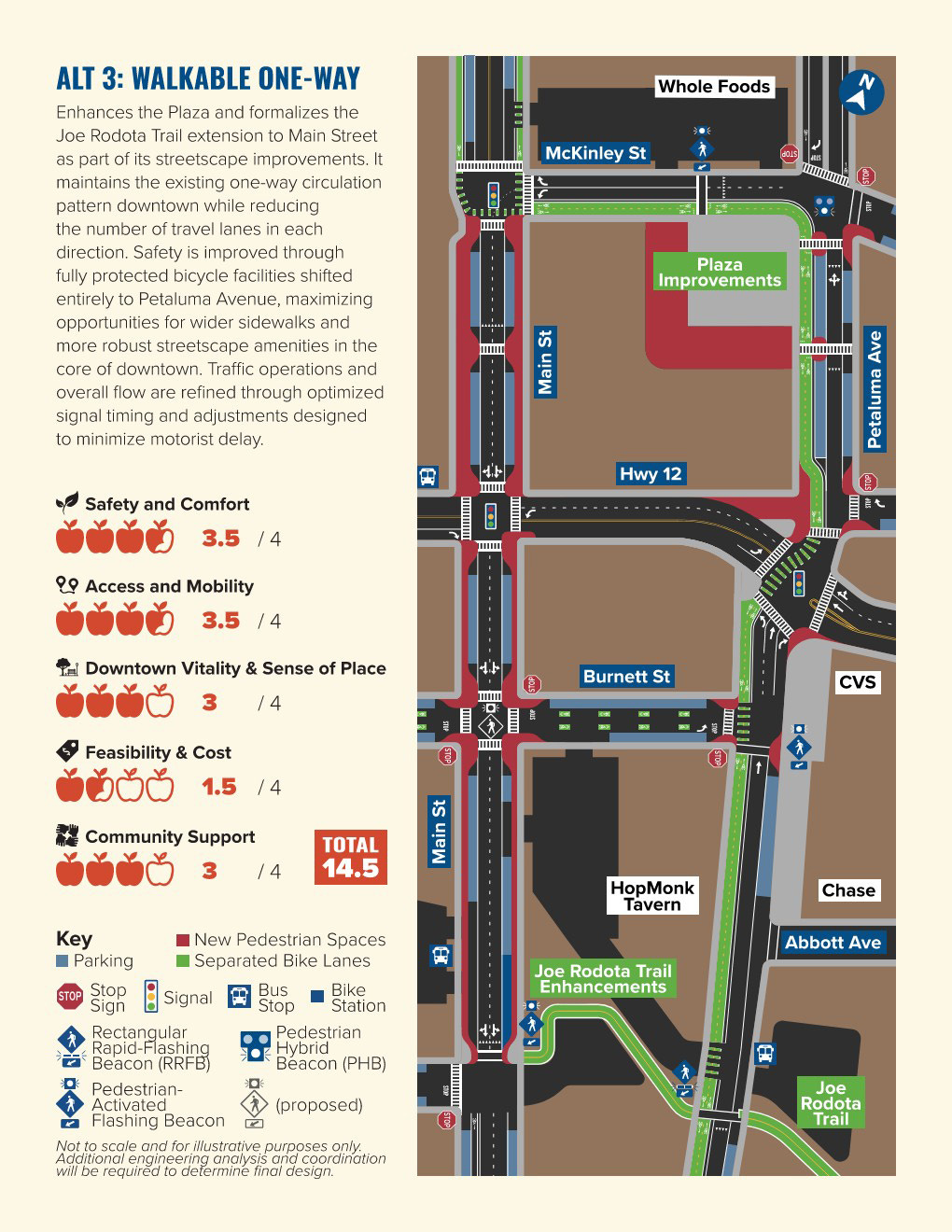
This plan keeps the vehicle one-way pattern but adds two-way Class IV bike lanes on Petaluma Avenue.
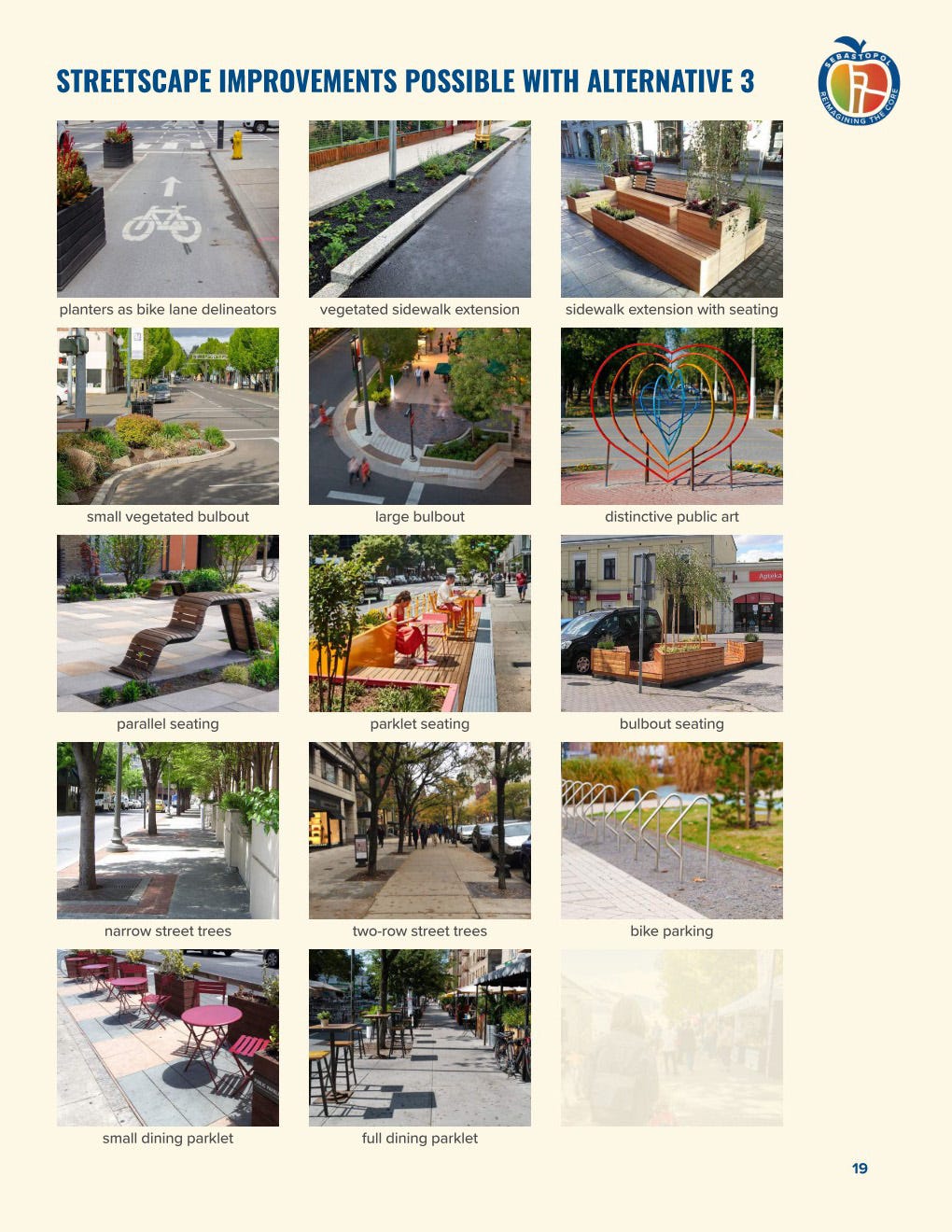
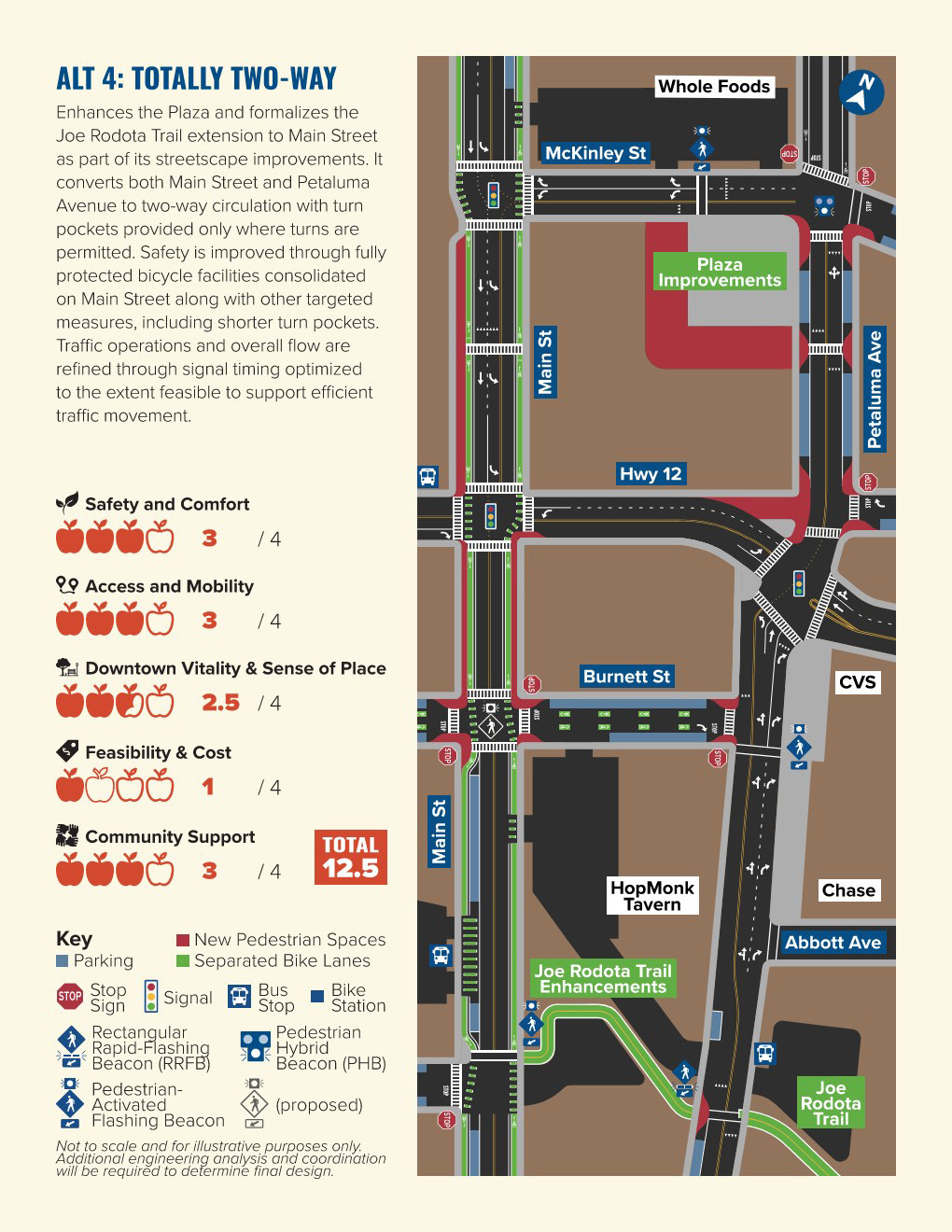
Alternative 4: Totally Two Way
This plan converts both Main Street and Petaluma Avenue to two-way traffic and includes Class IV protected bike lanes on Main Street.
A brief history of efforts to solve Sebastopol’s downtown traffic problem
Sebastopol’s downtown traffic patterns have been the subject of many studies and proposed plans in the past, including a 1990 Sebastopol Downtown Plan that followed the removal of train tracks on Main Street and the addition of the current downtown plaza lined by McKinley Street and Petaluma Avenue.
Sebastopol voters passed a measure to adopt the current one-way street patterns of Main Street and Petaluma Avenue in 1984. This was followed up by a second election three years later to go back to two-way streets. According to Sebastopol Times articles from the period, the votes in those elections were as follows:
In the June election of 1984:
931 in favor of one-way
887 against one-way
After the change to the one-way system, a vocal group of local citizens called for a return to two-way streets. This was put on the ballot as Measure A in June 1987. The vote count in that election was:
1,600 voters in favor of keeping the one-way system
387 voting to return to the two-way system.
In 2013, a small committee of local citizens, including current planning commissioner Paul Fritz, worked with a visiting team from the American Institute of Architects that made a series of recommendations for improving mobility and “sense of place” for the commercial core of the city that had recently been extended to include The Barlow.
The Caltrans-funded project, “Reimagining the Core,” is just the latest effort to re-think Sebastopol’s downtown, and it’s anyone’s best guess which (if any) of the four alternatives will be chosen.
Take the online survey here. Find out more about this project on the city website or the Fehr & Peers website. Please submit additional comments with the subject line “STG Downtown Comments” to the city’s planning department by Sunday, Feb. 8.

My response to the City:
"Background
I have lived in Sebastopol (city) since 1999 and until several years ago I walked everywhere (bank, drug store, library, Ives Park, etc).
Comments
Several "starters": 1) Next to pedestrian safety (and decreasing vehicle exhaust emissions), the primary concern when evaluating this realignment proposal should be the financial health of Sebastopol City government. And Sebastopol's financial health will be improved principally through increased sales and occupancy tax receipts. 2) I believe the general public "concern" with Sebastopol traffic flow is, deep down, really a concern about the quality and "sprightliness" of Sebastopol retail stores. People want Sebastopol to be a little more like Healdsburg instead of the tattoo parlors, nail salons, pizza parlors, and vacancies we seem to be specializing in.
With these "starters" in mind 1) I believe the City should do as little as possible to change the existing traffic flow. I think the worst thing that could be done would be to turn Main St. into two way. Can you imagine the delays that would be caused by cars waiting on Main St (heading south) to turn left (east) onto Sebastopol Ave. (route 12 toward Santa Rosa) if we had 2 instead of three lanes going south on Main? 2) I believe if the City or State want to improve pedestrian crossings (I think the new pedestrian crossing light to be installed on S. Main at Burnett is great), have at it. But a consideration should be maintenance costs (who is going to pay for watering and weeding the "planters"?) 3) I am all for more bicycle travel in the City. But I have seen little, if any, increase in bicycle use with the new bicycle lanes - particularly the lane on Petaluma Ave. (Under the rubric of "improving traffic flow" the City or State should delete the bicycle lanes on Petaluma Ave. and add another lane for cars - the reasons for which I am sure you have heard many, many times)."
The goal of this study is to improve the quality of Main Street and downtown, not improve traffic flow. The one way system was introduced to maximize the flow of cars through town. By doing that, we lost a lot of the character of our small town, trading people space for three lanes or cars on Main Street and turning South Main into a drag strip. This is our chance to reclaim downtown for people with wider sidewalks, crosswalks, bulbous and more room for bikes and street trees. The question we should be asking is; which option makes downtown the best for people, not which option benefits people driving through town the most. If a wonderful downtown means that people driving through Sebastopol are delayed a few minutes, I think that’s a fair trade. And for reference, the difference in travel time through town during rush hour and mid-day is only about 5 minutes.
I am in favor of all two-way streets but am disappointed to see that the consultant didn’t include that as an option. Two-way streets provide so many more route options than we currently have and having more options will improve flow. The consultant’s traffic studies from earlier work concluded that a two-way street grid would actually IMPROVE flow, not reduce it. Win-Win!