
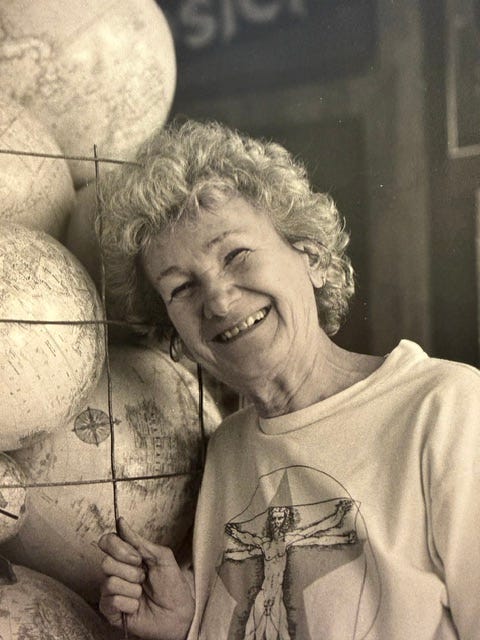
By Cristie Wold, Leslie Witt, edited by Roberta Alleman
Walking into Paula Kursh’s home in Sebastopol was like being invited into a kind of living biography — and being given permission to wander through her life, her mind, her sense of humor. A well-loved, eclectic record collection lined the walls. Cheeky altars to the Madonna and Child teased you into her more surreal domestic assemblages. There were tributes to the 1960s, to the natural world, to her father and her brother, to every place and person she’d ever loved — all of it layered together in her observant, witty way.
Paula was quirky and phenomenally creative — a substantial artist working across collage, sculpture, assemblage, fiber arts, and clothing design, a true mixed-media savant who followed her own instincts long before that kind of work had a name. She was a delightful storyteller, and a writer of memoir and short stories as well. Over the years she showed her art and sculpture pieces at the Sebastopol Art Center and other local venues, building a body of work that was unmistakably hers. Her creative reach extended into music, too: she spent years working for CBS Records in New York and was there at Woodstock, part of her generation’s reshaping our culture from the inside. She continued to be a music lover for the rest of her life.
Paula was born in New York and grew up in Nyack on the Hudson, in a home where art, design, and music were simply the air she breathed: her father, Maurice Kursh, was a well-known artist and graphic designer, and an amateur musician, and her mother, Irene Oakley Kursh, was a master seamstress and interior designer, who had been a Radio City Rockette in its early heyday. The family moved to the Bay Area, California, in the mid-1950s, and Paula graduated from Palo Alto High School in 1954. She spent a year at San Jose State, but New York pulled her back east, where she studied for two years at the Fashion Institute of Technology.
Her years on the East Coast read like a life built entirely on her own terms: she worked at the ad agency Kenyon & Eckhardt in New York, then at CBS Records, then at Church & Main Advertising in Keene, New Hampshire. Ever the free-thinking entrepreneur, Paula opened her own antique shop on Third Street in Manhattan, memorably named “Turkey Dinner $1.00”.
In 1970, Paula traveled to San Miguel de Allende, Mexico, to visit her father and stepmother, Charlotte Olmsted Kursh, and over the decades that followed, she built a life of her own there. She learned to speak some Spanish, hosted friends visiting from home, made many new ones, and became a genuine part of the local art community.
Paula’s move to Sebastopol in the early 1980s brought a grounded life she loved: her garden — she was a Master Gardener, her home and art studio, and, most of all, the deep friendships she found at the Sebastopol Art Center and the Sebastopol Senior Center, bonds she treasured for the rest of her life.
Paula was always eager to reciprocate the love and support of her many friends and loving family. She is survived by her nephew Stephen G. Kursh (Lysbeth Ackerman Kursh) and grand-nephew Gerrit Kursh, as well as many cousins and stepsiblings. In addition to her mother, father, and stepmother, Paula was preceded in death by her brother Stephen and beloved nephew Ryan Kursh.