

The Rotary Club of Sebastopol brought its plan for improving Ives Park to the Planning Commission last night for a public hearing. The room was packed—a rare thing for a planning commission meeting.
Introduced by consulting planner John Jay, the Rotary proposal consists of three parts:
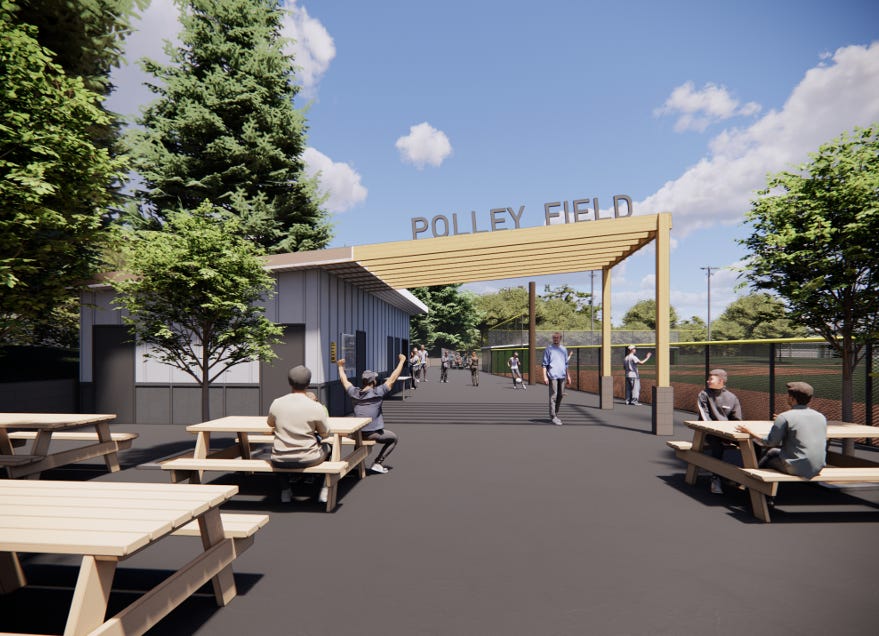
Polley Field Concession Stand & Restrooms: The existing concession stand structure will be removed and replaced with an upgraded facility constructed of durable materials. The new building would contain the concession sales space with views of the ball field, storage, and new ADA accessible restrooms. The space around the new building would contain tables and benches for use not only by players/parents when the field is in use, but also the general public during other events.
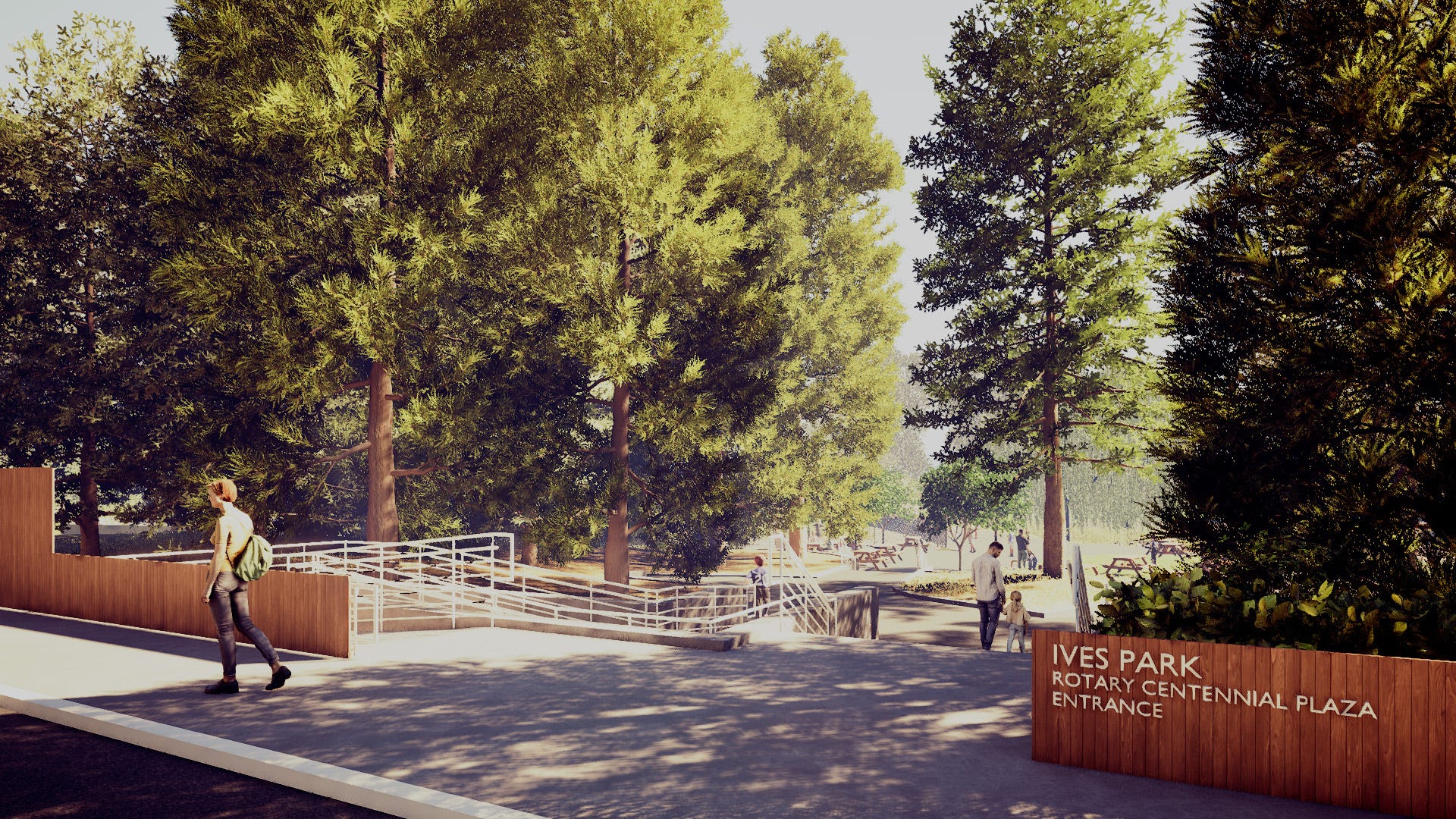
ADA Upgrades to West Park Entry (Jewell Avenue): The project will upgrade the west entry to provide an ADA accessible path of travel into the park, upgrade the landscaping and fencing in the immediate area, and install new Ives Park identification signage.
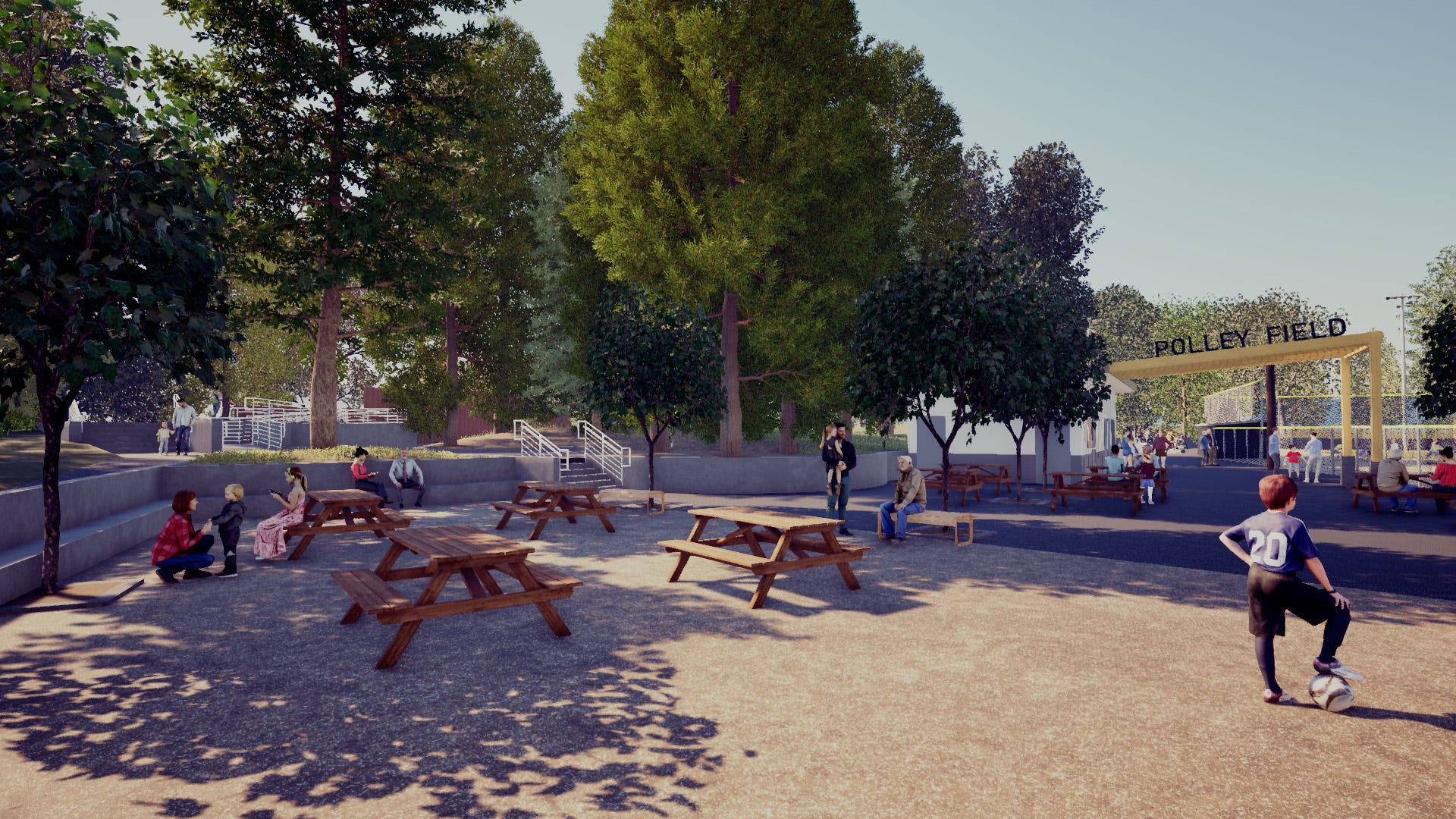
Rotary Centennial Plaza. In the area east of the entry and south of Polley Field, the project would provide a community-use space by refurbishing the existing landscaping, providing pedestrian-scale lighting, and adding moveable seating and tables. (See image at top of article.)
The Rotary Club’s fundraising chair David Schreibman explained how the project came about. The club celebrated its 100th year in Sebastopol last year. In 2023, the club formed a committee, made up of past and present Rotary presidents, to choose a centennial project. He said they reached out to many civic groups and organizations around town to get their input.
“Our committee evaluated 29 different projects and eventually chose a significant renovation of the northeast portion of Ives Park,” Schreibman said. “As you all know, Ives Park is more than the center of town. It’s the heart of Sebastopol. It’s the only public, civic venue for events like the Apple Blossom Festival and Peacetown, where our community truly comes together.”
“Supporting Ives Park is nothing new for Sebastopol Rotary,” he continued. “We were instrumental in putting the Ives playground in and have poured many thousands of dollars into the Ives pool, Peacetown and the Arts Center over the years. Improving our community is simply what we do, and what we’ve done for over 100 years.”
Schreibman gave a bit of history on Ives Park, quoting from its original founding document. “The will of Mrs. Ives provides that the trustee shall acquire attractive land to be dedicated to a playground and recreational uses and shall beautify said tract of land and install therein playground equipment and recreational facilities for the use of the children of Sebastopol.”
“We strongly believe the Sebastopol Rotary’s project fits like a hand-in-glove, honoring Mrs. Ives vision,” Schreibman said.
A field of conflict
Here’s the rub: the Centennial Plaza portion of Rotary’s Project conflicts with the Calder Creek Naturalization Plan, which was approved by the Planning Commission and Sebastopol City Council in 2022.
Although commission members thanked Rotary profusely for their interest in the park, they also came down squarely in support of the city’s existing plan for the park—which is to replace much of the current event space—the grassy area to the north of the redwood trees—with a winding naturalized creek.
Planning Commission Chair Paul Fritz praised Rotary’s plans for the new entryway and concession stand, but said, “I also support the creek naturalization plan. I was on the planning commission when that came before us. And I think at the time, the planning commission was very clear that we thought that was a good idea for the community. The city council also agreed that was a good idea for the community, and I continue to support that project.”
He also expressed “some frustration” that Rotary was presenting a plan that was so clearly in conflict with the city’s existing plan for the park.
“I feel like the Centennial Plaza portion of what the Rotary is proposing is a little problematic,” he said. “Staff mentioned in its report that maybe it could be temporary, but I would hate to see all this money and effort go into making this Centennial Plaza feature of the park that then has to be torn out in five years or whenever we get to the creek naturalization.”
Still, Fritz tried to strike a conciliatory note. Noting that the city’s planning, engineering and public works departments haven’t been fully staffed for almost two years, he said, “I feel like there needs to be kind of a regrouping and getting all the people at the table to talk about the park and how these features are going to go together, Fritz said. “I think that this plan by the Rotary doesn’t have to be in competition with the creek naturalization plan. I think there’s a way for this to work for everybody.”
Planning Commission Vice Chair Evert Fernandez echoed these sentiments. “I hope that we can bring these two projects together and find a way for them both to move forward together…because I think that both of these projects are going to be beneficial.”
In public comment, however, many people seemed eager to re-litigate the creek naturalization plan. Lisa and Steve Pierce, members of Friends of Ives Park (and, for transparency sake, friends of mine), have been skeptical of the creek naturalization from the start. Both staunch environmentalists, they nonetheless feel that naturalizing the creek at the western side of the park would take away from its use as a community gathering spot, making large events like Peacetown impossible to host.
“I don’t think most people understand just how much of our event area would be lost if we went with the CUSP plan,” Lisa Pierce said. (CUSP is the California Urban Stream Project, the group that spearheaded the development of a creek naturalization plan for Ives Park.)
“When the creek plan was passed, the consultants [from CUSP] were under the impression that the event space was just the green area right in front of the stage, and we all know that’s not the case,” Steve Pierce said. “People are packed in there [meaning the western part of the park] pretty much cheek to jowl when we have Peacetown.” (Jim Corbett, Mr. Peacetown himself, has also expressed reservations about naturalizing the creek in that area because of the amount of event space that would be sacrificed.)
“The consultants are now saying that we’re not losing any event space,” Steve continued. “Well, show us the calculations. It’s a question of how wide is that creek, how much slope is there, and how densely planted is it? We have no idea, because they haven’t produced the kind of more detailed drawings where you can come up with that calculation.”
The planning commission conceded that this would be good to know and directed staff to work with CUSP to come up with that figure.
The Pierces have long favored more a modest, less expensive but more immediate improvements to the park—better fencing, better landscaping—and they saw the Rotary proposal as a huge step in this direction.
“I’m here tonight to support the rotary plan,” Lisa said. “They have an incredible track record of amazing projects that they have gifted to our community through their dedication and hard work…What rotary is offering to our town and paying for themselves would be a huge boost for our park.”
Steve elaborated on this endorsement. “I know that part of the allure of the creek plan was its bringing excitement and money and design to the park. We passed the Ives Park Master Plan in 2013 (but nothing much happened) and now the CUSP plan came forward and people got excited. We now have fencing being replaced by the city. They’ve actually budgeted money to replace part of the fencing— unheard of in the history of Ives Park—and we now have the opportunity for Rotary to make a major enhancement to the park. So it’s not the sad, moribund thing that we all thought—excitement and investment is happening in the park, and the creek plan is in opposition to what can happen with the Rotary plan.”
Several Rotary members also rose to speak in favor of the Rotary Proposal, as did several Little League folks, who were mostly excited about the new concession stand. Kyle Falbo made a practical suggestion that, since the Rotary was adding ADA bathrooms to the concession stand, they should consider slightly expanding the footprint to make room for that.
The creek naturalization also had its defenders. A representative from CUSP reminded the commission that access to a naturalized creek would be a boon for local children and thus in alignment with Mrs. Ives original plan for the park. He called the creek restoration “a gift to ourselves and to generations to come.”
Public commenter Ted Luthin suggested Rotary throw its considerable resources behind the creek naturalization, which he noted was a part of the Ives Park Master Plan.
“I love that Rotary wants to make a huge contribution to this park, a huge investment in this park,” he said. “And I’m totally supportive of that. I would love to see that investment be the first step in achieving the Master Plan for the park. And I’d love to see those efforts dovetail together, rather than being in opposition.”
Luthin also criticized the Centennial Plaza design. “One of the things that I’m seeing here is pavement, I’m seeing walls. I’m seeing plaza stuff, not park stuff. So I’d love to see much more park and less plaza. Rather than being Centennial Plaza, I’d love it to be Centennial Green—just something more park like,” he said.
What’s next?
The Planning Commission didn’t give a definitive thumbs up or thumbs down at last night’s meeting. Rather its goal was to hear Rotary’s presentation and gather public comment. They’ll come back at a future date (as yet undecided) when they’ll consider whether or not to recommend a use permit for this project.
In the meantime, Fritz suggested creating a Parks Subcommittee to examine the issue and try to figure out a way to bring these competing interests together.
I'm very conflicted; I like both proposals. Both have strong merits. Having an open creek bothers me; it just takes one child to have an accident to cause upset to the open waters. When I was a young resident of Sebastopol, there were beautiful blooming trees around the perimeter of the ball field. Lots of folks from SF would travel up to our town to admire the seasonal blossoms. Might one of the proposals include a grove of blooming trees that would entice visitors to our city again? Plus I suggest a facelift to the eastern entrance (beside the creek) to the park; it's an eyesore. I support a compromise of the two factions.
The Calder Creek project was approved almost four years ago. I seem to recall that the city has been seeking grants for just a portion of the project due to the high cost. It seems like the Planning Commission is on board with time delay. Planning Commission Chair Paul Fritz expressed concern about wasting money now given that in five years there might be funding to "restore the creek". There could be a lot of enjoyment from the proposed improvements that are being paid for by the Rotary, not the city.
It would not be a surprise in five years that there is no grant money, there have been no improvements to the park, and it joins the city streets which by then. will be nearly all in poor or very poor condition, also due to no effective effort to "bring them back to life".
There seems to be little wrong with the proposal to create and ADA compliant entry and enhance the ballpark amenities. The Centennial Plaza looks like a much-needed sprucing up of the park making it more useable by residents. Rotary has the money, a plan and are ready to proceed. Beats waiting around five more years to see what kind of creek CUSP has in mind and whether money will be available.
I'm not sure children will ever get near the creek. Between liability to the city and the need to keep the homeless from living along the creek, a lovely fence would be in the future.
The city might focus on the flooding problems with Calder Creek, largely due to the silting of the Outlet. Time spent on grants should be grants to fix the streets.