


On May 19, the Sebastopol City Council discussed Barlow owner Barney Aldridge’s letter requesting that the city of Sebastopol add a TOT (transient occupancy tax) rebate program to the Development Agreement devised for the Barlow Hotel, which is proposed for the site currently occupied by Guayaki Yerba Mate.
The discussion of a potential TOT rebate program for the Barlow Hotel was relatively limited at the May 19 meeting, since it was not listed on the agenda. Public commenters differed in opinions, which you can read about here.
On Tuesday, the Sebastopol Planning Commission held a public hearing to discuss a report prepared by Jane Riley, the Interim Planning Director, on the amendment to the Development Agreement. The role of the Planning Commission was to reach a recommendation for the City Council regarding this amendment.
The report elucidates the details of the proposed amendment, which states that the city would return 50% of the 12% TOT revenue to the developers of the hotel for ten years. The rebate funds would be “dedicated to promoting tourism.”
Ari Wangerin, director of development for the Barlow Hotel project, stood in for Barney Aldridge, who was ill during the time of the hearing. Wangerin presented the proposed amendment alongside a series of successful precedents for California hotel TOT rebate programs and assured the Planning Commission that public-private tax sharing partnerships are increasingly common in this challenging economic climate.
Riley added that while rebate programs are common, a rebate marked specifically for “promoting tourism” is somewhat unique.
Planning Commission Chair Evert Fernandez immediately raised questions regarding the city’s current fiscal situation, as well as potential accountability for how the rebate money is spent.
Commissioner Alex Kanzler noted that the language of “promoting tourism” seemed “intentionally vague.”
From there launched an almost two-hour-long discussion on the details of the proposed amendment, with commissioners' attention spent largely on the question of what it means for the Barlow Hotel to use rebate funds to “promote tourism.”
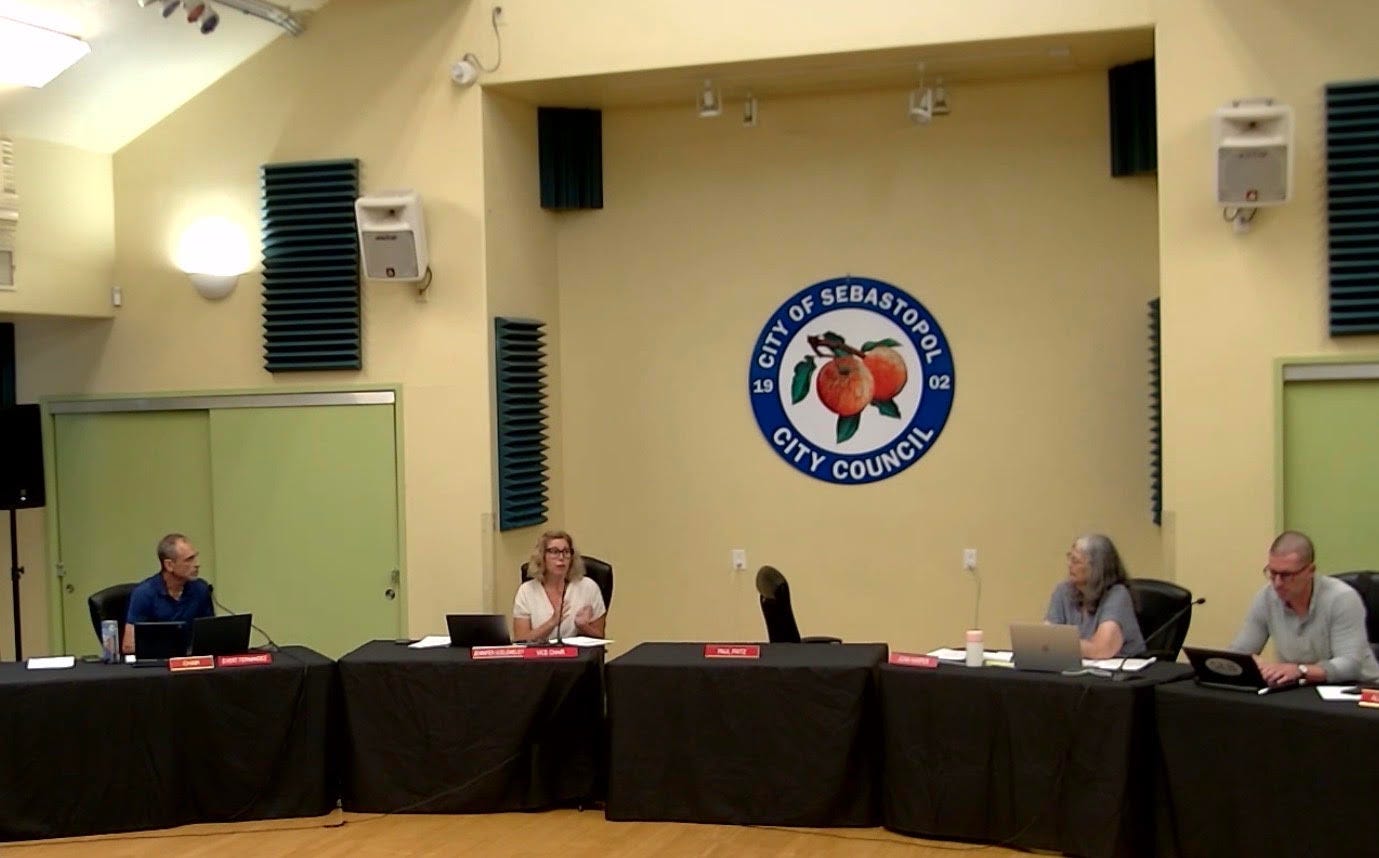
Vice Chair Jennifer Koelemeijer said, “these are public funds,” and sought assurance that efforts to “promote tourism” would promote tourism in the city of Sebastopol writ large, rather than just tourism within the Barlow, “which is owned by one individual.”
The report included two studies which projected two different numbers for annual revenue from the Barlow Hotel. RRC Associates, hired by the applicant, projected $1,548,000 in annual TOT revenue. EPS, hired by the city, gave a more conservative estimate of $891,000. In light of these rather significant amounts of money (even considering the radical discrepancy), Chair Fernandez wondered aloud about how much the city of Sebastopol could do with the whole of the TOT revenues instead of just 50%.
At this point, Wangerin stated quite frankly, “If we don’t get this agreement, the project is likely to go on hold.” He also mentioned that the language of “promoting tourism” was a recommendation given by the Sebastopol City Council at a previous meeting.
“They’re looking for city support to make this project go. Yes, it’s taxpayer money, but all the money is theoretical,” Commissioner Kanzler said. “It’s a one-in-the-hand, two-in-the-bush situation.”
Commissioner Joan Harper confirmed with Wangerin that the rebate funds would substitute a portion of the hotel’s $1,000,000 marketing budget rather than augment it. What she meant was, whatever rebate funds the hotel receives will be moved to the “marketing” bucket of the budget, and the money that was there before will go towards other operating expenses.
In the most basic sense, regardless of what the amendment allocated the money for, the Barlow Hotel would use the rebate to make sure the hotel can run, and to reassure its financiers that their investments were sound decisions.
Ella Berger, the director of development for Aldridge Development, stepped up to the podium to say, “We need money back in our pockets.”
This conviction did not seem to persuade Chair Fernandez to recommend the amendment.
Fernandez continued to express concern about accountability for rebate funds and was confused about why the document prescribes the use of funds to promote tourism at all. He raised the point that the promotion of tourism would be “a trickle-down benefit when the city has so many other needs.”
Vice Chair Koelemeijer said that the effort to include the whole city of Sebastopol in promotional work by the Barlow Hotel within a proposal that, at its core, is about acquiring the funds to finance the hotel, was “a goodwill gesture on their part.” She proposed that 15% of the remitted TOTs be allocated for promoting solely “the city of Sebastopol.” Commissioner Kanzler gave a big thumbs up.
There was then a very long debate about the basis for the number 15%. Chair Fernandez was skeptical of the choice of 15% as arbitrary and under-researched. Commissioner Harper agreed.
Each member of the commission seemed to want the Barlow Hotel to open in Sebastopol. Amidst discussions of better uses for city money, issues of oversight and semantic arguments about tourism in the Barlow versus tourism in the city of Sebastopol, the fact that the Barlow Hotel says it cannot open without this tax break got a little lost.
After an additional attempt by Chair Fernandez to revisit the idea that TOT revenue could be used to help the city in ways determined by the City Council, Riley stepped in to say, “Well, that is a whole other motion,” and redirected the conversation to the motion at hand.
Commissioner Harper suggested that they change the language of 15% to “some percentage of the funds, as determined by the City Council, committed to the promotion of the City of Sebastopol.”
Eager to reach a consensus, both Koelemeijer and Kanzler approved this change.
Additionally, struck from the original text was the language, “The City may request…documentation of how the remitted tax funds were spent…but the City shall have no authority to direct such spending.”
The language was amended to simply read, “Payee of tax shall provide documentation of how the remitted tax funds were spent for such purposes,” reconciling the accountability concern that Chair Fernandez had adamantly brought forward.
Eventually, the Planning Commission voted to recommend that the City Council accept the Development Agreement Amendment with those changes and one more change, which addressed a typo.
Riley commented that the meeting had been “hard work.” Wangerin looked relieved as he left the room after the meeting, which was an hour and 45 minutes long.
The City Council will meet on July 21 to vote on whether to follow the Planning Commission’s recommendation.

This town loves to reduce TOT revenue at all costs! Another comically bad revenue-reducing decision by them. Par for their "Chapter 13, here we come" approach to running the town. If they only treated TOT revenue like they treat our water bills...
When the economy tanks so does tourism. If the Barlow owner couldn't find outside investors then let's call it a day and not suck the money out of the town.