

The main items on the agenda for the May board meeting of the West Sonoma County Union High School District were:
Recognizing seven retiring Analy staff members
Approving a hate speech resolution
Approving a one-year contract between the District and its teacher union
Finalizing layoffs for the 2026-2027 school year
Behind all this activity is the reality facing almost every school district: it has to reduce its budget deficit by limiting expenses, most of which are labor-related, and the District cannot support all the services it has offered in the past.
The video of the May 6, 2026, board meeting at the El Molino campus can be found here.
2026 Retirements
The seven members of the Analy staff who are retiring at the end of this school year were recognized by the board for their accomplishments over many years. The retiring staff members are:
Maureen Oesterle, Special Education Teacher: 2001-2026
Paula Bush, TPP Coordinator & Behavior Assistant: 2005-2026
Sharon Hallengren, Counseling Secretary: 2019-2026
Mei Bach, Culinary Arts Teacher: 2019-2026
Julie McClelland, Library Media Specialist: 2016-2026
Staci Smith, Lead Food Service Worker: 2001-2026
Anita Sandwina, Art Teacher & DEI Coordinator: 2001-2026
Teacher Paige Greco about Analy librarian Julie McClellan
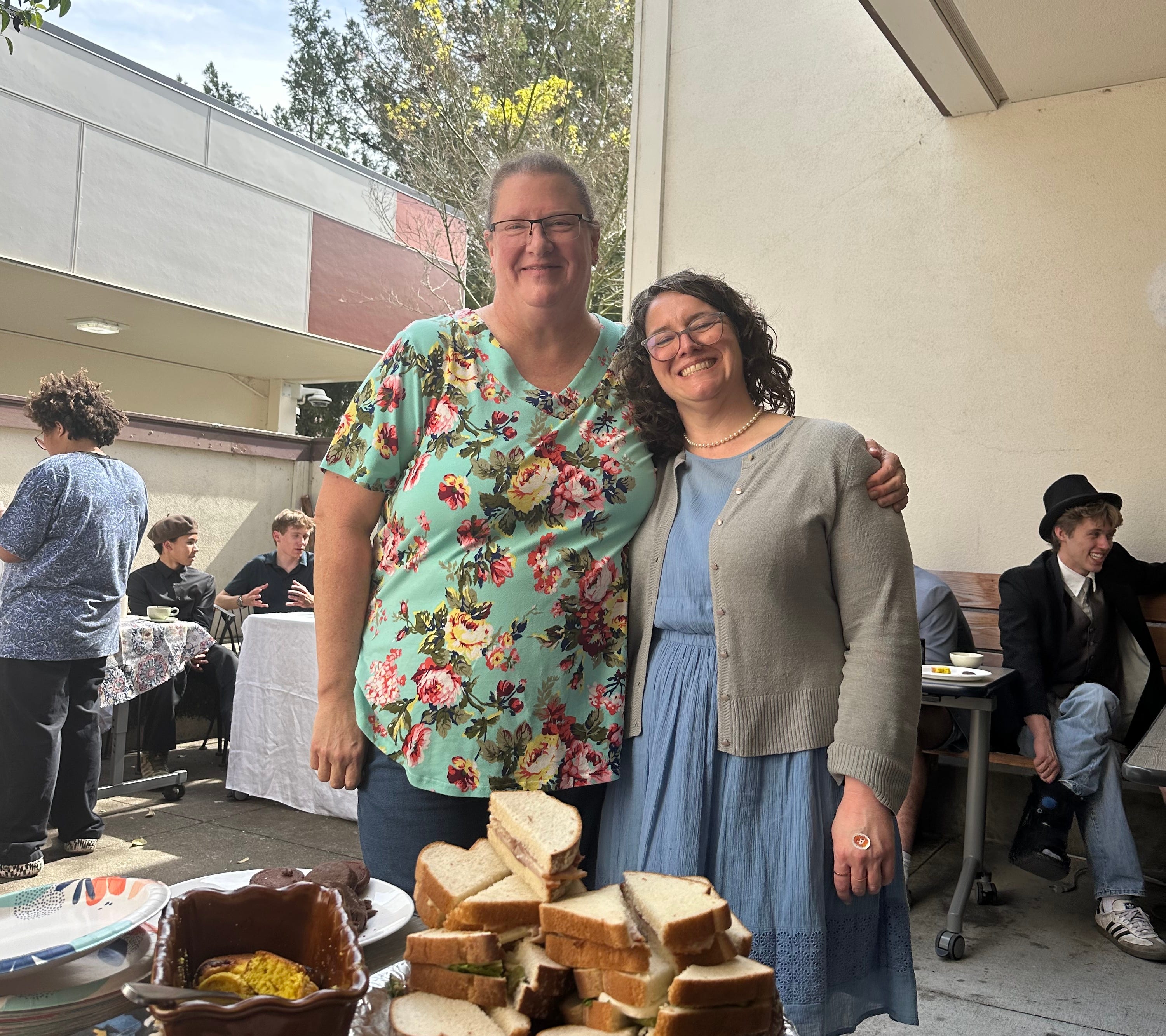
English teacher Paige Greco spoke about her special relationship with Library Media Specialist Julie McClelland.
Julie McClelland and I both started working at El Molino in 2016. Going to games and dance shows and plays was a big part of teacher culture at El Mo, and we got to know each other sitting in the gym, in the bleachers and the cafetorium. Leaning on each other through fires, floods, a strike and a pandemic cemented our friendship.
When Julie started here, the library was a place that few students and staff used and that hadn’t been weeded since the Reagan administration. She transformed it into the beating heart of the school. When she moved to Analy, she did the same thing with the library there. The Analy library hadn’t been weeded in so long, we found and subsequently threw out The Opera Goer’s Guide from 1910. When El Molino and Analy consolidated, she provided snacks and a safe place to scream for all of us as we adjusted and mourned, teachers and students alike.
Whereas a student may have different teachers from year to year, the relationships that they develop with Mrs. McClelland build and deepen over the course of their four years of high school, and none of these relationships develop by chance. Julie McClelland has a sixth sense for kids who are struggling emotionally or who need a friendly ear. She sees who comes in at lunch to hide behind a book because they don’t have friends to hang out with. She sees who comes in hiding tears at brunch because a family member died. She sees who lingers after school because they don’t want to go home. She sees who needs a quiet place to study because their home-life doesn’t provide a chaos-free zone. She soothes broken hearts, she listens, she connects students to resources and students trust her. Students confide things to her that they hesitate to tell their teachers and sometimes their counselors. And then she celebrates their wins, be it earning a scholarship or scoring a solid five dollar Friday deal at Safeway.
Julie and I are not allowed to talk about the fact that she is retiring and moving away. We tried once a few months ago and were both on the verge of tears before we’d really gotten a sentence out. This despite the fact that I helped pack up her house into a moving van already. My denial is selective, fierce and deeply necessary. She has been my partner in crime since I moved here. I do not know this place without her. I know I’m not the only one who will miss her terribly. As such, I’m excited for her to get to spend her time with her family who already know how lucky they are and for her baby granddaughter Violet to get to grow up with her nearby. I know I am not the only one who will miss having her living in my pocket every day.
Analy Principal Chuck Wade thanks Anita Sandwina
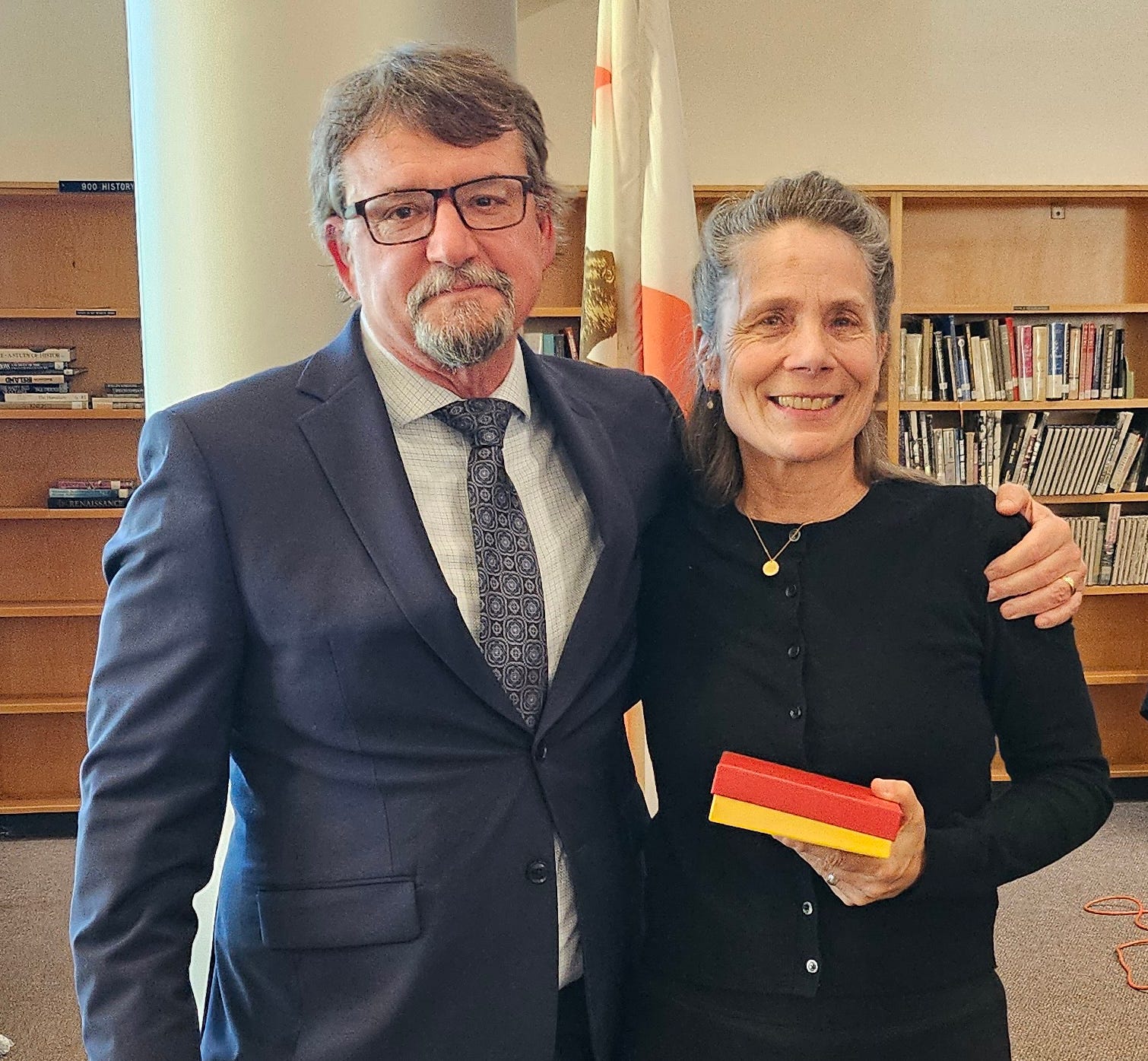
Chuck Wade spoke about the many valuable roles that Art Teacher & DEI Coordinator Anita Sandwina has taken on in service to the district.
It’s a true honor to recognize Anita Sandwina this evening as she retires after nearly three decades of service to our district—as a teacher, and more recently as a TOSA.
(Editor’s Note: A TOSA, or Teacher on Special Assignment, is an experienced educator who steps out of the traditional classroom, either partially or fully, to take on specialized roles like instructional coaching, curriculum development, or implementing new technology.)
Over the course of her career, Anita has been many things: an outstanding art teacher, a thoughtful coach, a systems-builder, and a trusted colleague. But what stands out most is the way she has consistently centered people in her work. She has always been attentive to the needs of both students and adults, creating spaces where people feel seen, heard, and valued.
In the classroom, Anita didn’t just teach art—she created safety, connection, and joy. She brought a spirit of curiosity and play to her work, and she modeled what it means to remain a learner over the course of a long and impactful career.
As a TOSA, Anita has been central to some of our most important work as a school. She has helped lead efforts to make our campus more inclusive, more tolerant, and more safe for all students and staff. Her expertise in restorative practices has helped us navigate some genuinely complex situations with care and integrity—not just responding in the moment, but building systems that reduce harm and strengthen community over time.
She has also been a driving force behind our coaching work with teachers, helping colleagues reflect, grow, and move closer to the best versions of themselves. Her ability to have difficult conversations with empathy and clarity is a rare and powerful skill, and it has made a lasting difference across our campus.
On a personal note, Anita has been an invaluable thought partner to me. What were meant to be check-ins to support her work have consistently become coaching sessions for me. She has a way of bringing calm and clarity—like the eye of the storm—no matter how complex the situation. I will miss those conversations more than I can fully express.
And beyond all of that, Anita has been a constant, steady presence—whether walking the campus during break and lunch, checking in, offering insight, or simply making sure people feel supported in the moment.
Anita, thank you for the wisdom, the care, and the leadership you have given to this school community for so many years. Your impact is profound and lasting, and it will continue to be felt long after your retirement.
We wish you all the very best in this next chapter—you’ve truly earned it.
Hate Speech resolution
The recent incident of racist and antisemitic graffiti left by juveniles behind Safeway was not the motivation behind the Hate Speech resolution passed by the board. However, it does point out the need to be explicit about what hate speech is and how to educate students about it.
Anita Sandwina explained that there had been ongoing work on this resolution, which originally focused on the “N-word” as hate speech. Sandwina said she sat down with Black students and listened to them about the proposed resolution. The feedback she got was that the resolution should not focus only on race but should be broader.
The Hate Speech resolution defines hate speech to include “any communication—spoken, written, symbolic, or online—that demeans, targets, or threatens an individual or group based on real or perceived identity, including race, ethnicity, religion, gender, sexual orientation, disability, or other protected characteristics.”
The resolution calls on the Administration “to develop and implement a simple, plain-language and sustained education effort to clearly explain what constitutes hate speech and bias; reinforce expectations for respectful behavior; and communicate available supports and reporting pathways.”
It asks that the Administration continue to “deliver this education through social media, school communications, and other appropriate channels to reach students, families, and staff on an ongoing basis.”

Labor agreement between District and WSCTA approved
The West Sonoma County Teachers Association (WSCTA) approved a one-year agreement with the District on April 30 that provided a 3.55% salary increase, effective July 1, 2026. It included a reduction of one (1) staff development day, decreasing the work year from 186 to 185 days. It also added a 15-day paid maternity disability leave.
Lily Smedshammer, President of WSCTA, thanked the District for the collaboration during negotiation. She said that “members overwhelmingly ratified the tentative agreement.” She continued:
There’s a lot in this agreement we’re proud of. A big one, we’re now the first district in Sonoma County to offer three weeks of district paid maternity disability leave. That’s a big deal. Los Angeles Unified made national headlines recently for expanding their leave. They give four weeks, and it is significant that we’re moving in that direction as well.
We also know the raise didn’t just appear out of nowhere. We appreciate the work it took to find the funding. The effort is noticed and appreciated. At the same time, I want to be real about something. We hear a lot about how strong our benefits package is, which is true, but our members made trade-offs to keep that.
During the recession, we gave up raises for about a decade to hold on to those benefits. So when we talk about compensation now, that history is still there, and that salary depression carries forward. The reality is, even when you include benefits, we’re not the top paid teachers in Sonoma County.
Andrew Soliz, the District’s Chief Business Officer, said that the projected increase of the new agreement is $626,000 in the District budget. Soliz said that “the reserve will go from 15.4% in the current year to 4.37% in the fiscal year 2028.” However, the reserve will remain above 3%, which is required by the bargaining agreement.
Smedshammer spoke about a one-year resolution on the use of AI, which was put forward by the union and approved by the board. The resolution states that “the District shall not implement or utilize AI Systems to displace bargaining unit positions without prior written agreement of the union.” This language is consistent with the California Teachers Association’s union efforts seeking to prevent AI use from displacing teachers.
While understandable, there are problems with this resolution. The restrictions in this agreement on AI use are not clearly defined, nor would they practically limit the use of AI, especially as almost any piece of software today integrates AI. Additionally, the District needs to also consider the possible benefits of AI to student learning and their postsecondary future. While protecting jobs serves the union and its members, there are competing educational and District financial interests as well that should be represented. Most of all, discussions about the use of AI now and in the future should not be confined to a negotiation in closed session between the District and WSCTA.
Finalizing Layoffs
Layoffs of classified and certificated staff for the 2026-2027 school year were first announced in the March board meeting. At that meeting, there was a strong showing of support for Spencer Burrows and his choir program, as summarized in this article, as well as support for Jolene Johnson and her dance program, which were among the cuts. At the April board meeting, there was equally strong opposition to cuts affecting CTE, in particular the Ag program.
At this meeting, some of the cuts announced in March were rescinded, but also the total reductions were finalized.
The reduction in certificated employees (i.e., teachers) was reduced to 8.0 FTE; in March, the number proposed was 9.8 FTE, so 1.8 FTE were rescinded. (FTE means “full-time equivalent,” so 1.0 FTE equals one full-time job.)
Dance teacher Jolene Johnson is going from 1.0 FTE (5 classes) to .60 FTE (3 classes), and Choir Director Spencer Burrows is going from .40 FTE (2 classes) to .20 FTE (1 class). Ernesto Aubin, a Spanish teacher, was reduced to .60 FTE, and Maren Powers, an Ag teacher, was reduced to .80 FTE. Christine Elze, a PE teacher, and Jennifer Freese, an English teacher, were laid off.
The preliminary classified reductions were 5.418 FTE, of which .50 FTE was rescinded, making the final classified reduction 4.918 FTE. (Classified positions cut or reduced included an attendance clerk, groundskeeper/custodian, College & Career Center coordinator, technology systems specialist, and an administrative assistant.)
Georgina Macias – .043 FTE
William Lepori – .875 FTE
Christopher Parman – 1.00 FTE
Matthew Yonker – 1.00 FTE
During public comment, Matt Yonker, the Analy Technology Systems Specialist, spoke about the elimination of his position, one of two in the department. He pointed out that the increasing dependence on technology in the classroom creates the need for more technical support, not less. With the new CTE buildings opening in the fall, Yonkers questioned how the District hoped to keep adding new systems and keep them up and running with just one person. Yonkers made a strong argument, which was supported by Anne Pederson, a special education teacher, who said it was “illogical to cut one of only two positions.” There was no response from the Board or the Administration.
One of the last items on the agenda was a resolution to pay coaches who are not on staff less than the coaches who are. Linda Helton opposed the resolution, saying that the students deserve the best coaches possible. However, this cost-cutting move demonstrates that even the athletics department cannot escape some reduction.
Overall, between the retirements and the layoffs, this was a hard meeting, with some speakers holding back tears and taking time to collect themselves before continuing with their comments.
Yet there was also the Board’s unanimous conviction: the District must reduce its annual budget deficit before it completely drains its reserves, and expenses must track to enrollment. These reductions are necessary to keep the District afloat, and even though they are unpopular with some, they are the new reality for the foreseeable future.
“While protecting jobs serves the union and its members, there are competing educational and District financial interests as well that should be represented.” - thank you for calling this out and presenting the other side of the story. This is great journalism that we need more of.
Excellent and thorough coverage. As a retired middle school teacher, it brings back memories of tough decisions back in the day when I worked in Wisconsin. I was especially delighted to read that my friend Kathy's talented son, Spencer Burrows, will still be on the payroll.