



The agenda for the April 21 Sebastopol City Council meeting seemed rather blasé, but the council chambers were packed with neighbors from some of the town’s worst-maintained streets come to plead with the city to fix them. Before the council got to that item on its agenda, however, it had to wade through a few other things, including a Climate Action Committee interview, the usual council preliminaries, and two public hearings. The road repair discussion was followed by a debate about fee waivers for events and how much staff time councilmembers are allowed to use without permission from the larger council.
Mayor Jill McLewis, Vice Mayor Sandra Maurer, Councilmember Neysa Hinton, and Councilmember Stephen Zollman were present in chambers for the April 21 Sebastopol City Council meeting. Councilmember Phill Carter was absent.
Preliminaries
Climate Action Committee Interview: The committee interviewed and approved Mark Szatmari for a term on the city’s Climate Action Committee, ending Dec. 31, 2027.
Proclamations: The city presented Lea Goode-Harris, Ph.D., of Creative Labyrinths with a certificate of gratitude for her work on creating the city’s new labyrinth, which is located behind the baseball field off Morris Street. (Full directions on how to find the labyrinth can be found at the end of this article.)
Quick look at the Consent Calendar
The consent calendar consists of items that are routine in nature or don’t require additional discussion, often because they’ve been discussed extensively at a previous council meeting.
In addition to approving the minutes of earlier meetings, the council unanimously approved the following:
The council approved the appointment of NBS Engineering to prepare the annual 2026-2027 Engineer’s Report for the Lighting Assessment District. The Lighting District’s assessment, which raises $94,458 annually, funds the citywide street light system. The cost of this engineering contract is $8,000. There will be a public hearing on June 2 to approve the final report recommendation.
The council approved a task order for GHD Inc. to prepare the Sewer System Master Plan, for a price not to exceed $132,634.
The council approved SCRR’s request for an annual garbage rate increase of 3.82%. According to the staff report, “The increase reflects documented increases in collection services costs, garbage disposal fees, organic and food waste diversion costs, and recyclable material processing costs, including regional waste reduction and compliance programs such as Zero Waste Sonoma.”
The council also approved a resolution authorizing Interim City Manager Mary Gourley to sign easements (and related) documents pertaining to the AmeriCorps Trail Project.
Public Hearings
A quixotic challenge to an alcohol license for the restaurant taking over the old Gravenstein Grill site
The council denied an appeal to the planning commission’s decision to let Mansoor, a proposed tableside-flambé restaurant at 8050 Bodega Ave., move forward toward opening and also to grant it a beer and wine license. The appeal came from a nearby property owner, who argued the project required a full CEQA review and additional parking.
The new restaurant, Mansoor, is described by Sonoma County Tourism as “a new concept focused on interactive, tableside dining,” with dishes “finished with fire in front of guests.” It will occupy the property that formerly housed Gravenstein Grill, French Garden Restaurant, and, for many years before that, Marty’s Top of the Hill.
At the heart of the issue was whether Mansoor should be treated as a new use of the property or as the continuation of a long-established restaurant use.
Appelant Riccardo Oliveira argued that the site has a significant parking deficit and that past property changes — including recorded easements and a lot division — should have triggered a deeper review. He also argued that the city should not rely on a categorical exemption under the California Environmental Quality Act, or CEQA, because the changes over the years created “unusual circumstances.”
Interim Planning Director Jane Riley told the council that the site is in a zoning district where restaurants are allowed and that the new operator is not proposing changes to the building or site plan. Because of that, staff said the restaurant use itself does not require a new use permit, CEQA review, or additional parking review.
The alcohol service was a separate question. Mansoor needed approval for a Type 41 license, which allows beer and wine service at a bona fide eating establishment. That is the permit the Planning Commission approved in February and that Oliveira appealed.
Riley disagreed, saying the city’s nonconforming-use rules allow legally established uses to continue even when an older site does not meet every current development standard, as long as there is no substantial change to the facility.
Applicant and property owner Sufi Sadati told the council the case was straightforward: one restaurant taking over a space already built and used as a restaurant. “There really isn’t anything different,” Sadati said.
Several speakers supported letting the restaurant move forward. Edward Fishman, who said he works next to the property, said he would rather see the space active than empty. “I’m pro-business, pro-revenue for the city,” Fishman said.
Councilmembers seemed similarly annoyed by the appeal.
“I was frankly kind of surprised to have this on our agenda,” Councilmember Hinton said. “ I have lived in Sebastopol—I’m fourth generation—and this has always been a restaurant. I have enjoyed going there. My parents used to go there after square dancing. I mean, I’m really shocked that this is even before us.”
Mayor McLewis echoed this sentiment.
In a 3-0 vote, the council denied Ricardo Oliveira’s appeal and upheld the Planning Commission’s approval of a beer-and-wine permit for the restaurant. Mayor Jill McLewis and Councilmembers Neysa Hinton and Stephen Zollman voted in favor of denying the appeal. Vice Mayor Sandra Maurer recused herself because she lives near the property.
Regular Agenda
Choosing which streets to repair
At long last, the item for which the majority of people in the council chamber had come to hear was up for discussion. Public Works Director Oriana Hart gave a brief introduction to the Citywide Pavement Improvement Project. She asked the council for permission to move forward with fixing two Sebastopol streets—Strout Street and Palm Avenue—both of which had been mentioned multiple times in previous discussions of streets in need of repair. She laid out the cost of each repair, which came to $395,000.
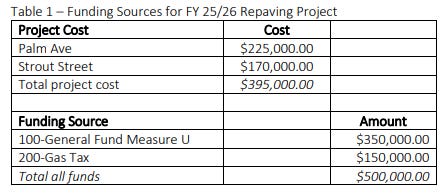
Hart noted that there was enough money in the repaving budget ($500,000) to add a third smallish street, which she asked the council to choose, based on this list of other streets that are also in poor condition.
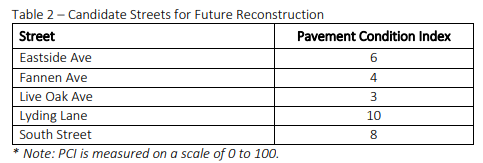
Although, it wasn’t listed, Hart noted that the PCI score for Palm is 8 and the PCI for Strout is 3.
Mayor McLewis asked which street Hart would recommend for the third repair. Hart said, “I would select Fannen, just because it’s a connector road between Petaluma and South Main as well, and so it gets the most traffic.”
When it came time for public comment, more than a dozen speakers rose to say their streets were in dire need of repair. Many came from Strout Street, a short street in the neighborhood behind the downtown Safeway, while others made the case for repairing a trio of streets off Palm Avenue, including Western, South and Eastside avenues.
Shannon Peterson, who has lived on Strout Street for 33 years, put it this way. “Our stretch of Strout Street reminds me of our travels in a third-world country, when our driver would swerve up over the curb and drive on the sidewalks for long stretches to avoid their horrible crumbling roads. For years now, we have watched our street further deteriorate with no upkeep…We have seen only half of the potholes filled infrequently, and with the heavy rain and traffic, the potholes are treacherous. We pay our taxes and in return, we expect the people in charge will keep our roads in a reasonably safe condition, thus allowing one to be able to ride a bike down our street without a pothole swallowing up our front tire and throwing us over the handlebars.”
Streets like Strout, Hart noted, require full replacement, not just patching. “The pavement is pretty much failed all the way down to the sub-base.” In fact, a couple of neighbors from these very low PCI streets asked the city to stop sending the street sweeper down their streets because it just creates a storm of dust and flying gravel.
Hart pointed out that her plan was to get to all the streets mentioned by the commenters in the next year: three in the coming six months, and three in the next fiscal year, which starts in July.
It seemed like a slam dunk. Alas, it was not to be so.
Councilmember Hinton said she was opposed to prioritizing Palm, a short connector between South Main and Petaluma Avenue, just south of the hospital area. She thought there were worse streets, and Zollman concurred.
“I don’t feel like we have a scientific plan and analysis,” he said, clearly frustrated. “I want a scientific method…I’m thinking it should be PCI, but I’m hearing from staff that it’s a balancing test as well. I’m not understanding the factors of the balancing test…So I’m not in favor of moving ahead. What I am in favor of is helping people get their needs met by having it come back in a month with staff being able to cite a scientific analysis…for why we voted to spend money on one street or two streets, because, right now, this does not make any sense to me. So I just want to put that out there. I’m not voting for this tonight. I’m voting for a continuation, for a thorough analysis that everyone in the public can understand.”
Hart tried again to explain the concept: yes, streets are chosen on the basis of PCI, but also on the basis of which streets get the most use—that it’s a balance between the two.
Councilmember Maurer begged the council not to delay.
“I think the difference we’re talking about here, hopefully, is a matter of six months between doing all of these streets,” she said. “Our public works director said she’d hope we could get them all done within the year. So you’d have a first batch, and then you’d have a second batch. So I’m willing to go with what staff is recommending: Strout, Palm and Fannen.”
Late in the debate, the attorney Schuyler Schwartz, a Redwood Public Law attorney who was standing in for the city’s usual City Attorney Alex Mog, decided the council couldn’t decide on a third street after all, since that decision hadn’t been properly noticed in the staff report.
A clearly frustrated Jill McLewis said, “That’s why I was asking earlier for someone to clarify what we were talking about…it would be good if we got the proper guidance in the beginning so we didn’t waste everyone’s time talking about all this stuff, thinking a decision could be made.”
In the end, the council voted 4-0 to repair just one street: Strout.
Though they voted to approve, McLewis and Maurer were clearly frustrated with this outcome. “Why does everyone hate Palm?!” McLewis exclaimed earlier in the evening. After voting yes, Maurer said, “I’d just like to get something done.”
Council approves a $15,000 fee waiver for Apple Blossom
The council often grants city permit fee waivers for events it believes benefit the community as a whole. The Sebastopol Chamber of Commerce was requesting a $15,000 waiver for Special Event Permit fees, City staff time and material for the Apple Blossom Festival and Parade not to exceed $15,000. This included a Special Event Permit Fee: $1,950; Public Works Staff Time: $4,255.04; Material/Rentals: $2,855.34; and Police Staff Time: $5,670.
In the past, the council has asked to be reimbursed for some of this by the Chamber if it made enough money at Apple Blossom, which is their biggest fundraiser of the year. Mayor McLewis said she didn’t want to pay for the material/rentals, which she felt should just be accounted for by the Chamber as a cost of doing business.
Councilmember Maurer suggested as a compromise that they grant the waiver, but that the Chamber reimburse the city for $2,855.24 in materials after the event. The council approved this 4 to 0.
No exemption for small fee waivers
Sebastopol currently requires that all fee waiver requests must be reviewed and recommended by the Budget Committee going before full City Council. Frustrated by a delay in processing the Kiwanis Easter Egg Hunt’s request for a city special event fee waiver, Councilmember Hinton put forward a resolution to waive Budget Committee review for fee waiver requests of $2,000 or less.
“I brought this forth because it saves staff time, and it expedites the situation, and it’s such a small drop in the bucket…of our multi-million dollar budgets, I just don’t see why we have to go through that extra step of the Budget Committee, which we never used to,” she said. “It just seems like we can avoid a lot of red tape by bringing it straight to council.”
Mayor McLewis concurred, arguing that it was “an attempt to reduce the bureaucracy that so many people despise government for.”
Council members Stephen Zollman and Sandra Maurer opposed this, arguing that all expenditures, outside of the existing city budget, should have to go through the Budget Committee first. Maurer also noted that the Chamber's request for a $15,000 waiver for permit fees and city services had never gone before the Budget committee, in violation of the existing policy.
The vote split two to two, and thus the motion failed.
Limiting staff time for agenda items proposed by city council members
Frustrated by the amount of staff time spent on Councilmember Carter’s soccer field proposal (more than 20 hours), Mayor McLewis and Councilmember Zollman put forward a proposal for a change in city protocols that would limit the amount of City staff or consultant time that a council member could command without approval from the council as a whole.
Interim City Manager Mary Gourley said the City Protocol Committee decided five hours sounded like a reasonable limit. Councilmember Maurer thought this was far too much. She said she’d been under the impression that councilmembers were supposed to do most of the legwork themselves on proposals so that staff only had to spend one hour compiling the report. (That one-hour number turned out to be apocryphal.) Gourley said three hours was a sort of unwritten rule.
Councilmember Hinton, who has been on the council since 2016, said that in her experience the amount of time required by staff for various councilmember proposals varied widely, depending on the topic. “I don’t want to put a policy in place that really ties our hands,” she said.
Mayor McLewis asked Gourley to explain what controls had been put into place to make sure excessive expenditures of staff time at the request of a single councilmember didn’t happen again.
“I’ve spoken with all department heads, and any item that is coming forward now has to be run through the city manager’s office,” Gourley said.
When the vote was called, the council split two to two again and the motion failed.
After the meeting ended, one council member said this had been the worst council meeting they’d ever experienced—what with the time wasted talking about an issue that hadn’t been properly noticed combined with the deadlocks caused by a councilmember’s absence.
See the agenda and documentation for the April 21 council meeting. The next Sebastopol City Council meeting is Tuesday, May 5, 6 pm, at Sebastopol Youth Annex, 425 Morris St., Sebastopol. See the agenda and associated documentation for the upcoming meeting.
Thanks to Roger Coryell for his work on the agenda item regarding the appeal challenge to Mansoor’s alcohol permit.
