


This is Part 1 of a two-part article.
Tuesday’s packed city council meeting included an audit of last year’s budget and discussions of street repair, a blight ordinance, and Narcan distribution boxes. The council also quickly approved extending the contract for Interim City Manager Mary Gourley. They also revisited their vote to opt in to AB1033, which allows residents to sell their ADUs as condominiums.
Mayor Jill McLewis, Vice Mayor Sandra Maurer, Councilmember Phill Carter, Councilmember Neysa Hinton, and Councilmember Stephen Zollman were present in chambers for the Jan. 20 Sebastopol City Council meeting.
The meeting began with interviews for three openings on the Design Review Board. There were four candidates and, after the interviews, the council chose DRB veterans Lars Langberg and Melissa Hanley and newcomer Blake McDowall.
There was a very short consent calendar: just the typical approval of a previous meeting’s minutes and what was meant to be the finalization of their vote to approve condominiumization of ADUs. The council had voted 4 to 1 (McLewis dissenting) at the Jan. 6 council meeting to allow this, but McLewis wasn’t going down without a fight. She pulled the 1033 ADU condominium approval off the consent calendar and tried vainly for more than an hour to convince her colleagues that it was a very bad idea. More on this issue in Part 2 of this article.
Presentation: The audit of the 2024-25 budget
The city’s new auditor, Chavan and Associates, gave last year’s budget the thumbs up or to put it in the confusing language of auditing, “an unmodified opinion.” Which is a good thing. The audit found that the City’s financial statements were free of material misstatements and complied with generally accepted accounting principles and standards.
“Just from a budget committee perspective, I wanted to point out two things,” Councilmember Maurer said. “This seemed to be a really good experience for both staff and the auditor. They got a lot of praise during the budget committee and said it went really well. So thank you both for that. And then there was one recommendation that I thought was of interest…and it’s that they recommended that the staff implement a routine and timely petty cash count and reconciliation process for the police department. The staff said they were working on that.”
Note, there was no suggestion here that the police had been running amok with the petty cash; this was merely a procedural recommendation.
A final note: as a reporter who has listened to many an audit presentation over the years, this is the first time I have heard one delivered in plain, non-jargony English that everyone could understand. See the full audit here.
The digout list
Sebastopol has some of the worst streets in the Bay Area. That’s not an opinion. That’s the official determination of the Metropolitan Transportation District’s Pavement Condition Index, which ranked Sebastopol’s streets 11th from the bottom (that was Vallejo).
During the public hearing for this year’s Capital Improvement Plan, the city council added $500,000 for street repairs. At Tuesday’s meeting, Public Works Supervisor Eric Billing presented a draft list of streets for digouts and repairs.
Mayor McLewis complained that Palm Avenue, which is in serious disrepair, wasn’t on the list.
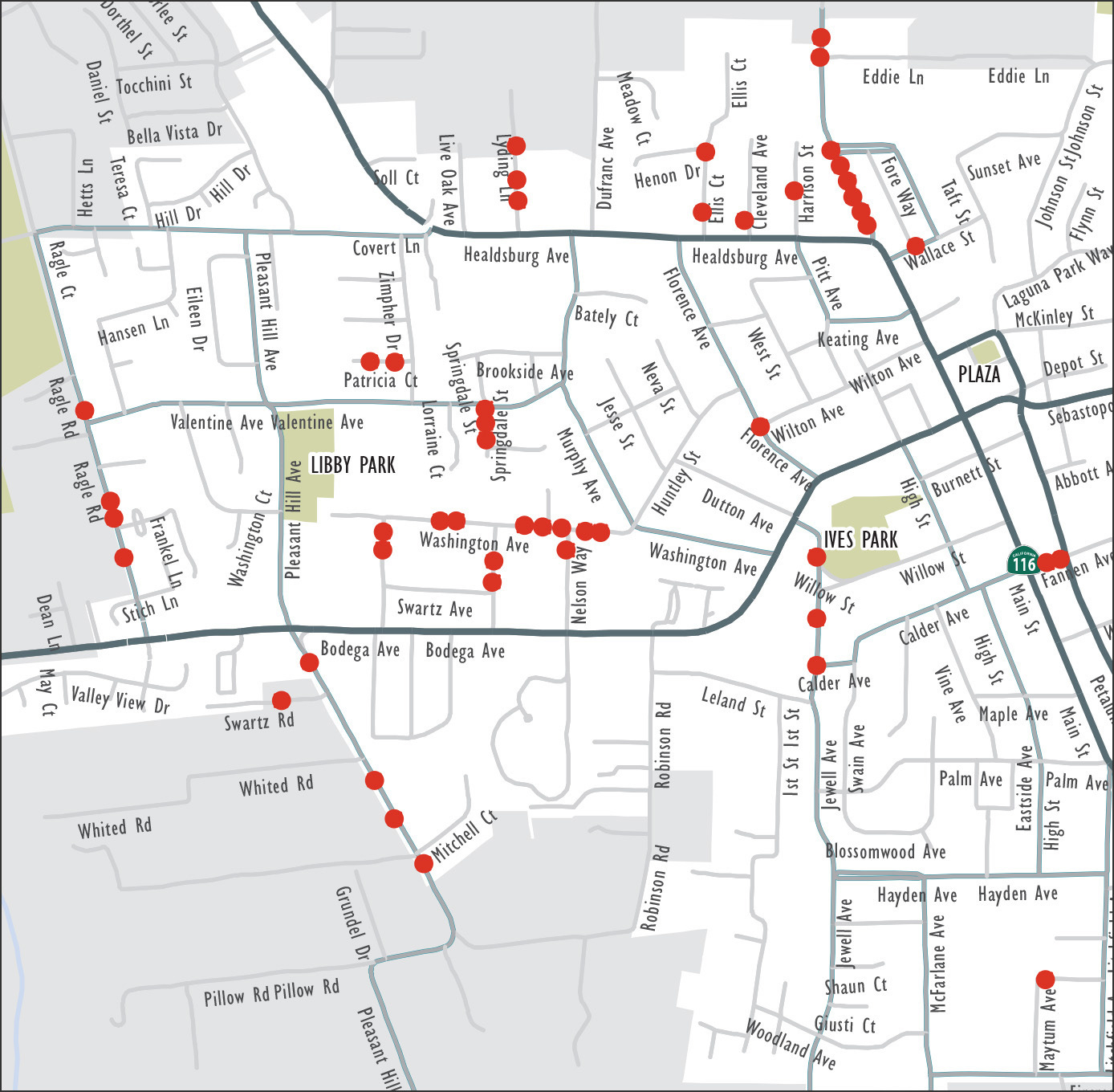
Billings described a digout as “a step above pothole filling.” The process involves removing a section of pavement, reinforcing the base, and filling it with new asphalt.
There was some confusion about how long this fix would last and whether it was just a band-aid solution. Billings at first said a digout repair would last “one to two to three years” then upped that to three to five. The city’s contract traffic engineer, Mario Landeros, thought digouts would last five to 15 years, depending on the surrounding road surface.
Mayor McLewis and Councilmember Zollman questioned whether it was worth spending a large sum of money on temporary solutions. McLewis suggested that fixing a smaller number of streets permanently would be better than this temporary, scattershot approach.
“It’s not a waste of money,” Billings said. “It helps us preserve the pavement that we have now so we can get a more permanent solution.”
That permanent solution, the city hopes, will come in the form of a grant the city has applied for from the Sonoma County Transportation and Climate Action Authority (SCTCA) for overlays and reconstruction work. According to the staff report, “The grant is highly competitive, and the City will not know whether the grant is awarded until spring/summer this year.”
“If we are not awarded that grant, then we’ll have to come back to Council to take a look at how we’re going to start repairing some of these streets, such as Palm Avenue, given our funding constraints,” said GHD Engineering consultant Toni Bertolero.
Both Mayor McLewis and several public commenters expressed frustration with the idea of waiting for a grant. Frequent commenter, Robert, noted that the city had been waiting for one grant or another for years.
“That’s what every council the last 20 years has said: ‘We’re going to get grant money. This is going to be solved with grant money.’ In the meantime, you’ve gone from what might have been good streets 20 years ago to now over half the streets in the city are very poor,” he said. “It took 15 to 20 years of neglect to get that far along, and anytime you say, ‘You know what, in a few months or next spring, we’ll make a decision. Every time that happens, it puts it out another year.”
In the end, the council decided a temporary fix was better than no fix. They voted 4 to 1 (McLewis dissenting) in support of the list of Draft Street Locations for Digouts and Repairs, with the possible inclusion of a pothole on Bodega near Gravenstein Grill (The city needs to check to see if that particular pothole will be fixed by the Bodega Avenue Rehabilitation project.) The final list will be returned to a future city council meeting for approval. Staff will also look into the cost of restoring and repaving Palm Avenue and will bring that back to council as a future agenda item.
Council kills Blight Ordinance
In September 2024, the City Council directed the City Attorney to prepare a blight ordinance to address nuisance conditions that occur on private properties around the city now and then. City Attorney Alex Mog said the ordinance was written broadly to deal with a variety of conditions and that enforcement officers would have to use discretion in deciding which instances of blight to pursue. Investigation would be complaint driven.
As the council discussed the ordinance, however, some councilmembers noticed that many of the restrictions—which regulated what you could keep in your front yard, driveway or backyard, as well as the condition of buildings, fences, and walkways—might apply to their own properties.
Councilmember Hinton was first out of the gate. “I think there’s so many unintended consequences to this,” she said. “I’d be willing to look at a briefer ordinance that solves a problem that doesn’t involve backyards, that doesn’t involve criminal action, that doesn’t involve $500 a day fines, which I think is just out of reach for so many people who are just trying to survive. I mean, I know I have a rotted fence post in my backyard right now. My neighbor keeps reminding me about it, but I’m just not going to support this tonight. It’s a deep, broad ordinance, and there’s so many changes that would need, in my opinion, to be made to make it viable. I understand the intent, but this is just too much.”
Councilmember Maurer found it equally unappealing. “I understand that the bottom line is that this is a tool to get compliance. But in my opinion, it’s too strict. When I attended the Mayors and Councilmembers Cal Cities Conference in Sacramento when I was first elected, I was talking to the city manager from somewhere in the Bay Area, and he said, “Oh, Sebastopol. Sebastopol is so kind.’ And I really felt good about that—that this was a reputation that we had, as kind. And to me, this ordinance is not kind at all. I think there’s a risk of pitting neighbors against neighbors.”
Maurer said she’d discussed this ordinance with some of her neighbors. “One of the first things they said was, “Why didn’t we get notice of something like this?” If the city is going to reach into people’s backyards and front yards, businesses’ backyards and front yards, have the ability to go in and inspect these places and have such serious fines, maybe there should have been more notice.”
McLewis said she was in favor of the ordinance, in part because of issues she’d had in her neighborhood with old, inoperative cars in a neighbor’s driveway and on the street that became homes for rats—a problem she said lasted a decade, while she appealed to the city for help to no avail.
“I guess I just want to go back to the spirit of this, which is truly just to help us [the city] with taking care of situations that are truly not acceptable and create safety issues,” she said.
Her fellow council members seemed to feel that existing regulations were enough to deal with any situation that might arise, though some, including Councilmember Carter, expressed interest in a more limited ordinance.
The council voted 4 to 1 (McLewis dissenting) to table the blight ordinance.
Part 2 of this article, about free, public Narcan distribution and other issues, will appear this afternoon.
Blight…wow. I wish our council would come up with creative solutions to issues that affect our neighborhoods. Like mutual aid/community organizing. Maybe we need an org with volunteers that creates some kind of application process for folks that need help getting things taken care of in their yards…People are working hard taking care of families and kids and going to jobs…life is intense, maybe some folks can’t afford it. Maybe they are ill or disabled. Maybe they don’t feel cared for and then choose to hermit and don’t realize what things are like our front…and maybe they are just hoarders. But can’t we have some sort of creativity when it comes to solving some of this without being punitive? Being more inclusive to begin with is what our community and world needs more of. I am happy to see two members were so opposed to this.
I also would really love to understand the process and policy when it comes to who becomes mayor. I do not live in city limits but spend much time in the city. I don’t vote for them. Yet it seems that over and over we have witnessed some leadership that is less than popular. Can someone explain how or why a mayor is chosen from the most disagreed with member of council? I am purely just curious so I can understand how it works. Thank you. I also appreciate these members of council, even when I disagree with them. They are doing a lot of work that I know we don’t all see.
Once again, almost better than being there. If only, like the UN, I could have Laura as a live feed translating the procedure and personality nuances while I watch a meeting live.