

The Reimagining the Core Project, funded by a Caltrans Sustainable Transportation Grant, is coming to an end next month. All the money has been spent. Based on extensive public involvement, the consultants from Fehr & Peers developed four alternatives for different street configurations downtown—two one-way options and two two-way options. After looking at the four alternatives last month, the Sebastopol Planning Commission chose a fifth alternative, a hybrid that combined the pedestrian amenities and downtown parking of Alternative 3 with the two-way street configuration of Alternative 4.
At Tuesday’s meeting, the city council had to decide whether to accept the planning commission’s recommendation or go another way. Mayor Jill McLewis was absent, so Vice Mayor Sandra Maurer ran the meeting.
Interim Planning Director Jane Riley introduced the discussion at Tuesday’s meeting with a few preliminary notes: “This study that you’re going to be looking at does not commit you to implementing anything. I want to be clear about that,” she told the council. “I also want to be clear about the timeline. The planning, design and implementation for reconstructing the downtown is not something that’s going to happen this month or next month, next year or even the next couple of years. Conceivably, we could do some things within a three-to-five-year time frame, but we’re really looking at between eight and 15 years to restructure the downtown.”
Fehr & Peers consultant Geoff Rubendall gave a quick history of the grant project. He said that he is in agreement with the Planning Commission’s recommendation, arguing that “it takes the best of several different alternatives.” In support of the two-way configuration, he said research proved that two-way streets made people drive more slowly, were safer, lowered vehicle miles travelled and supported local business.
Answering Councilmember Hinton’s question about parking, Rubendall said the plan would end up with a loss of 10 to 15 parking spaces across the entire downtown (not just on Main Street) but that many of those would have been lost anyway due to recent Caltrans rules regarding parking near street corners and the visibility problem that causes.
Councilmember Maurer asked Rubendall, “Do you support the Planning Commission decision? Why or why not?”
“I do support their decision,” he said. “The discussion that we had at the Planning Commission included really leaning into the pedestrian walkability of the downtown first and auto circulation second.”
He realized this was controversial. “There’s clearly a lot of communication that we need to have as a community to understand what the full ramifications of any changes would be,” he said. “But a majority of folks that I heard from through the surveys, in person and in workshops really wanted a walkable downtown. So as long as that was the highest priority, you got me.”
This flies in the face of public opinion as measured by Fehr & Peers’ own survey. Out of 646 survey responses, 59% of respondent preferred the one-way solutions (#3 & #1), while 41% of respondents preferred the two-way alternatives (#4 & #2). (The hybrid plan wasn’t included in the public survey because it was created after the survey was completed.) In addition, in terms of letters that people have written to the planning commission and the city council over the last two months, the count was 21 in favor of one-way and only five in favor of two-way.
Rubendall argued that if you looked at survey respondents that had included written comments, what the public seemed really interested in was, not the direction of the traffic, but a walkable downtown.
Ted Luthin supported this theory, saying he’d voted for “Option #3: Walkable One-Way” because he hadn’t liked that “Option 4: Totally Two Way” got rid of all parking on Main Street. He felt the hybrid plan solved this and that many of the people who’d originally voted for “Option #3: Walkable One-Way” would probably now be fine with the hybrid two-way plan.
In his PowerPoint presentation, Rubendall said, “The Planning Commission Recommendation is consistent with community feedback for a safer, walkable downtown that supports local business and would foster a strong sense of community.”
While this statement is technically true, it also ignores the rather clearly stated public preference regarding one-way versus two-way traffic. To point this out is not to say that the public is right and the experts (i.e., the consultants and the Planning Commission) are wrong. It is simply to report the public survey data as it stands without reinterpreting what the survey was primarily about.
Rubendall showed a comparison of how Main Street would look with the Planning Commission two-way recommendation versus the “Option #3: Walkable One-Way,” arguing that they are virtually the same.
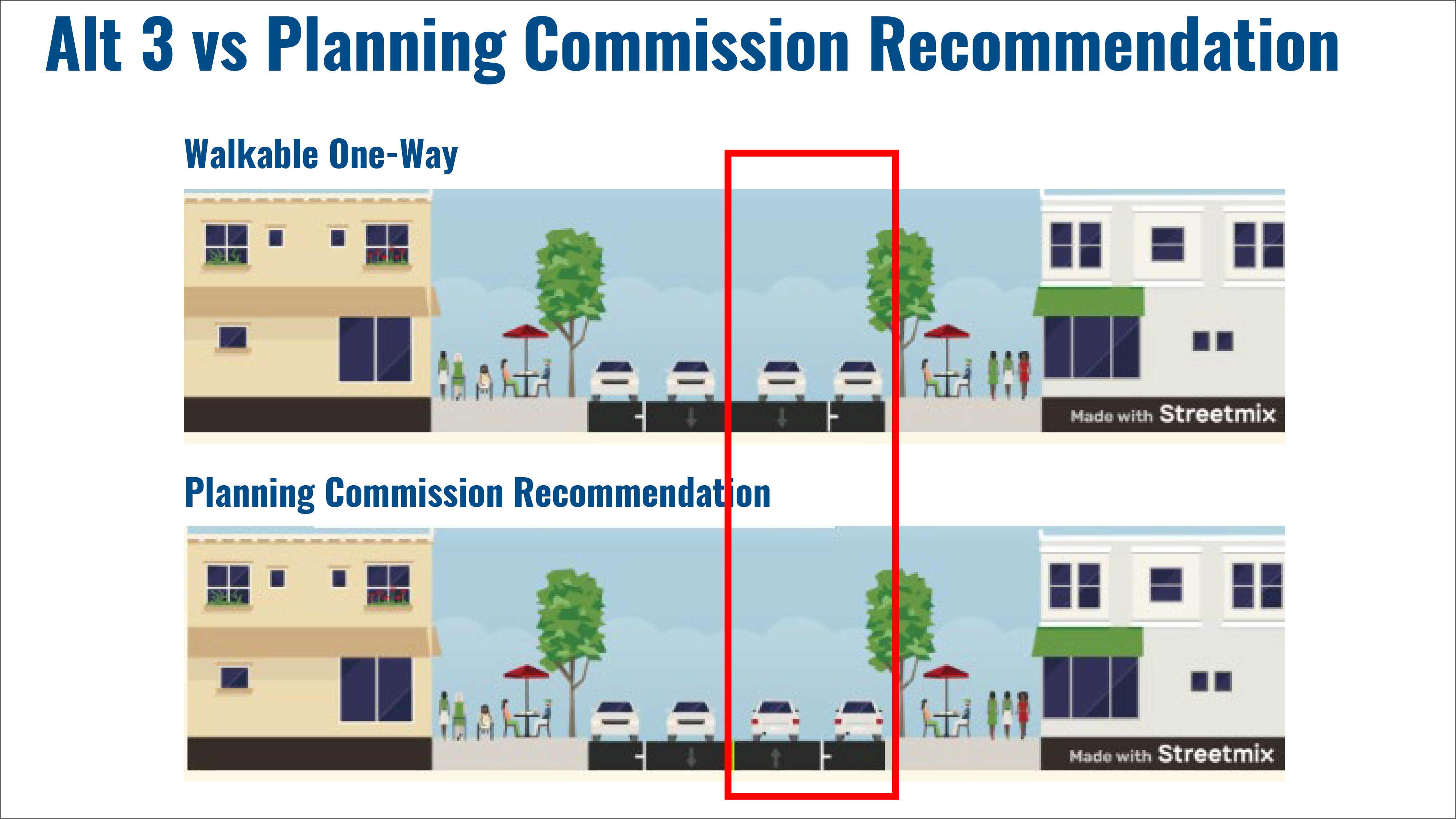
“If you look at it, it is nearly identical, except the cars on the right are facing the other direction…It’s just the auto circulation that is different.”
Public comment splits down the middle
Public comment went on for an hour. There were 25 commenters: 10 in favor of one-way, 11 in favor of two-way, and four whose opinions I couldn’t deduce from their comments.
Lisa Pierce, who has been a consistent voice against a return to two-way streets, was one of the first speakers.
“What we need to acknowledge here is that there is a small but very committed group of people who have a vision that if driving gets difficult enough, people will not use their cars and will walk or ride bikes instead,” she said. “These people have given multiple presentations around town, including at Rotary, Kiwanis, and the Chamber of Commerce. This week, they put flyers around town. The inconvenient truth about this vision is that the vast majority of people who support our businesses and restaurants do not live downtown or even close to downtown. Many who do are older. I’m all for making biking and walking safer in town, widening the sidewalks, narrowing and slowing the traffic, and creating a more beautiful town. Let’s do all that. But changing to a two-way system would create a traffic quagmire. That’s not going to help anybody. It’s pretty clear, looking at this new Alternative #5, that it is the worst one out of all the alternatives, as far as traffic congestion goes, and despite the lobbying from the advocates for two-way system, most people are not buying it.”
Oliver Dick also spoke against two-way streets. Noting that the junction of 12 and 116 is the busiest crossroads in the entire county, he said. “As far as I can see, there seems to be some sort of utopian idea of people walking around and enjoying two-way traffic, and people stopping in and getting a coffee and so on. But the reality is, we have huge through-traffic.”
Bill DeCarli of Hopmonk and Stacey Renati of the Feed Store both opposed the two-way option because of the difficulties (and accidents) they foresaw with people trying to turn, across traffic, into their parking lots.
But for every voice against the two-way option was another voice in favor.
Paul Fritz, a member and former chair of the Planning Commission, has been a longtime advocate of returning downtown to two-way streets. “The question for us tonight is whether downtown is a place to drive through or a place to drive to,” he said. “The one-way coupled system we have today is a mid-20th century solution to moving cars through places as quickly as possible. It is a system that prioritizes vehicles over other users…I read a book recently with this quote that said 20th century urban planning changed the concept of a street from a place to pass time to a place to pass through. 21st century planning is about reversing that mindset and prioritizing people living in a city over cars driving through it. Many other places have restored their two-way street networks to great success. I won’t list them all here, but I have not heard any that have regretted it.”
Designer Tina Grob, whose firm, Sevenfold Creative, is located in downtown, also supported the two-way concept. Grob said, “It seems to be consensus amongst urban and transportation planners these days that one-way streets in downtowns and the focus on increasing the level of service is an outdated approach—an approach that has its origins in the ’50s and ’60s. That’s 70 years ago! Focus has shifted to making towns livable and giving people priority by going to two-way streets. This approach has been applied in many towns and cities, and studies have shown that it has positive impact on bike and pedestrian traffic, but also business revenue. Two-way streets will make being on Main Street a better experience. It seems unreasonable to ignore current national trends, informed and based on current situations in small towns and in cities all over the U.S. and instead favor 70-year-old trends.”
Alice Duvernell, whose business Biophilia Botanicals is on South Main Street, said that Main Street, as it is now, is scary because of how fast the cars are going. Duvernell, who is French, contrasted that with her experience of Europe.
“I have lived in Europe most of my life, and when I go to Europe, I heal, and the reason I heal is because I walk, and the reason I feel happier is because I feel embodied. I have an experience in town where I feel like I’m slowing down: I’m having eye contact; I’m seeing kids on the sidewalk; I’m seeing animals interacting with people. And there’s something that happens in the heart.” She urged the council to “consider just breaking the paradigm and bringing this European-style feeling to this beautiful city and making it a destination and a place where we feel safe.”
Ted Luthin explained his support for the Planning Commission’s hybrid two-way model this way: “To me, it sounds like a win, win, win, win—a four-way win. Pedestrians win with the more walkable downtown, drivers win with reduced travel time and miles driven…businesses win by having a more pedestrian-friendly downtown, and families win with the safer streets. So to me, this is kind of a no brainer.”
Former Councilmember Michael Carnacchi had the most cynical—and, alas, probably most accurate—take of the evening. “I’ve had a small business on Main Street for 33 years now, and over those years, I don’t have enough interest to count how many studies this city has invested in,” he said. “Time, staff, consultants, and basically, lots of money has gone into all of these studies that currently sit at City Hall, collecting dust. So the truth is this is another one of those studies. It’s going to be done, we’re going to say, ‘Yahoo!” and then we’re going to put it on the shelf, on top of the last one to start collecting a new coat of dust. I think that big aspirations are great, but I just don’t ever see this happening.”
Council discussion
Many of the councilmembers alluded to Carnacchi’s comment by asking Rubendall about the funding available to actually build the hybrid plan recommended by the Planning Commission—or any of the other options. Caltrans and the Sonoma County Transportation Authority were mentioned as possible grant sources.
“The grant study will include a chapter that identifies many of the grant opportunities and how the preferred alternative could be funded,” Rubendall said.
He also said the study would include a “planning-level cost estimate for the preferred alternative” which “goes into how we know we need to get $10 million or $100 million or a gazillion dollars.” (He said he was joking about the gazillion figure.)
Because the Planning Commission’s hybrid alternative hasn’t been fully studied and all the grant money is spent, the city will have to toss in an additional $7,000 to $10,000 dollars from Planning Department budget to pay for Fehr and Peers to do the kind of in-depth study on the hybrid option that they did on the first four alternatives.
Council discussion was relatively brief. One by one, for their various reasons, councilmembers embraced the Planning Commission’s recommendation of a hybrid plan. Councilmember Phill Carter pushed hard to move the bike path from Petaluma Avenue to Main Street, and his suggestion was ultimately incorporated into the complicated motion made by Councilmember Hinton. Restated by Interim City Manager Gourley, that motion went as follows:
“To affirm the city’s primary downtown priorities—our safety, walkability, environmental sustainability, business vitality—the future street design decision should advance measurable improvements in these areas; adopt Planning Commission’s recommendation to advance a preferred downtown street design framework that achieves the priorities by narrowing portions of Main Street to calm traffic and shorten pedestrian crossing distances, retaining on-street parking on Main Street to support local businesses; incorporating protected bicycle facilities on McKinley and Petaluma avenues; establishing a two-way circulation framework for Main Street and Petaluma Avenue; directing staff to enter into a professional services agreement with the consultant not to exceed $10,000 for the additional study, as outlined above; eliminate the two mid-block crossings between McKinley and Bodega Avenue in the downtown; and explore limited options to explore the two-way cycle lanes on Main Street.”
This motion passed with 4 votes in favor.
A Q&A with Geoff Rubendall
Councilmember Sandra Maurer created a list of questions for Fehr & Peers consultant Geoff Rubendall. At Maurer’s request, Interim City Manager Mary Gourley sent this Q&A around to other councilmembers the day of the March 3 council meeting.
Do you support the planning commission decision, and why or why not?
I support the recommendation of the Planning Commission. Given what we have heard and learn throughout this process, I feel their recommendation and thoughtful reasoning behind it are well aligned with the community goals expressed as part of this study and industry best practices related to safety and placemaking.
Do you have any reservations about their direction? Please explain.
No reservations. The process will take time and energy (and grant funding) but that is likely the case with any of the alternatives.
Please provide your credentials, i.e., what qualifies you to do this study and how long you’ve been doing this kind of work?
I am a registered civil engineer, traffic engineer, and passed the Roadway Safety Professional certification exam. I have been practicing complete streets planning design and engineering for over 20 years. I am surrounded by professionals with more experience in the transportation planning and engineering field, including several colleagues on national boards of safety and complete streets initiatives.
Will refinements—i.e., plaza design, sidewalk width, etc.—return for later decision or can we see them now?
I think this study seeks to identify a commitment to improvements and enhancements, but does not plan to lock in any particular plaza improvements. Or at least it doesn’t have to. If the council sought to make that part of the final plan adoption, that would be fine, but I wouldn’t suggest that be part of this study other than acknowledging the Plaza itself serves a purpose today and can build on that over time as part of the larger downtown enhancements.
Is there a redesign plan for the plaza?
No, just identifying that it can be enhanced based on a community-driven planning process.
How many parking spots will this preferred plan eliminate and where?
We haven’t looked at that since the hybrid configuration the Planning Commission recommended. That is new. I would estimate we are talking about 15 to 20 fewer parking spaces on the street that are there today. Our existing conditions assessment identified about 600 parking spaces in the downtown core, in a combination of on- and off-street facilities. So that parking change is about 3 to 4 percent fewer parking spaces in the downtown core. One of our proposed recommendations is to perform a detailed parking and curbside management plan as a future study to evaluate what and how the parking policies, operations, and supply are working or not working, and come up with strategies to make the most out of potential parking facilities on the street and in private lots under the city control.
In the meetings and preparations, was the potential Gravenstein Apple Trail discussed as an alternate bike path to Petaluma Avenue?
The Gravenstein Apple Trail has not been advanced as part of this, nor has the Apple Blossom Trail. However, we are looking at additional bikeway connections via off-street paths that can further accommodate safe and comfortable bike use for all ages and abilities. This study builds off of the community engagement, recommendations, and projects identified in the Active Transportation Plan.
What about left turns?
We propose to accommodate access at various intersections. Any proposed left turns at signalized or other major intersections are expected to be protected left turns, not the “permissive” left turns described from the pre-1985 conditions. This is what our analysis has included/assumed as part of this study.
Can you confirm this effort is aiming to reduce Caltrans liability?
I wouldn’t categorize this study as aimed to reduce Caltrans liability. This study is enabling the city to evaluate opportunities to improve Caltrans roadways in the downtown core using Caltrans recent Complete Streets Design Standards, to address mobility and access to make the streets through downtown work for the community, to support businesses and a more vibrant downtown.
Can Cal Trans direct people down Occidental Road to go to Santa Rosa? Or Llano for through traffic to Forestville/ River area?
This question is a bit complicated to answer via email, but I will say Caltrans is not typically directing motorists off of their facilities, except in emergency or other ways the local agency supports (such as the I-80 ICM corridor in Albany/Berkeley/Oakland). I would say Caltrans’ policy is to safely accommodate users of their facilities and design their facilities according to their own policies and standards, partnering with local agencies such as Sebastopol when their facility is part of their roadway network spine.
If the Council approves two way and people initiate and get a ballot measure to return to one way, what happens then as far as Caltrans goes?
Based on my understanding, if the Council approves/decides to convert to two-way circulation, the City would have to work with Caltrans to secure approval and implement the change within their right-of-way. Because this is a state highway, neither the Council action nor a ballot measure can change the configuration by itself. If a future ballot measure directed a return to one-way and it required the city to take action, the City would need to formally request Caltrans approval again, and Caltrans would evaluate it based on safety, operations, and state policy before any change could occur.
How were the four options developed?
They were developed based on community feedback of 11 circulation options and community feedback, stakeholder input, and our initial regional circulation assessment effort.
Was a traffic count completed, and if yes, how was it done?
Yes, in November 2024, we collected peak hour traffic counts, hoses on the ground that collected speed volume and vehicle type data and watched video of the intersections to determine existing queuing of cars through intersections.
Was there an analysis of the traffic and traffic patterns?
Yes, we developed a detailed model of the study area using a software called VISUM and tested the different circulation options and reported out network level metrics. We also performed intersection operations analysis for the signalized intersections for all four alternatives.
Were the four options based on a study or public feedback?
They were developed in response to community feedback, results from our analysis, and “built” using Caltrans’ Complete Streets Design Standards and modal priority from Caltrans DIB 94, their recently adopted design standards for context-dependent Complete Streets Design Standards.
What are the credentials of your consultant team?
Our team includes folks from several firms, certifications and licenses, including Professional civil engineer (PE), professional traffic engineer (TE), American Institute of Certified Planners (AICP), Roadway Safety Professional (RSP), as well as licensed an architect and registered landscape architect (RLA).
While I don't know whether two-way or one-way is ultimately a better, safer traffic configuration, I do have to ask WHY we have to reinvent the wheel and have this conversation every few years when other, more pressing (and probably less expensive and less headache-inducing) traffic concerns should be dealt with first (like finish repaving Bodega Hwy out to Watertrough Road!). In fact, I have a lot of "why" questions about this issue:
-WHY not wait until we've lived with the other massive changes approved by the planning commission and city council that are going to affect Sebastopol traffic (the hotel on Depot Street and the condo-ification of the O'Reilly building) and see how they impact the town before deciding to create further chaos redesigning the flow of traffic?
-WHY not take an honest look at prior planning commission and city council approved measures that have made traffic worse and try to remedy those first (2-lane reduction to 1-lane)?
-WHY have a small number of people make decisions about huge issues like traffic flow and congestion when they admit that auto traffic is not their chief concern in redesigning city streets (Rubendall, Fritz)?
-WHY all this talk about making Sebastopol more walkable? This town is eminently walkable with sidewalks and crosswalks everywhere in the roughly 2-mile town radius. All the talk of turning Sebastopol into Amsterdam with bikes everywhere, or Brooklyn with closed-to-traffic streets, completely --and cruelly-- disregards the fact that Sebastopol is a town that serves a huge rural population in a hilly area that requires vehicular access by most of those people living in West County. These people not only outnumber the town residents many times over, they also pay Sebastopol sales tax with every purchase they make in town, yet they get no say in what happens in town. For all you town dwellers who pat yourself on the back for being green and buying local, try thinking about all of us who make and grow the goods you buy at your local stores but who need vehicles to transport them to you.
-WHY are the city planners and city council so unconcerned about traffic, and so blind to the fact that increased traffic is going to make their utopian vision of Sebastopol even more unattainable (walking and biking amidst angry drivers fighting traffic and who can't park their cars is no fun). Sebastopol isn't --and shouldn't be-- a theme park. It's a working town for working people. It’s an economic center covering a vast geographic area that's provides necessary goods and services to a broad area, not just constant entertainment for tourists, pedestrians and bikers. City planners and city council need to stop feeding this insatiable desire to somehow make a perfect Sebastopol. Recognize that it's a nice town with a lot going for it already, and trying to make huge infrastructure changes to it every few years, without the total support of the majority of its consumers and inhabitants (in the widest sense possible) is reckless and, ultimately, futile.
Thanks to the Sebastopol Times for ongoing thorough evenhanded reporting of this issue, and many others.
A link to comments on the One Way vs Two Way Street issue is attached. The comments highlight how the public surveys were ignored, Geoff Rubenall from Fehr and Peers was forced into backing away from his company's carefully considered trade study recommendation to back an undefined hybrid plan, the traffic situation was ignored, impacts to surrounding streets were ignored, safety impacts are not substantiated, impacts of removing parking from downtown businesses were ignored and there is no commitment to improve or maintain bicycle infrastructure.
Comments were made by authorities in the Commission Meeting regarding improved access to the Barlow and the hotel (that will never be built without tax abatements), that's may be what this was really about.
Here are detailed comments on the two way traffic plan.
https://drive.google.com/file/d/1jxpBcBoRBN3TxMdR9CQ0L-5i467SfXAF/view?usp=sharing
But there is no need to be concerned, the time frame for this is so far out that we will all be in flying cars before it happens.
Lastly, there have been so many private meetings on this issue between City Council members and various interests that the Brown Act may come into play. Feed the following question into your favourite AI and see what you get:
Is the following statement from a City Council member in possible violation of the Brown Act in California? "Even if you attended, you're not privy to all the details, and council members have very limited time to explain their thinking at the mic. That's exactly why the conversation we had beforehand was so valuable — thank you sincerely for all of that input."
Additional details provided upon request.