


Well, that was rough. Despite a host of important and provocative items on the agenda, there were just a handful of council watchers in chambers at last night’s meeting, and some council members—and public commenters—got a bit testy.
Work still got done. Council voted to remove some newspaper racks from public spaces but declined to prevent people from sitting or lying on local sidewalks. They voted to reimburse the city’s water and sewer funds for $350,354 in misallocated legal fees, approved 10 hours of legal research on the question of how to deal with racist incidents behind the Safeway, and gave the go-ahead for the city to spend money on the EIFD (Enhanced Infrastructure Financing District) in hopes of profiting from that arrangement in the future.
In Part 1 of this two-part recap, we’ll cover the beginning of the meeting, which included an unusually substantive public comment period, the consent calendar and the newspaper rack debate.
Mayor Jill McLewis, Vice Mayor Sandra Maurer, Councilmember Phill Carter, Councilmember Neysa Hinton, and Councilmember Stephen Zollman were present in chambers for the Aug. 4 Sebastopol City Council meeting.
Proclamations
The city proclaimed August 24 as Ukrainian Independence Day.
Public comment for items not on the agenda
Public comment seemed particularly interesting this week:
In public comment, Steve Levenberg of Sebastopol World Friends thanked the council for the proclamation above and reminded the council that Sebastopol has a sister city, Chyhyryn, in Ukraine. “The people in Ukraine really appreciate any show of solidarity. It just makes them not feel so alone,” he said. “Sebastopol World Friends has been a strong supporter of Chyhyryn and has raised funds since 2022 to benefit humanitarian projects in and around Chyhyryn. The most recent one being that of renovation of a dormitory that’s housing internally displaced people who have lost their homes and often lost their cities as a result of the war. It’s very exciting tonight to announce that Sister City International recently awarded Sebastopol World Friends the award for Innovation in Humanitarian Assistance.” He noted that Sebastopol World Friends continues to raise funds for the dormitory project, and said that Rotary Sebastopol, in coordination with a Ukrainian Rotary Club, received a $140,000 grant to help with the completion of that project.
Bianca Blomquist praised the work of “Keep Sebastopol Local,” a group opposed to Grocery Outlet coming to town. “I just wanted to recognize the work that the Keep Sebastopol Local campaign is doing, and how important it is that the City Council sticks to its General Plan. Keep Sebastopol Local campaign is doing a great job of reminding folks of what that General Plan is,” she said. “But we just really encourage the City Council to continue to evaluate how the Grocery Outlet proposal will impact our workers and the small business owners and the small grocers and independent grocers that already exist in Sebastopol. Economists like to call this the local multiplier effect. That for every $100 spent at a locally owned business, it generates about $68 in local economic activity, and then this is compared with just $43 at a national chain … As the famous economist Michael Sturman says, ‘The more times and the faster $1 passes between hands without leakage, the more income, wealth, and jobs in a community.’”
Laurie Ogg, representing the Sonoma County Commission on the Status of Women, presented a resolution proclaiming August 26, 2026, as Women's Equality Day in Sonoma County.
The indefatigable Kate Haug held the council’s feet to the fire regarding the City's alleged misallocation of Water and Sewer funds:
“I am here to ask why the council and city did not respond to the financial documents produced by the EFOC in the city’s Grand Jury reply? [See our article on the Enterprise Funds Oversight Committee report.] The EFOC has at least 50 pages of financial documentation based on actual city budgets. Why was this not included in the Grand Jury reply? When the council says they want to research more to determine the dollar amount owed to the enterprise funds, why didn’t they respond to all the financial analysis the EFOC has provided? The city organized the EFOC. The ratepayers pay probably $1,500 or more for each meeting, as staff is paid to prepare for and attend the meetings. Why is there no response to the fact that the finance administration cost tripled in nine years to almost $1 million, even though the number of accounts and services remained steady? How come there’s no response to the fact that the cost allocation plan wasn’t adjusted after doubling the size of the finance department, which most likely accounts for the fact that expenses tripled? How come there’s no response to the fact that the current council has allotted the enterprise funds for over 50 percent of their entire budget, even though we all know this is not a true allocation. The EFOC has recommended efficiencies in the finance department. Why hasn’t council responded? The EFOC has recommended getting bids for third-party vendors for billing to reduce costs to ratepayers. Why hasn’t the council responded? Why are ratepayers paying for the EFOC if the council is not going to address the issues with which the EFOC is presented? Why is there no response to the council from valid work that has been done? One of the EFOC’s recommendations is for a forensic accountant.”Lisa and Steve Pierce shared a 2-minute comment period to respond to a recent suggestion by the Building the Commons committee to move the library, city hall, the senior center, the community cultural center and other nonprofits to the O’Reilly site. Lisa said she hoped the library, at least, could remain downtown. “The library should be central and easily accessed by students and pedestrians in town, while the community center, which hosts events with hundreds of people, requires ample and available parking by the event space,” she said. “These two needs don’t lend themselves to being under the same roof.” Steve elaborated on this idea, noting that, if City Hall moved to the O’Reilly site, the library (9,400 sq. ft.) could remain where it is, and expand into the space between it and what is currently the city hall property—the in-between space being roughly 5,000 sq. ft. He noted that the existing city hall building would have to be torn down and replaced with a two-story building (8,000 sq. ft.). Altogether, these would add up to the 22,000 sq. ft. space the Sonoma County Library would, ideally, like a new Sebastopol Library to be.
Kyle Falbo accused the council of “not representing the needs or the interests of the residents of the city of Sebastopol. These council members here are serving the interests of the city employees and city management.” After accusing councilmembers of never questioning the advice of the city manager, financial director or city attorney, despite the questionable recommendations staff has made over the last several years, he said, “We need electeds that serve our residents and the interests of our residents and are not just puppets for the city administration.”
Quick look at the Consent Calendar
The consent calendar consists of items that are routine in nature or don’t require additional discussion, often because they’ve been discussed extensively at a previous council meeting.
In addition to approving the minutes of earlier meetings, the council unanimously approved the following:
Approved an amendment to the municipal code to give the City Manager the authority to hire a City Clerk.
Approved voting delegates and alternates for the League of California Cities Annual Conference & Expo. Mayor McLewis will be attending the conference.
Extend the contract with 8th Wave, a contractor hired to deal with HUD compliance and other issues involving Gravenstein Commons.
The issue of creating a TOT sharing arrangement with the Barlow Hotel—reimbursing the hotel for 50% of its TOT taxes—was moved to the regular agenda for more discussion, but we’ll cover it here.
Public commenters Kyle Falbo, Michelle Kelley and Bianca Blomquist argued that the wording of the amendment to the development agreement gave the city no leverage to ensure those funds would be used to market all of Sebastopol and not just the Barlow Hotel.
Here was the language in question:
“The Developer is required to use the TOT rebate for advertisement of tourism in the City of Sebastopol, including the Barlow Hotel. The City is entitled to request and receive, at least annually, documentation on how the TOT was spent.”
The council seemed satisfied with the amendment as written and voted to approve it on a 3 to 1 vote, Maurer dissenting. (Mayor McLewis recused herself because she runs a small business across the street from the proposed hotel site.)
Regular Agenda
Most newspaper racks to be removed from public right of way
As part of Mayor McLewis’s ongoing efforts to spruce up the city, the council asked city attorney Alex Mog to come up with an ordinance to deal with unsightly, often abandoned newspaper racks. He introduced this ordinance at last night’s meeting.
According to the staff report, the highlights of this ordinance include the following:
Under the ordinance, newsracks are prohibited near certain critical access points, such as within ten feet of any fire hydrant, crosswalk, curb ramp, or driveway. Additionally, the ordinance prohibits newsracks in locations that impede the flow of pedestrian, wheelchair, or vehicular traffic.
There are a number of other rules regulating placement of newsracks in order to minimize blight by overconcentration of newsracks in certain location. For example, the ordinance requires newsracks to be located at least 100 feet of each other, and prohibits more than three (3) newsracks on any individual block. A permit is required before any new newsrack can be installed, and the ordinance establishes requirements for staff to process the requirement in a timely manner.
Under the ordinance existing newsracks have six (6) months to come into compliance with the various location requirements or be removed.
The proposed ordinance’s maintenance standards are intended to ensure that newsracks are maintained in a safe and clean condition. Among other requirements, newsracks must be kept free of graffiti and any plastic/glass parts must be unbroken and free of cracks.
Additionally, the name, address, and telephone number for the owner must be affixed to newsrack.
Newsracks remaining empty for sixty days will be deemed abandoned under the ordinance. An abandoned newsrack may be removed by the City and disposed of if it is not claimed by the responsible party within thirty days.
Vice Mayor Maurer noted that this language would require the removal of the large 8-box rack in front of the theater at the corner of Main Street and Bodega. She also raised a concern about impeding the freedom of the press to distribute their work.
Speaking of the 8-box rack in downtown, she said, “So in that rack, there’s a little library. There’s the Community Voice. There’s La Prensa, which is a Spanish news, and there’s the Bohemian. So were any of these papers reached? Did anybody reach out to them to ask them their opinion of removing the rack?”
No one had.
The problem, according to City Manager Mary Gourley, was that the city didn’t know who (if anyone) actually owned the racks around the city, though she said they were endeavoring to find out.
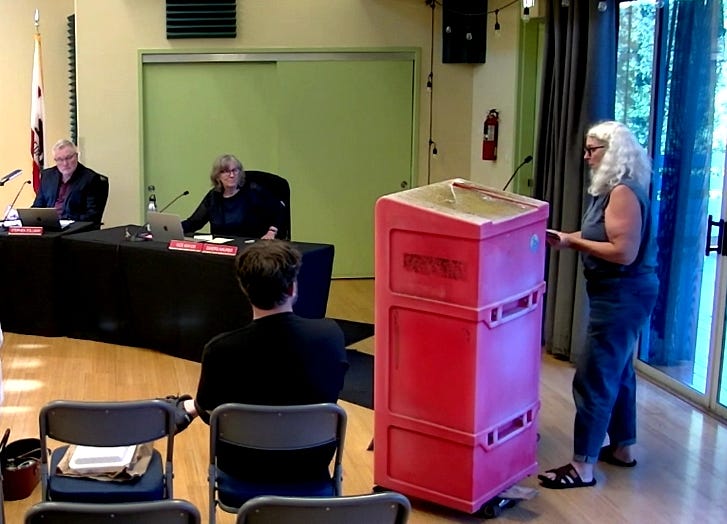
In public comment, Michelle Kelly “liberated” an old, defunct, faded red plastic realtor circular box and wheeled it into the council chamber. She wondered if realtor and other advertising boxes raised the same constitutional issues as newspaper racks. (City Attorney Alex Mog said commercial speech was a form of free speech.) Kelly also noted how these racks and boxes crowded the sidewalks and wondered why the ordinance hadn’t mentioned ADA sidewalk-width requirements. Finally, she questioned the “3 per block, 100-foot spacing” and asked for more objective, evidence-based design standards. Regarding boxes like the one she brought in, she said, “They’re blight wherever they are. This is horrible … Nobody wants this.”
Kate Haug worried about the cost to the city of this ordinance and wondered if the problem of junk racks couldn’t be dealt with in a more forthright way.
“I’m just wondering how much all of this is going to cost to notice and re-notice and go back and forth. Many of these boxes, I too have seen over the last four years, they’re completely shot and abandoned. They look like garbage standing on the street…It almost just seems—if it’s not in use for like three months—that it should just get picked up and put into the garbage.”
Oliver Dick worried about the liability of having defunct metal racks cluttering the public right-of-way. He suggested that the unhoused might pick them up and throw them at passing cars, and the city might be held at fault for that if the owners of the racks couldn’t be identified.
As the co-owner of the Sebastopol Times, I suggested the city simply call up the few remaining print newspapers—the Press Democrat, the Bohemian and the Community Voice—all of whom have or use distribution services, and ask them for their help in dealing with the issue of unsightly or unused racks.
In council comment, Councilmember Zollman echoed the concern about the liability —though not about rack-throwing homeless people—but said he was worried about the cost of enforcement. Oddly, he seemed concerned that the street-level enforcement of this ordinance would be left up to the police. (Enforcement would actually be up to the building inspector.)
Hinton said she was comfortable with the idea that sticking a notice for six months on racks to be removed would be enough to notify newspaper distributors and the owners of the racks about their impending removal.
In the end, the council voted 3 to 2 (Maurer and Zollman dissenting) to approve the ordinance and pave the way for the removal of at least some of the newspaper racks around Sebastopol.
I appreciate your rapid review of the City Council meeting, Laura! The potential newsrack ordinance had my attention, so I submitted my suggestion that, yes, the City establish an ordinance. Too many racks get vandalized or abandoned, so they must be maintained on a regular basis to avoid blight. The spacing of 100 feet apart per rack doesn't make sense since grouping allows people to pick up more than one paper at the same location.
When I owned the Gazette, our distribution team was paid to clean and maintain the racks, but when Sonoma Media purchased the Gazette, they stopped that monthly maintenance, and the new owners even stopped printing the news magazine, but left racks on the streets. I have removed many and donated them for NARCAN distribution sites, but that non-profit has enough now. I volunteered to pick up Gazette racks and donate them to anyone who wants to refurbish them into Little Free Libraries for their neighborhood. I hope to hear back from the Council. Anyone who wants a rack to turn into a library or other imaginative use is welcome to contact me at vesta@sonic.net - the contact information that is STILL on racks even though I sold the Gazette in December of 2019.
It's interesting to watch a public meeting. Who are they for?
First, the stars of the show, the Council and Staff, clearly know more than they say. Council and Staff rarely say anything introductory about an issue. Comments and "discussions" often begin with weedy technical issues. A public council meeting is a terrible place to get an overview of either a problem or an opportunity. If you learn about something for the first time in a public meeting, you can be pretty sure your reaction will be an emotional response to sub-issues.
Second, public comments can come from anybody. It's hard to tell whether comments come from experts, prepared amateurs, local reactionaries, or unidentified identities with built-in conflicts of interest. We saw examples of all of those on display last night.
Third, ironically, clarity can come from the least informed. Perhaps it's the Dunning–Kruger effect. Those with the most at stake, the one's likely to understand a particular issue's place within the larger network of important civic issues, cautiously parse their words. It's so refreshing when a direct question is answered briefly and succinctly.
-----
Practicing what I just preached...
I am the Senior Center representative on the Building the Commons committee. I believe and have experienced professionally that working side by side will produce more opportunities to work together. I've seen that work lead to better outcomes. It is the underlying premise of the Commons. It is why we are looking to bring as many civic facing entities together as we can.
It is why the Senior Center and the library need to be together on a multigenerational and multipurpose campus. To the Pierce's point, the Community Center is a bit of a wobbler, in that their mission is best served when they have multiple kinds of venues at the ready. In the O'Reilly scenario, there is excellent transportation access and parking. We imagine the Community Center having program and event spaces there IN ADDITION to their existing midtown options.
There are all kinds of practicalities at play with the Commons. We could (and have) imagined that everyone stays where they are, and everyone gets a new right-sized, purpose-built facility. That would cost something like $100,000,000; probably take a decade to realize, and it sets up an immediate problem of where to temporarily house everyone during reconstructions. A past estimate of costs to only build a second floor on the library was over $30,000,000.
There are the hard costs and then there are intuitive hurdles. One of which is that no matter where you are along Sebastopol's North/South, East/West corridors, you'll find a group of students and pedestrians who can easily access it. A move of anything will necessarily change the group of people who can walk a few blocks to it. The practicality here is that the service areas for the library, the Senior Center, and the Community Center go far beyond their current immediate neighborhoods. We need to always balance someone's sense of local loss with someone else's sense of gain, and then put both of those in context of the greater community benefit.