
By Lisa Pierce
[Editor’s Note: Sebastopol resident Lisa Pierce was curious about the history of our one-way street system and wanted to learn more. She combed through old Sebastopol Times newspapers, which are all available online. Here’s what she found and how it has shaped her view of the current controversy. She is opposed to Sebastopol returning to a two-way street system.]
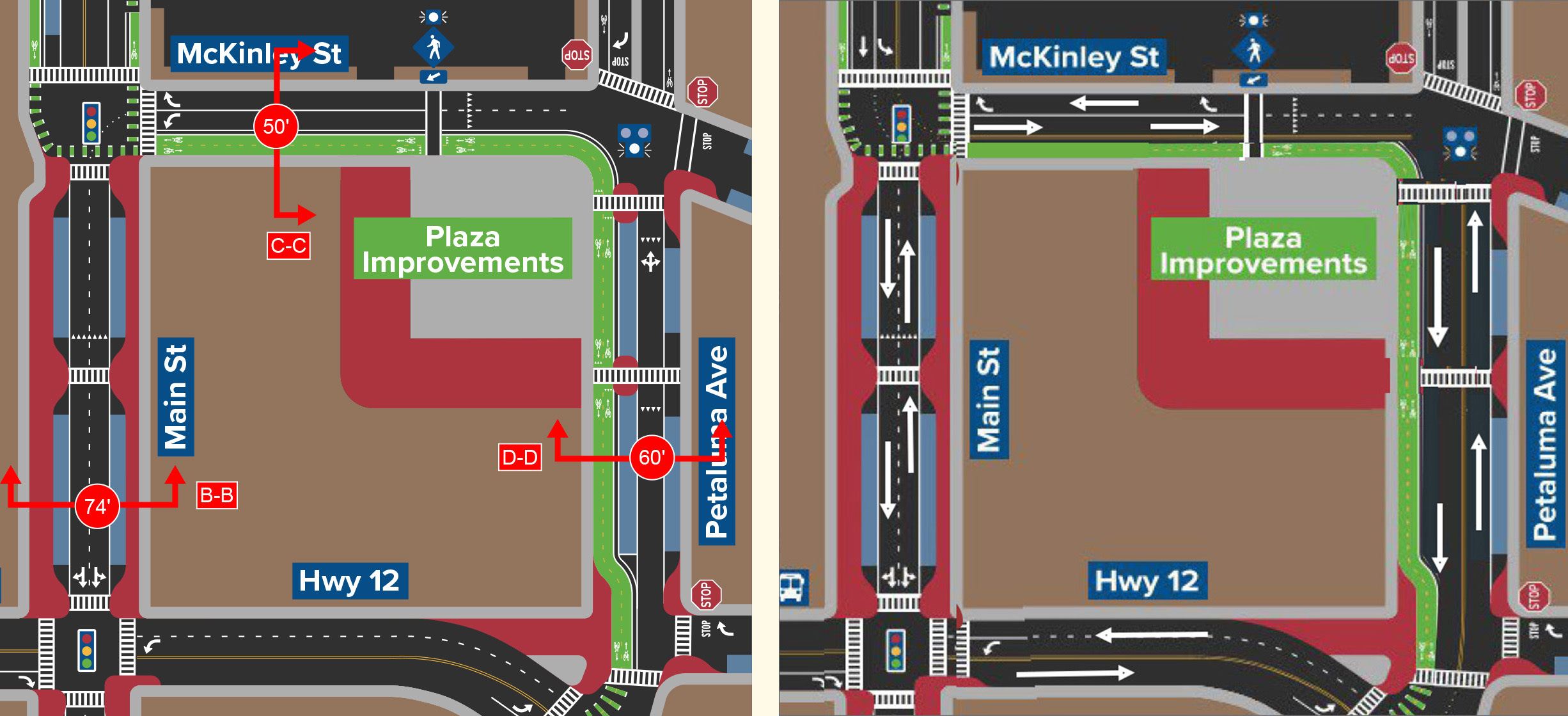
As Sebastopol is facing a big decision, it seems like a good time to look back to see how we got where we are today. Many people don’t know that all of the streets downtown were two-way until 1985 and that changing them to one-way streets created a very long and bitter fight that caused painful rifts among neighbors and friends.
For better and for worse, Sebastopol built itself around the intersection of the two main highways serving the West County. Building a stagecoach stop and then a town on top of these main thoroughfares probably seemed like a good idea long ago.
City Council members have heard complaints about traffic in Sebastopol since before the 1950s. All the streets in town were two-way, and congestion and safety were increasing concerns.
From an article in the Sebastopol Times, Feb. 24, 1977: “The city’s increasingly heavy traffic congestion results in an accident/ injury rate above the state average for similarly sized cities. More than 30% of all accidents occur within a block of the intersecting state routes.” (Hwy. 12 & Hwy. 116)
From an article in Sebastopol Times, April 6, 1978: “Traffic congestion is often said to be Sebastopol’s biggest problem.”
From an article in Sebastopol Times, June 3, 1983: “The change to one-way traffic on Main St. was first recommended in 1958.”
The debate about one-way vs. two-way continued to build through the years and was emotionally charged, as an avalanche of letters to the editors shows.
Finally, in 1984, the city council members put the “creation of a one-way couplet” on the ballot for a vote. This led to a blitz of efforts to win hearts and minds. Yard signs, car windows and buttons on clothing all divided up the people into two competing camps. Many people remember this as a painful period for Sebastopol, and the newspaper certainly shows this. It was “us against them” all over town.
Before 1985:
The arguments against one-way:
Northbound traffic (and customers) would miss seeing the Main St. shops, hurting sales.
Cars would speed through town.
Sebastopol’s charm and “small-town feel” would be lost.
The arguments in favor of one-way:
With no oncoming traffic, vehicles would be able to make left-hand turns without causing a backup.
Many people avoided coming to Sebastopol because of the gridlock traffic.
Businesses were moving away from Main Street because of gridlock. Redwood Market Place was built as a response to shoppers wanting to avoid Main Street.
Bike riders and pedestrians on residential streets were impacted by more traffic because drivers were using side streets to avoid getting stuck on Main Street.
When the votes were counted in the June election of 1984, the results were close:
931 in favor of one-way
887 in favor of two-way
The merchants were also surveyed. Just over half of them voted in favor of one-way.
On June 17, 1985, the one-way system became reality. Naturally, people’s reactions were mixed, although an increasing number of merchants, including Copperfield’s, which had been opposed, expressed in the June 27, 1985, edition of the Sebastopol Times that the new system was better than they expected and did not result in a decrease in sales, as they had feared it might.
From an article in Sebastopol Times, April 3, 1986:
“Sebastopol police Lt. Dwight Crandall said police studies taken six months before and six months after one-way streets came to Sebastopol show a decline in traffic accidents.”
This trend continued. From the Sebastopol Times, June 4, 1987: With the increased population, vehicles moving through town has increased 7.9% from two years ago, but the accident rate has actually decreased by 37% since the introduction of one-way streets.
From the Sebastopol Times, Sept. 10, 1986: “A majority of Sebastopol residents and City Council (4 to1) members voted to adopt the one-way street system two years ago. Since then, many of the people who initially opposed the idea have conceded that it has indeed helped, but not completely solved, local traffic congestion problems. They also agree that the one-way traffic system has enhanced the safety factor for motorists and pedestrians alike, a fact attested to by virtually all local public safety and traffic officials.”
From an article in the Sebastopol Times, Feb. 19, 1987: City traffic engineer Walter Laabs noted that “Traffic was flowing well. A year earlier, before the change to one-way, gridlock had been the norm.”
The biggest reason? Before the change, all vehicles turning left at traffic signals, into parking lots, side streets and driveways had to wait for a break in oncoming traffic to turn, causing traffic to back up behind them. Fewer vehicles could pass through the signal lights because the vehicles turning left came from multiple directions.
Parking was also challenging on Main Street. With packed traffic lanes, backing into a parking space was problematic. After 1985, drivers could keep moving because now, with two lanes, they could go around the parking car.
After the change to our one-way system, there was a vocal group calling for a return to the old two-way system. This was put on the ballot (Measure A) and put to a vote on June 2, 1987. The result was:
1,600 (76%) of voters being in favor of keeping the one-way system
387 (24%) voting to return to the two-way system.
According to a Feb. 19, 1987, article in the Sebastopol Times & News, Sebastopol city traffic engineer Walter Laabs reported that vehicle counts on Main Street were 14,000 per day in 1986. We now have close to 30,000 vehicles a day.
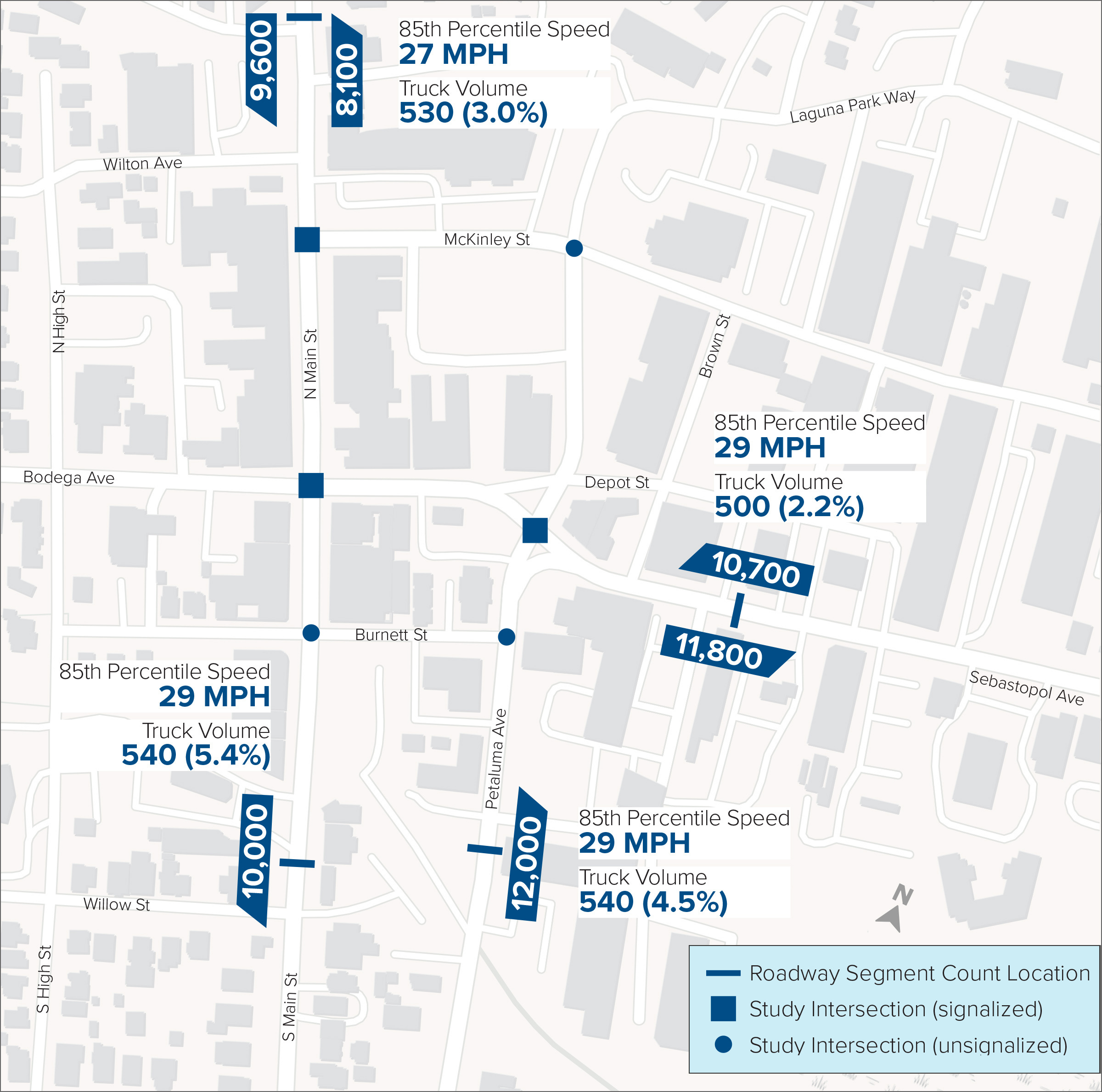
If a bypass around town could be accomplished someday, that would be a game-changer. Unfortunately, as history shows us, there are huge obstacles with this option, which has been extensively studied and worked on repeatedly through the years.
This brings us up to the present. We are again at a crossroads on this issue. Through a CalTrans grant, the City hired the consulting firm Fehr & Peers to examine traffic options for our downtown, including bike and pedestrian options. Geoff Rubendall led this effort.
After conducting a survey showing that (surprise!) traffic congestion was by far our biggest concern, they produced four alternative options. Two of the options showed one-way streets, and two of the options showed two-way streets. They then conducted a survey to gauge public opinion.
On Feb. 10 of this year, the results of the survey were presented to the Planning Commission.
381 (59%) voted for one-way
265 (41%) voted for two-way
After Mr. Rubendall initially recommended the “Walkable One-Way” option, with the option of changing to a two-way in the future, Commissioner Fritz said “I’m not a fan of this.” adding that “Having two lanes going south on Main Street is a disaster.”
Despite the survey results and despite Mr. Rubendall’s initial recommendation, the Planning Commission chose a new “Alternative 4: Totally Two Way” option, dubbed Alternative 5, that incorporates some bike lane and sidewalk changes from “Alternative 3: Walkable One Way.”
“Totally Two-Way” received just 23% of the vote.
So, to refresh, in 1985, why did traffic improve when Sebastopol changed to a one-way system? After 1985, drivers could simply make all turns without causing a backup.
Considering how central this issue was, I was always puzzled by Mr. Rubendall’s claim that the one-way options and the two-way options were roughly the same as far as level of service. (A “low level of service” means congestion is bad.)
He graciously agreed to meet yesterday to answer some questions. I asked him, “Looking at the one-way vs. two-way options, was the traffic impact of left turns into streets and parking lots taken into account in your modeling?”
The answer was “No, that level of detail doesn’t usually show up in a macroscopic model like the one we were using.”
Delays caused by waiting to turn left were not considered in the level-of-service results. It was eye-opening to learn that the most significant difference between one-way and two-way was not considered or studied yet.
The City Council will look at options at their meeting on March 3.
Do you remember the switch from two-way to one-way streets in downtown Sebastopol in mid-1980s? Tell us about it.
The Sebastopol Times would love to hear from long-time Sebastopol residents who remember what traffic downtown was like in the mid-1980s before and after the switch from two-way streets to one-way streets. Comment below or email us at sebastopoltimes@gmail.com.
" It was eye-opening to learn that the most significant difference between one-way and two-way was not considered or studied yet." Sebastopol has had financial woes for what seems like a long time. Now it turns out that the city hired consultants who did not consider the most important aspect of the study they were hired to conduct. And nobody on the City Council noticed? What else is the City Council not noticing? Don't get me wrong, I love our small town feel, but our leadership needs to pay attention. And personally, I remember the backups downtown and I'm for keeping the streets one way. Safer is better.
There doesn't seem to be a clear and material benefit from making this change which will, at a minimum, cost us money and inconvenience. Given the attention we have to pay to the existential threats to our democracy and to the planet, it seems like this project is like rearranging the deck chairs on the Titanic. Please let's prioritize how we spend our money and our time and energy.