

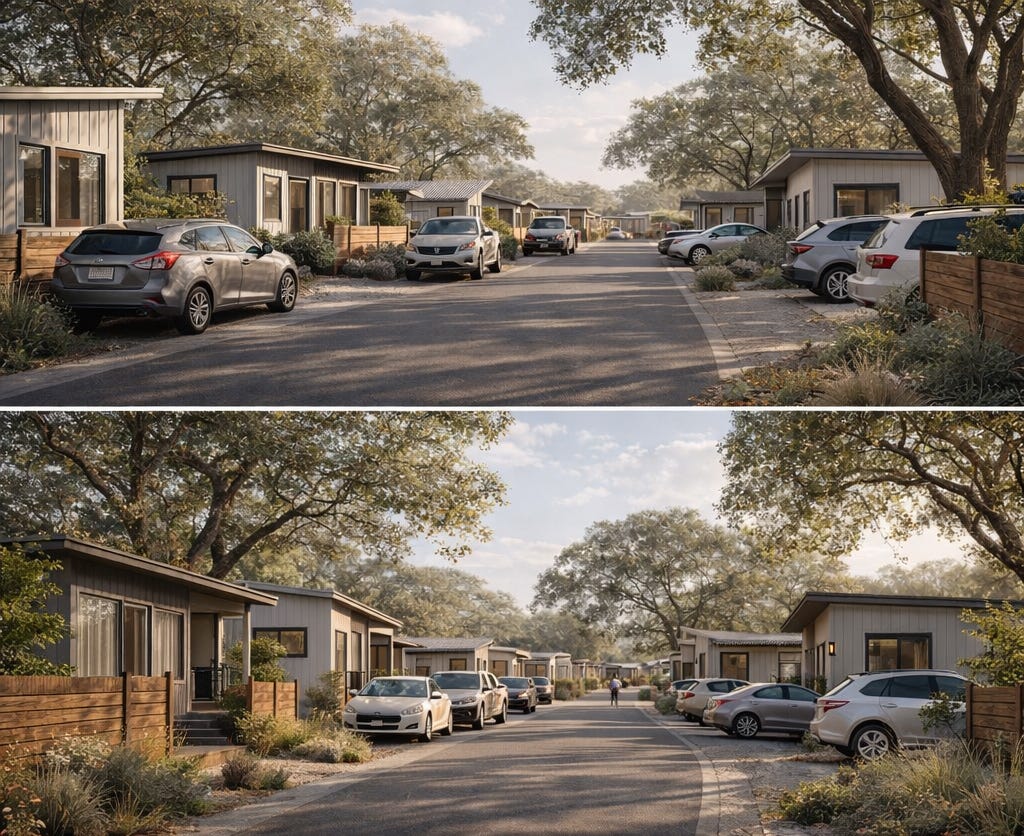
For years, rumors have circulated in Graton that an affordable housing project was coming to the corner of Highway 116 and Graton Road. It is not a rumor. It is a reality — though one that has taken years of permitting battles, shifting plans and persistent effort to reach this point. And now that it’s close, the neighbors have things to say.
Nearly eight years after purchasing a two-acre parcel on Graton Road, Two Crows Housing — led by partners Simon Farmer, John (J.J.) Yost, Rusty Davis, and Noah Zimmermann — is inching toward what they hope will be one of the first new manufactured home communities built in Sonoma County in a generation: 33 small homes, priced within reach of teachers, nurses, firefighters, and the kind of middle-class families who have been quietly squeezed out of one of the state’s most beautiful and expensive counties.
The project has the support of state housing law and County planning staff. It also has a vocal group of neighbors who believe the lot is too small, the infrastructure inadequate, and the design still too vague to warrant approval. What follows is an attempt to let both sides be heard.
From redwoods to real estate: the Two Crows story
Three of the partners of Two Crows Housing first met while attending UC Santa Cruz, where a trailer park tucked into the redwood-shaded campus offered students a rare $300–$400-per-month option in otherwise pricey Santa Cruz. “It was just a really nice community,” recalls Simon Farmer, a Two Crows partner.
After graduating, the four partners immersed themselves in ecological land use and permaculture — studying in Australia, India and across the United States — before launching a design-build-landscape contracting company in Sonoma County. Their early projects ranged from private gardens and organic farms to an eco-resort in Nicaragua outfitted with custom treehouses. For years, the team lived together on a shared West Sonoma County property, each partner building a modest structure. Farmer and his wife called a 10-by-12-foot shed with an outdoor kitchen home.
“That low cost of living helped us build our business,” he said. “We really enjoyed living in small spaces, together in community. And it reminded us of the trailer park at UCSC.”
As the contracting business grew, Farmer and his partners explored whether they could create the kind of affordable, community-oriented living they’d experienced at UCSC. They researched tiny homes, RV parks and manufactured housing. An early attempt to develop an RV park in Sebastopol ran into the County’s formidable permitting maze.
Undeterred, they pivoted. Two Crows Housing acquired its first distressed RV park in Port Angeles, Washington. Rather than displacing low-income residents, they improved the community: fixed utilities, created common spaces, planted edible landscaping and — critically — didn’t raise rents. The company now owns and manages several RV and mobile home parks, including Redwood Village in Guerneville — a mix of tech workers, nurses, firefighters, teachers, retirees and young families, all living side by side.
“We just need more affordable places for people to live,” Farmer said. “We’re trying to serve a middle-class group of people who wouldn’t otherwise be able to afford a house.”
The Graton Small Homes Community project: What’s proposed
In 2018, Two Crows purchased the Graton Road parcel with a vision: a village of small, thoughtfully designed homes at prices accessible to working Sonoma County residents. What began as a proposal for 40 tiny RV-style units has become a plan for 33 manufactured homes — small, permanent structures on stable foundations, ranging from roughly 500 to 800 square feet.
Manufactured homes are built in factories to California’s stringent construction codes, using two-by-six framing and meeting modern insulation and energy standards. Today’s models increasingly reflect the aesthetics of the tiny home movement: clean lines, modern finishes, and interiors that feel far larger than their footprints suggest.
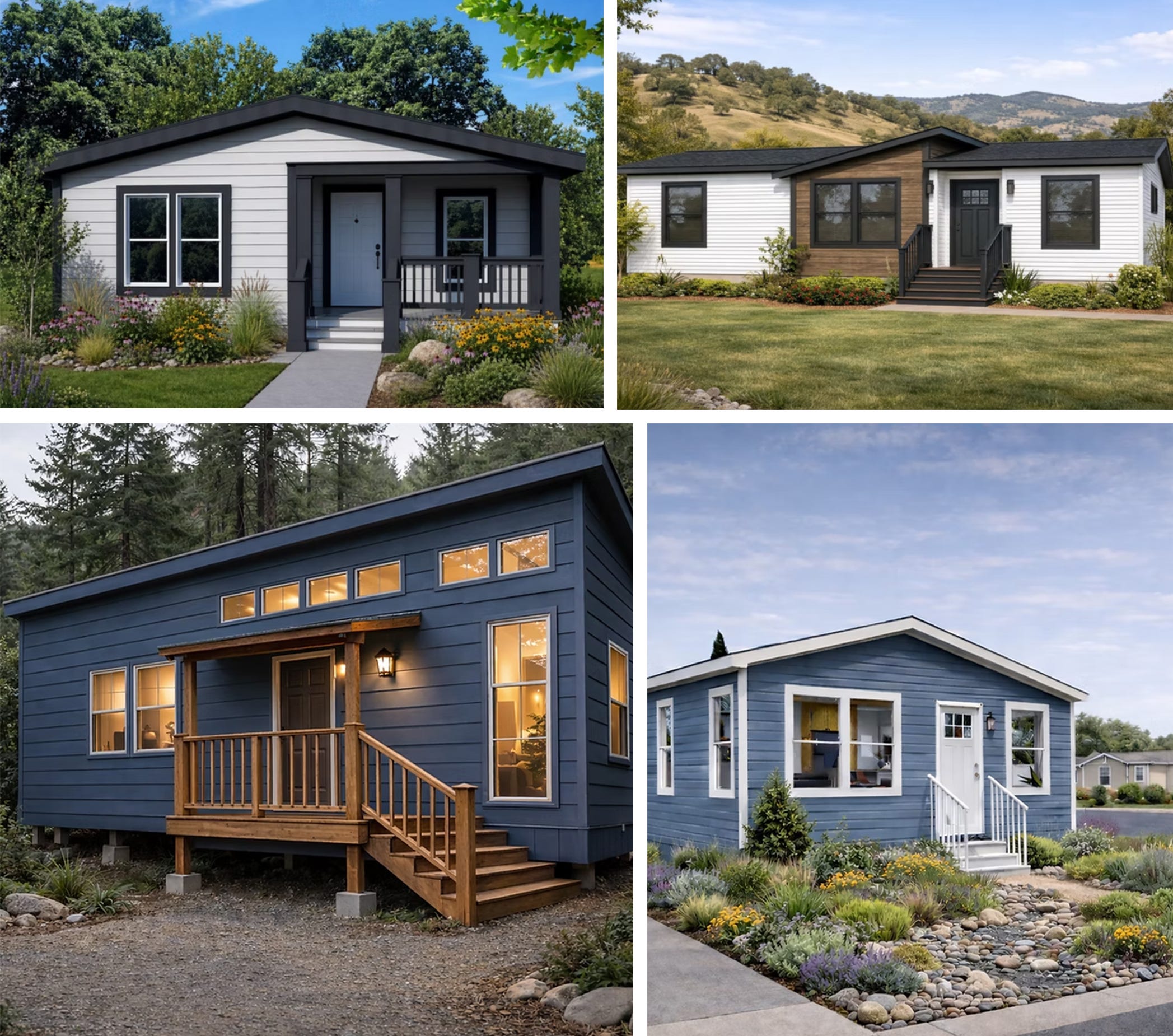
“I think that the things people in the community should know about the Graton Small Home Community are that it will be made up of around 30 stick-built small houses, each with a small yard, and all of them cohesive in terms of color and design,” Farmer said.
Under California law, manufactured home communities are subject to sub-CPI rent control, limiting annual site rent increases to no more than 75 percent of the consumer price index. Twenty percent of the units will be deed-restricted affordable; the remaining 80 percent will be priced well below what a comparable townhouse or condo would cost. Farmer puts the economics starkly: construction costs for traditional stick-frame homes in West Sonoma County now run $500 to $1,000 per square foot. Factory-built manufactured homes can be built for under $200 per square foot.
“It’s a way for people to build equity—buy an asset and build equity,” Farmer said. “It’s a great starter home. When you move out of an apartment, you have nothing. With a manufactured home, if you’ve lived there for five years, you’ll likely have a chunk of money for a down payment on something else.”
The Neighborhood’s Concerns
Neighbors (who asked not to be identified) are not opposed to housing on the parcel — they said so plainly. Their concerns are specific, and several raise real infrastructure questions that the project’s approval process has not yet fully resolved to their satisfaction. All of the concerns have previously been raised with the developers and County Planning staff.
Water and sewer. Because the site lacks access to municipal water, the project would rely on two deep private wells. Neighbors with older shallow wells worry about the impact on the shared aquifer — a concern sharpened by memories of the 2015–16 drought. They also question the project’s proposed sewer solution: an 8,000-gallon holding tank that releases into the Graton Community Sewer District main during off-peak overnight hours. They say a nearby existing break in the sewer system, identified in a prior consultant’s report, has not been addressed.
Lot size. The parcel is under two acres. California typically requires two acres for a mobile home park, and the project is seeking an exception under California’s Builder’s Remedy—a legal mechanism that allows building projects that don’t conform to local codes to be approved anyway if the governing authority—a city or county—fails to maintain a state-certified Housing Element or, as in this case, if the county was merely late in approving its Housing Element. Neighbors contrast the property at
116 and Graton Road unfavorably with larger nearby RV parks on five to ten acres. “It’s just too small for what they’re trying to do,” one neighbor said.
Design clarity. Neighbors say the project’s description has shifted repeatedly — from RV park to tiny homes to manufactured homes — and that they have never seen a complete design. Some neighbors are unsure whether all units will be on permanent foundations, and one neighbor noted she was required to dig unusually deep footings when building an ADU nearby because of the area’s unstable soil.
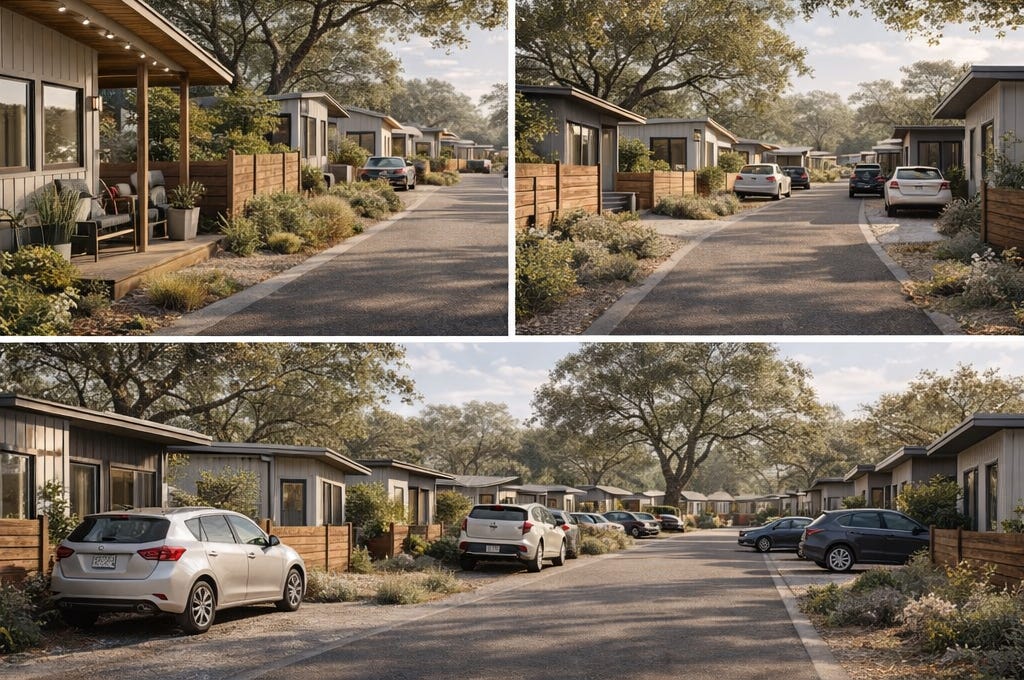
Traffic and parking. The intersection of Highway 116 and Graton Road already experiences frequent accidents. Neighbors question whether the proposed access — a right-in, right-out configuration — will be enforced and whether one parking space per unit is adequate for households that likely have two cars. They anticipate overflow parking that will block neighboring driveways.
Fire safety and evacuation. West County’s wildfire history makes evacuation planning a pressing concern. Neighbors describe the internal road as narrow — about 22 feet — and worry whether fire apparatus could maneuver effectively. They also note that a full traffic study of the internal road has not been completed. “When we all have to get out of here,” one neighbor said, “that corner is going to be a problem.”
Builder’s Remedy and process. At the most recent County hearing, neighbors say the committee chair stated that the project would not have been recommended to move forward under normal circumstances. The County’s failure to meet its housing element deadline triggered the Builder’s Remedy provisions, which limit the County’s ability to deny the project. Neighbors also report that a required formal land survey and a Caltrans traffic report had not been completed or made publicly available as of the last meeting.
The developer responds
Farmer and his team have prepared responses to each of these concerns, and they are direct.
On water: “We hired an engineering company that completed a comprehensive study of the surrounding area’s water use capacity and our potential impacts on the aquifer and our neighbors. The study showed that there would be negligible impact on the aquifer and no impact on neighboring wells. We are not drilling two deep wells, but rather two residential wells, only one of which will be in use; the other is for emergencies. The County was involved in this process and agreed to their findings. This report is publicly available.”
On sewer: “Graton Community Sewer District worked with us to create a solution wherein we release our blackwater at non-peak hours. This solution — which has been used by other affordable housing projects in Sonoma and Napa Counties — reduces the impact on the sewer system. Our use of GCSD infrastructure will be at a time of day when no one else is using it.” He adds that GCSD’s engineering company, his own engineers and the County have all agreed to the plan.
On lot size: “We would love to build a larger small home community on a larger site. Large parcels with appropriate zoning are extremely rare, which is part of why we do not see many mobile home parks built in California. The Builder’s Remedy allows us to build on this property. The alternative would be apartments. It would be functionally impossible to meet the density requirements with any other type of development.”
On design changes: “We have always been working to build a tiny home/small home community. The difference between nice park model RVs and nice small, manufactured homes would not be discernible to the average person. We are building a mobile home park that will use small, standalone structures on permanent foundations.”
On traffic and parking: Access will be right-turn-in, right-turn-out only, enforced with signage and flexible barrier medians. Residents’ leases will prohibit off-site parking.
On fire safety: “Our site’s one-way internal road meets both local and state fire standards. We also have a secondary, gated access off Highway 116 for use by EMS.”
On the land survey and Caltrans: “The land survey has been completed and recorded. Caltrans applications and permitting requirements have also been met.”
The bigger picture
Sonoma County’s housing crisis is not in dispute. Median home prices have long exceeded $700,000. The County has a state-mandated obligation to plan for thousands of new units — including a significant share of affordable units — yet production has lagged for years. That failure is precisely what triggered the Builder’s Remedy provision, which is allowing this project to advance.
Farmer, who grew up in Sebastopol, watched the human cost of the lack of affordable housing play out in his own life. Cousins who grew up in Sonoma County have left. Childhood friends can no longer afford to stay. The teachers and tradespeople who form the backbone of local communities increasingly commute from far away — or leave altogether.
“If we don’t build houses that are affordable by design,” Farmer said, “we’re going to end up with a much less diverse community — economically and otherwise.”
He acknowledged, with some wryness, that he once drove up from college to oppose a housing development near his family’s Sebastopol home — a subdivision proposed for a beloved horse field. He lost. The houses were built.
“I think that’s probably for the best,” he said, laughing. “It’s hard to see change around you. But on a basic level, urban infill projects need to happen.”
The neighbors, for their part, are not unreasonable. Several said they’d welcome well-designed housing on the parcel — something that looks and feels like a real community, with adequate infrastructure, and homes people would be proud to live in for decades. The question they’re really asking is whether this project, on this lot, with this design, is that.
Farmer thinks it is. “This community is going to be an absolute asset to the town of Graton. Once it is built and people are living in it, I think Graton is going to greatly appreciate having it,” he said.
Based on the public record and Farmer’s responses, the more pointed concerns — water, sewer, fire access, and traffic — appear to have been addressed, if not yet to the neighbors’ satisfaction. The required studies have been completed. The County and relevant agencies have signed off on the key infrastructure solutions. The internal road meets fire standards. The Caltrans requirements have been met.
What lingers is the harder issue to resolve: The feeling that this particular corner of Graton is not the right place for this level of housing density, that the lot is simply too small, and that the project is too provisional in character to inspire confidence. These are not unreasonable feelings. But they are not, by themselves, grounds for denial under state law — and that, in a County that has failed for years to build the housing the state requires, may ultimately be the point.
Farmer is hoping for final County approval within roughly six months, with a groundbreaking possible in the fall of 2027. Ten years after purchasing the land, a shovel in the ground would feel like a milestone.
“We hope it’s going to work,” Farmer said. “It feels like a huge risk. And there’s not a lot of help along the way.” He paused, then smiled. “But that’s okay. Because we just need more of these.”
You can find out more about Two Crows online by searching Two Crows Housing or Two Crows Homes. (The former features their small-home housing developments; the latter features examples of manufactured home designs they’ve used before and that will likely use in this project.) You can also research its permit history by searching on the address (8525 Graton Rd, Sebastopol, CA, 95472) on the Permit Sonoma website. Residents with questions or concerns regarding the Graton Small Home Community can contact Two Crows Homes directly. The company also welcomes inquiries from prospective residents.

Thanks for your report, Dewey. Looks like you've given a pretty complete overview of the Two Crows project in Graton. Lots of details yet to work out, but it sounds like there might be enough willingness on everyone's part to make something good happen for local working families. I only know what you just reported, but the Two Crows team sounds like they want to do the right thing, versus so many other developers business model and values. I think if I were a next door neighbor, I'd want to see the parking and other potential impacts from 33 new homes more fully addressed and put down on paper. More good information from the Sebastopol Times will help make this the best expected outcome. Our young families need housing and a good place to start a career and family.
Thank you Dewey - Love how you detail the issues and how they are being addressed. Between the lines is that continuing saga about how change agents bring new visions, and locals prefer things the way they are. It's the shapeshifting, role switching debates about micro vs. macro, preservation vs. adaptation, comfort vs. fear, and underlying everything -- trust and distrust in process. It's the Tragedy of the Commons personified. We all want everything out of our shared bit of land, when of course it is only sustainable if we are all only partially satisfied.