

Last Saturday, when Christina Schoen and her son, an Analy student, were volunteering at the Voting Center at Sebastopol Center for the Arts, only one person came to vote in person that day—and it was Christina’s mother. When only 15 people dropped off ballots, Christine became concerned about the turnout. Her son worked the next day, and only a few people showed up between 9 am and 5 pm. It was Memorial Day Weekend, she reminded herself, and there are many ways to drop off or send in your ballot by mail. But Christina contacted Sebastopol Times in hopes that we could remind people that polling places were open.
She also wondered if people were waiting to vote because they were undecided or they were waiting for something to happen that would make the decision clear to them. “Democrats may cast last-minute ballots for governor” was the headline of an article in the LA Times, which talked about voters waiting and hesitating to vote early. It quoted Democratic strategist Steve Maviglio: “This has been a roller coaster of a race, and I think voters are waiting to see when the ride is going to end and cast a vote at that time.”
“It’s a lot of work to figure out who to vote for,” Christina told me. “It’s hard and takes a lot of time,” she said. I asked her what she’s looking for in the candidates. “Believability and trust,” she replied. “I have to know if they practice what they preach. Trust is the bottom line.”
The Vote Center at Sebastopol Center for the Arts will be open on Sunday, May 31, and Monday, June 1, from 9 am to 5 pm and on Election Day (June 2) from 7 am to 8 pm. You can vote there in person during any of these times, or you can drop your ballot at the box inside the Vote Center. If you do that, your vote will go straight to the Registrar of Voters that evening. (There is also a box in front SebArts, but these are picked up less frequently.)
The Sorting Hat Election
If people find choosing candidates in this election difficult, the ballot and ballot guide for the June primary doesn’t make it any easier. Perhaps we can help to sort through these decisions ahead of Tuesday, using the magic of the Sorting Hat from Harry Potter to try and make sense of the June 2 election.

When you open the ballot, even if you have decided on a gubernatorial candidate, you might struggle finding that person among the names listed over three columns. There are 62 names listed on the ballot. Two of them—Eric Swalwell and Betty Yee—have withdrawn, but they are still taking up space.
You might think the candidates would be listed in alphabetical order, A-Z. But no. You need a sorting hat because they are listed in randomized order. It’s not quite like pulling names out of a hat, though, because it’s deliciously complicated.
The Secretary of State pulled letters out of a hat (we don’t think they use a hat…) 82 days before the election, according to this official explanation of the randomized alphabet. This year, the letter T came out in the first position. Then P and W followed by Z and so on. The candidates are listed by matching their last name to the randomized order. That’s why Tony Thurmond is the first candidate listed in the first column, followed by Thunder Parley and Katie Porter, and then Thomas Woodward, and then comes the Z’s, three of them who avoided being sorted last — Zacky, Zezulak, and Zickefoose.
It doesn’t take much money to get on the ballot for Governor or Lieutenant Governor. As described here, California has a pay-to-play primary. For Governor, it costs $4,918.58; for Lieutenant Governor, it costs $3,688.94. (The filing fee a candidate must pay is equal to 2% of the first year's salary for the position.) The fee is waived if a candidate is able to collect 6,000 signatures.
With such a low bar for entry, there are many “vanity candidates.” These are people who want to say that they ran for governor in 2026. They have no chance of winning, but that’s not the point. They’re content being also-rans.
Personally, I find it rather entertaining to read the state’s Ballot Guide to learn more about these candidates. What’s surprising is how some of them fail to provide any statement about who they are or what they stand for. Then there’s a few whose name-change says it all: LIVINGFORGOD AND COUNTRY DEMOTT and BARACK D. OBAMA SHAW—the D stands for Denzel.
Scott Alexander, a prolific writer on Substack, humorously writes about “The Types Of Candidate You Find In The California Gubernatorial Race.” Some of these candidates have paid for sleek media profiles of themselves, while others have used AI to generate policy proposals and yet others have asked AI to create posters showing that they are leading in the polls.
Alexander writes about the top-tier Democratic candidates:
One of these people will definitely win, but what else is there to say about them? They’re all the same. They’ve all paid the danegeld to some set of unions and interest groups, then put up some kind of incredibly generic platform about how they’re compassionate but also a fighter.
He says that the Republicans are “more or less the same as the top-tier Democrats, minus the chance of winning.”
While the Republicans and Democrats stand for different approaches to governing, both seem to be playing the same roles that are expected of them.
What is a jungle primary?
There’s been a lot of talk about the California Governor’s race being a jungle primary—a term I hadn’t really heard much about until this election. A less pejorative term is a “top-two primary” in which voters can choose any candidate regardless of their party affiliation, and the top-two vote-getters move on to the general election. The only other state that uses this exact same method is the state of Washington.
Our partner, Cal Matters, explained the origins of the jungle primary in this 2022 article:
In a top-two system, labeled a “jungle primary” by its opponents, all candidates for an office are listed on the same ballot and the two top finishers, regardless of party, then duel in the November general election.
It came about because in 2009, Democratic leaders of the state Senate desperately needed one more vote to pass a controversial budget and turned to moderate Republican Sen. Abel Maldonado to provide it. However, Maldonado — with the support of then-Gov. Arnold Schwarzenegger — insisted that his vote hinged on placing the top-two primary before voters.
Democrats eventually agreed and Proposition 14, creating the top-two system, appeared on the June 2010 primary ballot with Maldonado and Schwarzenegger contending that it would give moderates and pragmatists in both parties better chances of winning legislative and congressional seats. The leaders of every political party opposed the measure but voters passed it handily.”
So basically anyone who can jump the relatively low bar to get their name on the ballot can do so. That explains why the list is so long, but it doesn’t explain why Democratic Party didn’t make it easier by making an official endorsement.
Here’s why: At the state convention in San Francisco in February, none of top contenders met the threshold of getting at least 60% of delegate votes in the Endorsing Caucus to get the party’s endorsement.
Afterward, California Democratic Chair Rusty Hicks basically begged the Dems who didn’t have a chance of winning to drop out. Few did.
There also many Republicans running for governor. Republicans Steve Hilton and Chad Bianco were running neck-and-neck for a while, until President Trump threw his weight behind Hilton.
You can also watch the Cal Matters governor interviews.
What do the polls say?
The polls are another way of sorting the candidates.
The Public Policy Institute of California reported on their mid-May poll—finding 1,700 people with landlines and who answer their phone:
Five candidates in the top-two governor’s primary have double-digit support from likely voters: Xavier Becerra (D; 23%) and Steve Hilton (R; 20%) are in the lead, followed by Tom Steyer (D; 15%), Chad Bianco (R, 13%), and Katie Porter (D; 12%).
Most Republicans support the two Republicans (53% Hilton, 33% Bianco), and most Democrats support the three Democrats (39% Becerra, 23% Steyer, 15% Porter); few partisans support a candidate outside of their party.
Independents are divided among the top five candidates (20% Porter, 17% Hilton, 15% Becerra, 14% Bianco, 14% Steyer). Since our December survey, support has increased for Becerra (14% to 23%) and Hilton (14% to 20%).
A poll released this past week by the UC Berkeley’s Institute of Governmental Studies and Los Angeles Times showed 25% of likely voters support Xavier Becerra. Steve Hilton registered 21% support while Tom Steyer rose to 19%. The table below shows the gains made by Becerra since March with Steyer making a closing dash to the finish. Candidates like Mahan and Thurmond have not changed their position, while others such as Democrat Katie Porter and Republican Chad Bianco have lost ground.
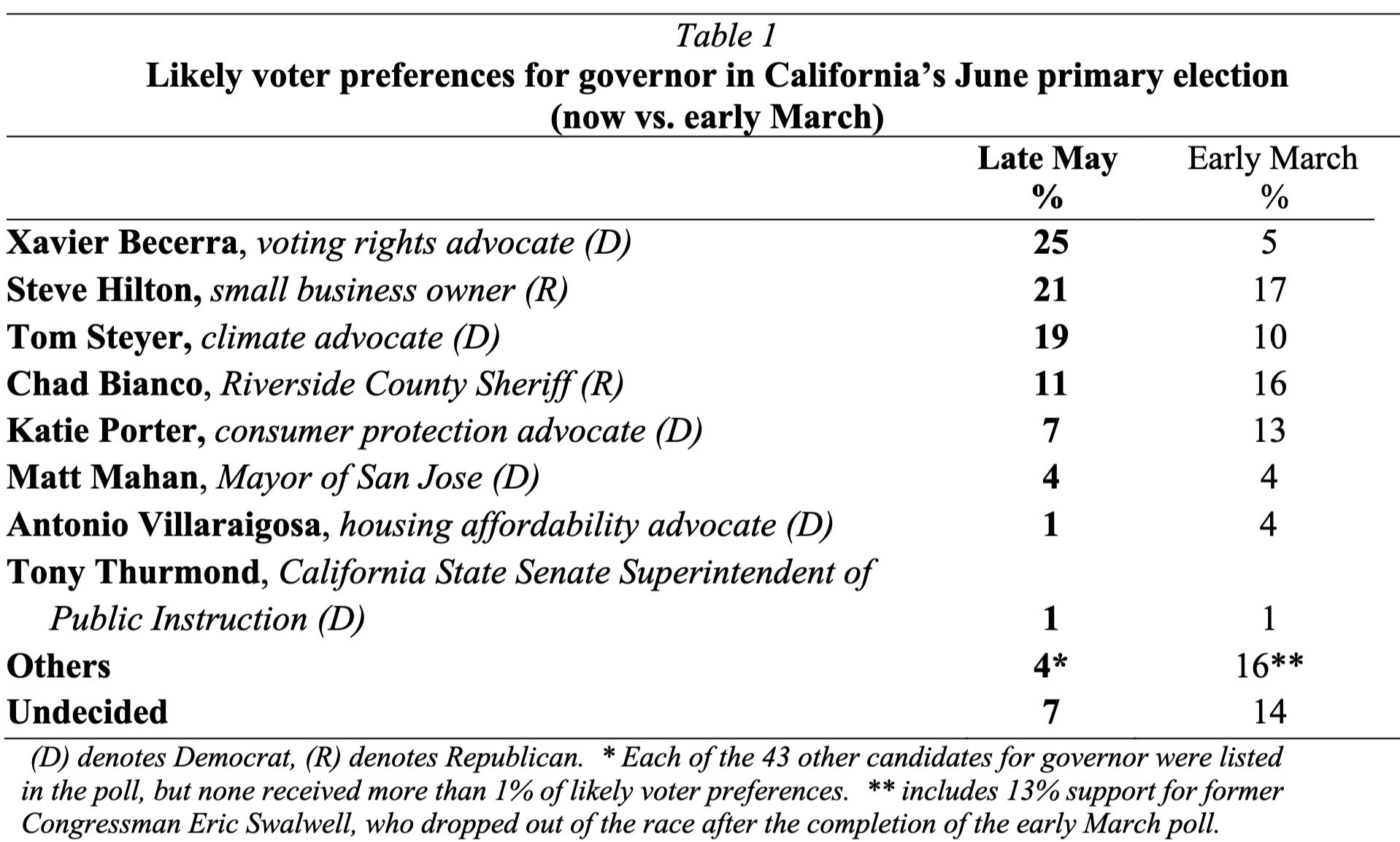
The primary election will determine whether the general election for governor will be a contest of a Democrat versus a Republican or one Democrat pitted against another. What’s predictable is that the two candidates who will face off against each will likely becoming to that race after gathering only 20-30% of the vote in the primary.
Even if the polls say that Becerra and Hilton will move on to the general election, voters don’t necessarily vote the same way as what they tell pollsters. Yet voters also watch polls as a signal for deciding upon a candidate with the best chance of winning. One might like Katie Porter but realize that the polls show that she doesn’t have enough support to win.
Emily Hoeven, an opinion columnist for the San Francisco Chronicle, advises voters to choose the best candidate, not the most likely to win. “The state’s political establishment and power brokers have twice closed ranks around milquetoast candidates despite the struggle to articulate even a basic policy platform,” she writes. She singled out Eric Swalwell (well, that didn’t work out) and Xavier Becerra as those establishment-backed candidates. “I have no intention of artificially limiting myself to a subset of mediocre candidates simply because of what the polls say,” she said. She adds that it would be best to have two Democrats facing off in the general election rather than a sure-thing Democrat against a Republican. If you see things that way, it might be best to vote for a Democrat that has the best chance to finish second in the primary.
It’s hard to know why Becerra has risen in the polls after Eric Swalwell dropped out of the race. The PPI poll shows most people are dissatisfied with the government, but Californians don’t seem to blame Democrats. Becerra seems like a careful, career politician out of the Biden-Harris mold, a minority candidate who wants to be seen as a safe choice but the problem is he’s uninspiring.
Tom Steyer became a billionaire as a hedge fund manager, but his politics are progressive, rather like a wolf of Wall Street in sheep’s clothing. He is an outsider like Trump who is anti-Trump but his efforts to make populist appeals seem forced. He has made a virtue of persistence.
Prediction Markets
Prediction markets allow people to make predictions on may possible futures, such as who will win the election; they can back up their prediction by betting on the outcome they predict. Here is a screenshot from one of the predication markets, Kalshi, which shows Becerra the favorite.
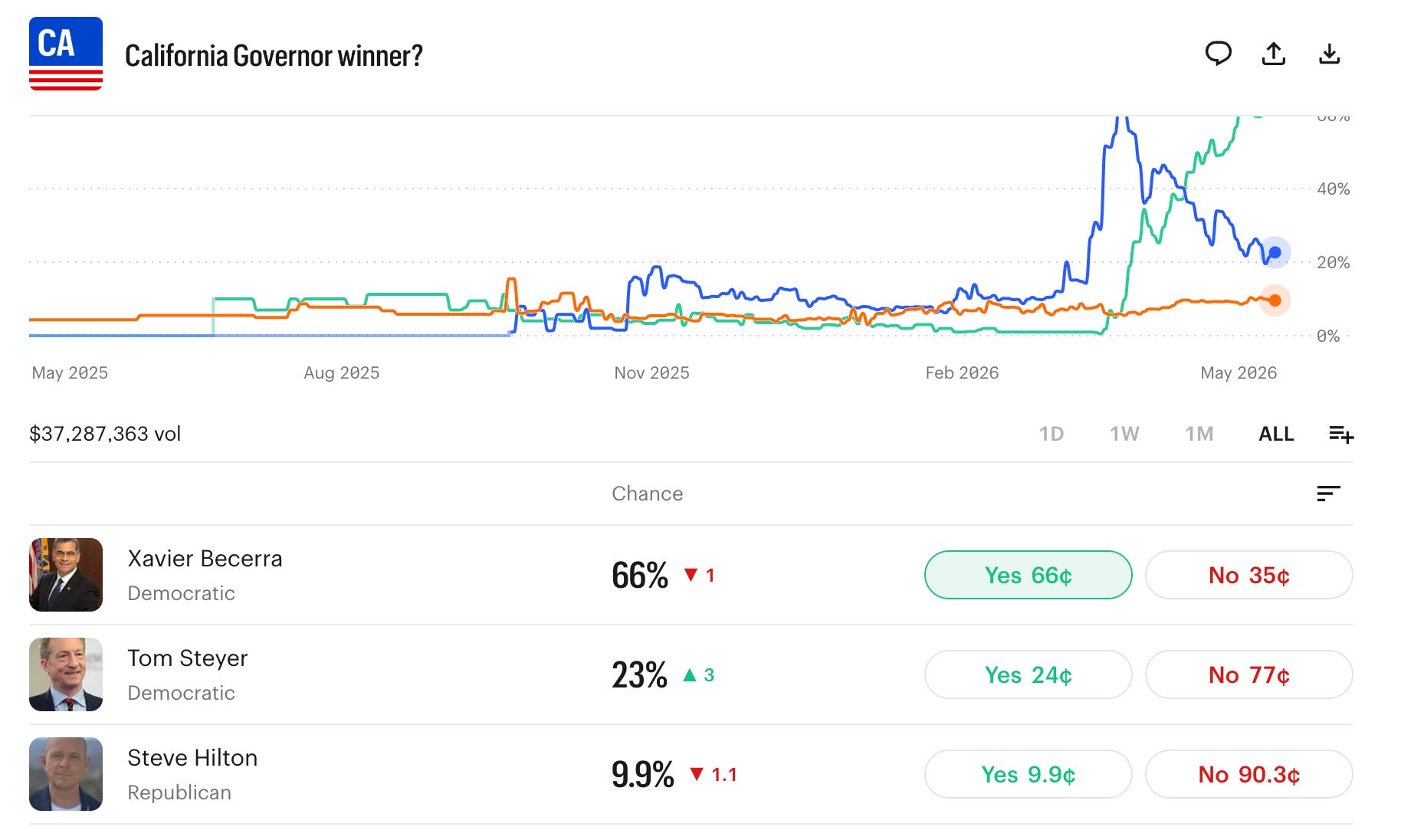
The volume—the amount of money bet on the governor race—is rather staggering—$37M. The betting reflects who bettors think will win, but what do they know? On April 15th, Steyer was at 66% and Becerra was at 6%, and in over a month, the two have moved in opposite directions, which pretty much follows the polling.
Where the money goes
According to Transparency USA, here are the total contributions by candidate for governor.
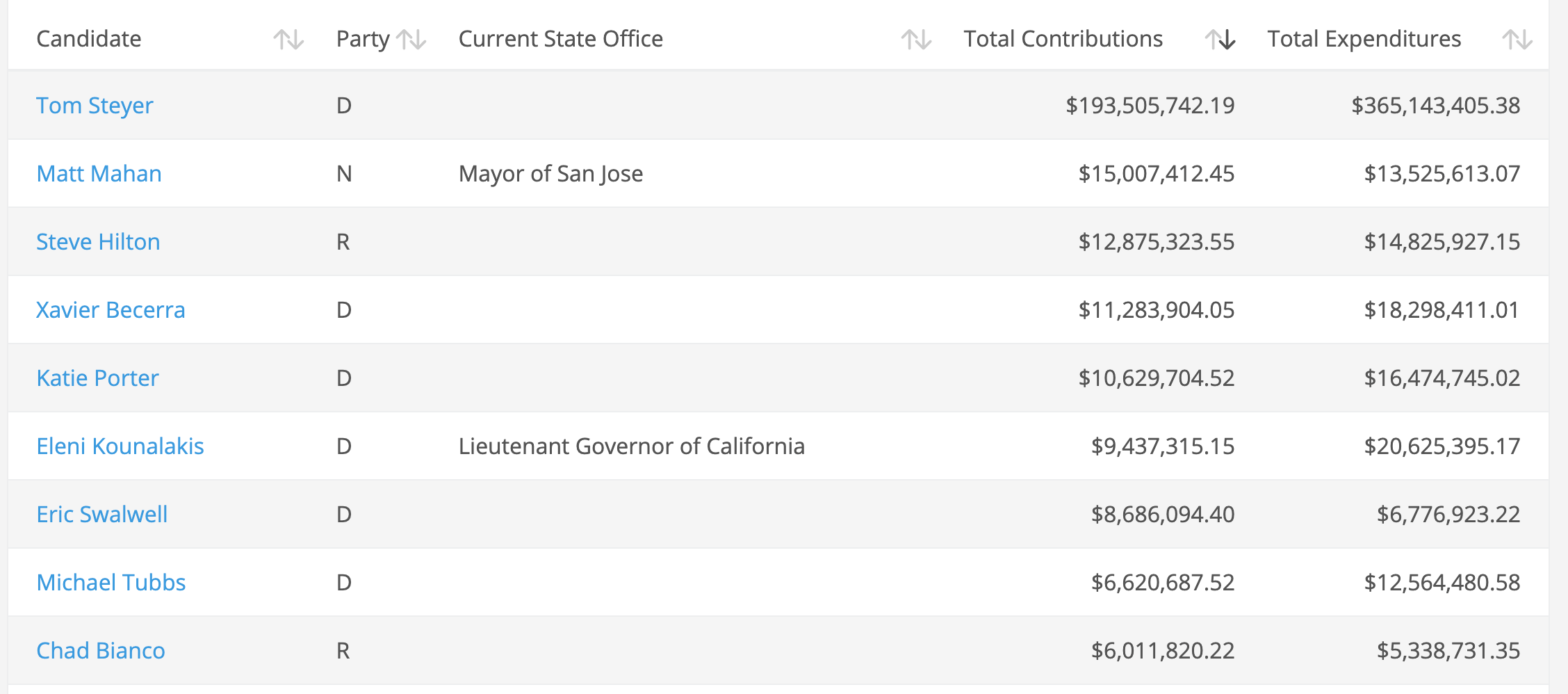
One thing to note is that most of them are outspending what they’ve been able to raise to date. Next is that the amount of money raised is not the best sorting mechanism. Contributions don’t always turn into votes or even raise the poll numbers.
Democrat Matt Mahan, mayor of San Jose, raised over $15M from Silicon Valley donors, and he’s been unable to make any headway in the polls. As a former teacher and current mayor of San Jose, he is a centrist candidate with reasonable positions but not much name recognition. TV ads and social media have not made him more popular. His donors are high-net-worth individuals who do not themselves have a big following or represent a group like a labor union with lots of potential voters.
Katie Porter, who is maybe the most talented speaker/debater among the candidates, has raised about $10M, according to Transparency USA. Despite her progressive credentials and a previous campaign for US Senator, Porter seems to be losing ground.
When it comes to campaign finance, Tom Steyer is his own exclusive donor, pouring in over $200M of his own money into his campaign. Just as odd, various groups including PG&E and McDonald’s have put up $47M to run opposition ads against Steyer. In other words, there’s more money being spent by Steyer than anyone else and that spending attracts more money to oppose him than any candidate raised to support their own campaign.
Many of the same contributors who are opposing Steyer are also paying to support Becerra. Tom Steyer said in a speech this week: “Chevron, PG&E, and Meta are supporting Xavier Becerra because he represents more of the same — promising change while taking money from the same people blocking it.”
A Housing Debate
One can sort candidates on the issues but the Democrats are not very far apart from each other. If you want divergent views, look to a Republican who promises to break everything.
Take housing, for example. In a forum on housing moderated by Ezra Klein of the New York Times, the five Democratic candidates at the top of the polls were on the panel: Tom Steyer, Xavier Becerra, Katie Porter, Matt Mahan and Antonio Villaraigosa. This forum, which was better than the debates, proved that as a group the candidates all agree that there is not enough new housing and individually they have good ideas on how to address the problem. Whether any of the candidates have the leadership muscle to get things done, especially when there are factions within their party that oppose it, that’s the challenge.
Katie Porter stood out among the group: “I am not scared of anybody because I’ve got three teenagers that I do not want living on my couch. And you all seem very lovely, but I don’t want you living on my couch or a street corner or in someone’s attic. I want you to all have housing where you can flourish.”
Lt. Governor: “A job about nothing”
A CalMatters article on the Lieutenant Governor race said the position was largely ceremonial, “a job about nothing.” Actually, the Lieutenant Governor has these responsiblities:
fills in as Acting Governor when Governor is out of state; and would assume the role of Governor if there were a vacancy.
serves as President of the Senate and votes in case of a tie.
serves as a voting member of the Board of Regents of the University of California, the Board of Trustees of the California State University system, and the Board of Governors of the California Community Colleges system.
The current Lieutenant Governor Eleni Koulanakis — you knew that — is termed out, and she’s running for Treasurer. Governor Gavin Newsom served two terms as Lieutenant Governor.
Sixteen people are running for this position: eight Democrats, five Republicans, one from Peace and Freedom and two without any party. Sacramento’s KCRA listed the five top candidates:
Josh Fryday (D), California Chief Service Officer
Janelle Kellman (D), Environmental Attorney and former mayor of Sausalito
Fiona Ma (D), California State Treasurer
Gloria Romero (R), Former State Senator
Michael Stubbs (D), Former Stockton mayor and Special Adviser to the Governor for Economic Mobility and Opportunity
Using AI as a Sorting Hat
In his post, Use AI this election, Scott Alexander says that you might consider AI to do your research.
I’m not saying AI is superintelligent or can decide better than you can. I’m saying that if you - like me - spend an hour or so doing research before voting on local seats, AI can aid that research very effectively. And if you don’t do that research—because you weren’t willing to waste an hour on it before—AI makes it so much faster that you might want to start.
Alexander tells Claude, an AI chatbot, about himself and his political profile.
I’m a centrist liberal abundance YIMBY whose favorite political writers are Kelsey Piper, Matt Yglesias, and Ezra Klein. I’m wary of government overreach, but I’m not a doctrinaire libertarian and want to help people when we can figure ways to do it that work. I’m going to ask you about each race on my ballot, and I’d like for you to list the various candidates’ bios, policies, endorsements, your read on the most important differences between them, and your advice for me as I try to make my choice.
He then asks it to assess which candidates for State Superintendent of Public Instruction align with his views. You can read his article to see what AI told him about the candidates that were the best fit for him. He concludes:
This is better than any voter guide I’ve ever seen. I didn’t end up taking Claude’s advice (about the specific person to vote for) but Claude’s advice was crucial in helping me prioritize what to research further.
Alexander writes that “a lot of my hope for how the post-AGI future might turn out well—despite all the risks of dictatorship, inequality, surveillance, etc.—hinges on people taking advantage of AI advisors to make better political decisions.”
Back to the Sorting Hat…

In Harry Potter, the Sorting Hat tells new students at Hogwarts which house they belong to. One could think of the house as a proxy for a political party. The Sorting Hat told Harry that he should be in Slytherin house but Harry objected. He wanted to be in Gryffindor and said so. Later, in the second book of the series, Harry asks the wizard Dumbledore why the Sorting Hat told him one thing and not the other. Dumbledore said it wasn’t important; what was important was that Harry made his own choice for himself. We can contradict what the Sorting Hat or advertising or AI tells us and make the decisions that are right for us.
It’s time to vote and hope for the best.
You put my quotes perfectly Dale. Thanks for spreading the word. Cristina Schroen
I appreciate the article, though I find the prominent placement and seeming endorsement of the idea that "they're all the same" somewhat regrettable. None of them are perfect, but Porter and Steyer, for example, have refused to take donations from fossil fuel companies (yes, he once invested in them, but he changed his views, as I hope more in his position do), whereas Becerra has a long history of being funded by oil & energy companies. That's a significant difference, to my mind. Also in the same Scott Alexander quote is the rather belittling reference to unions—but how, other than through unions, is the working class supposed to have a seat at the table? Anyways, what seems to me an over-reliance on Scott Alexander aside, thank you for the summary of the situation.