

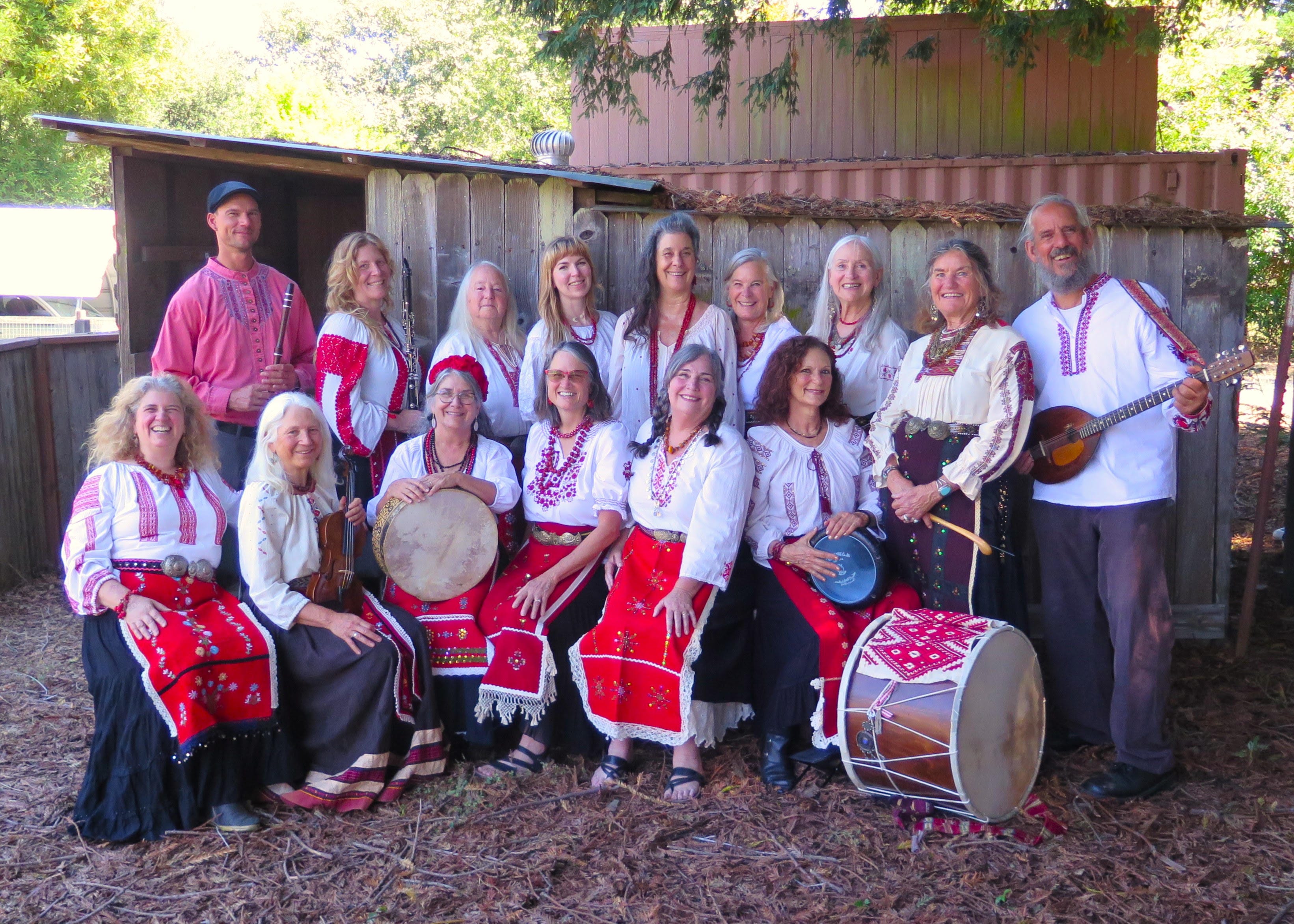
Like the bagpipes, Balkan Music is an acquired taste. Both are haunting, eerie, loud and a little grating (or at least surprising) for an ear trained on traditional Western European music. But Balkan music has a wide fan base in Northern California, in part because of the surprising success of the group Kitka, which was founded almost 50 years ago and is still singing, albeit with an almost completely new crew. Kitka birthed other Balkan groups around the Bay Area, as well as events like the Berkeley Balkan Bacchanal that happens every third Saturday at the Starry Plough.
But you don’t have to drive deep into the Bay Area to find Balkan music; you can find it right here in West County this Saturday when the local Balkan singing group, Gradina, plays at the Occidental Center for the Arts.
Sebastopol resident Rebecca Dwan is one of Gradina’s founders.
“We started sometime before the year 2000. We started just getting together to sing this music,” she said. “Some of us come from the Balkan dance community, and some of us just come from liking the music. I came from dance. Most Balkan musicians come from the dance side. You fall in love with the dancing first, and then you kind of get used to the music because some people—you know, the first time you hear that music, it can sound kind of raw if you’re just used to listening to American music.”
Tabitha Doniach, who joined Gradina in 2012, began singing Balkan music with the Berkeley Group, Savina, a spin-off of Kitka. When she moved to Sonoma County to do her medical residency, she began singing with Gradina — in part as a way to decompress from her demanding work life.
“I have a bit of Russian ancestry—Russian and Jewish ancestry actually—and that kind of got me into Slavic music. Then I heard the Yale Slavic Chorus, and that made me realize I could sing the music. It was just really a great revelation.”
“Having the passion for the music developed over getting to know it more,” Doniach said. “I just really enjoy the odd rhythms and the different kinds of harmonies.”
Interestingly, few Balkan singers in the Northern California music scene are actually from the Balkans, which means that most are learning songs written in Bulgarian, Macedonian, Serbian-Croatian or Russian phonetically.
“It’s not a big deal,” Doniach said. “So basically, it’s kind of like singing ‘supercalifragilistic’ or something. You just learn the sounds, and you learn the style.”
That style involves vocalizations, unusual in Western music, like yipping, droning, or dramatic glottal stops. “You also have to be able to sing in hard voice,” Doniach said. “That’s the other characteristic of these types of songs. A lot of them are in what we call chest voice or hard voice,” which she characterized as “less operatic, less heady.”
“A lot of pop singers sing in hard voice and country singers too, so it’s not foreign to us. In fact, the Bulgarians like [American] country music apparently,” she said.
“The harmonies are very different—they’re kind of variants of the Western style. So there’s a lot of seconds, sevenths, and notes that jar a little bit. There’ll be like a drone … where you have one person singing a home note, and then someone else singing above it and singing the melody, and the melody will then sometimes clash.”
That clash, she said, is part of the charm.
“That brings out a kind of haunting, eerie sound—it’s a little bit jarring, and it takes a little while to get used to it, but when you do, you enjoy it. It’s a nice, exciting sound.”
It’s “crankie,” not cranky
An interesting addition to Saturday’s concert will be Rebecca Dwan’s homemade “crankie,” a visual storytelling tool developed in late 18th-century Europe. She’ll use it to accompany Gradina’s performance of a Greek song about the Aegean Sea, titled “Mes Stou Aigaiou.”
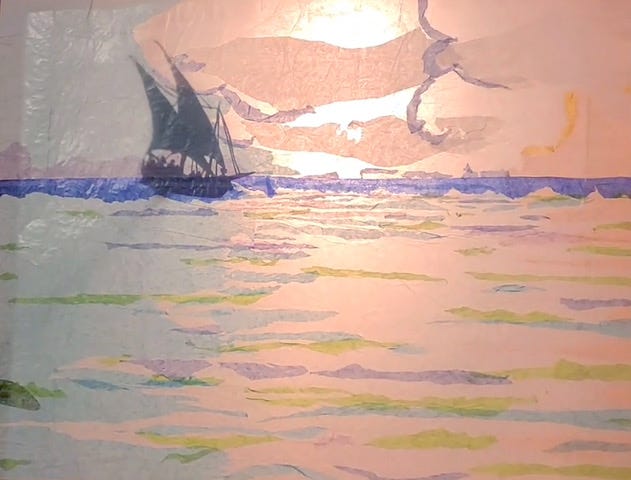
A crankie consists of a painted roll of paper strung between two rollers. You turn the crank to advance the story. Very large crankies were sometimes used to change the scenery backgrounds in 18th- and 19th-century plays. Dwan and her husband Kevin created a small, television-sized crankie for the performance. The images are made with paint and torn tissue paper.
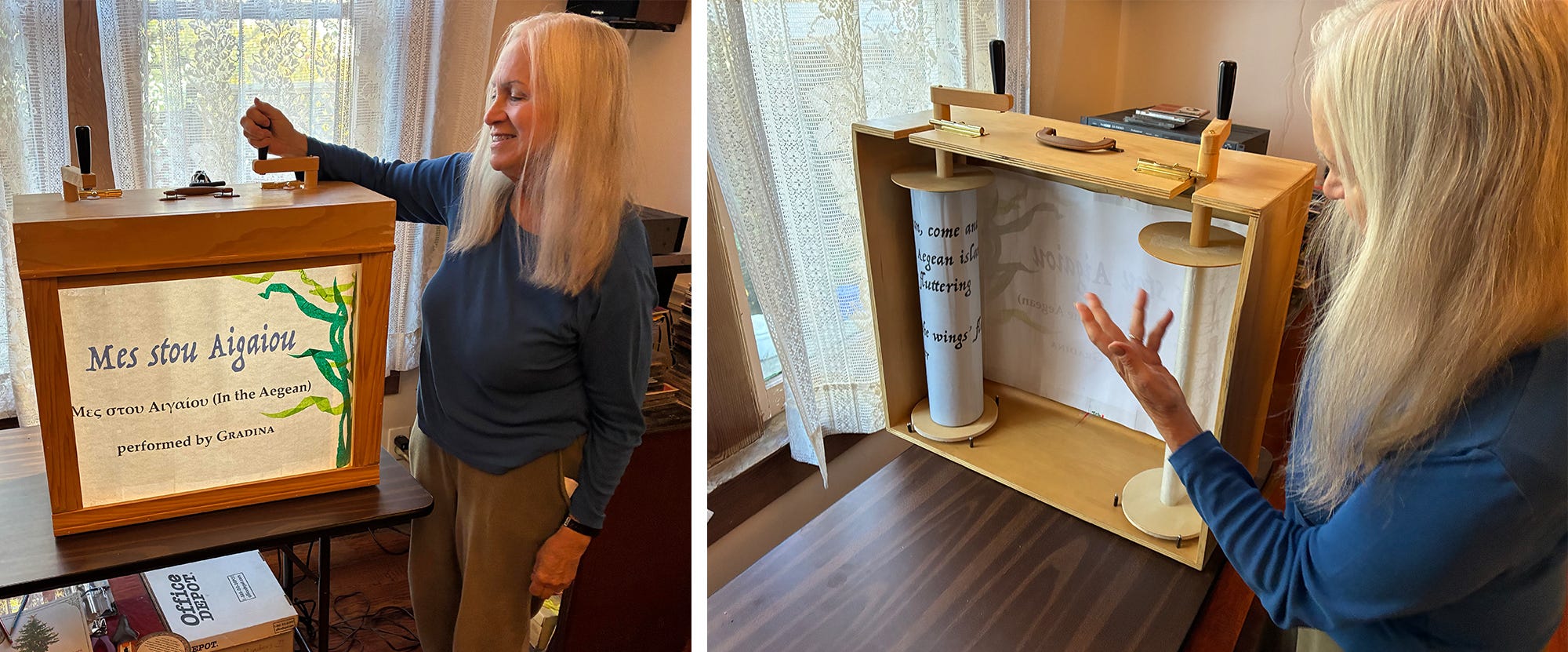
The crankie is lit from behind, and figures and objects, like the ship in the image below, appear as moving shadows, rather like Balinese shadow puppets.
Between Gradina’s Balkan stylings and the crankie, it’ll be an interesting, quirky and old-fashioned evening’s entertainment—about as different from the AI slop on your phone screen as it’s possible to be.
You can hear Gradina (and see the crankie) on Saturday, Nov. 14, 7 pm to 9 pm at Occidental Center for the Arts, 3850 Doris Murphy Court, Occidental. Get tickets.