
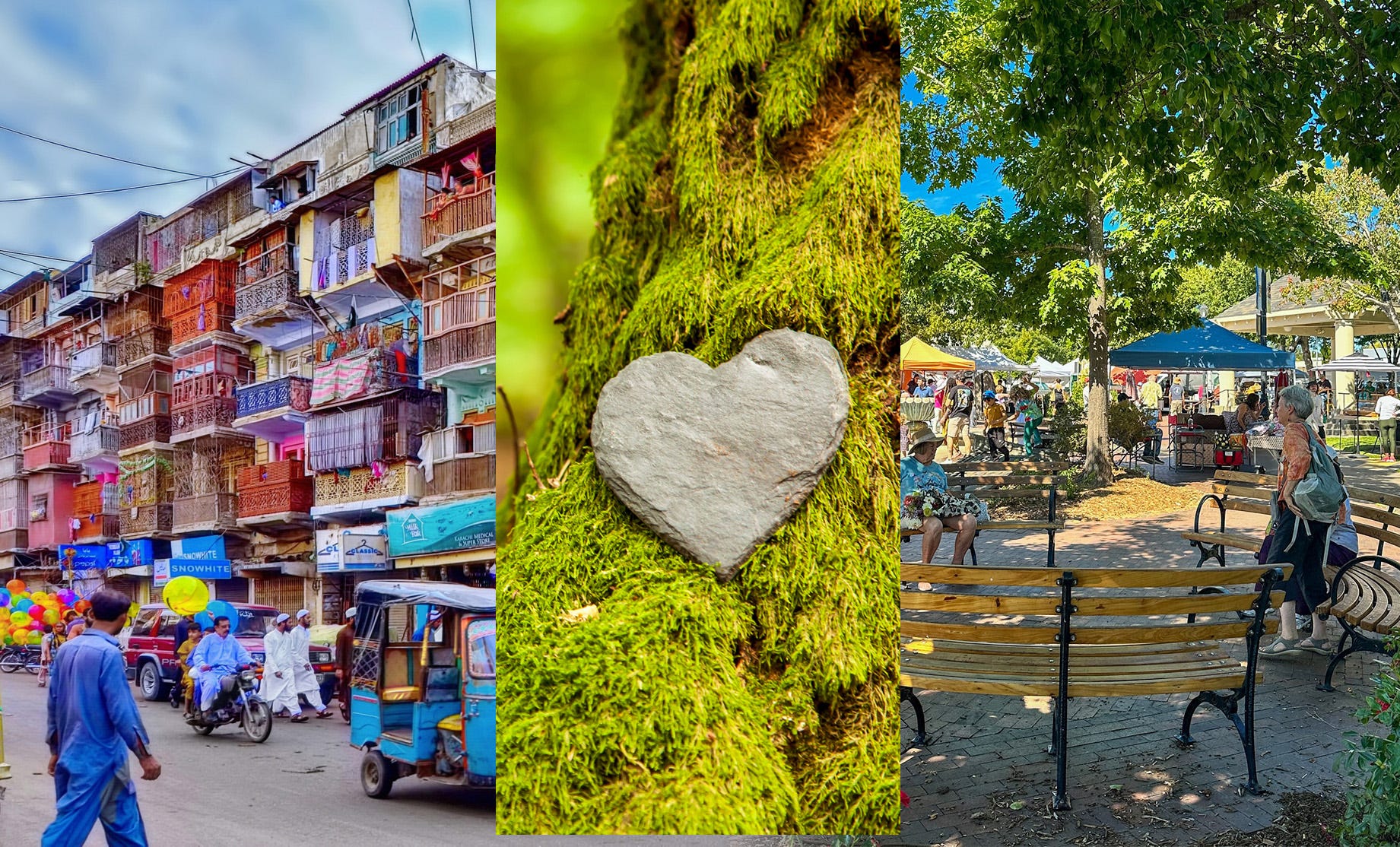
By Saba Khalid
“It’s a cult,” I tell him, the words heavy between us. “You, sir, are in a cult!”
I wait, holding his head between my hands and looking straight into his eyes. I watch his face for any sign of denial or agreement. “We are in a cult,” I pronounce each word slowly.
He looks amused, one of those almost-smiles edging his lips. “What’s so cultish about this place?” he says, looking around us from the park bench at the Sebastopol Farmers’ Market.
“Because it’s not real,” I shoot back, my voice rising with passion.
“Real is what you make out of it in your head,” he counters calmly.
I explode. “No, real is poverty, war, hunger, discrimination, homelessness. Real is sadness, corrupt governments, and growing miserable, diseased and old. Real is corporate or indentured slavery, traffic problems, climate disasters.”
He gestures around us, “All of it exists here too, maybe in lesser degrees.”
“You mean here in Hipsterville, where every corner is a setup for Instagram?” I ask.
“Not every corner,” he smiles. “Have you seen your closet?”
“Right, you actually think Sebastopol is real! Are you kidding me? This town could be sponsored by organic coffee and vintage flannels. Under every rock is a beanie-wearing writer and hand-knitted scarf-wearing musician.”
“You’re a beanie-wearing writer,” he laughs, tugging at my Goodwill hat.
“I think our neighbor’s chickens have their own therapist,” I said.
“Oh, you mean the intergenerational ancestral trauma from escaping the coop?” he suggested.
“And Flora—your friend—told me her dog whispered in a dream that they/them wanted to go vegan!” I accused.
“There’s been some compelling research suggesting—” he began.
“No,” I cut him off. “And the other day, when I was biking, I saw a guy just lying there in the sun with his dog, sleeping, right in the middle of the day.”
He feigns a gasp. “The indignity!”
“Who has that kind of time? To just sleep through the day?” I scoff. “Only in a cult, right?”
“Of course, you were out there biking, being a productive member of society,” he teases. “Not for enjoyment, right? That would be too… ‘Sebastopol.’”
“I keep it real, dawg,” I mutter, pretending not to see the irony.
For a moment, I fall quiet. Because the part I hate the most is how much I envy it here.
The stupid 20-something guy on his skateboard, walking his dog, and pushing a baby in a pram. The mothers with wavy hair and their calm babies at oak barrel tables. The older couples walking hand in hand like joy is still legal for them. It’s everything I never had — and everything that makes me feel like I don’t belong.
These were the first things I learned about Sebastopol.
But not the first things I learned about him.
Because I didn’t come here by accident. I came because of him.
Months before this farmers’ market rant, I stepped off the Sonoma County Airporter at the Rohnert Park hotel — my suitcase heavy, my heart heavier — expecting yet another Bumble date. A last date before flying back home to Pakistan. A symbolic “Goodbye, America” moment.
But there he was: tall, 15-years older, wearing a faded national park T-shirt and holding red roses like a man who had both sincerity and a plan. His old Tacoma truck looked like it survived several road trips and hiking adventures. He smiled at me as if I were the ending he didn’t know he was working toward.
He drove me into Sebastopol, fog rolling over the fields like this place had hired its own cinematographer. I had never seen anything like it — handmade signs, apple orchards, a witch store.
“What is this place?” I whispered.
He said, “Home,” with a confidence I mistook for an invitation.
We hiked the next day, through trees older than our entire family histories combined. He stopped at a tree growing around a large stone lodged deep in its trunk. The bark had folded itself carefully around the rock.
“Look,” he said. “The tree adapted to the stone.”
“Or the tree had poor boundaries,” I replied.
But I remembered it.
And that was the beginning of everything.
We fell in love the way things fall here — slowly, with way too much intention. I came back from Pakistan for him and for a life that felt like a soft gravitational pull. I learned his German ways: waking at 6 am sharp, no snooze, wearing the same national park shirts, mending sweaters, reading every user manual before turning on an appliance. Bicycling to Santa Rosa through the Joe Rodota Trail and splitting a burrito every now and then at Papas and Pollo as a treat.
And in our small bed in Bloomfield we curled into every night, in that no-frills, sustainable, Costco-stocked life of his, I began to see myself more clearly. I complained about privilege, but I had grown up in Pakistan in a three-bedroom upstairs house of my parents’ that I never paid a cent for, with cooks, drivers, gardeners, guards — people whose labor made my ease possible. I never ate leftovers. I never washed a dish. I never scrubbed a sink. Domestic life was something others performed around me like quiet choreography.
At first, his simplicity felt charming — adorable, even. Then, slowly, the charm turned into overwhelm. I realized how accustomed I was to being carried by invisible hands. How much privilege I dragged behind me, even as I cast myself as the perpetual outsider, the brown woman navigating a white town.
And the truth is: I tried to hate him for how easily he belonged in Sebastopol. I tried to hate the way doors opened for him, the way smiles came first for him. But hating him only made me see myself more clearly. I hated his belonging because of race, but I had a belonging in me — a lifelong cushioning — that he had fought his entire life to have.
Because this man — this stone I kept pushing against — had left his childhood home at 14. Fourteen! While I was being driven to school by a chauffeur, he was navigating life without a safety net. And just when he finally learned how to survive Germany, he packed up and moved again — to the U.S., to start from zero a second time. He self-taught himself programming languages the way some people teach themselves guitar chords: patiently, obsessively, alone. He bought three acres of neglected land from an alcoholic in Sebastopol, a house with a literal hole in the floor of the house, and rebuilt everything himself — the barn, the ceilings, the floors, year by year, screw by screw, weathering storms, floods, breakages, setbacks.
I didn’t know any of it. I just arrived when everything was done — when the house was beautiful, the land green, the barn standing, the life arranged. I mistook the finished product for something that had always been there, instead of something he had carved from absolute nothing.
He was the stone. Strong because he had to be. Stable because flexibility wasn’t a luxury he’d been born with.
And I was the tree — swaying easily because life had always caught me before I hit the ground. The bending I’d mistaken for resilience was really privilege.
The stillness I resented in him was really survival.
We walked again to that redwood last week. I couldn’t locate the tree that grew into the stone.
Maybe the tree broke the stone.
Maybe the stone broke the tree.
Maybe they couldn’t coexist.
He stood beside me, quiet, hands in his pockets.
“We could still figure it out,” I said softly, surprising myself.
Not him alone.
Not me alone.
Both of us, shifting just enough to create a shape that doesn’t require bruising.
He didn’t answer. He rarely does at first. His silence is a kind of thinking.
I walked ahead on the trail, letting the forest close behind me. Letting anyone who hears this story assume the simplest ending, that I left. That the tree finally stepped back from the stone.
Maybe I did.
Maybe I didn’t.
Maybe we’re both waiting to see if the other is capable of even the smallest movement.
All I know is this:
A tree can live with a stone.
A stone can steady a tree.
But only if both agree that growth is worth the effort.
And maybe, if we ever listen to each other, the two can find a way to grow side by side, not out of sacrifice, but out of choice.
Saba Khalid is a Pakistani immigrant and a conflicted lover of two chaotic homelands: Karachi and Sebastopol. She worships trees, dogs, long trails, and complicated men. She writes to survive the whiplash of living between a city that never sleeps and a town that sometimes sleeps in the middle of the day.
What a sweet story. Thank you for sharing your unique perspective on Sebastopol, my lifelong home. One gets used to things the way they are and forgets they aren’t this way everywhere. I hope you stay!
Hot damn! What a great piece.