

This is Part 2 of a two-part article. See Part 1 here.
Author’s note: After listening to the Planning Commission meeting a second and third time, I’ve changed my mind about what happened there. Although I initially thought the Planning Commission had rejected the recommendation of the consultant (and the public survey), I now think it would be more correct to say that although they chose another option (Alternative 4: Totally Two Way), they also borrowed features from ‘Alternative 3: Walkable One Way,’ the public’s favorite and the consultant’s recommendation, to create what is essentially a hybrid of the two plans. (Part 1 of this article has been edited to reflect this.) Here’s the story of how that hybrid happened.
Paul Fritz, the longtime chair of the Sebastopol Planning Commission (now a mere member), would like you to know that the commission did not make its decision to embrace a plan to return to two-way streets in downtown lightly or without due consideration. Nor did they ignore the public’s stated preference for Alternative 3: Walkable One-Way.
“We basically voted to approve Alternative 3 [Walkable On-Way], but with two-way streets,” he wrote to the Sebastopol Times, the day after the decision. “Granted, that is not an insignificant change, but I think what many people like about Alternative 3 is the improved pedestrian environment. I love that too! I just don’t think the one-way system serves us well, particularly in regard to safety and placemaking.”
The actual motion that the council passed unanimously went as follows: “I move that we move forward with a Totally Two-Way system of vehicular circulation, using the kind of curb line and design of Alternative Three [Walkable One-Way], with bike facilities on a two-way cycle track on Petaluma Avenue, parking on both sides of Main Street, and improved pedestrian infrastructure.”
Here, as a reminder, are what those two alternatives look like:
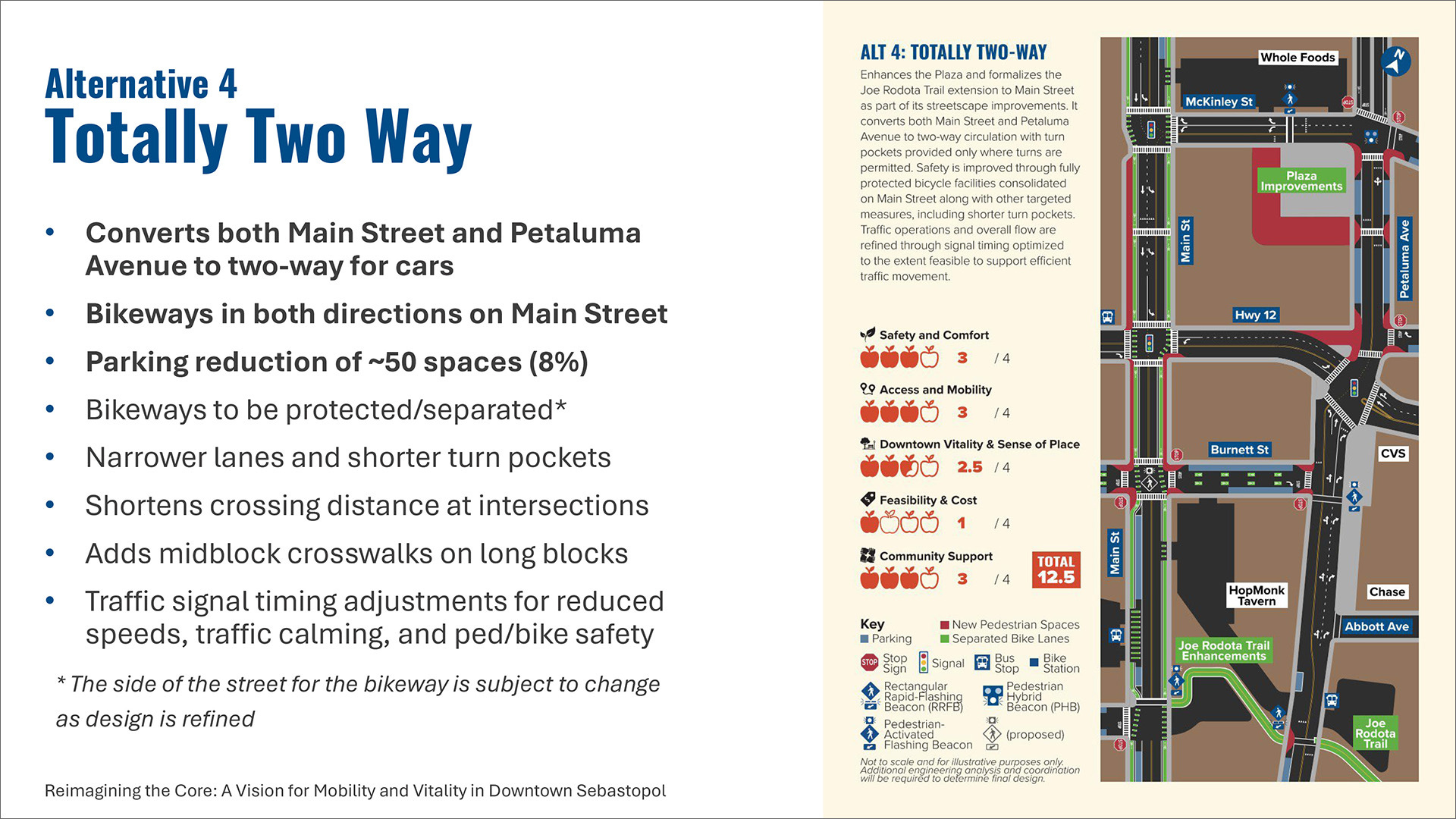
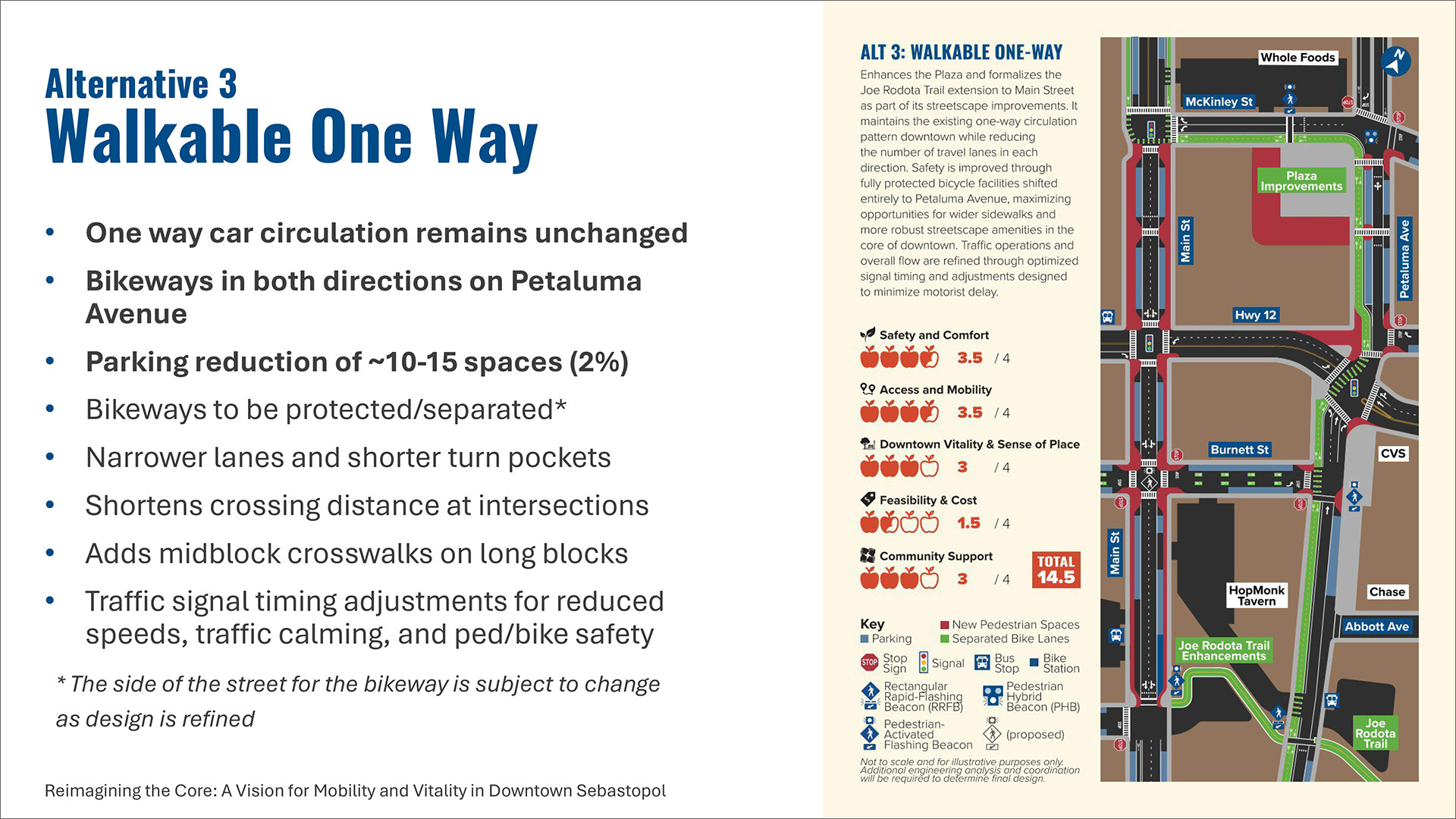
There is no official illustration of the Planning Commission’s hybrid plan at the moment. According to Fehr & Peers consultant Geoff Rubendall, “The approach we have been asked to follow is to wait until after the city council meeting before we advance this Alt 3/Alt 4 hybrid alternative.”
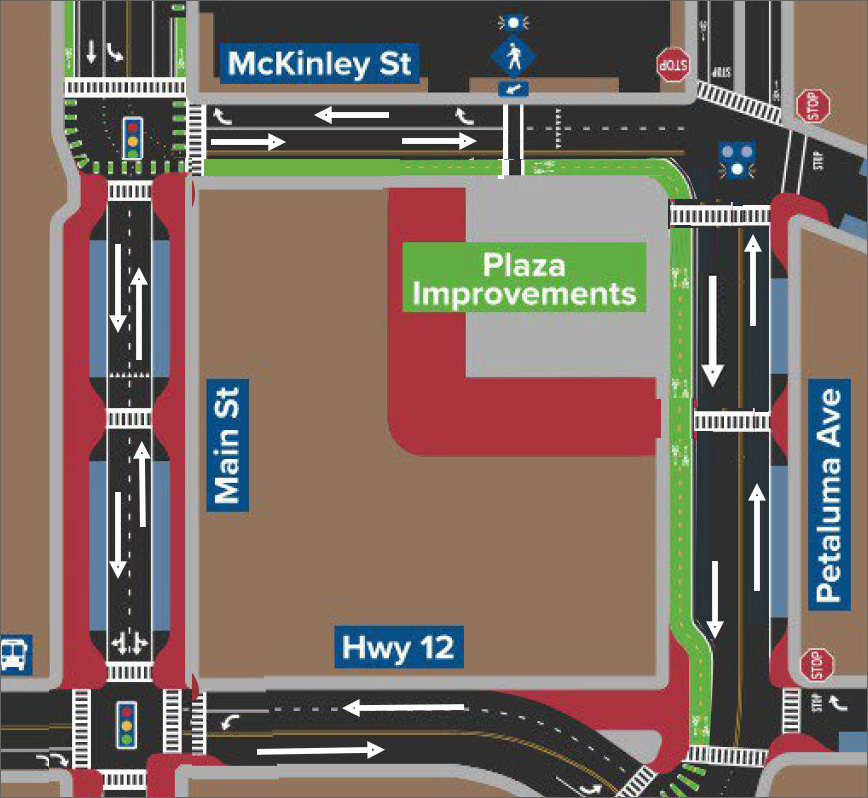
To help you visualize what the Planning Commission’s hybrid plan might look like, we’ve created our own illustration, which we ran by Fritz and Rubendall to ensure that we’d understood the planning commission’s intent.
“Obviously, a lot of details need to be worked out, but this is conceptually the direction we gave to Fehr & Peers,” he said.
Rubendall suggested focusing only on the downtown section because there are still too many open questions about how the hybrid model would look south of Burnett.
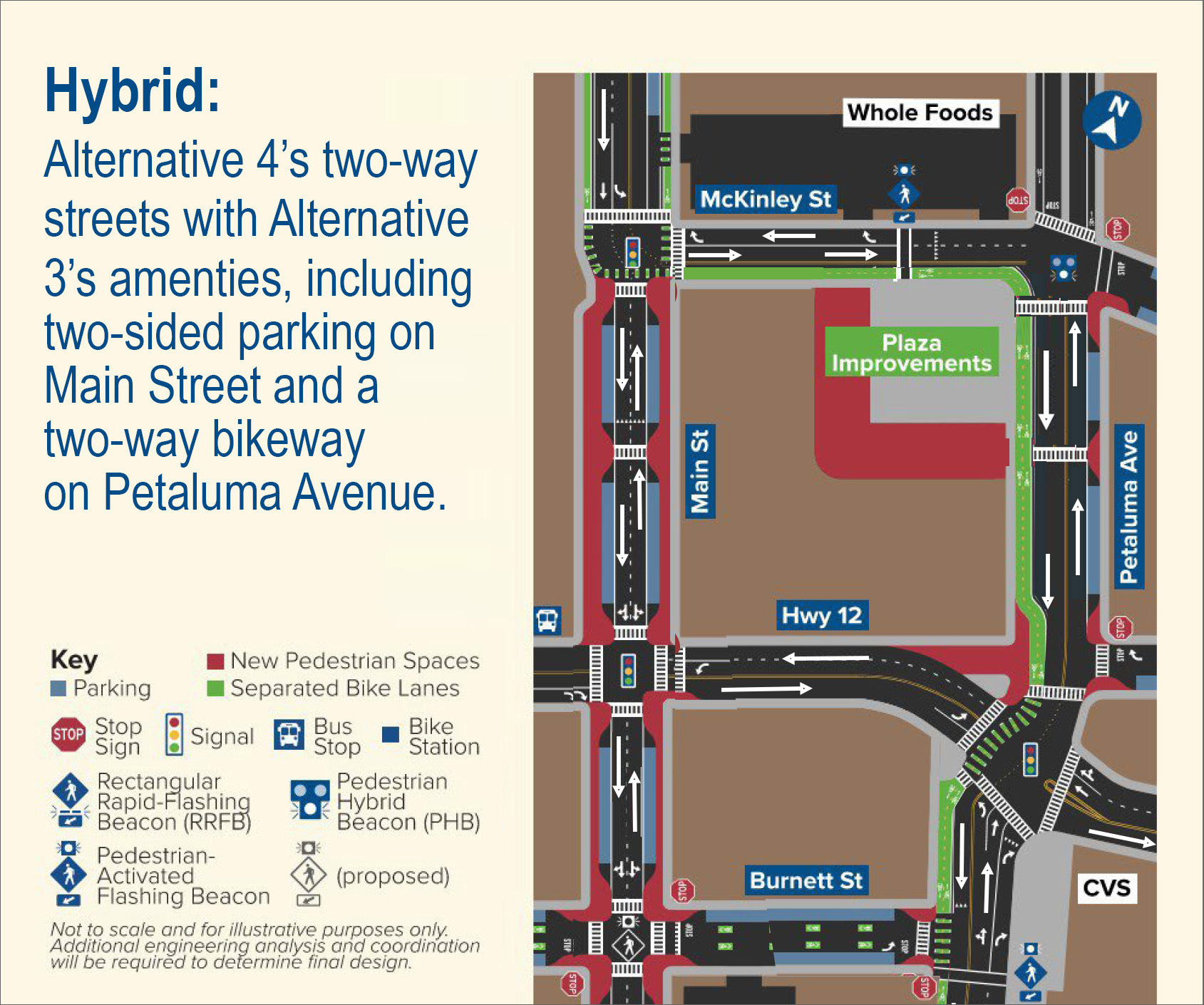
Although all the streets in this hybrid model would be two way, Santa Rosa-bound traffic coming from the north would be directed to turn left onto McKinley in front of Whole Foods, then right onto Petaluma Avenue, then left on Bodega Avenue/Sebastopol Road heading east out of town. (Vice versa for traffic coming from Santa Rosa and north through Sebastopol.) The idea is to move a big chunk of traffic away from Sebastopol’s historic Main Street to make walking and shopping there a more pleasant experience.
“So Main Street becomes much more of a small-town Main Street, and Petaluma Avenue/McKinley becomes like a through-way. I just find that super appealing,” Fritz said at the meeting. “I just want to have a small-town Main Street.”
Improving Main Street and engaging in what urban planners call “placemaking” was also important to Planning Commission Vice Chair Jennifer Koelemeijer, who also owns a business on Main Street—a domestic-arts store called Gather.
“None of these alternatives are actually going to provide a solution to traffic,” she said. “Since they’re all going to be fairly equitable in terms of changing or not changing the traffic impact, I definitely share the belief that we should focus on placemaking and creating a vibrant downtown and creating more walkability and better pedestrian access and increasing safety for our pedestrians and our bikers.”
Fritz, as he has often done in the past, doubled down on this theme.
“I don’t think trying to solve the traffic problem should be the emphasis here because it’s just not going to happen,” he said. “The one-way street system was done initially to solve that problem, and people still complain about congestion. If we do nothing, people will continue to complain about the congestion downtown. If we do anything different downtown, people will definitely complain about the congestion, because they will say this has made it worse, whether it has demonstrably made it worse or not—that will just be everyone’s perception.”
He then floated a quirky idea that complaining about traffic is a kind of bipartisan sweet spot for Sebastopol—uniting everyone of all political persuasions.
Planning Commission Chair Evert Fernandez said that all the new development in town isn’t helping the traffic situation. “Lately, it’s just been build, build, build. And if you look at the housing coming online, and the number of cars they have and the number of trips—I think we calculated something like an additional 500-600 vehicle trips—so my concern is about adding more and more traffic. But when you say, ‘Don’t build,’ everybody’s like ‘Well, people need places to live.’”
After the meeting, Rubendall said there were small but potentially significant traffic differences between the alternatives. “When accounting for auto traffic from all directions, travel times through downtown under Alternatives 3 and 4 were approximately the same (i.e. many routes become more direct, some might be a little longer). None of the alternatives studied eliminated or significantly reduced congestion. The May 2024 workshop also highlighted the vehicle miles traveled (VMT) benefits of two-way circulation, which showed an overall reduction of about 5 percent in total VMT—a meaningful and measurable improvement.”
Koelemeijer asked Rudendall if some of the current grant funding could be used to explore solutions to Sebastopol’s perennial traffic problems.
“As part of the grant funding, could we explore the ability to actually address the traffic because I think the things that need to be evaluated when we talk about addressing the traffic issue are different than changing this from a one-way to a two-way,” she said. “It’s about busses for students in town. It’s about changing the direction of traffic from Analy. It’s a much broader conversation than just about which way the roads are going.”
Rubendall said that was outside the scope of the current grant.
Koelemeijer also noted that the “Totally Two Way” alternative, as presented, got rid of all parking on the downtown block of Main Street (replacing it with bike paths).
“Removing all the parking on Main Street would kill the businesses,” she said. “It would be very difficult.”
Then she and the other commission members began the process of imaginatively moving pieces of “Alternative 3: Walkable One-Way” into “Alternative 4: Totally Two Way.” They removed the two-way bike lanes from Main Street and stuck them on Petaluma Avenue. In the end, they came up with the hybrid plan pictured above. (“I’ve just seen how the sausage is made,” wrote one commenter, Kent Jenkins, on Part 1 of this article.)
All of the commissioners seemed excited about the flexibility that having two-way streets downtown would provide, not just for everyday driving, but for events.
“In my mind, one of the biggest things with a totally two-way system—both streets [Main Street and Petaluma Avenue] being two way—is that we have a lot of flexibility about doing things downtown,” Fritz said. “We could close Main Street and have a festival. We could move the farmers market to Main Street. We could close McKinley and Petaluma Avenue around the plaza and have events on the plaza that spill into the streets.”
The consultant’s recommendation
The commissioners were so excited by the prospect of two-way streets that they were about to make a motion to vote on it, when Interim City Planner Jane Riley reminded them that they hadn’t heard the consultant’s recommendation yet. They’d held off hearing Rubendall’s recommendation until the end of the evening so that it didn’t influence the commission’s or the public’s discussion one way or another.
“Based on the community feedback, the high priority on pedestrian safety and a downtown vibrant character, we were going to recommend proceeding with Alternative 3 [Walkable One Way], primarily with street changes between McKinley and Burnett,” Rubendall began. “It has the biggest opportunity for that pedestrian-focused placemaking on Main Street, with several key changes to bring in the things about the two-way that a lot of people have provided positive feedback on. Alternative 3 had the greatest support in the survey, and because it doesn’t change the directionality of the downtown on day one, it can happen in phases, block by block, as grant opportunities arise. So it’s a little bit easier to phase in. However one thing that we would highly recommend is that the design of Alternative 3: Walkable One Way is revised so that it’s fully compatible with a total two-way alternative.”
He suggested that the planning commission adopt Alternative 3: Walkable One-way, to get the ball rolling and that the city undertake a feasibility study to evaluate the engineering and cost implications of going two-way.
Riley said she understood that there “strong support for a pull-the-band-aid-off Two Way All the Way” from the Planning Commission. “But I think what we’re trying to get to is funding availability,” she cautioned. “If we don’t have funding to do Two Way All the Way immediately, would you be okay with, as an alternative, developing those Main Street improvements as part of Alternative 3 [Walkable One Way] that would not preclude allowing the Two Way All the Way in the future?”
The answer was no, the commission would not go for that.
“I would be super concerned that we would do this,” Fritz said. “We’d say, ‘Well, maybe in the future we’ll go to two-way,’ and then we would just never do that. I think we need to either commit to the Totally Two Way in some manner tonight, or I just don’t see this being a good compromise.”
More “sausage making” ensued, regarding the location of bulb-outs and bike paths and parking, and in the end, the commission voted unanimously for a hybrid model that combined ‘Alternative 4: Totally Two Way’ with the pedestrian and bike amenities of ‘Alternative 3: Walkable One Way.’
After the meeting, Rubendall seemed pleased with how things turned out.
“The Planning Commission’s recommendation combines key elements of “Alternative 3: Walkable One Way” and “Alternative 4: Totally Two Way,” he said. “What they are advancing to the city council is best described as a ‘Walkable Two Way’ option, which closely aligns with the community feedback we’ve heard throughout the study and in the survey results. If the council moves forward with this approach, I would expect this hybrid alternative to perform very strongly when evaluated against the four alternatives already studied.”
Fritz's and Koelemeijer's comments about traffic are dismissive and self-serving. Fritz actually says "I just want to have a small-town Main Street." Well we shouldn't care what he wants! As a member of the planning commission, he should be unbiased and willing to look at all factors, all problems, and all possible solutions before making informed input, not just doing "what he wants." Sebastopol, for many years, had a small-town Main Street. Forty years ago it was the businesses who lobbied for a one-way street in the hopes of getting more vehicular traffic to go slowly down Main Street. Decades before that it was, again, the businesses who exerted their influence to get the highways to go straight through town, rather than skirting around Sebastopol as originally planned. I support Sebastopol businesses by doing most of my shopping in town, paying local sales taxes, even supplying a business with produce, so I have no wish to hamper their progress. But having these dreamy notions of "placemaking" and festivals without giving due weight to the serious issue of traffic congestion is insulting, especially if your stated goal is to have a small-town Main Street.
As for the public opinion and surveys referenced - how many people responded? If the planners really care about public opinion, put this issue to a vote, a vote where all West County residents can have a say. Those of us who live outside city limits but who regularly use --and pay for-- the services provided in Sebastopol, are the ones who keep the businesses afloat, not the pleasure-seeking, festival-going, placemakers (whatever that actually is -- I've lived in Sebastopol most of my life and always considered it a "place" without any help from outsiders).
If we're to have any faith in the town council and planning commission, how about some accountability for past actions approved by them? They're the ones who approve 80+ unit buildings without invoking any feasible plans for the increased resultant traffic. They're also the ones who reduced four-lane roads to two, and added bike lanes everywhere. I have no problem with safe bike lanes but have they ever actually studied the actual use and impact of these lanes? Everyone I've asked over the years says the same thing -- they can count on their hands the number of times they've ever seen bikers using Petaluma Avenue while stuck in traffic. After spending hundreds of thousands of dollars adding bike lanes to Hwy. 116, how about putting a few signs on Ragle Road directing bikers to use those bikes lanes just a few hundred meters away on the highway, instead of riding down a no-shoulder road like Ragle, between Mill Station and Covert, bringing two-way traffic to a complete halt. And do we really need a double crosswalk in front of Screaming Mimi's at Depot, Hwy 12, and Petaluma Avenue? Take a look -- there are two east-west crosswalks in that intersection, and on a hot day when people are pouring out of Mimi's with their ice cream cones, they can literally stop green-lighted traffic on a highway at either of those crosswalks. Seriously, Sebastopol planners -- take a look at your past mistakes and fix them before expecting us to swallow yet more of your dreamy, impractical, nonsense.
The hybrid model is interesting, but the problem of the coming from the north or west down from North Hwy 116 and transitioning to Hwy 12 East remains. Yesterday to move from Main to Hwy12 East took several signal changes before I could get to the intersection. With the new housing being build on West 116 and the communities to the West, that will become a greater problem. I'm not sure how the traffic flow can be adjusted to solve that situation which will only be getting worse. Moving the traffic from Main St to Petaluma is only going to complicate the traffic flow.