

The behavior of the hordes of high schoolers who hang out at the front of Safeway during the school year is a common topic of discussion in Sebastopol. For much of this year, Mayor Jill McLewis, Police Chief Sean McDonagh, Analy Principal Chuck Wade and a changing cast of managers at Safeway met monthly to discuss the issue. Some residents see the kids in front of the store as miscreants; others see them simply as teenagers being teenagers.
But the kids who hang out behind the store—that’s a whole different story. Some of the neighbors who have to deal with their antics say they take adolescent misbehavior to a whole new level.
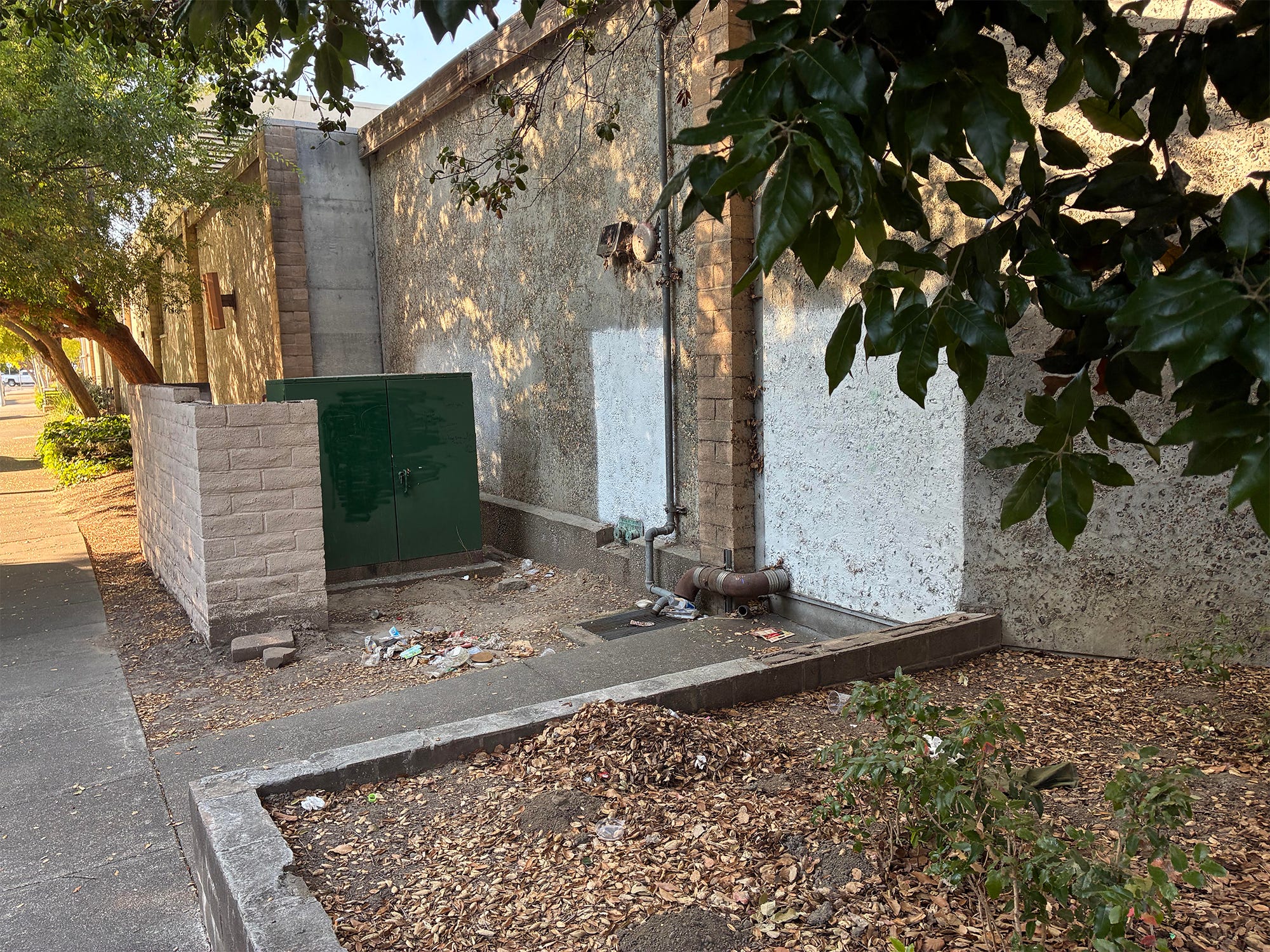
At the end of April, three high schoolers were cited for defacing a street-facing wall and a utility box with Nazi and anti-black graffiti, including the N-word, the phrases “Nigga-killer” and “Hitler was right,” along with a swastika and Nazi eagle. (See our article on this event.) They were referred to the juvenile justice system.
Vandalism of this sort would be worrying on its own, but its location—directly across the street from an apartment complex with both black and Jewish residents makes it doubly concerning.
One of those neighbors, Dezi Rae Kai, who is black, appeared before the Sebastopol City Council on July 21 to ask the city for help with what she and her neighbors say are ongoing problems behind the Safeway.
“I’m one of the neighbors that lives behind the Safeway. As a lot of you know, there has been an ongoing issue in the back of Safeway that has become out of hand,” Kai told the council. “There’s lots of individuals, but mainly the Analy High School students, and we’ve had our run-ins with inappropriate behavior at that spot.”
She mentioned the graffiti incident, but said that wasn’t the end of it.
“A few weeks back,”— this would be in early June — “we had a group of teenagers making monkey noises after seeing some of the black children that lived across the street,” she said.
One of the neighbors actually took photos of the teenagers involved in that incident. She sent the photos to Analy Principal Chuck Wade, and also to the Sebastopol Police.
“The principal seemed genuinely concerned,” she said.
The police came and took a report as well.
It wasn’t the first time the neighbors noticed peculiar noises.
“The noises have been going on for a while,” the neighbor said. “That was not the first incident. That was the first time I had specifically heard monkey noises. But every Thursday…I would hear screaming outside, and so I would come outside every single time that it happened, just to check and make sure everyone’s okay.”
She said when things get too rowdy—like when the kids start throwing shopping carts around—she calls the police, but the kids frequently run around the building and melt back into the larger group of kids in the front of the store.
Sometimes, she said, she also sees kids up on the roof of the Safeway building.
Neighbors have also seen teens drinking alcohol—Biggies Buzz Balls (an alcohol with packaging that looks like it’s designed for children)—and doing drugs at this spot after school. At a recent council meeting, one public commenter noted that she often picked up and disposed of needles she found there, though this may or may not be related to the teens who congregate there.
Monkey noises and the difference between a hate crime and a hate incident
As painful as it may be for the victims, Police Chief Sean McDonagh wrote to the Sebastopol Times that making monkey noises doesn’t rise to the level of a criminal offense.
“Unfortunately, despite the potential victim of this claiming the noises were directed at them, they cannot, with any prosecutorial level of confirmation, confirm this, and even then, the First Amendment provides significant protections for free speech, and there is no specific crime for making monkey noises,” McDonagh said. “It’s much like a protester voicing their opinion on Main Street, whether we like to hear it or not.”
“We as a police department must carefully consider the constitutional issues and avoid driving the city into unnecessary federal civil rights litigation, such as that recently settled from the incident, prior to my tenure here back in 2024. I do my very best to ensure our officers are educated on these issues … It’s a balancing act, sometimes.”
The website for California Attorney General Rob Bonta explains the difference between a hate crime and hate incident. Monkey noises seem to fall into the latter category:
A hate crime is a crime against a person, group, or property motivated by the victim’s real or perceived protected social group. You may be the victim of a hate crime if you have been targeted because of your actual or perceived: (1) disability, (2) gender, (3) nationality, (4) race or ethnicity, (5) religion, (6) sexual orientation, and (7) association with a person or group with one or more of these actual or perceived characteristics. Hate crimes are serious crimes that may result in imprisonment or jail time.
A hate incident is an action or behavior motivated by hate but which, for one or more reasons, is not a crime. Examples of hate incidents include:
Name-calling
Insults
Displaying hate material on your own property.
Posting hate material that does not result in property damage.
Distribution of materials with hate messages in public places.
At the August 4 Sebastopol City Council meeting, the council directed City Attorney Alex Mog to research the city’s legal options for dealing with this kind of behavior. Councilmember Stephen Zollman and Vice Mayor Maurer requested that these solutions emphasize restorative justice. (Sadly, a county-sponsored program that provided restorative justice programs free to schools and police departments ended this spring.) Mog said he could have a report done in time for the Sept. 1 council meeting.
The Kai family met with representatives from the city, including Mayor McLewis, the day of the August 4 council meeting, but the Sebastopol Times didn’t get any responses back when we inquired about what happened at that meeting.
The neighbors have some suggestions
The neighbors would like to see the area fenced off, or, at the very least, they hope that Safeway or the city could install security cameras. (The city can’t install cameras on Safeway property, of course, but neighbors say that the sidewalk is city property and cameras could be installed from there somehow.)
A few weeks ago, before they met with the city, the Sebastopol Times met with Dezi Rae Kai’s mother, Althea, who is Jewish, and two of her neighbors, Sarah O’Brien and Bonnie Summers. We stood in the late afternoon sunlight at the place behind Safeway where all the trouble was happening during the school year. There’s a small walled utility area and a large low planter with a big shade tree. On the back wall of the Safeway, two large white-painted squares cover up the Nazi and racist graffiti from earlier this spring.
Althea said the neighbors’ preferred solution is a tall, locked fence.
“Just fence this off,” said Althea Kai, gesturing at the space. “Fence this in and then have it completely covered on the top, and have a lock that the city has, that the police have, that Safeway has access to.”
“We were hoping that before school started, we’d kind of have a plan in place so this would be less accessible or less ‘friendly’”—by which she meant, less attractive to teenagers. “You know, if they can’t put a fence up, put a camera. It’s just a matter of figuring it out. It just feels like everyone is passing the buck. Like Safeway is saying they can’t do it. The police say they can’t do it because it’s Safeway’s property.”
Safeway's response has been less than reassuring.
“I talked to the manager [at Safeway], and he said, ‘Can you write this all up, and we’ll send it to corporate, and see what they can do about it.’ Then I didn’t hear anything back for two weeks, and I called, and he [the manager] no longer worked there, so I got a new manager. So I said, ‘Okay, well, I’ve sent this email. Can you confirm that you received the email? Confirm that it’s going forward.’ Nothing. I called three or four times and just didn’t get any calls back.”
The Sebastopol Times reached out to Safeway’s corporate offices in Pleasanton. This was their response:
“We understand and share our neighbors’ concerns, and we are working closely with local leaders to address issues affecting the area surrounding our Sebastopol store. Our Asset Protection team regularly meets with law enforcement, city officials and school leaders to discuss safety concerns, review incidents and coordinate response efforts.
“Ahead of each school year, we work with school leaders to prepare for increased student activity near the store. We promptly address graffiti and property damage when reported, notify law enforcement of safety-related incidents and collaborate with community partners to help maintain a safe and welcoming environment for customers, associates and neighbors. While not all reported activity occurs on Safeway property, we remain committed to supporting community-wide efforts to address these concerns.”
The Kai family and several neighbors on the street are frustrated by the lack of action.
And now, it’s back-to-school week at Analy High School. The first day of school is Thursday, Aug. 13.
“Once school starts, it’s going to happen again because this is their hangout,” Althea said.
She said she’s been disappointed by the responses of the city, the school and Safeway—but she was also disappointed by the response of the Sebastopol community as a whole.
“I’m really upset about the fact that this happened and these kids witnessed it, and then the response has been mom and neighbors trying to get someone to address it and trying to get someone to address it—as opposed to a big response of the whole community and the whole city, like ‘We don’t tolerate that here. That’s not something that’s acceptable.’ You know, ‘You belong here. You’re loved here.’ These kinds of things. I hoped that that would be the response. I hoped that people would have reached out. We did have one woman who came over, knocked on the door, told us she heard from your story, and came up and cleaned this whole thing like two or three days after. But that was it.”
At the city council meeting in July, her daughter Dezi put it this way: “We ask that City Council work with Analy, Safeway, the police and us neighbors to find a solution. We are a neighborhood of people of color and children that walk to school every day. We need to feel safe in our homes and need to know that our community will support us in finding a solution.”
None of the neighbors in this story wanted their pictures taken for fear of retaliation.
I feel so sad and ashamed that our neighbors dealing with this awful problem have not felt supported.
Before I reached my teens I met relatives from Europe with blue numbers tattooed on their wrists. I grew up with black people. I learned that everyone, regardless of any differences, deserves to be treated with respect, unless, by their actions, they prove otherwise. I am appalled that neither their parents, nor our educational system, has instilled that idea into the heads of these kids. I am appalled that, with all of Sebastopol's brain power, we cannot (or will not) correct this situation.