

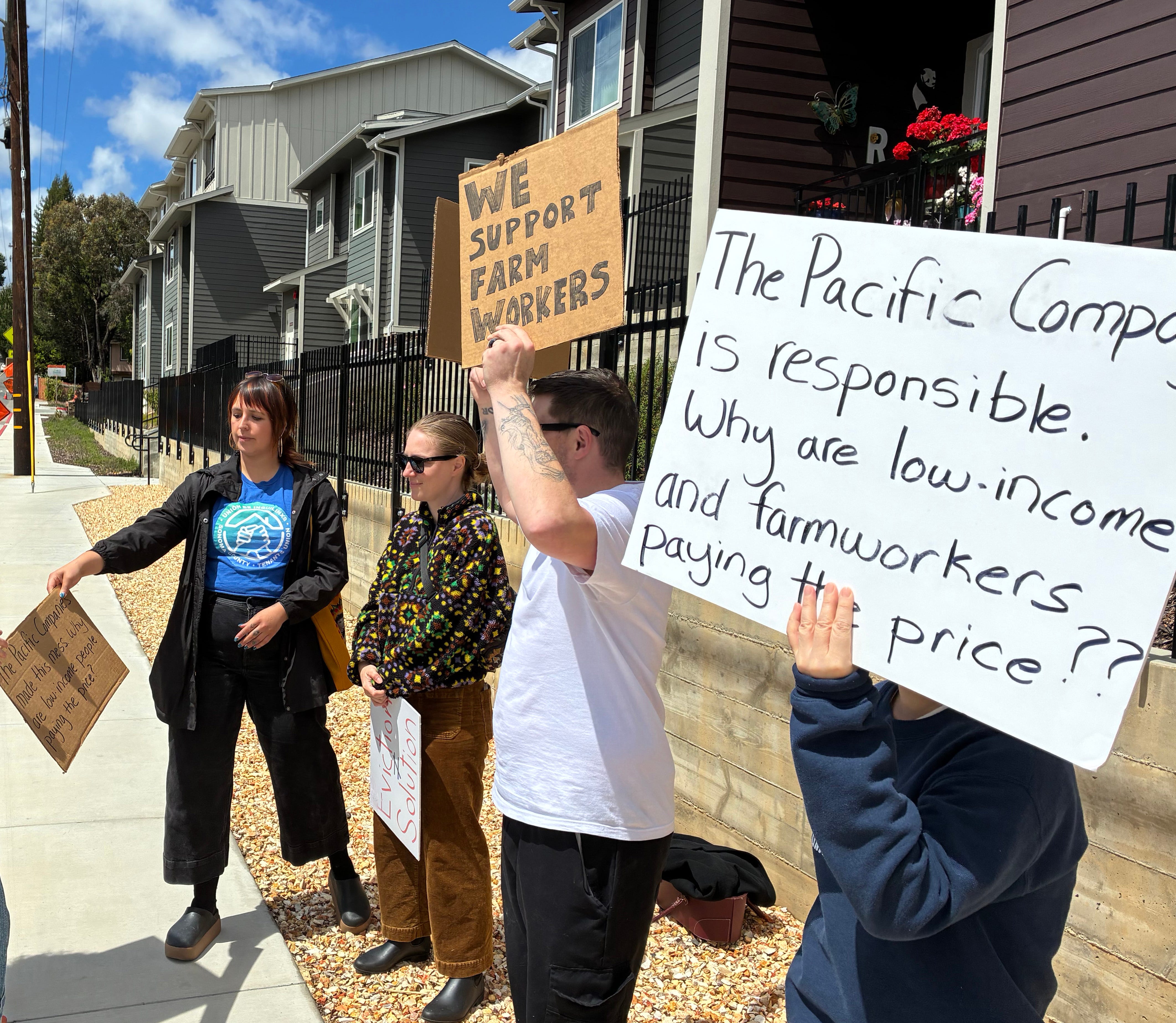
On Wednesday, April 22, Woodmark Tenants United and 14 of the original Woodmark tenants filed suit in federal court against The Pacific Companies (TPC), owner of Woodmark Apartments. The remaining tenants are a diverse group made up mostly of single mothers and seniors, including Alyssa Aguirre, Ananda Ahearn, Gabriela R. Ortiz Alonso, Glenda Barton, Vincent Barton, Elizabeth Galllock, Trinell Meyer, Melissa Page, Genevieve Perkins, Sandra Russell, Kari Snyder and Amanda Quillin.
The plaintiffs are represented by attorney Anthony Prince, who also serves as General Counsel for the California Homeless Union, which represents thousands of unhoused families and individuals, many of whom became homeless due to wrongful evictions. Prince is hoping to keep his clients at Woodmark from joining their ranks.
The group held a press conference yesterday in front of the Woodmark Apartments to announce the filing of the lawsuit. Tenants waved protest signs and chanted. Prince, whose law office is in Berkeley, couldn’t attend the press conference—he got tied up in court—but he spoke to reporters on speaker from one of the tenants’ cellphones.
Explains Attorney Prince: “In exchange for substantial financial benefits, TPC was obligated as a participant in the USDA’s Off-Farm Labor Housing program to make a determined effort to prioritize farmworkers and agriculture-related families as tenants but failed to do so. Instead, TPC filled Woodmark Apartments with low-income, non-farmworker families who were deliberately misled into believing that they were eligible to become longterm tenants. Nine months later, when the scheme was exposed by local media, TPC tried but failed to force these tenants to falsely represent themselves as a condition of signing a new lease.”
Charging violations of the federal Fair Housing Act, False Claims Act, state and local tenant protection laws, breach of contract, breach of promise and infliction of emotional distress, the tenants are requesting the federal court to issue a declaratory judgment and a preliminary injunction preventing TPC from wrongfully evicting them.
Legal Aid lends a hand
The battle to keep the tenants in their home is being fought on two fronts: Prince is running the civil case, while Legal Aid of Sonoma County will handle any eviction proceedings.
“We’re taking on the eviction defense side, which is really the kind of legal work that we are very, very familiar with,” said Legal Aid’s supervising housing attorney Patrick McDonnell. “We are ready to help defend the Woodmark residents in eviction matters, if evictions are filed, and we’re in communication with Anthony Prince about the affirmative lawsuit that he just filed.”
“We’re just trying to make sure that these two different parallel strategies to protect the residents are mutually reinforcing and supplemental to each other to try to keep these people in place,” he said.
Aperto, the management company for TPC, sent Intent to Evict notices to the 14 remaining tenants 60 days ago. That 60-day notice period ended this week, which means TPC can now file individual court cases against each tenant, asserting “unlawful detainer.” The tenants have been paying the rent all along—but after the Intent to Evict notices were sent, Aperto stopped accepting their rent.
“The name “unlawful detainer” is just the term of art for eviction,” McDonnell said. “They [the property owner] will file a lawsuit, telling the court that the tenant is unlawfully detaining the premises. They’ll say ‘Here’s the notice that I gave them. They have now overstayed that notice or…and now I want the court to issue an order getting rid of them.’”
McDonnell said tenants would then have roughly two weeks to respond by making their own court filing, presenting a legal defense for why they’re staying on the property.
“The Woodmark folks would then come to us, and we would have those defenses ready to go,” he said. He declined to explain what those defenses would be so as not to tip their hand.

McDonnell said that summary proceedings for evictions are quick because they’re about one thing and one thing only: “It’s about who has the legal right to possess a Woodmark apartment unit…That’s the only thing that the court determines is whether the tenant has the legal right to be in that unit or the landlord has the legal right to get the tenant out and take that unit back.”
“It’s up to the judge to say or the court to say, because of these things, the tenants cannot be legally evicted from the units,” McDonnell said. “But in terms of relief beyond that, they can’t get that in eviction court. They have to get that through a separate civil case, and that’s what Anthony’s lawsuit is about.”
Lawsuit makes a slew of claims
The lawsuit, filed by Anthony Prince on behalf of the tenants of Woodmark, makes five main claims:
Fraud in the Inducement: This claim argues that TPC through its management company Aperto lured tenants into taking up residency at Woodmark by falsely informing apartment seekers that eligibility was not limited to farmworkers.
Fraud by Way of Negligent and Intentional Misrepresentation. This claim argues that TPC/Aperto willingly made false statements to its tenants regarding their eligibility and that it knew those statements were false.
Violation of Sebastopol Municipal Code Chapter 9.36 and California Tenant Protection Act (AB 1482). This claim argues that TPC violated both local and state tenant protection laws.
False Claims Act and Attempted Fraud. This claim argues TPC and its agents coerced and/or tricked all tenants, none of whom are farmworkers, into signing lease agreements intended for farmworkers, constituting a false record. It further argues that TPC failed to make the required genuine, good-faith effort to reach out to Sonoma County’s farmworker community with information about Woodmark and the benefits available through the Off-Farm Labor Housing Program. It argues that the defendant did this for financial gain from the USDA’s Off-Farm Labor Housing Loan Program.
Solicitation to Commit Fraud. This claim argues that by adding an addendum to the new lease, informing tenants that they must be farmworkers to qualify for an apartment, it was soliciting them to commit fraud.
Violation of the Americans with Disabilities Act. This involves the complex’s refusal to make an accommodation in the case of one tenant’s need for a ground-floor apartment.
Negligent Infliction of Emotional Distress. This claim argues that by engaging in the course of conduct described above, TPC caused and is continuing to cause tenants great anxiety and emotional distress.
Interestingly, this lawsuit does not contain a request for damages, though it does ask TPC to pay for the tenants’ attorney fees. The tenants are merely asking to be able to stay in their apartments. The suit requests that the judge issue a temporary restraining order enjoining TPC from moving forward with eviction efforts and that it comply with state and local tenant protection laws.
Speaking of the cooperation between his office and Legal Aid Sonoma County, Prince said, “One way or the other, we’re going to be doing our best in both courts—state court and federal court—to see if we can stop these guys.”
The suit mentions that both Supervisor Lynda Hopkins and Sebastopol Councilmember Stephen Zollman had reached out to The Pacific Companies in defense of the tenants now resisting eviction.
The Sebastopol Times reached out to TPC owner Caleb Roope this week but received no response.
Prince said that early on, he had a brief talk with TPC’s attorney. “What the attorney told me was that, as far as they were concerned, what’s the big deal? The tenants got what they call the benefit of the bargain. They signed a one-year lease, and they were able to stay there for a year. Well, the problem with a statement like that is that you forgot to mention that, under the law, the tenants had a right to sign, or be offered to sign, a renewed lease with essentially the same terms.”
One of the questions the Sebastopol Times sent to Roope this week was whether TPC had essentially been ordered by the USDA to remove the current tenants and replace them with farmworkers. There is some evidence that that’s the case.
Zeke Guzman of Latinos Unidos del Condado de Sonoma, who we’ve quoted in previous articles on Woodmark, filed an official complaint with the USDA. As we reported in September 2025, “Guzman has been in communication with Woodmark’s developer and the USDA. He said that the developer and the USDA had agreed on what’s known as a Corrective Action Plan—and that plan involves moving the current tenants out and farmworkers in. (We reached out to the USDA and The Pacific Company for confirmation, but have not yet heard back from them.)”
Legal Aid’s McDonnell said the USDA’s participation in this situation could be key.
“I think everyone involved with this, including TPC, would enjoy having the USDA at the table to see if there’s a resolution to this.”