
By Dan Kerbein
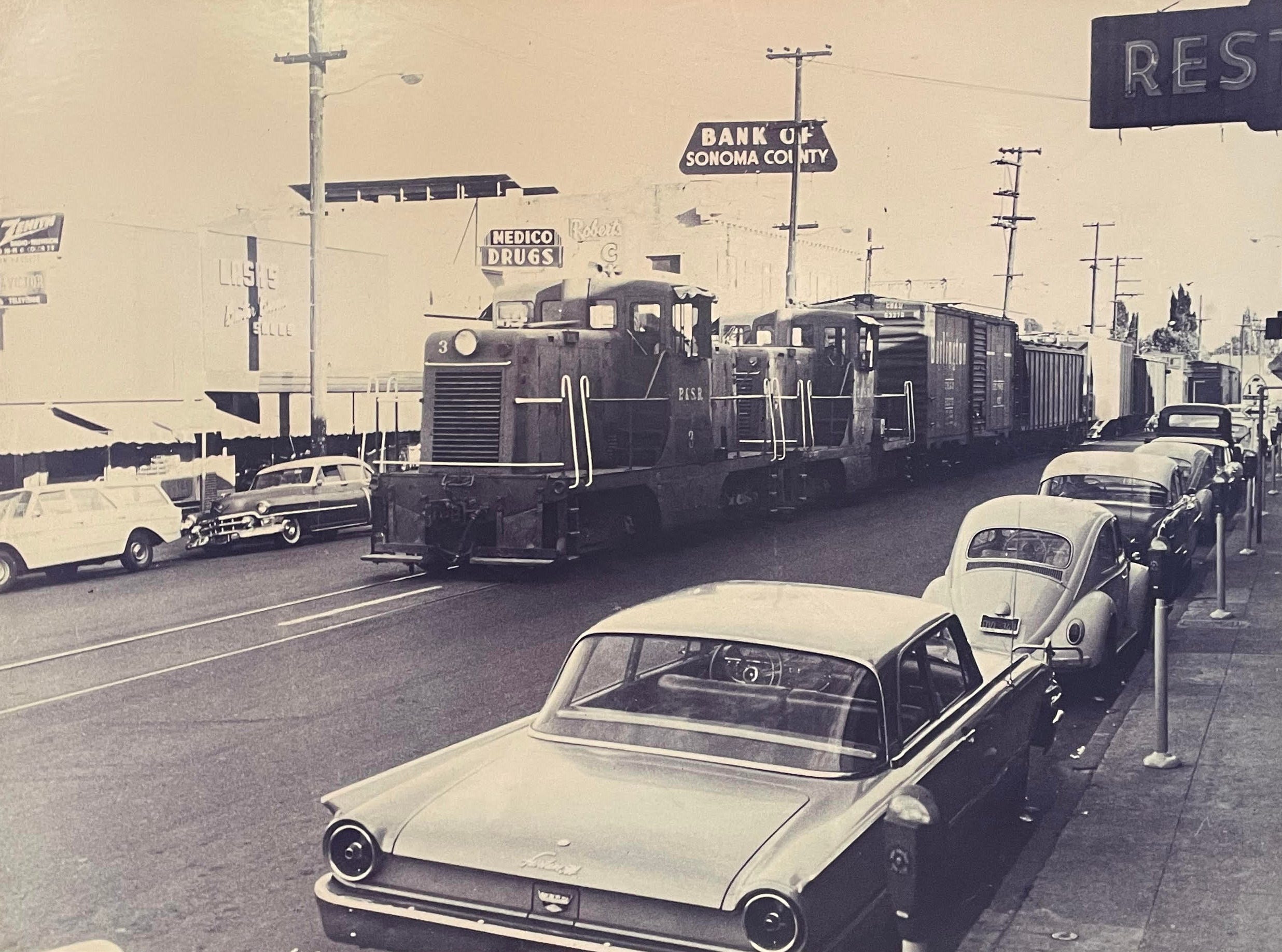
“Are you in a newspaper office or a railroad station?!” the person on the other end of the line hollered so I could hear him over the noise of the train passing about 20 feet from the front door.
“A little of both,” I replied, both of us chuckling because almost as long as there had been a Sebastopol Times office, there had also been a train down Main Street. And everyone in the newspaper’s circulation area knew that at this time of the day, all conversation would be virtually drowned out by the din of a diesel engine and clanging wheels.
That was in 1978, and one thing I now know is this: If you can get used to a train rolling up the main traffic artery of your town every day, you can get used to just about anything.
You can also get used to seeing them replaced by quiet walking trails.
I was 27 back when I was working for the original Sebastopol Times, and I was partly annoyed by the train but also fond of it, amused by this reminder that Sebastopol was still a country town at heart, not a city. The apple industry had long been in a slow decline, but you could always get a bushel of Gravensteins every August, and anyone you asked could advise you on making apple pie. It’s still like that to this day, except maybe for the pie part.
Ah, nostalgia. But what about that traffic issue, with drivers having to steer clear of an iron behemoth. What kind of moron would lay out the Petaluma & Santa Rosa Railway to do that? Well, to be fair, there weren’t any cars on the road yet in 1904 when the rails were completed. In those days when someone said, “I’ve got to go see a man about a horse,” they either meant that literally or were fixing to visit the outhouse. That’s right, there was no indoor plumbing back then either. Or telephones. Or electrical wiring in Sebastopol homes.
But there was electricity in a massive untamed form, powering factories and transit systems, and that’s what moved crops and people quickly to destinations only dreamed of before.
The train down Main was also the Santa Rosa trolley, with wires sparking over the cars just like in San Francisco. Massive transformers located in what is now Hopmonk supplied them with a constant flow of 600 watts. Locals were impressed by that, especially in Forestville, where you could end your train ride with a stay at the Electric Hotel.
Every local farm benefitted from having a train bring the day’s harvest to market. Pick the fruit at dawn, get it sold before noon. The P&SR transferred its freight and passengers to steamers in Petaluma, which could take them to San Francisco, Oakland, or Napa. All of this (along with its loamy Gold Ridge soil) made Sebastopol the apple capital of California.
By the time I was sweating over deadlines and old-fashioned air conditioning at the Sebastopol Times, the train was down to running only once a day. The phase of history I described earlier, of peak new technology and peak production, lasted until the 1960s. It was destined to give way to the Interstate Highway System. Now apples get trucked in from Washington state, and Gravensteins are a fine gourmet specialty.
I respect what the P&SR Railway accomplished and what it took to build it. It has its place in the march of progress, and its descendant, the SMART train, has spared me many an hour of staring at a freeway of brake lights.
Having said that, I must admit I enjoy the trails a whole lot more than I enjoyed that hobbling old diesel train. But how can I not get at least a little nostalgic when I think about it?
I remember it well. I worked for the engineers in the (now Hopmonk) old power station. Our secretary was married to one of the train engineers, and she’d go out on the loading dock at the back every day and wave to him when the train rolled through.
Good memories, long ago!
So who is the writer of this fun article?