


This is Part 1 of a three-part article on the city’s water and sewer funds, which have come under increasing scrutiny over the last few years. In the last month and a half, two reports have been released about the city’s handling of its water and sewer funds—one by the Sonoma County Grand Jury and one by the city’s own Enterprise Funds Oversight Committee. Part 1 of this article will deal with the recently released Grand Jury Report; Part 2 will deal with the Enterprise Funds Oversight Committee Report; and Part 3 will deal with the City’s response to their findings.
In May, the Sonoma County Grand Jury released a report criticizing the city of Sebastopol’s management of its water and sewer funds. The report found that the City violated state law regarding water and sewer fees and now owes its Enterprise Funds (i.e., its water and sewer funds) more than $5 million, the result of mismanagement over more than a dozen years.
The city sent out an initial response to this report, disputing the $5.5 million figure and denying that it was ever in violation of state law. City manager Mary Gourley said the City was currently working on a longer, more formal response to the Grand Jury report.
The legal framework
The Grand Jury Report, entitled “City of Sebastopol’s Water and Sewer Systems: Deferred Action has Consequences,” begins by laying out the legal framework for their complaint—namely, that the city was in violation of at least two state laws governing Water and Sewer Funds, including Proposition 218 and Proposition 26
Prop. 218, a state law known as the “Right to Vote on Taxes Act,” was passed by voters in November 1996. Regarding municipal fees, Prop 218 requires the following:
Revenues derived from the fee must not exceed the funds required to provide the service.
Revenues derived from the fee must not be used for any purpose other than that for which the fee is imposed.
Fees may not be imposed for general government services.
Proposition 26, passed in 2010, reiterated this, finding (among other things) that fees for municipal services, such as water and sewer, cannot exceed the actual, reasonable cost of providing those services.
How does a city determine the reasonable cost of providing water and sewer services?
To set ratepayer fees for water and sewer, cities hire highly paid consultants to conduct two complex and different (but connected) studies: a cost allocation study and a rate study.
A cost allocation study examines what it costs to run a city and then allocates those costs among the city’s different departments. The cost allocation study also determines how much the city’s Water and Sewer Funds need to pay the city for the use of city services, such as administrative, legal, human resources, and IT, as well as policy and management costs, like the cost of the city council or city manager. Water and Sewer are expected to reimburse the city for those services. The result of this analysis is a Cost Allocation Plan.
A water and sewer rate study looks at the full cost of delivering water and sewer services and how that will be shared among rate payers (i.e., the rate structure). In order to establish that, one needs to know how much the city is going to charge Water and Sewer for the city services listed above. These charges are enumerated in the Cost Allocation Plan.
Cities are supposed to update this plan every three to five years to ensure that enterprise funds like Water and Sewer are charged a fair — not inflated — share of those overhead costs. (While updating these plans every 3 to 5 years is considered a best practice, it is not legally mandated.) Though the city hired consultants to run several water and sewer rate studies over the years, Sebasstopol hadn’t updated their Cost Allocation Plan (CAP) since the year 2000. By the time a new Cost Allocation Study was finally conducted in 2024, the city had been operating on an outdated CAP for almost a quarter of a century.
The consequences were significant. When the new consultant, Clear Source Financial Consulting, did the city’s new Cost Allocation Plan in 2024, they also reviewed the allocations for the previous year (2023-2024). In that year, Clear Source found that the city had overcharged the Enterprise Funds by approximately $714,000.
That money didn’t vanish into thin air. It went into Sebastopol’s General Fund to support everyday city operations — a practice that California’s Propositions 218 and 26 were specifically designed to prohibit.
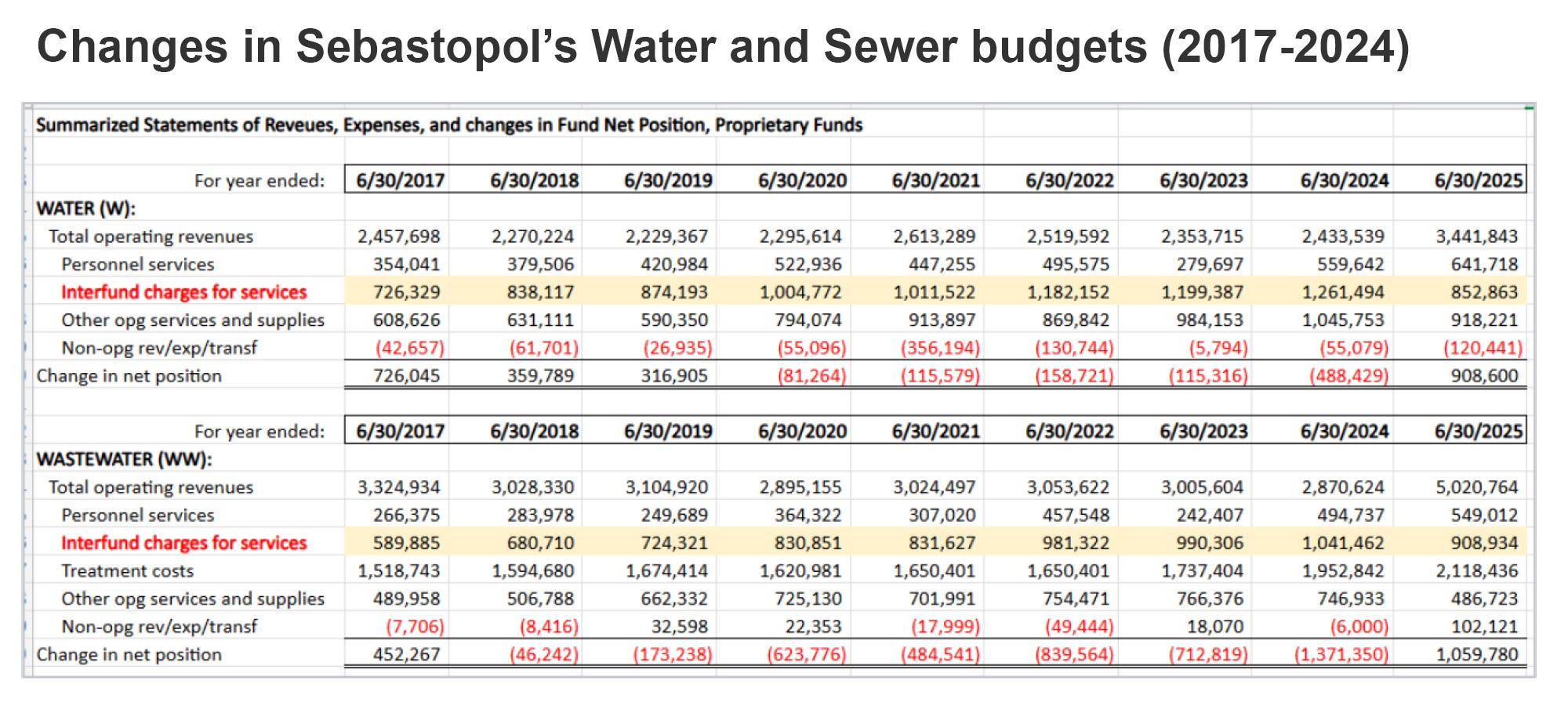
The chart below is telling. Look at the yellow row: the Interfund Charge for Services—i.e., what Water and Sewer Funds paid to the city’s General Fund. This line item increased steadily every year between 2017 and 2024: a 73.7% increase in the cost for city services for Water and a 76% increase in that cost for Wastewater over 10 years.
Even more striking is the increasing percentage of Water and Sewer Funds’ annual revenues going to Interfund Charges for city services:
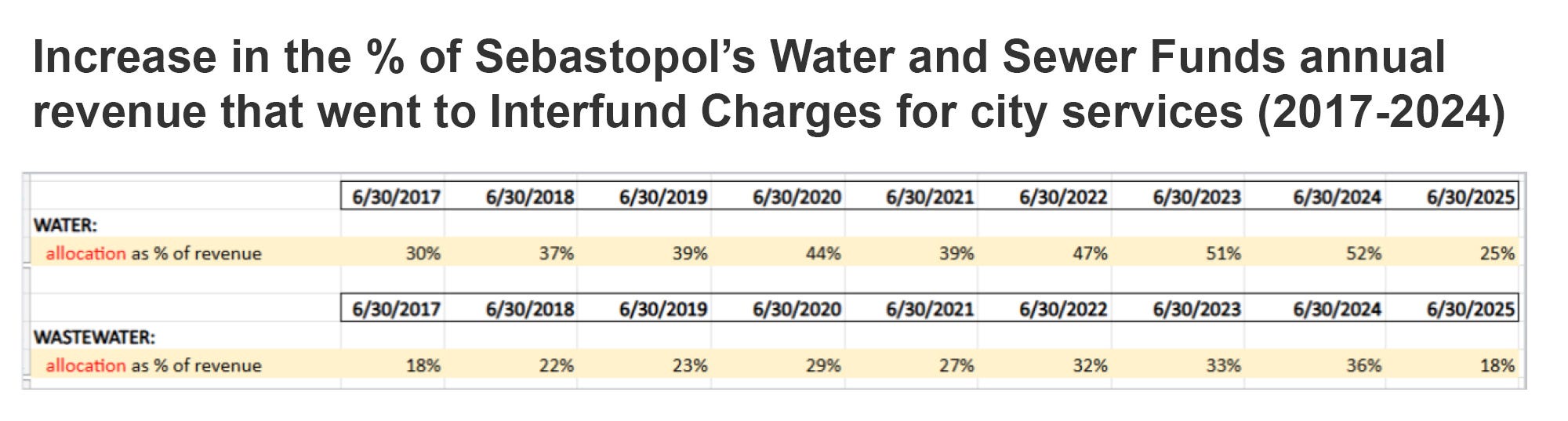
Wondering just how out of line this was, the Sebastopol Times reached out to Professor Justin Marlowe at the University of Chicago’s Harris School of Public Policy, where he also serves as Director of the Center for Municipal Finance. He said that the percentage of water and sewer revenues going to overhead typically falls more in the 15% to 30% range.
And, in fact, that’s exactly what happened once Clear Source did its cost allocation plan for Sebastopol in 2024. The cost of city services as a percentage of water and sewer revenue dropped to 25% and 18% in 2025.
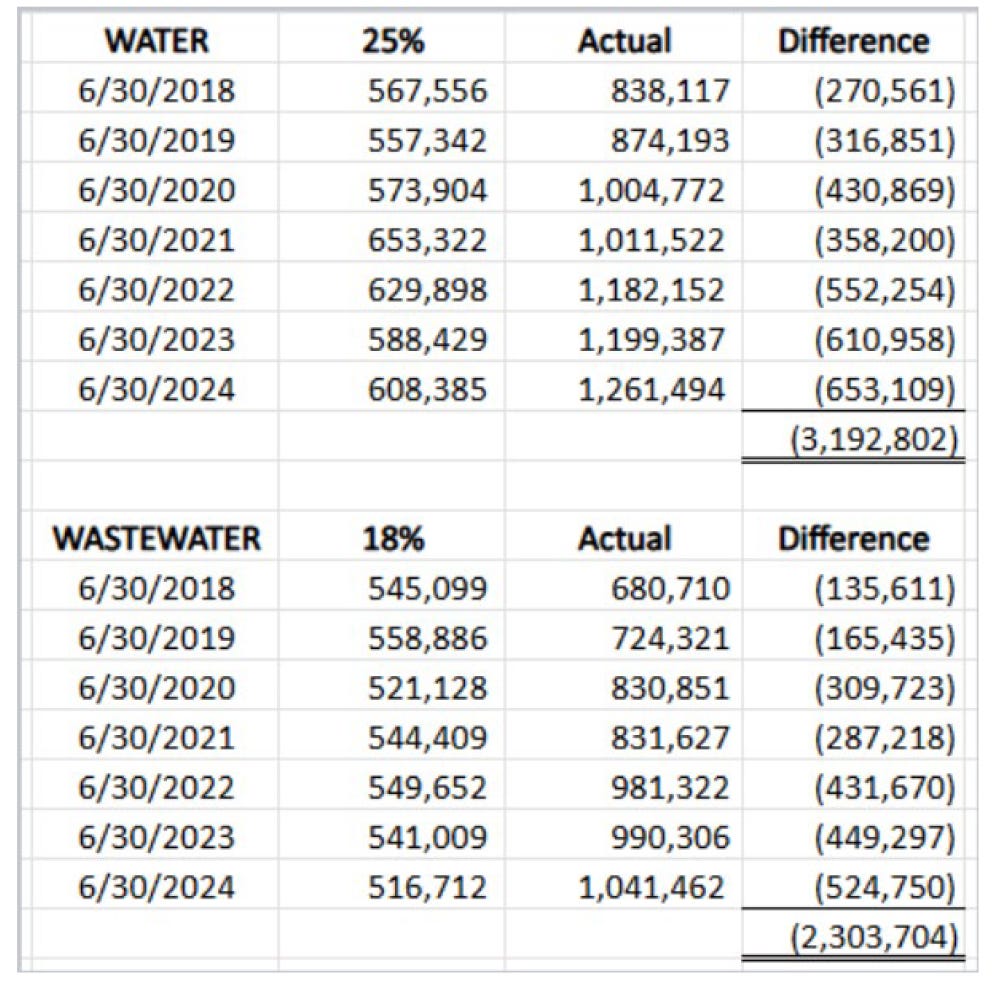
These figures are central to the Grand Jury’s claim that the city owes its Water and Sewer Funds $5.5 million. The Grand Jury simply projected the percentage of revenue rates of 25% and 18% back in time over the past seven years.
A rate shock years in the making
The financial woes of Sebastopol’s Water and Sewer Funds did not end with the old cost allocation plan. The Grand Jury also found that the city’s rate-setting process had been plagued by infrequency and miscalculation.
The city conducted water and sewer rate studies in 2005, 2012, 2019, and 2023. The 2019 study was particularly problematic. It set rates through 2023 without anticipating the success of water conservation programs that city and state officials had been actively promoting.
As the city of Sebastopol explained in its annual financial report for 2023-2024, “Revenue shortfalls and increase in expenses are the primary cause of the decreases in net position and are attributed to the delay in implementing water rate increases, as well as rising subregional costs and personnel services.” What this doesn’t say is that much of those increased expenses were inflated Interfund Charges for city services.
As you can see in Figure A, the Enterprise Funds operated at a net loss from 2020 to 2024. (Note all those red numbers.) In 2024, the city stepped in with a $1.1 million loan to the Wastewater Fund.
According to the Grand Jury report, “The Grand Jury found that the Enterprise Funds’ insolvency resulted from a combination of overallocation of indirect costs for more than 20 years and insufficient user fees that were based on infrequent rate studies and adjustments, and on inaccurate projections of usage for fees in place between 2019 and 2023.”
According to the report, “Based on its 2023 rate study, the city of Sebastopol adjusted water and sewer fees, raising them by a shocking 37%, with approximately 4% annual increases scheduled for each of the next four years. Despite steps the City has taken to correct course, Sebastopol’s Water and Wastewater systems suffer from years of underfunding that have resulted in deferred maintenance and neglected upgrades.”
The cost of deferred maintenance
The Grand Jury mentioned several of these deferred maintenance issues in its report. While it commended Sebastopol’s recently released Water and Sewer Master Plan, the Grand Jury picked out four particularly important items that it said should have been addressed years ago.
1 – Pleasant Hill Loop (Estimate $900,000 +): This is a critical safety element lacking in the water system. Redundancy is common to any well-engineered system, particularly for health or safety related systems. In good practice, fire/potable waters system main lines are loops so that an individual break or leak can be isolated and water is still available to users, fire hydrants etc. Currently there is a section of the water system that is not looped and a rupture in this line, be it a leak or a rupture caused by a seismic event, could leave more than half of the city without water pressure to fight a fire for as long as it takes to repair the rupture. This could be catastrophic. (For example, although the City’s 2005 Master Water Plan recommended that the Pleasant Hill looping project be completed, the City has yet to fund and complete the project.)
2 – Well 4 Replacement (Estimate $3 million): Well 4 is the workhorse of the City’s water system. This is a multi-year, multi-faceted program which needs reliable, consistent funding to ensure the entire project is completed in a timely matter.
3 – There are significant water main and branch projects in the Master Plan. These are projects that need to be engaged and completed to avoid costly and disruptive water outages. It is much less expensive and inconvenient to replace mains as planned projects rather than on emergency basis.
4 – Clearing the 60-inch storm drains to the Laguna. Storm drains are part of the funded maintenance program for the City’s infrastructure system. Failure to permit, fund and execute the clearing of the outfall lines puts parts of the city, particularly the downtown, in jeopardy of flooding in the event of major rain events, such as atmospheric rivers.
What were the Grand Jury’s final recommendations?
At the end of its report, the Grand Jury acknowledged that “the City has taken steps to right the ship. After conducting overdue studies, it has reduced the allocation of indirect costs to the Enterprise Funds and adopted painful but necessary water and wastewater rates.”
It also cheered the Sebastopol City Council’s creation, in November 2025, of an Enterprise Fund Oversight Committee, which the Grand Jury said “promises to provide the City Council with insights and expertise regarding decisions concerning oversight of these critical systems.”
Perhaps because the city had recently taken steps to redress the problems with its Water and Sewer Funds, the Grand Jury had only three recommendations:
Recommendation 1: By October 1, 2026, commit to fully comply with Proposition 218 by conducting cost allocation and rate studies at least within 3-5 years intervals and adjusting its cost allocation and ratepayer fees accordingly.
Recommendation 2. By October 1, 2026, reach an agreement on the dollar value of mis-allocated indirect costs and commit to a repayment schedule to restore funds transferred from the Enterprise Funds to the general fund by overallocation of indirect costs. This money can be used to implement critical improvements identified in the Master Plan.
Recommendation 3. By October 1, 2026, consider adding a Certified Public Accountant to the Enterprise Fund Oversight Committee to assist the City Council and City Manager with fiscal compliance, analysis, and transparency.
How has the city of Sebastopol reacted to the Grand Jury report?
By law, the city has 90 days to formulate a formal response to the Grand Jury report. On May 20, the city released a brief initial response. While it acknowledged much of the Grand Jury’s analysis, it pushed back on two of its main conclusions:
“The Grand Jury’s suggestion that the Enterprise Fund was overcharged by $5.5 million is not accurate and based on a flawed understanding of cost allocation, that improperly assumes that cost allocation should be set as a predetermined percentage of overall fund revenue each year.”
“The City refutes any finding of non-compliance with Proposition 218 or past overcharging.”
“The City is still reviewing the Grand Jury report, as well as the source data, the City’s audited financial records, and the applicable actuarial valuations,” City Manager Mary Gourley said. “Once that is complete, the City’s formal response to the grand jury will comprehensively address the report’s findings and recommendations, as well as the Grand Jury’s calculations. The City’s response is scheduled for the August 4th City Council meeting.”
You can read the full Grand Jury report here.
The last 10 years of City Council members have been as corrupt as anyone in the Trump administration. The fact that they cloak themselves in a hail of virtue signaling only makes it worse in many respects. The continued lying to the public, the autocratic gaslighing of public outrage and continuously voiced concerns from the tax payers is a disgrace. The only thing they seem to know how to do is form "ad hoc committees" and then hire consultants and waste more tax payer money, discovering that all the things they've been doing (and that we told them were going to be a huge problem) are creating the problem. So they "solve" that by ignoring the fundamentals and just blithely stealing money from Rate payers to the tune of millions. As Kyle Falbo humorously illustrated by dawning a pirate costume in last council meeting, they're a bunch of bankrupt pirates. Full Stop.
I have the sense that Seb and other very small city/town supervisors get pulled in so many directions, mostly driven by the demand for more services and subsidies. It's understandable that it's hard to ignore all the real, and some spurious, needs crying for solutions involving more money from taxpayers. But it looks like there aren't clear priorities, like systems for staying on top of fundamental, big ticket services like water/sewer costs and keeping the public in the loop in advance of problems like this one. I fear that many of the well meaning supervisors are mostly not financial people and are probably bored by the process of doing the dirty work that the Grand Jury has done to identify the sewer/water problems. If only we elected people with the qualifications to manage sizable, complex budgets and projects and to nit pick, instead of electing nice popular people.